Welcome to the website of the
Asteroids and Remote Planets Section
of the
British Astronomical Association
You have arrived at the ARPS 'old' website !
It is currently being ported to the NEW WEBSITE so please bear with us whilst we make the transition.
Richard
The aim of the Section is to offer something of interest to
active, virtual and armchair observers, e.g.; visual telescopic observing, imaging
using your own equipment (photographic, CCD, webcam), remote observing, working with on-line resources, orbital
studies, the impact hazard, the history of
discovery and observation, as well as keeping up-to-date on the findings of the latest space missions to these minor bodies. Please report your observations of asteroids to the undersigned.
I would be pleased to advise anyone looking to start observing asteroids. The two main areas which observers can contribute comprise photometry and astrometry. I often help people get up to speed in both these disciplines and it is encouraging to see them go on to make regular observations including reporting their results to the Minor Planet Center: the official repository for accurate astrometry of minor planets. It is heartening to see that each year several amateurs based in the UK obtain a unique IAU Observatory Code for their back-garden site or otherwise.
Richard Miles
Director
Email: arps [at] britastro.org
Section Observing Programme
In 2017, we completed an Observing Campaigns in which section members pooled studying a particularly slow-rotating object, namely (846) Lipperta.
These are the on-going reports sent to participants:
The main activities currently envisaged are:
(a) V photometry of selected asteroids approaching zero phase angle - This is a continuation of a previous campaign which involved some 21 minor planets and was conducted during 2010 thru' 2013. We need more data on some of these objects plus we shall be introducing new targets. A list of brighter asteroids attaining a phase angle of 0.20 degrees or less can be found on Page 56 of the 2017 Handbook. One problem with the earlier photometry was the shortage of accurate star catalogues. In 2014, the UCAC-4 catalogue was released and this contains also the AAVSO's APASS photometric catalogue and so it is much easier to achieve absolute photometry accurate to about 0.02-0.03 mag than was the case when we first embarked on this low-phase-angle quest.
(b) Differential lightcurves of asteroids in support of the Gaia-GOSA Project overseen by professional astronomer, Toni Santana-Ros.
(c) Follow-up of recent Near-Earth Object discoveries. -
(d) Exoplanet transit studies:-
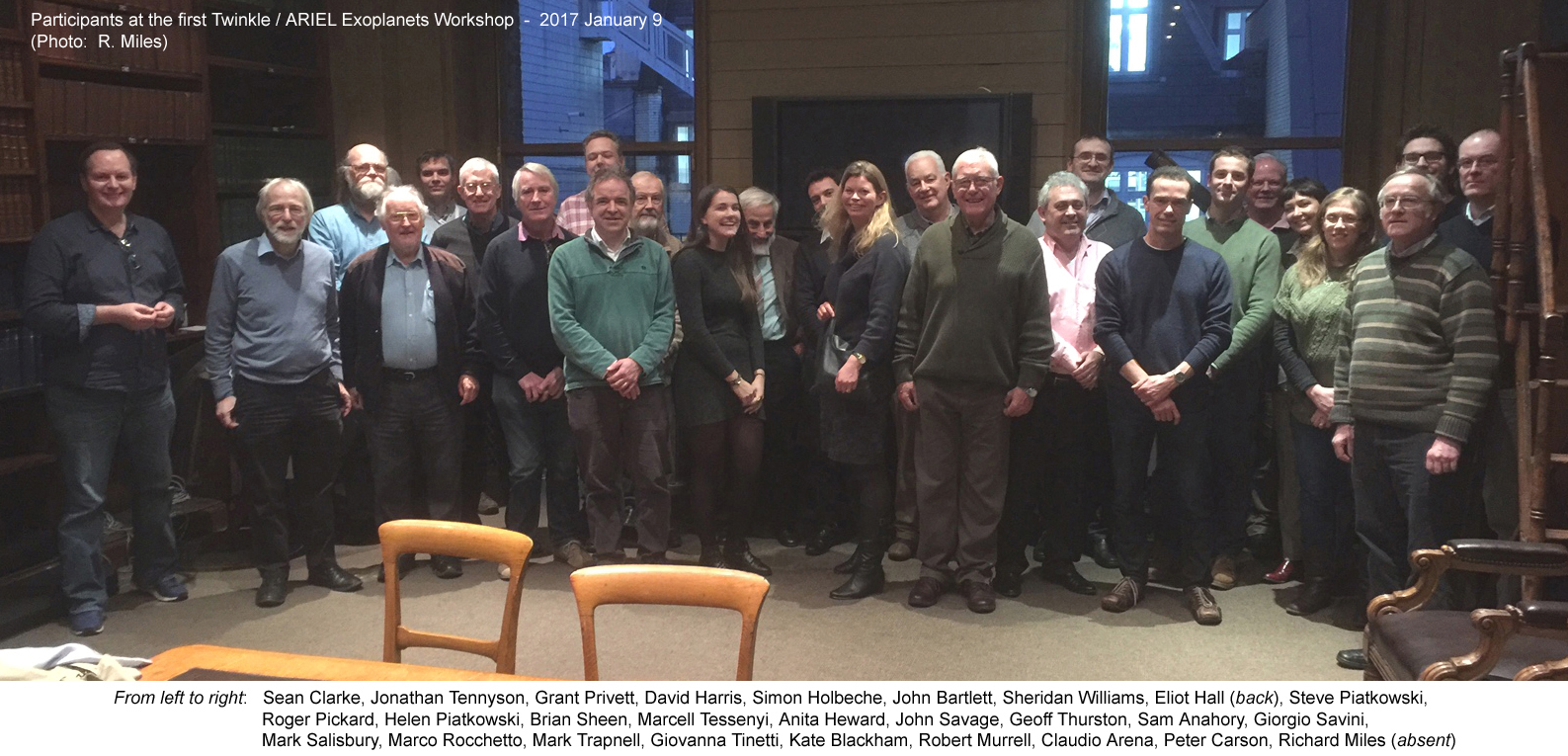
On 2017 Jan 9, a workshop was held at Burlington House, the first of several, aimed at promoting ground-based observations by amateurs of selected stars with planetary systems that are planned to be targets for future extrasolar planet space observatories. More workshops are planned and in due course an observing plan will emerge. The account of this, the first exoplanet workshop, has also been published as a report in the 2017 February issue of the Journal.
.
Participants at the first Twinkle/ARIEL workshop
See also the Twinkle Amateur Campaign website.
A second workshop in support of Twinkle, ARIEL and other exoplanet space observatories was held at University College London on Thursday, 2017 March 02.
Recent News
1. Asteroid 2018 CB passes close by the Earth on 2017 February 9
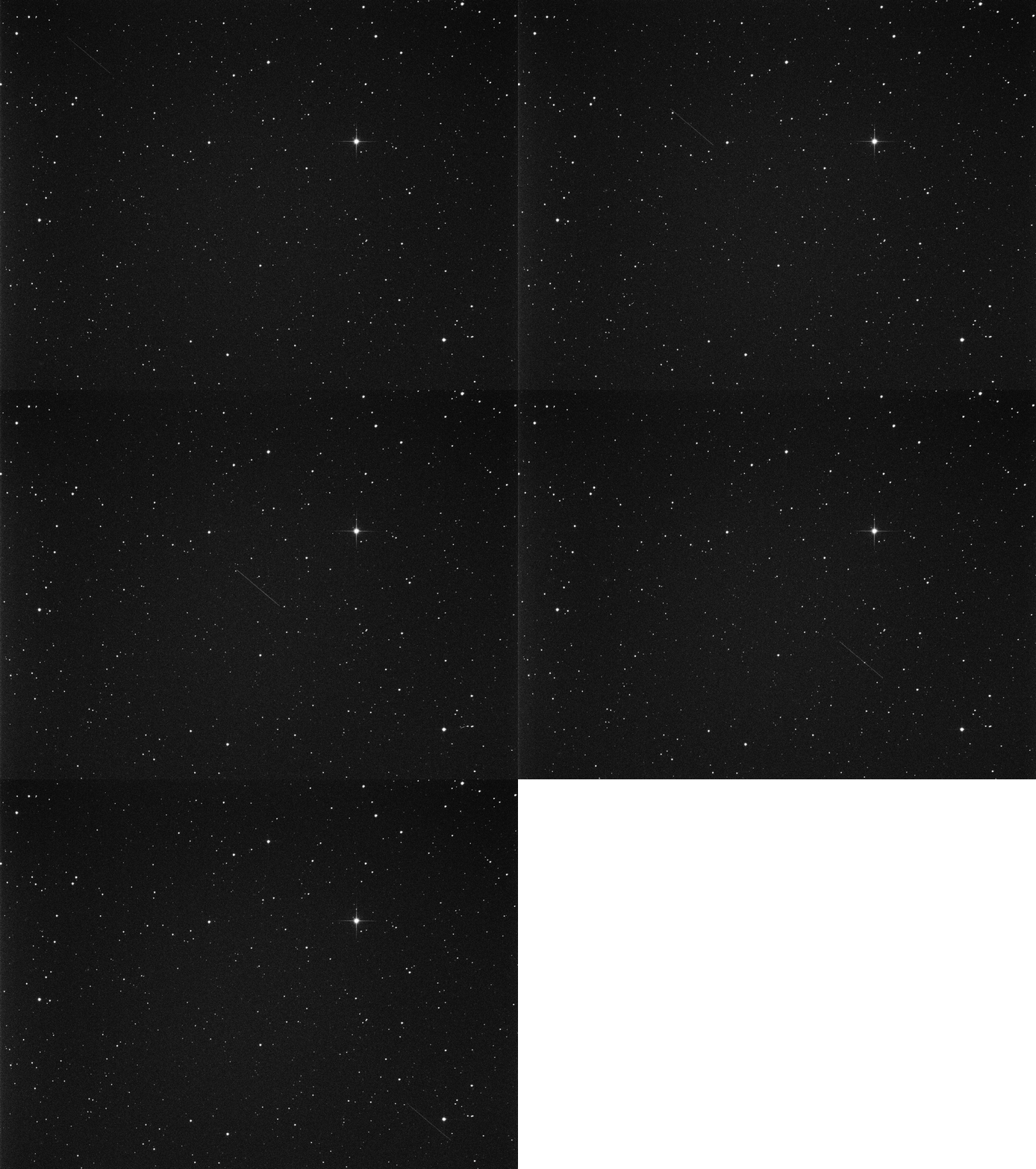
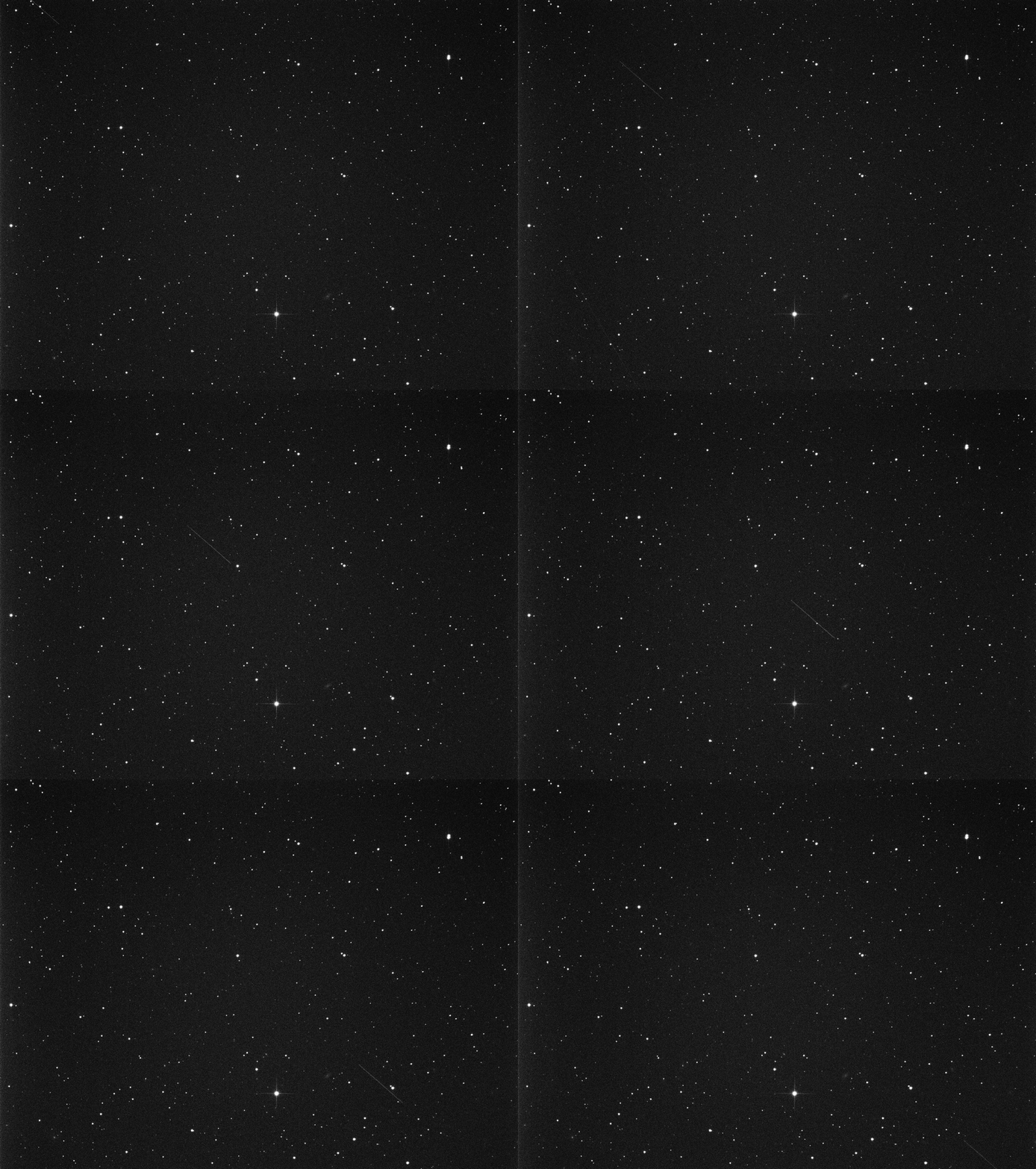
A natural body measuring a little under 20 metres across, discovered on 2018 February 04.22 by the Catalina Sky Survey, has made a very close pass of the Earth, less than 70,000 km from our home planet. Closest approach was on 2018 February 09 at 22:29 UT. BAA member George Carey, used a 0.20-m home-made reflector on a ASA DDM60 mount and QSI 683 camera with 20 second exposures just 2 hours before closest approach to record an animation as it trailed across his detector.
First starting at 2018-02-09T20:28:28
And second at 2018-02-09T20:33:05
Very well done, George.
2. Asteroid 2017 BH30 passes within 45,480km of the Earth's surface on 2017 January 30 at 0450UT
A natural body measuring some 4-10 metres across, discovered on 2017 January 29.22 by the Catalina Sky Survey, has made a very close
pass of the Earth.
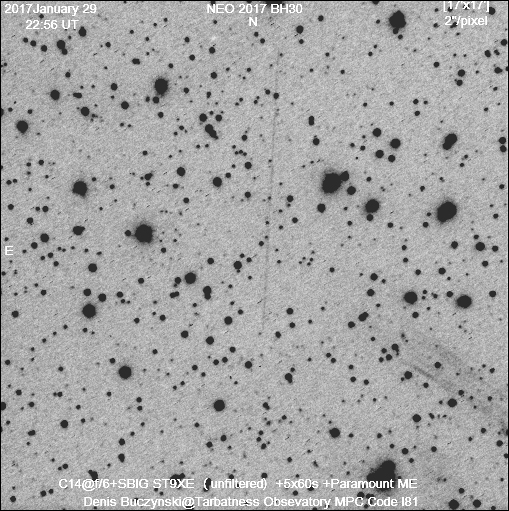
The very fast mover tracked across the sky heading northwards at just over 1 degree per minute near closest approach and was potentially visible from much of the northern hemisphere. At its brightest it attained 13th magnitude.
For the UK observers,the weather proved problematic. Denis Buczynski, observing from north-east Scotland, has sent in the only successful UK report. Denis's image showing the 5-minute long trail as it sped across his skies as a 16-17th magnitude object is shown below:
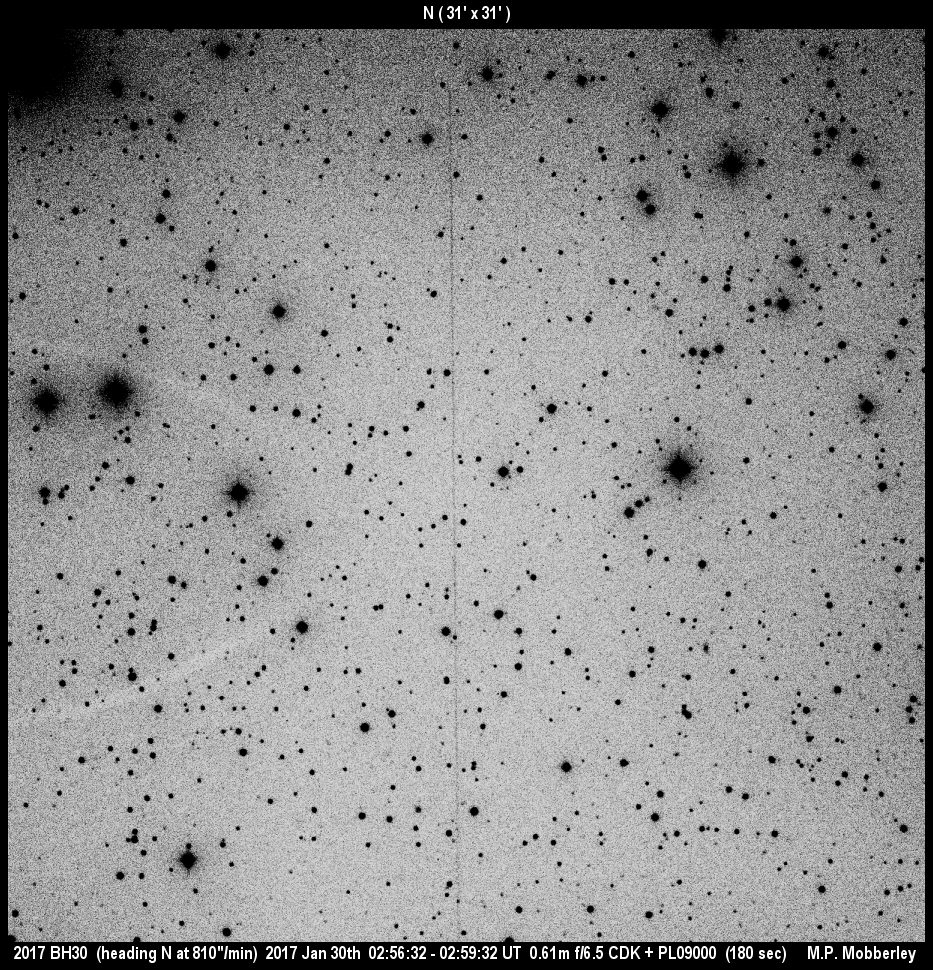
Martin Mobberley also was successful using a robotic telescope. He writes:
I reserved a 180 second slot on itel T24 (0.61m f/6.5 CDK) last night. The strategy was to get to the 03:00 UT field a few minutes early (for California location MPC U69) and then take a 180 second exposure, hoping 2017 BH30 would whizz through. This relied on T24 only taking a few minutes to slew to the field after my plan started at 02:55! So, a lot of luck was involved, not least, whether it would be cloudy. I was not sure if something flying at 810"/minute would register, even with a 24" CDK and a decent CCD.
Remarkably, it was recorded...the ghostly trail heading north in the picture!
Image centred on RA 07:32:27 Dec: +40° 54' 53".
Bright star in top left corner is mag 7.8 HIP 36769.
Martin
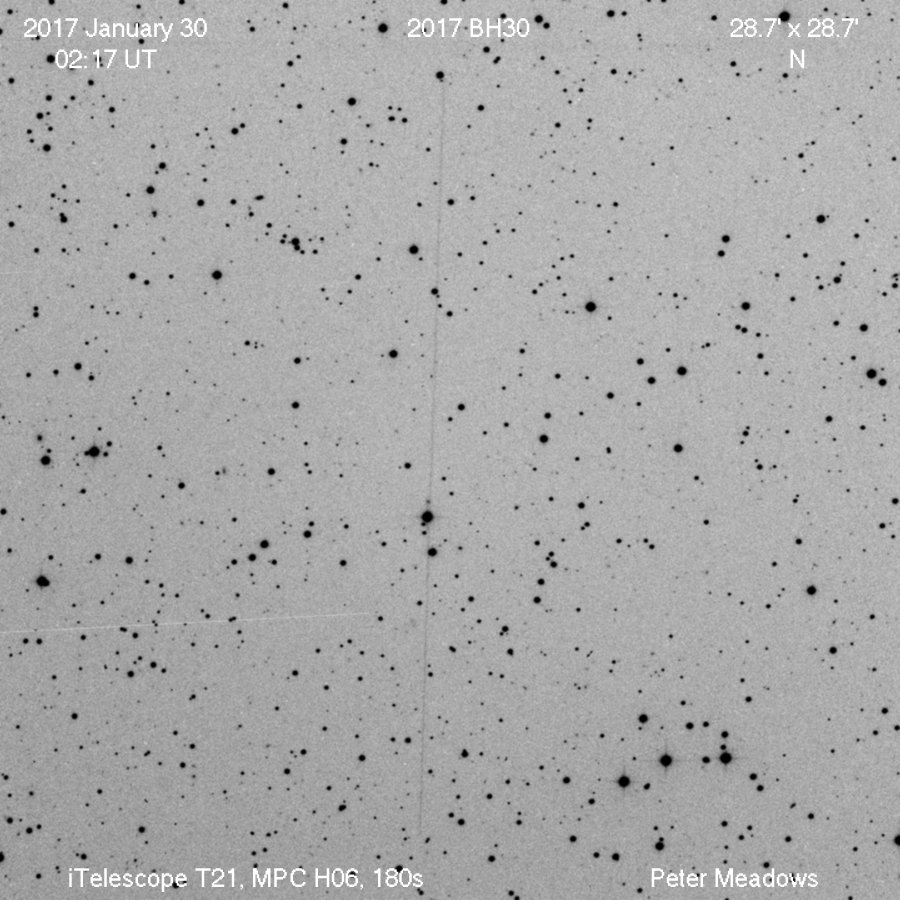
Peter Meadows has also reported another robotic observation - this time a 180-sec exposure from New Mexico. Here is Peter's report:
I've recently been using iTelescope to image various objects. When I saw Guy's TA e-circular last night, I thought I would have a try NEO 2017 BH30. The image I acquired is attached. This was a 180s exposure starting at 02:17 UT this morning from New Mexico. The MPC ephemeris indicates that 2017 BH30 was at mag 14.9 travelling at 460" per minute at a distance of 0.001 AU (150,000 km).
Peter
2. First successful occultation report of 2017: In the Blink of an Eye!
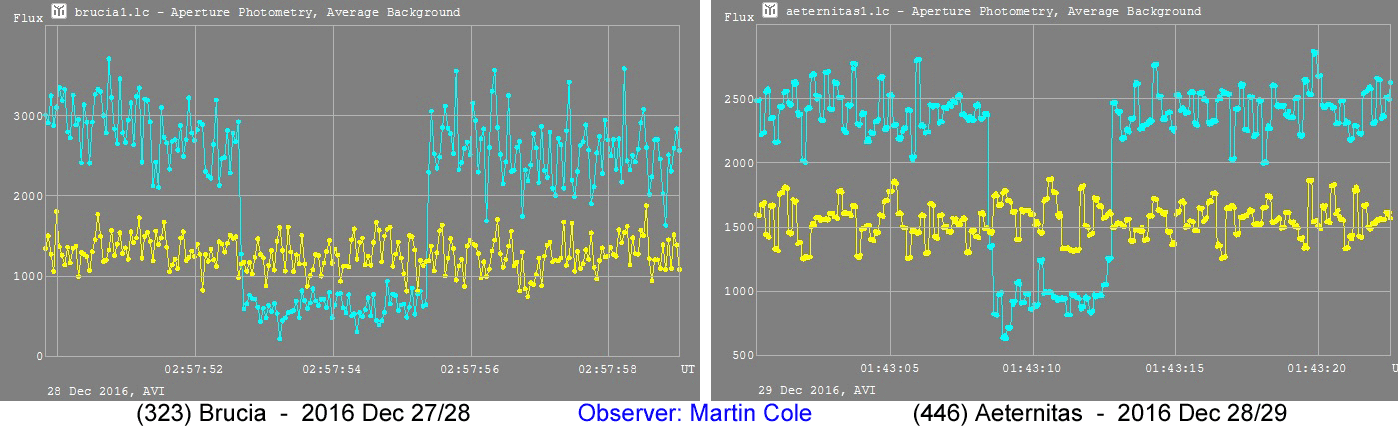
This came from Alex Pratt, who used a Watec-910HX CCD camera taking images at a rate of 50 Hz and Celestron 11 telescope to monitor a possible occultation of an 9.0V magnitude star (TYC 4663 0053) by a 20th magnitude asteroid (1999 TA91) on 2017 January 5 at 17:42UT. As the asteroid measures only about 7km across, Alex was remarkably lucky to find himself more or less in the centre of the shadow as it tracked across his observatory site (Z92) near Leeds. If he had tried to observe the event visually it would have been impossible to be sure the star had blinked off as the duration the star was fully-occulted was a mere 0.30 second. Here's a 6-second extract from the video record so you can see for yourself how transient a phenonemon it proved to be:
Video Clip of 0.3-s occultation
And using the software Tangra to extract the lightcurve, here on the left is the result plotted in turquoise compared to a field star (yellow) in the same frame; and on the right Alex's data - this time of each 0.02-s exposure using the software Limovie:
:
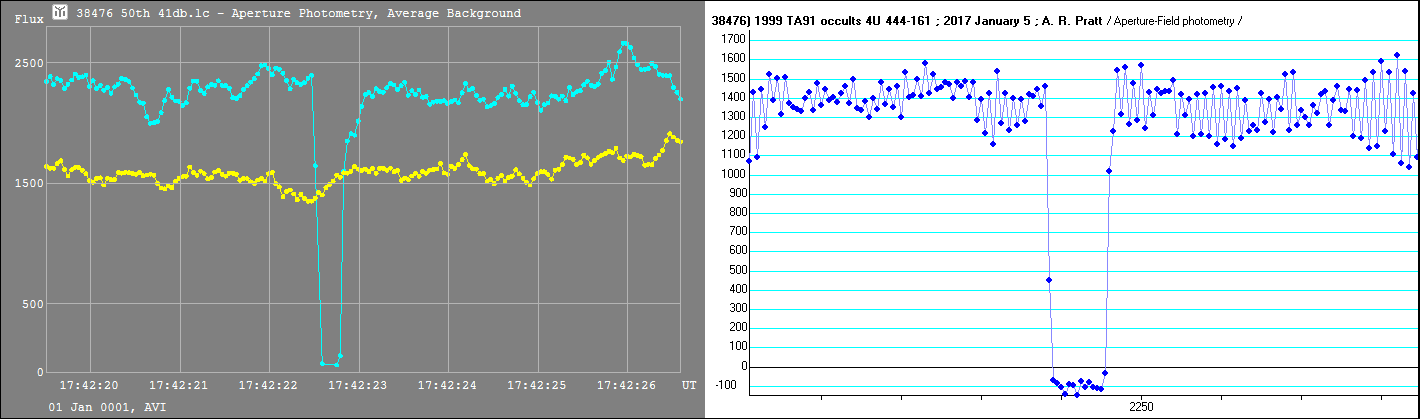
Alex's success underlines the power of the occultation technique. At the time, the asteroid was 406 million kilometres distant and whilst only ~7km in size, it clearly blotted the star out for a moment. Now if he asteroid happened to have been a close binary system then the star may have blinked out twice in quick succession.
As star catalogue accuracies improve and orbits become evermore accurate, more and more observers are having successes.
A good example of this occurred during the early hours of the nights of 2016 December 27/28 and 28/29, when Martin Cole, observing from Keighley recorded two positive events on consecutive nights, involving the asteroids, (323) Brucia and (446) Aeternitas, lasting 2.7 s and 4.3 s, respectively. Well done Martin. Alex tells me that he was fogged out at the time!
3. New Release of the Asteroid Lightcurve Database on 2016 December 25
Details of this invaluable database maintained by Brian D. Warner and Alan W. Harris of MoreData! are available at http://www.minorplanet.info/lightcurvedatabase.html
It now has a total of 19272 entries !
4. Section Workshop at Burlington House on 2016 September 24
This workshop attracted a good turn-out on the day with some 34 members taking part. The Director is very grateful for assistance on the day from Madeleine Davey, Julia Palmer, Hazel Collett and Ann Davies, who kept us organised, plied with beverages, and listened politely to our deliberations. Speakers comprised the Director, Peter Birtwhistle, Roger Dymock, Steve Harvey, Alex Pratt, Eric Watkins and Derrick Ward.

Click for a larger image.
Workshop Programme on the day.

A fuller account of the workshop will be posted in due course.
5. European Symposium on Occultation Projects (ESOP 35) held at the University of Surrey, Guildford on 2016 August 19-23
Each year, the European Section of the International Occultation Timing Association holds a symposium in one or other European country and in 2016 it was the turn of the UK to act as the host for this event. Thankfully, Tim Haymes as ARPS Occultation Co-ordinator and his wife, Anne were the prime-movers in organising this event, helped in part by Alex Pratt and the Director. I would formally like to thank Tim and Anne for a job very well done including excellent and interesting trips to the Hampshire Astronomy Group, Stonehenge, Salisbury Cathedral and the Observatory Group at Herstmonceux on the Monday and Tuesday. A list of the 38 participants together with links to pdfs of most of the talks given at this symposium are available HERE.
6. The close approach of asteroid 2004 BL86 on 2015 January 26-27
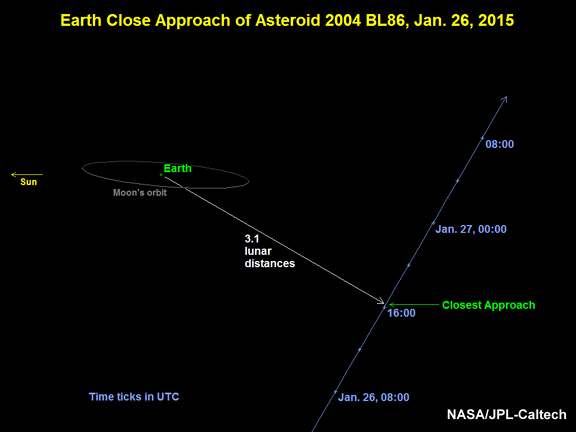
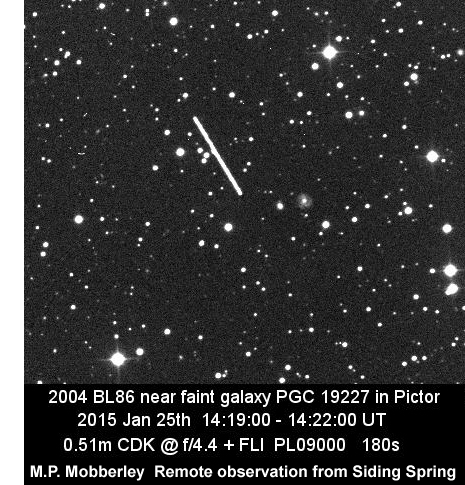
As predicted, on the night of January 26/27, asteroid 2004 BL86 (also designated asteroid 357439) made a close pass of the Earth becoming, for a short time, the brightest natural near-Earth object (NEO) that we know of (other than the Moon) over the next 12 years. Its orbit is such that the object was very favourably placed for observation, especially for observers based in the UK. On the night the cloud cover across the UK and northern Europe was very extensive but a few intrepid observers managed to image the very fast-mover during relatively brief clearer intervals.
BACKGROUND:
This potentially hazardous asteroid (PHA) is quite large (0.4-1.0 km across) attaining 9th magnitude as it passed the Earth at the safe distance of 1.2 million kilometres. Although it orbits the Sun every 1.84 years ranging between 0.90 AU and 2.11 AU, this event marked its closest geocentric approach for several centuries passing almost 3 lunar-distances away on January 26 at 16:20 UT. This close approach is especially unusual (for a PHA) in that it brightened by more than a factor of 2 after closest approach as it moved towards opposition, reaching the remarkably low phase angle of 1.1 degrees, and attaining a V magnitude of 9.0 on Tuesday, January 27 between 03:40-05:10 UT, during which time interval its apparent speed slowed to ~2"/sec. From the UK, the 9th magnitude object rose soon after 19:00 UT becoming readily visible an hour or so later.
CHARTS:
Charts showing the object's track across the sky for the night of January 26/27 (UK-based observers) were prepared by Steve Harvey, Director of our Computing Section. For Jan 26.5-27.0, the chart is at:
http://britastro.org/computing/ch/357439_2004_BL86_2015Jan26Jan26.html
Likewise for Jan 27.0-27.5, Steve's chart is here:
http://britastro.org/computing/ch/357439_2004_BL86_2015Jan27Jan27.html
REPORTS:
We now know thanks to photometric observations by J. Pollock, P. Pravec, J. Oey and D. Reichart made over several days prior to closest approach that the main asteroid is relatively spherical in shape and so did not exhibit rotational variations in brightness of more than about 0.2 mag BUT that it also possesses a companion and so, as I highlighted in an earlier note, this is indeed a binary asteroid system. Subsequently, radar observations revealed the small companion as can be seen in this animation courtesy of NASA/JPL-Caltech.
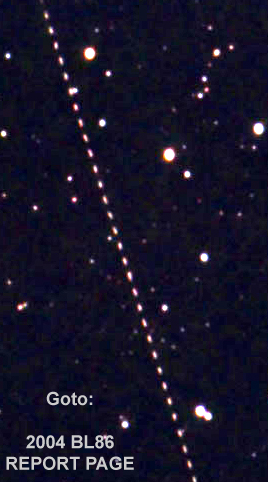
A special 2004 BL86 Report Page has been set up. Click on the image below (courtesy of David Strange) to access this:
Contributions have been received from the following 23 observers:
Alexandre Amorim
Tony Angel
David Boyd (high-quality spectrum)
David Briggs
Denis Buczynski
Peter Carson
Martin Cole (visual)
Roger Drew
Gordon Ewen
John Fletcher
Maurice Gavin
Gary Gawthrope
Nick James
Martin Mobberley
Tom Moran
Alessandro Odasso
Alex Pratt
David Pugh
Martin Ratcliffe
John Rogers
Dave Shave-Wall
Dave Storey
David Strange
John Talbot
Soon after 05:00 UT, the asteroid skirted the edge of the open cluster, Praesepe (Messier 44) in Cancer. Roger Drew obtained a nice animation of this appulse using a Takahashi FSQ106 refractor and QSI683 CCD camera, from which this fine stacked image can be seen. A full account of the close pass and results from observers is being constructed on this dedicated BL86 Webpage.
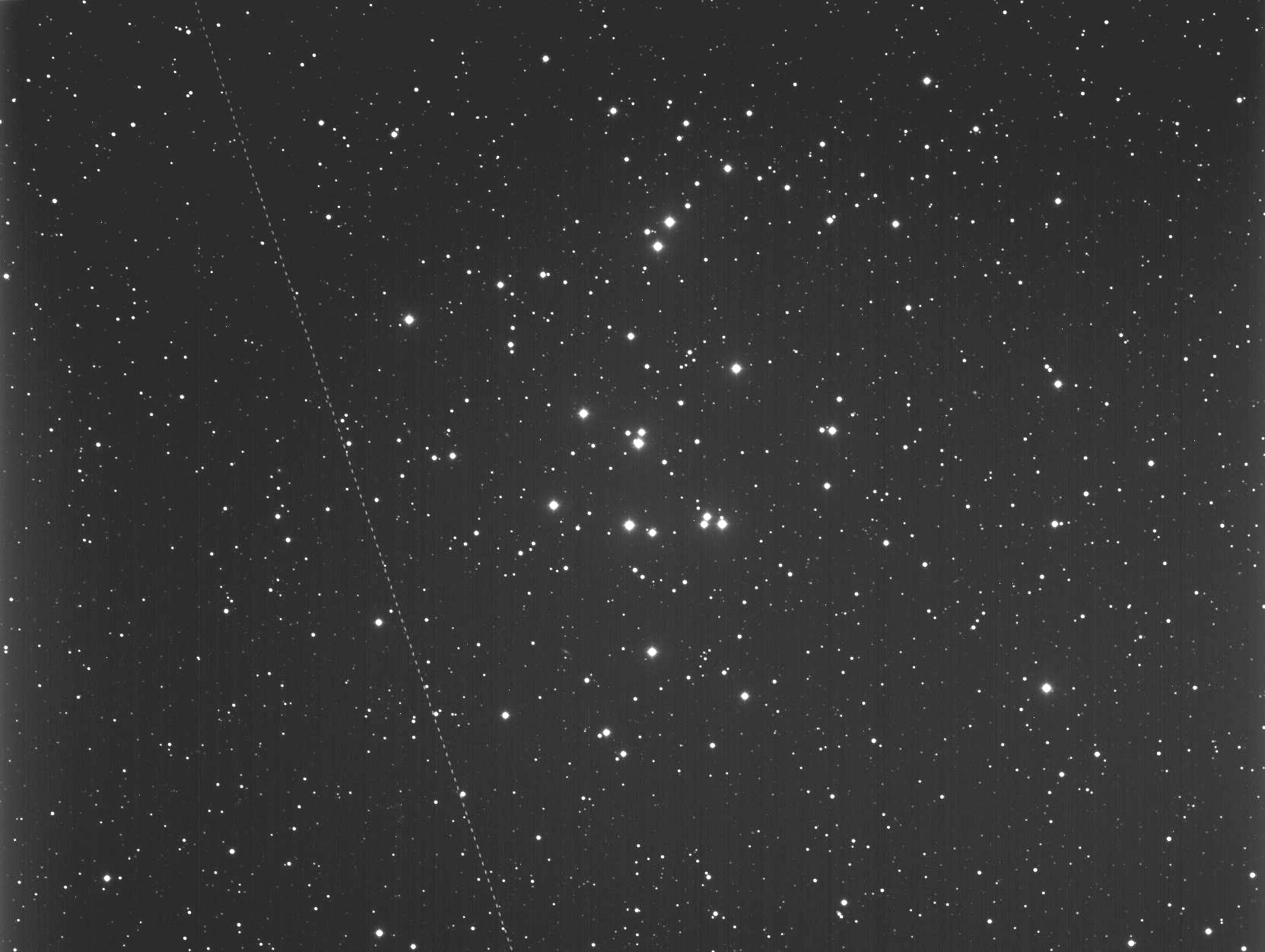
7. Long-duration asteroid occultation event observed by John Talbot
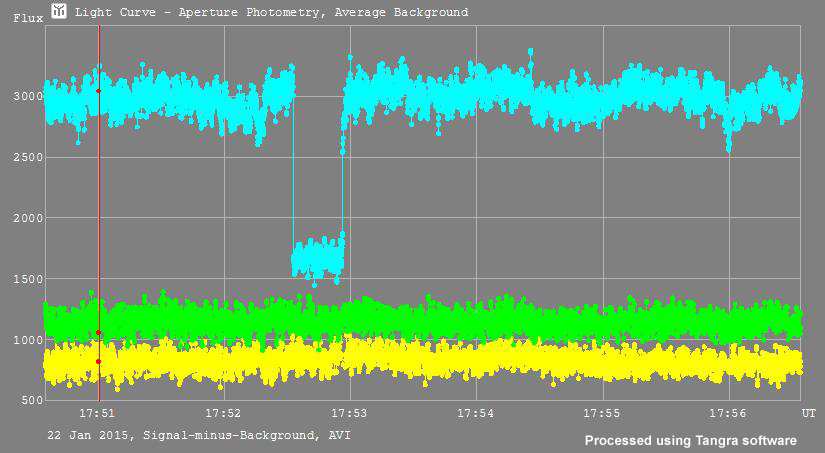
Asteroid (81) Terpsichore occulted TYC 2398-01289-1 on evening of January 22/23
UK observer John Talbot based in Abingdon has recorded a 23.5-sec duration occultation using a Watec 910HX video camera and 30-cm f/4 Newtonian telescope. This was John's 6th positive result and astonishingly it came after a run of 56 consecutive negative observations. This must be some sort of record and demonstrates John Talbot's dedication in monitoring all possible asteroid occultation events from his location, including small asteroids which have a much lower probability of success. John reports that "the path shifted considerably to the west to lie right over the UK but patchy conditions meant that some UK observers were clouded out. The event occurred about 50s before the predicted time but within the specified error."
8. Asteroid occultation on 2014 April 18 - SECOND UPDATE
Asteroid (241) Germania occulted 2UCAC 38779497
This 184-km diameter asteroid passed close to a 12th magnitude star in Gemini on Friday18 April 2014, at 2059 UT (2159 BST). The shadow track passed NW to SE over central UK and N Ireland. The maximum length of disappearance was predicted to be 8.5 seconds for someone in the centre of the shadow.
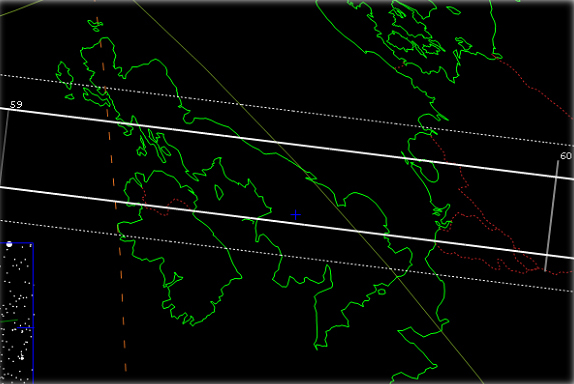
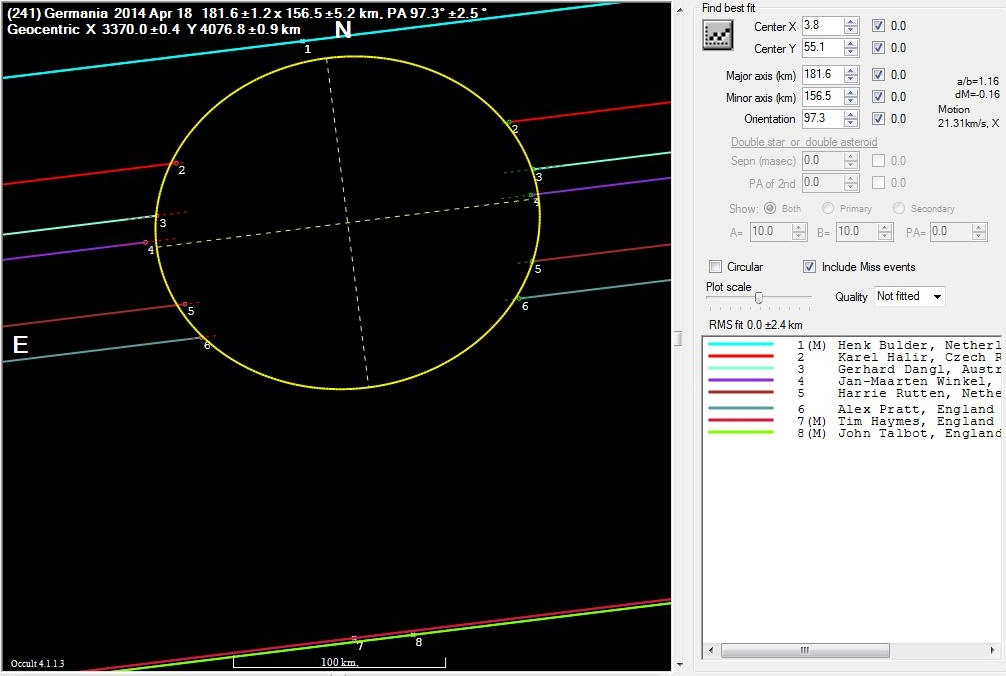
The star proved to be rather fainter than expected. Alex Pratt in Leeds successfully timed a 7.04 seconds occultation but both John Talbot and Tim Haymes in south-east England recorded misses. Today (August 2) an extra report was received from Karel Harir (CZ) in addition to 3 other observers in Europe (Harrie Rutten, J-M Winkel and Gerhard Dangl) who made accurate timings of the event. Alex Pratt has produced a new provisional profile of the object using Occult-4 software, as shown.
The calculated dimensions have been refined from these observations are 182+/-2 x 157+/-5 km which can be compared with previous results of 184 km, and there was a path shift of about 50km to the NE, with the occultation occurring about 9s earlier than predicted.
See also the Occultations page.
9. Video Astrometry - A new observing opportunity
Section member Alex Pratt is a keen occultation observer for which he uses an integrating Mintron video camera and GPS time-inserter to record asteroidal and lunar occultations of stars. Recently he used his observing equipment to record the passage of some fast-moving asteroids, notably 1998 QE2 and 2012 DA14. Exposure times as short as 0.04 sec per frame can be employed yet, using relatively wide-field optics, several field stars were recorded in addition to the asteroids and so it was possible to measure the astrometric positions of the movers with high precision thanks to the very accurate time stamp on each frame. What made all the difference was the availability of the software TANGRA 1.4 written by Hristo Pavlov with which it is possible to analyse the frames for both astrometry and photometry, and which has recently been upgraded to version 3.
Thankfully, Alex has compiled A Guide to Video Astrometry for anyone wishing to try using a video camera for measuring the positions of very fast-moving objects (VFMOs). This 2.2 Mb PDF is a nice step-by-step 'How-To' guide which sets out all aspects of the process involved and includes relevant weblinks. His results proved good to an accuracy of about 0.2 arcseconds even for an object moving at a rate of some 10 arcsec per second of time! He even used the equipment to measure the positions of some main-belt asteroids, which after submitting these to the Minor Planet Center enabled him to receive his own IAU Observatory Code (Z92). Great work, Alex!
2015 June 10: Revised version of Alex's Video Astrometry Guide now uploaded including an example of vide photometry of a comet (C/2014 E2 (Jacques)).
10. February 15: Record close approach of near-Earth asteroid 2012 DA14
A gallery comprising all observing reports received to date can be reached via the following thumbnail:
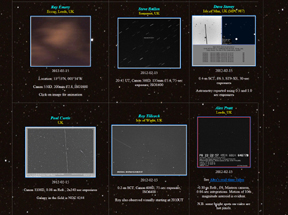
The following UK-based observers have obtained images, submitted reports, videos, etc.:
Peter Birtwhistle, Damian Peach, Nick Quinn, Richard Fleet, Ian Sharp and David Briggs from southern England, Peter Carson from Essex, Martin Willock from York, Steve Johnston in central England (visual, remarking on its orangish hue), Jay Tate from Spaceguard UK, mid-Wales, Dave Storey from Isle of Man, Roy Tillcock from Isle of Wight, David Strange and Steve Bullen from south-west England, Robin Leadbeater (who also obtained a spectrum of the object!), Ray Emery and Alex Pratt from northern England, Denis Buczynski from Scotland, and Kieran Rooney from N. Ireland. Also animation courtesy of Bill Ward available.
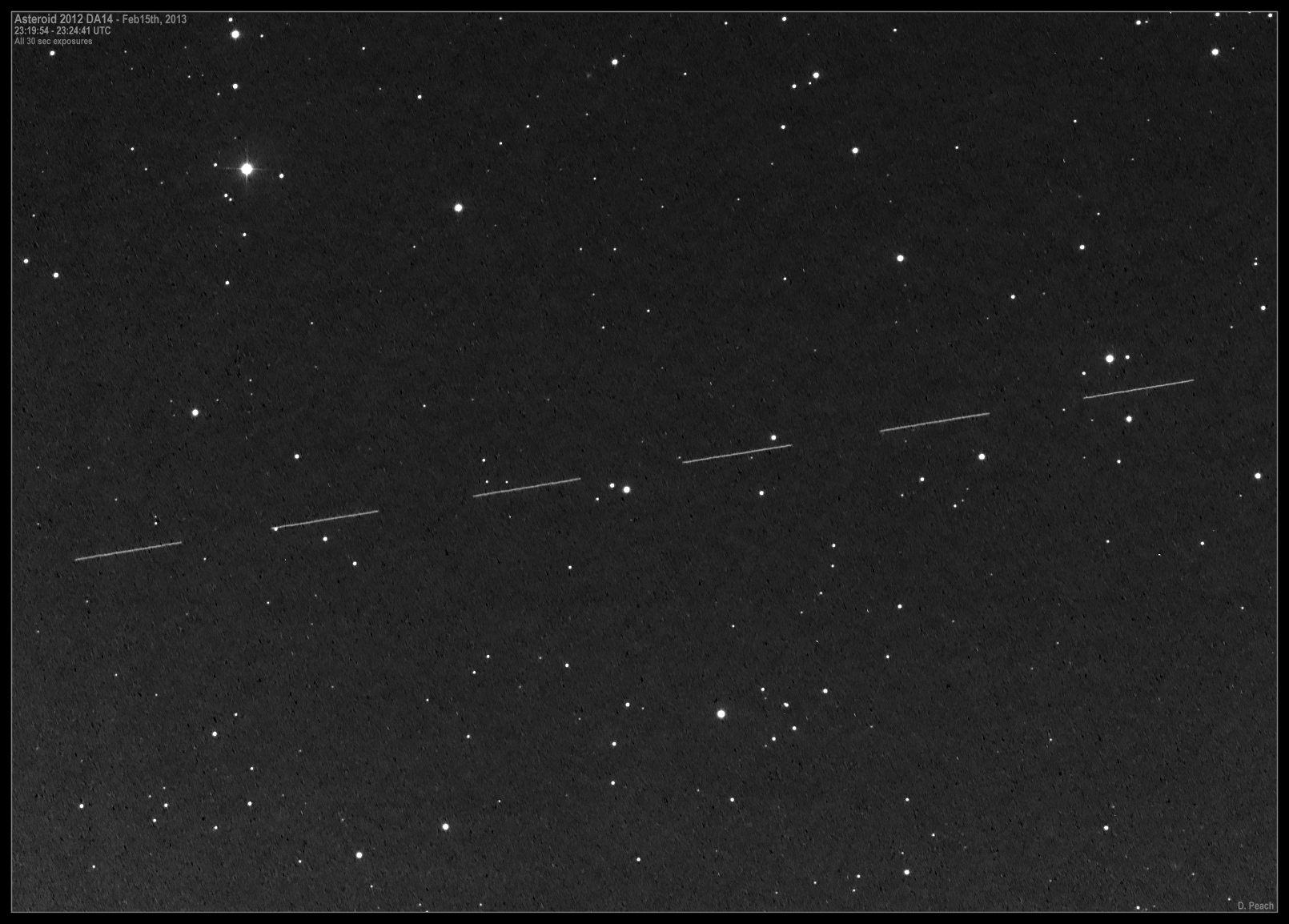
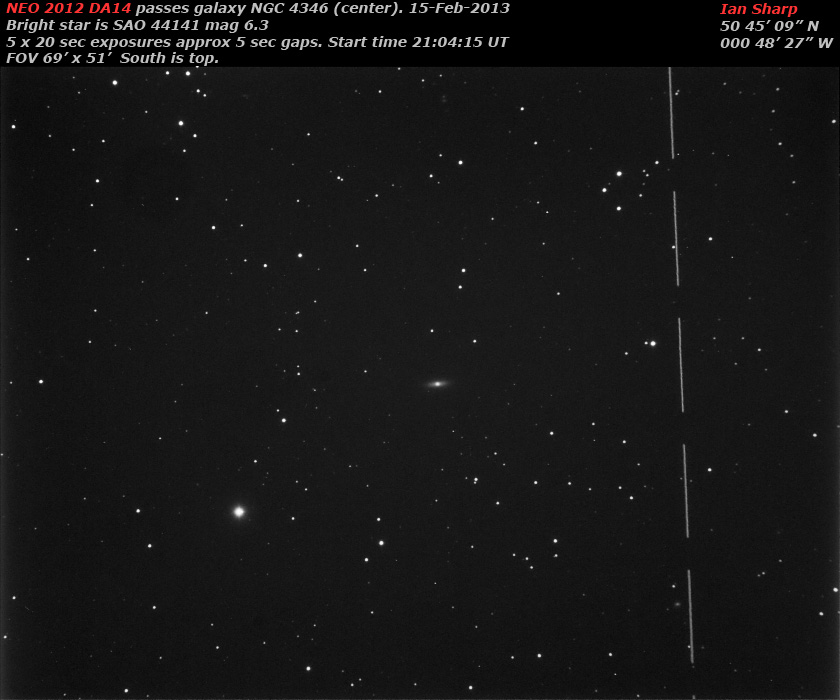

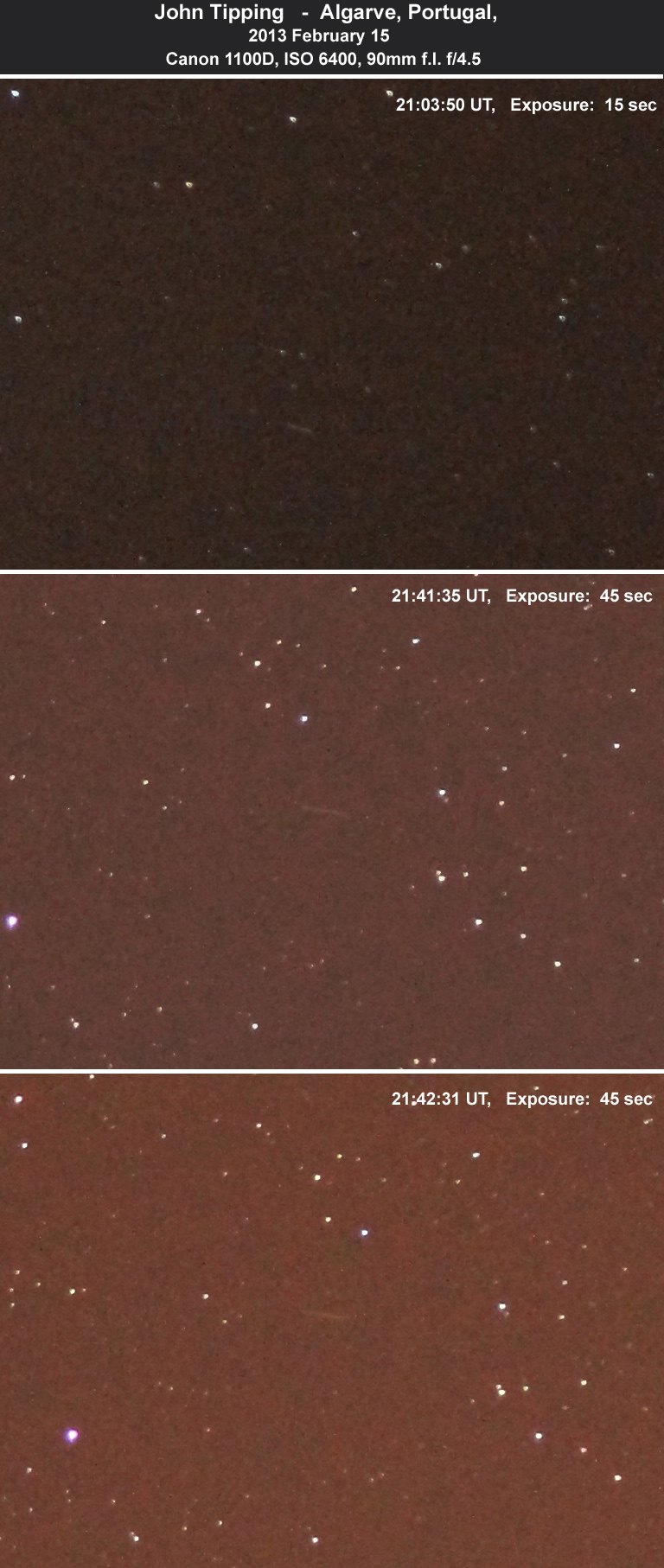
ARPS member Vagelis Tsamis observing from near Athens, Greece sent this exciting written report of his experiences. John Tipping also imaged 2012 DA14 whilst in the Algarve, Portugal.
Many observers at the Norman Lockyer Observatory and the Hampshire Astronomical Group at Clanfield succeeded in seeing it visually. You can also connect to the observations which have already been posted on the Web by clicking on the name of the observer indicated in blue font above.
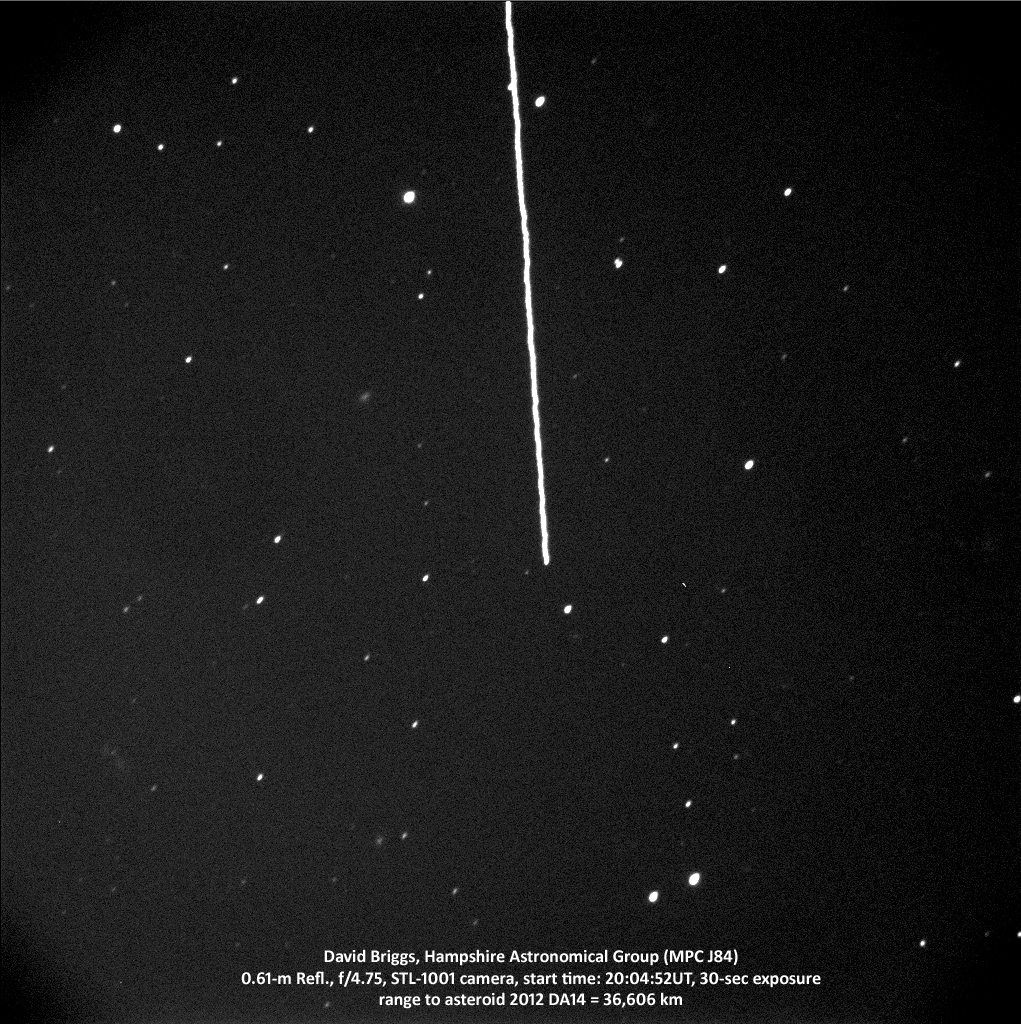
Unlike the bolide seen and felt in the Urals earlier the same day, the dramatic passage of near-Earth asteroid 2012 DA14 had been forecast one year in advance thanks to it having been discovered last February by amateur astronomers at the La Sagra Sky Survey in Spain (MPC Code J75).
Reaching 7th magnitude, it is the brightest-ever NEO to be observed approaching the vicinity of our planet (<0.1 AU) and visible with modest telescopic aid, e.g. binoculars. 2012 DA14 passed about 14x closer to the Earth than our companion Moon. To put this in perspective, scientists at NASA's Near-Earth Object Program Office in Pasadena, California estimate that an asteroid the size of 2012 DA14 flies this close every 40 years on average and that one will impact Earth, on average, about once in every 1,200 years!
Nick James and Dominic Ford had organised and undertaken a live webcast of the 2012 DA14 close-approach, by periodically updating live images from a small telescope with a field of view of around 1 degree. Unfortunately cloudy skies have dogged the attempt with just the occasional star or two being visible from time to time. The animation generally showed only passing clouds. This new facility should however prove useful as the BAA should now be able to furnish live webcasts of interesting celestial events in the future.
A challenge for observers was suggested:- that was to pick a site where you have a low eastern horizon and try and image the fast-mover as soon as possible after it rises. The further east your location the better chance you would have had. There'll be a prize for anyone observing from the UK who records the earliest image of 2012 DA14 !
WINNER: is David Briggs who secured his first image using the 24" telescope of the Hampshire Astronomical Group at 20:05 UT when the asteroid was just 8 degrees above the horizon.
11. Joint Asteroid-Comet Section Meeting 2012 October 6
We held this very successful joint meeting with the BAA Comet Section on 2012 October 6 at the Open University, Milton Keynes, UK.
The Meeting Report is now available which includes links to seven of the presentations.
Nick James has kindly provided mp3 sound and jpeg copies of the slides shown by each speaker on the day in the form of zipped files available here.
(photo: David Briggs)
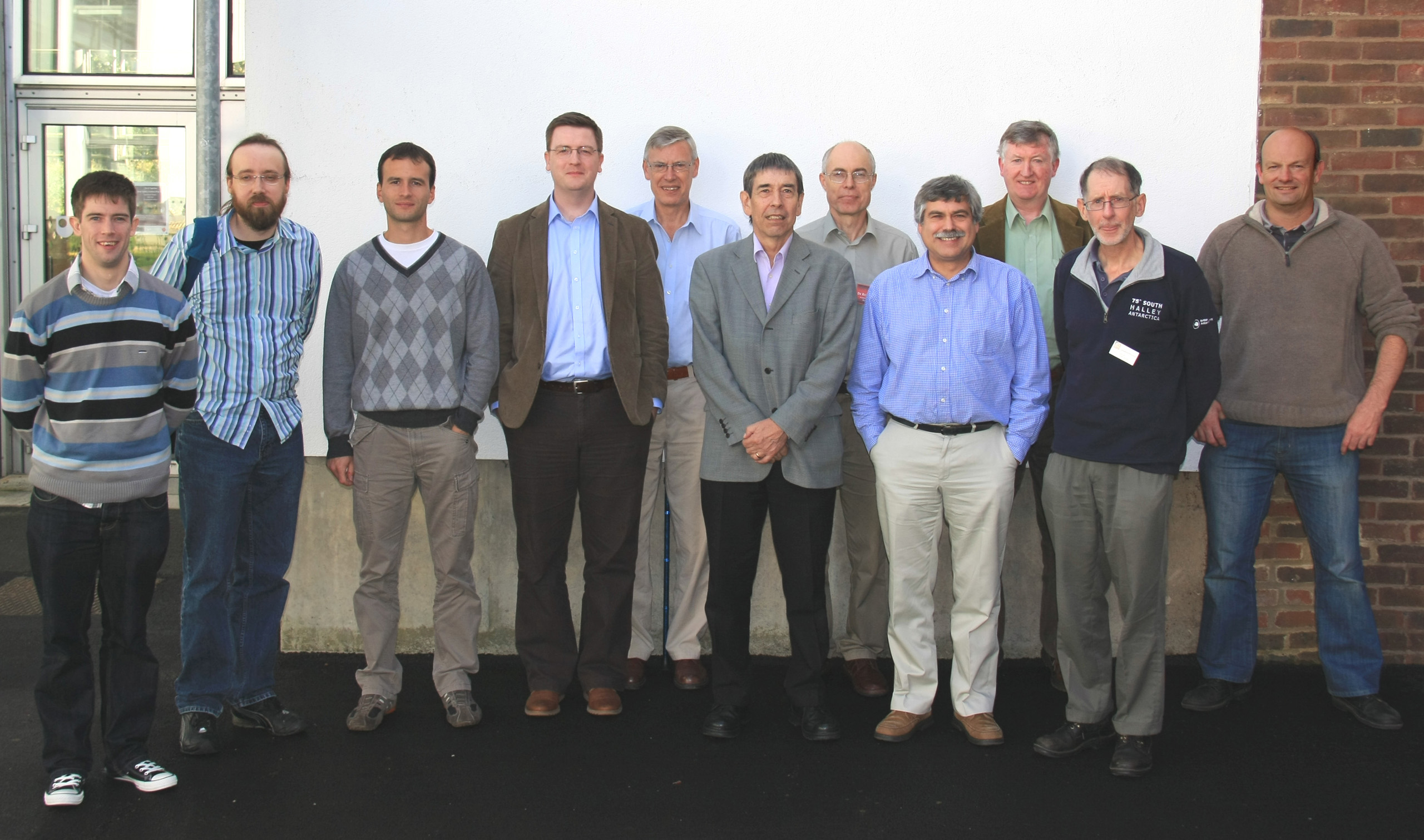
(left to right: S. Duddy, G. Williams, L. Buzzi, S. Lowry, G. Relf, R. Dymock, R. Miles, S. Green, E. Ansbro, J. Shanklin and N. James
11. News Archive
The News archive can be accessed here
The Site Guide may help you to find your way
around the site, along with the Table of Contents
The What to observe page lists many different aspects of observing and imaging together with current projects as well as ephemerides and other useful information from the current 2014 Handbook of the BAA.
Footnote:
[A
four-disk