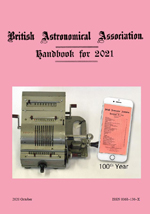
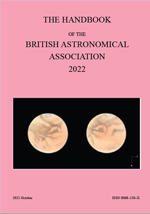
The British Astronomical Association was formed in 1890 and membership is open to all persons interested in astronomy. It has an international reputation for the quality of its observational and scientific work.
The Computing Section began in 1920. Its work is nowadays largely concerned with the preparation of the annual Handbook of the British Astronomical Association, together with data for other publications.
On this site you will find, amongst other things,
- useful observing aids in the form of applets and scripts, calculating in real time, often with a detailed graphical display;
- finder charts for currently visible comets and asteroids;
- Handbook sections additional data, which changes little from year to year;
- background information about the Handbook and its contributors;
- history of the Computing Section.
BAA members can download a PDF version of the Handbook from the Downloads option on the logged-in Members menu of the main BAA site.
What's new
You may need to clear your browser's cache to see latest changes (in Windows: Ctrl+F5).
The charts pages (asteroids and comets) are frequently revised, so will not be listed here every time.
- 2021 Feb 03 - Added Jupiter satellite eclipsing and occulting pairs (From Greenwich).
- 2020 Feb 29 - Added Exoplanet Charts page.
- 2015 Jan 19 - Added 2 extra close-up charts for NEA 2004 BL86.
- 2015 Jan 17 - chart added for NEA 2004 BL86. Close approach Jan.26
- 2014 Aug 25 - Tables added showing mutual phenomena between Jupiter's satellites which run through to the end of July 2015. Access is either via the Handbooks page (under additional material for 2015) or the page showing Jupiter's Galilean satellites.
- 2014 Jun 28 - The Handbooks page now contains details of the total solar eclipse of 2015 March 20 - more details and diagrams than will fit in the printed Handbook.
- 2014 Apr 30 - A new program by Richard Kaye calculates orbital elements for the major planets for any date and time.