
2022 February 17
CPRE’s Star Count 2022
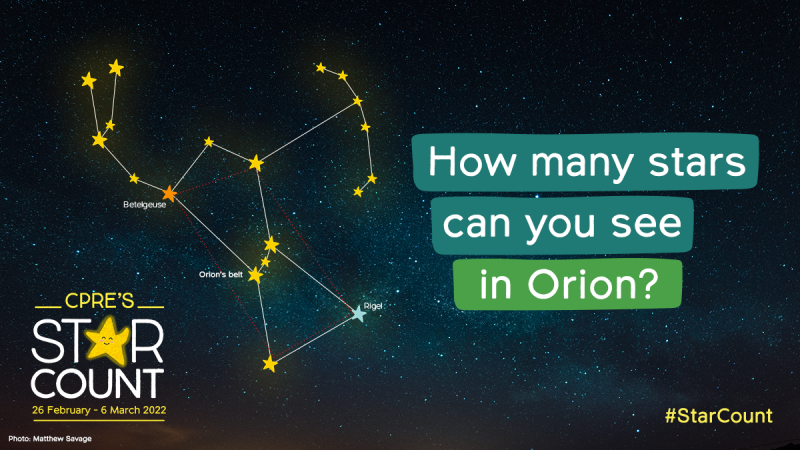
Dark starry skies are a beautiful sight, and a distinctive feature of the countryside. In urban areas, light pollution from poorly aimed and over-bright lighting means that many of us can’t see the stars. To celebrate our starry skies and to help to protect our view of the stars, CPRE, the countryside charity is inviting the nation to be ‘citizen scientists’ and take part in Star Count 2022 – a cosmic census that will help map our view of the stars and trends in light pollution across the country.
Whether you look at the night sky from a town centre or from the darkest countryside, from a garden, a doorstep or even a bedroom window, you can take part.
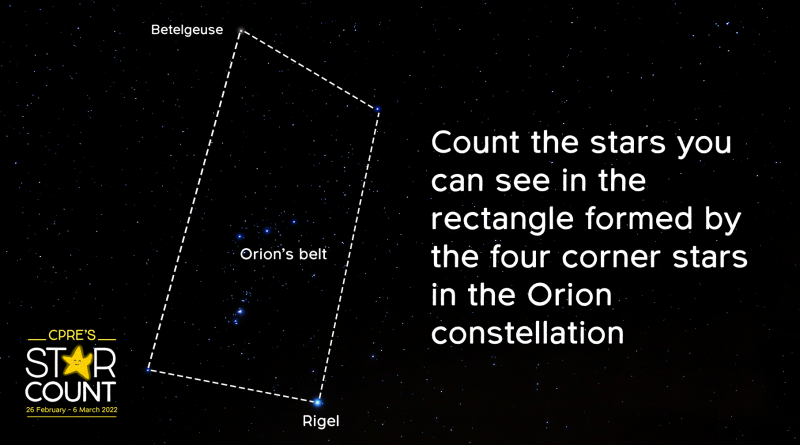
Stargazers will be asked to count the number of stars they can see from their selected location (with the naked eye) within the constellation of Orion. Sign up and find full details at https://takeaction.cpre.org.uk/page/95329/data/1?locale=en-GB
You don’t need a telescope or any equipment to take part. The number of stars visible within the constellation of Orion is a good measurement of the amount of light pollution, and can be compared with previous years’ data to show how our ability to see truly starry skies is changing. We’ll also use the data to produce an interactive map of the nation’s view of the stars.
Star Count will take place during the darkest skies, well after sunset and when the Moon is absent, from Saturday 26 February – Sunday 6 March, inclusive. Star Count is taking place with support from the British Astronomical Association’s Commission for Dark Skies.
| The British Astronomical Association supports amateur astronomers around the UK and the rest of the world. Find out more about the BAA or join us. |