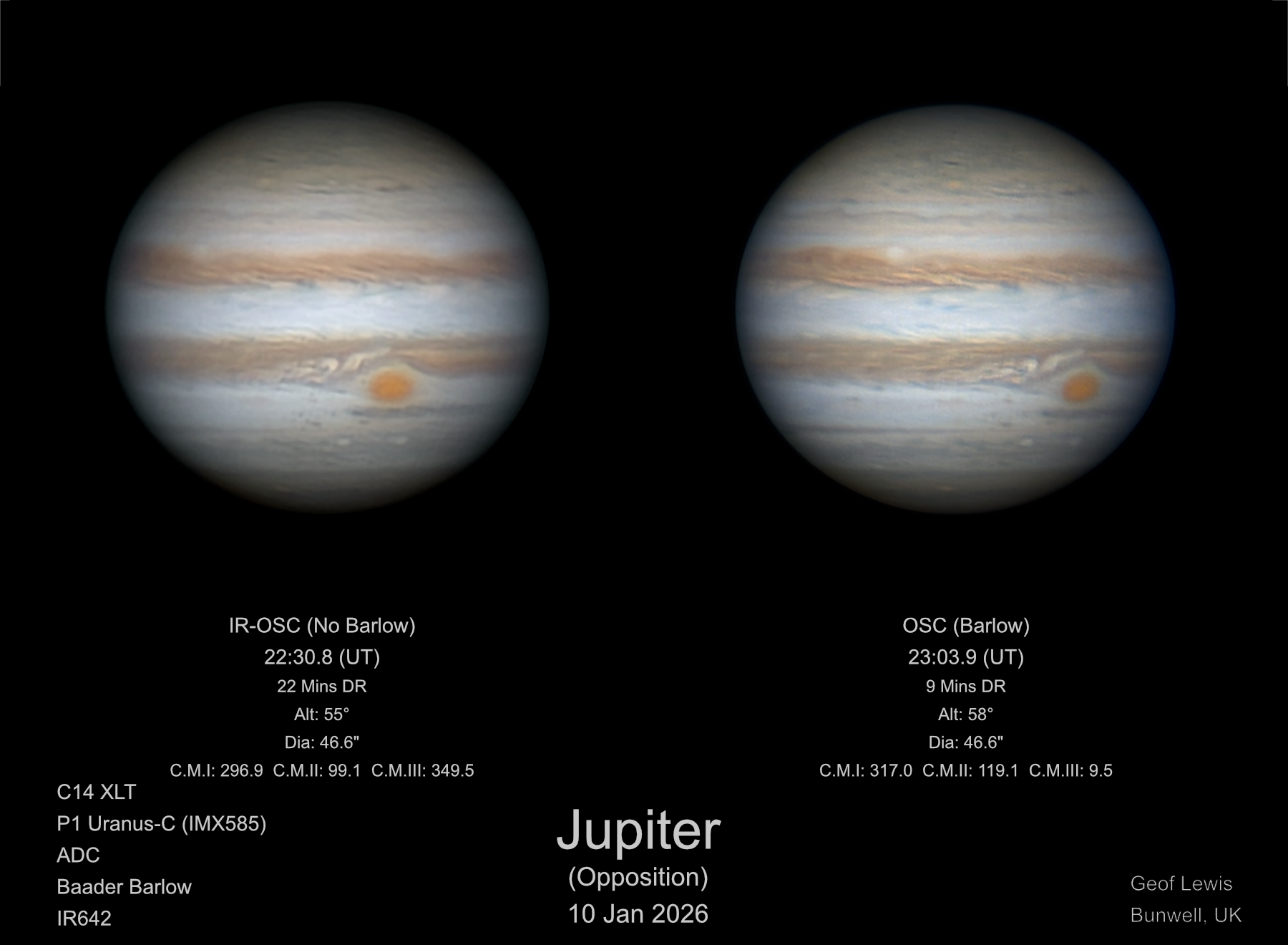
I had an interesting session for the night of Jupiter's opposition. I bought a new camera (Player One Uranus-C) a few days prior, so used that, probably not the wisest decision for opposition, but I wanted to give it it's first light.
As soon as I got Jupitor on the larger chip of the Uranus-C's IMX585 sensor (which BTW was much easier than with the smaller IMX462 sensor of my ASI462MC camera) I could see that the seeing was very good. However, the Uranus-C camera histogram settings in FireCapture threw me a curve ball, so it took some time for me to understand what I was seeing on screen and make adjustments that I was happy with; hence I lost between 30 mins and an hour just messing about, without recording usable data in what was the best seeing I've experienced this apparition...!!
I started the session with just the camera plus ADC at prime focus, shooting a series of IR and OSC SERs, but then decided to pop the Baader variable Barlow lens inside the camera nosepiece for additional amplification. I again captured a series of IR and OSC SERs.
However, when I processed the SERs the following day there was something decidedly weird in the data, with lots of striation lines particularly apparent in the IR data captured with the Barlow in train. I've shared the data pretty widely for 2nd, 3rd, 4th, etc., opinions, including a Zoom call with Martin Lewis (Sky Inspector) here in the UK and the general concensus is that there must have been some unusual seeing conditions, maybe ice crystals in the very cold atmoshphere even close to ground level, or particular seeing patterns from the jetstream which was passing directly overhead, that are getting resolved into 'features' by Autostakkert.
My conclusion is that the IR data from the part of the session where the Barlow was in train are unusable.
The effects in the earlier data without the barlow were less problematic, so maybe the lower amplification didn't resolve whatever it was so easily, or maybe the atmosperic conditions deteriorated later in the session, or perhaps a combination of both - who knows...!!
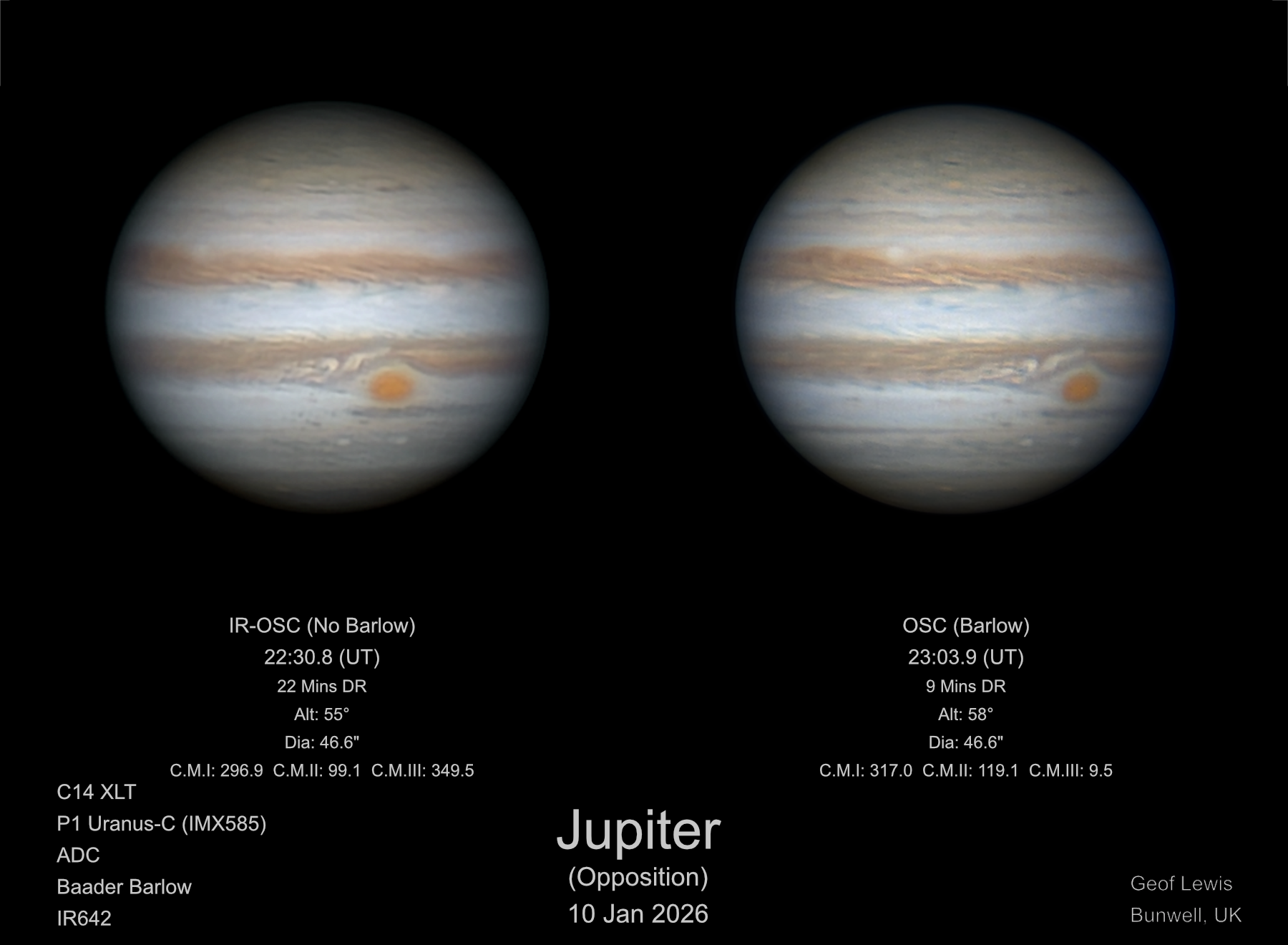
Anyway, I decide to create a combined IR-OSC image from the data captured without a barlow and a pure OSC image from the later data where the Barlow was used. The annotated image shows them both side by side with the images displayed to the broadly the same dimension.
Two things are noticable from the side by side images:
Firstly the 'frequency separation' methodology that was used to extract high freqency IR data to enhance the OSC colour image does not change the colours, which are the same in both the IR-OSC and pure OSC images
Secondly, the increased resultion from including the Barlow resulted in the OSC data revealing almost the same level of detail without applying any IR enhancement, as is seen in the earlier IR-OSC image.
N.B. The additon of the Baader Barlow increases the focal ratio of the image train to FR20.4 (resolution 0.08"/px), compared with FR13 (0.13"/px) without the Barlow. A focal ratio of 20.4 is equivalent to x7 pixel size in microns, so at the upper end of the recommended x5 to x7 range suggested for optimal planetary imaging.