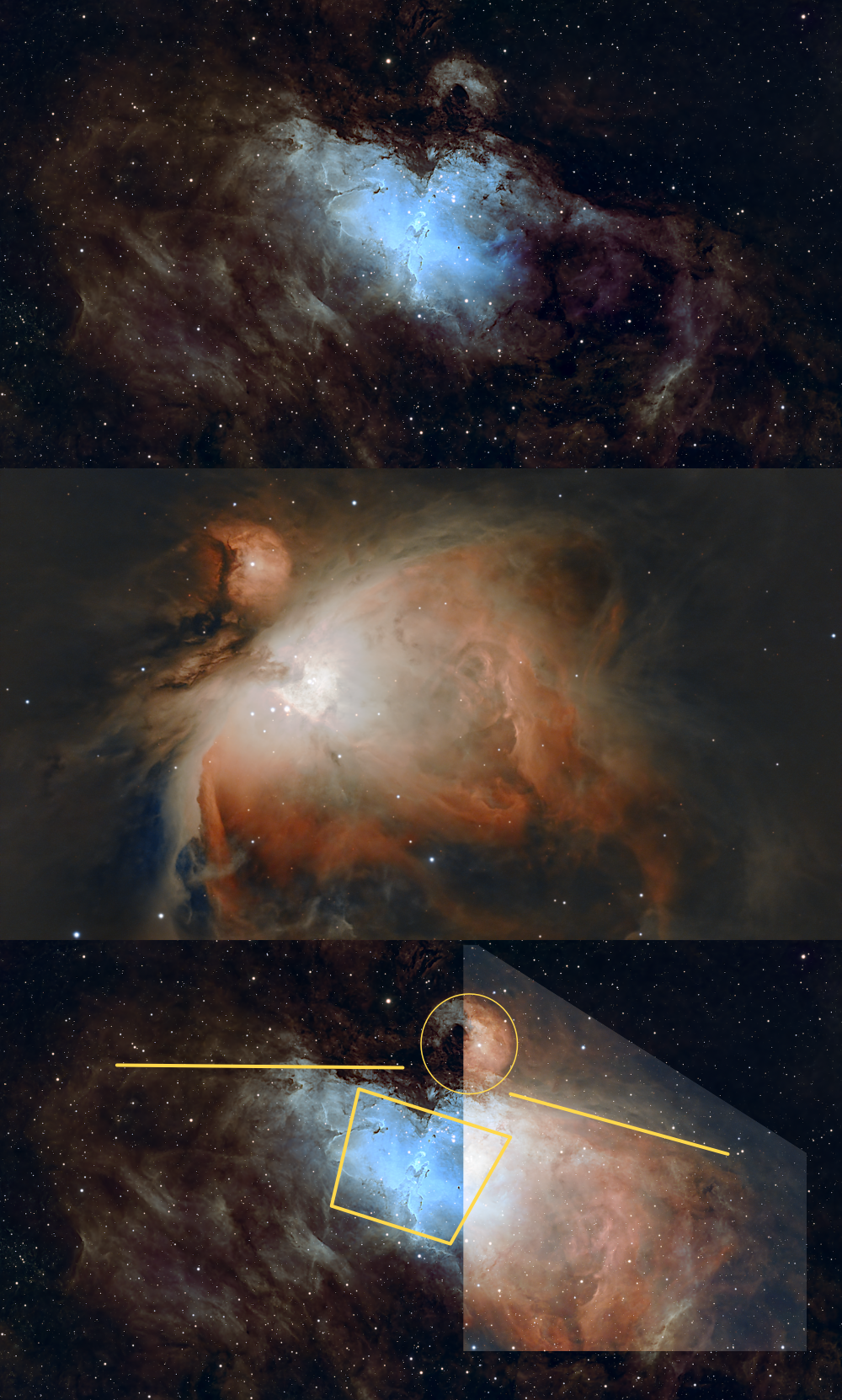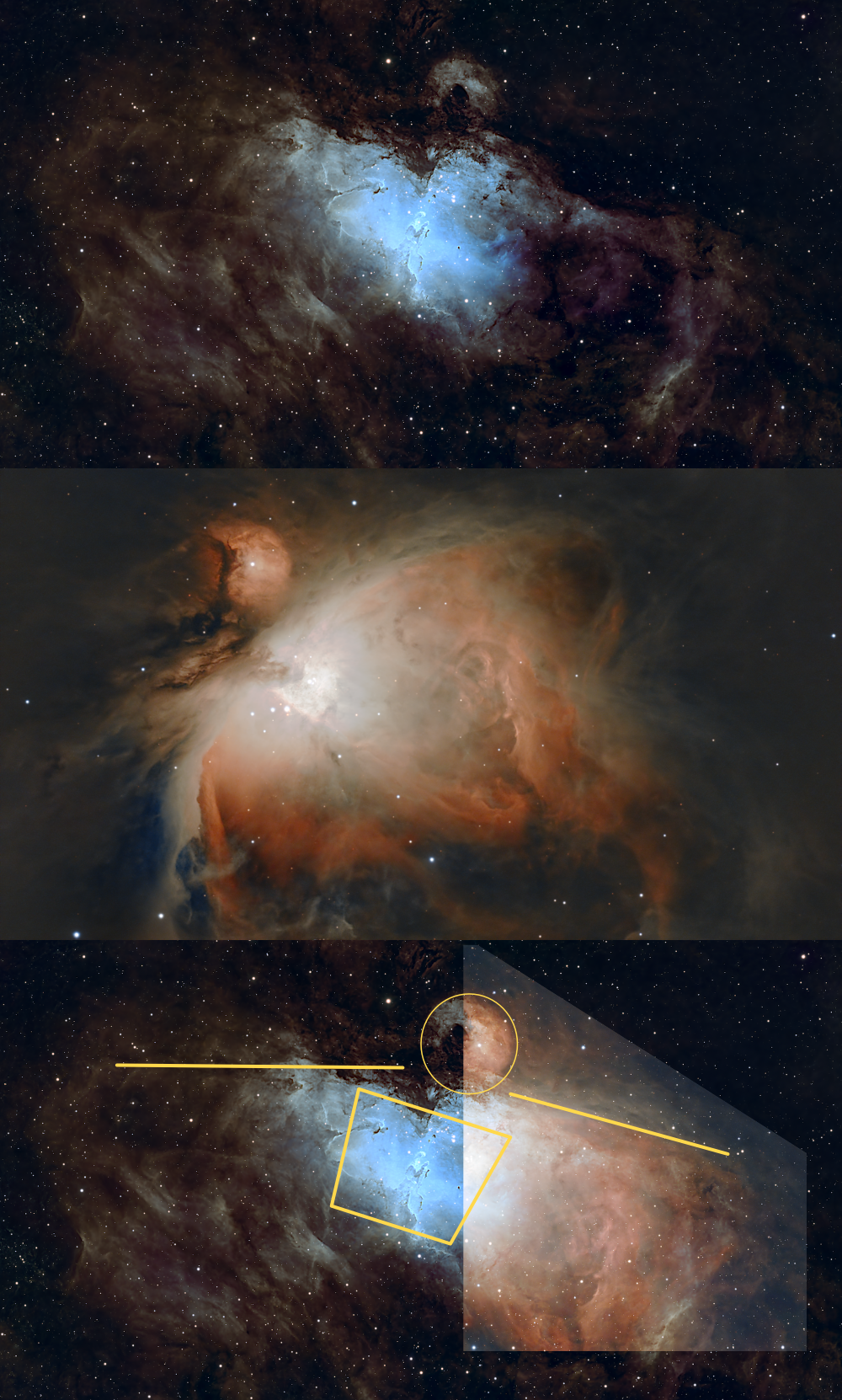
The Orion Nebula M42, the Eagle Nebula (NGC 6611), and the Seagull Nebula (Sh2-292)... these nebulae share a fascinating geometry: in each, one can observe a structure composed of a sphere and a fan-like tail branching out from it. This distinctive shape is determined by a phenomenon known as the Strömgren Sphere.
A very hot star, typically of spectral type O or B, emits ultraviolet radiation so intense that upon striking the hydrogen atoms within its surrounding cloud, it strips them of an electron (ionisation). This process creates a bubble of brilliant, searingly hot ionised gas.
Within this region, powerful stellar winds sweep away debris, creating a cavity of rarefied gas maintained at high pressure and temperature. The radius of this sphere is defined by the equilibrium between the number of ionising photons emitted by the star and the density of the surrounding gas providing resistance.
If the star is located at the periphery of the molecular cloud, the boundary of the sphere eventually encounters a region of much lower density (the edge of the cloud). At this point, the "wall" of the nebula can no longer contain the internal pressure and gives way. Due to the immense pressure gradient, the hot gas is violently ejected outward, opening up like a fan. This suggestive phenomenon is known as the Champagne Flow.
Another prime example of a Strömgren Sphere is the Rosette Nebula (NGC 2237). This nebula is considered one of the most spectacular, "textbook" examples of a Strömgren Sphere (or, more precisely, an evolved H II region) because it represents a "multiple" Strömgren Sphere. While M43 is illuminated by a single primary star, the Rosette is powered by an entire stellar cluster at its core (NGC 2244). This group of O and B-type giant stars emits a colossal amount of ultraviolet radiation, creating a giant Strömgren Sphere approximately 130 light-years in diameter.