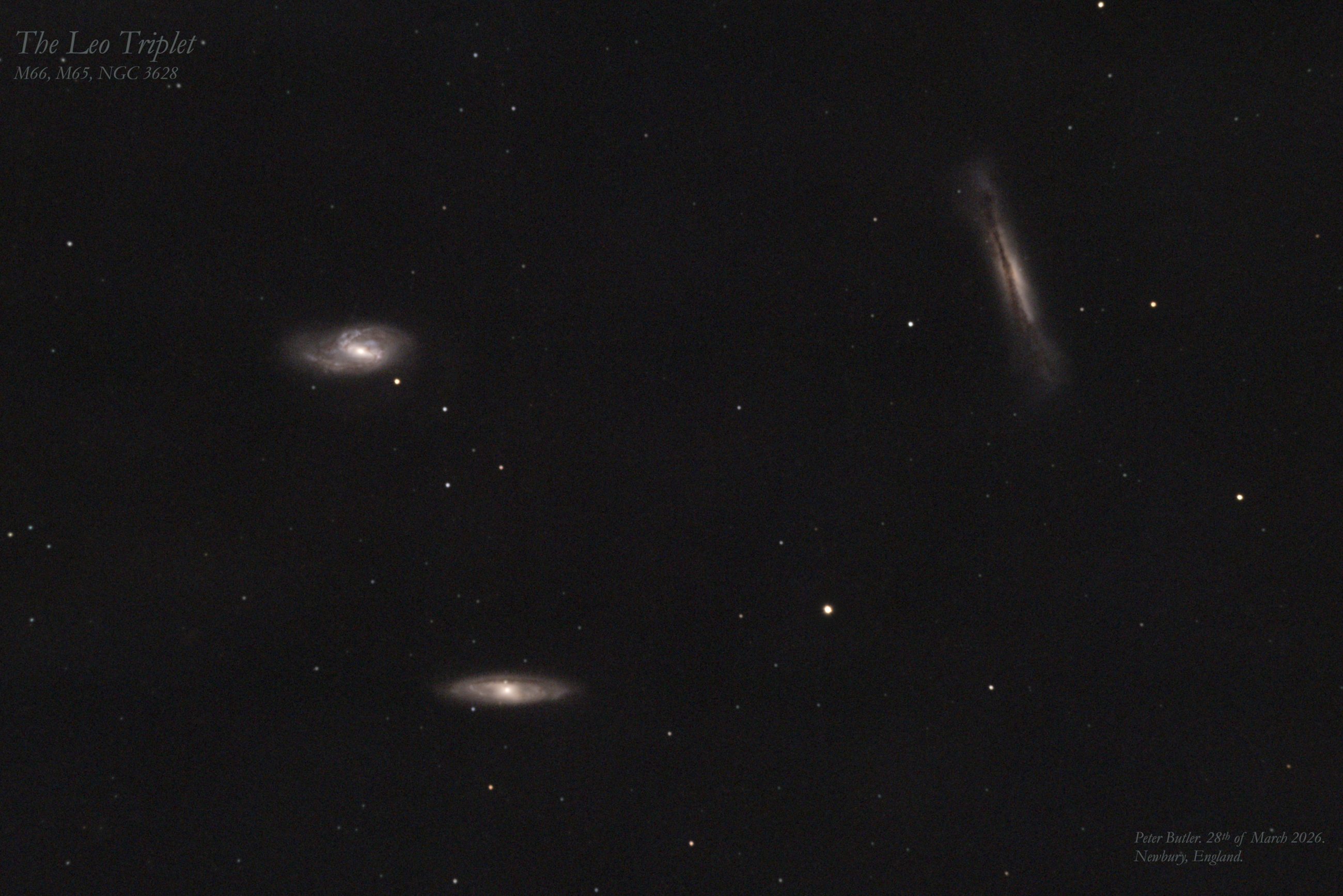
Observation by Peter Butler: The Leo Triplet on a Moonlit Night

Uploaded by

Peter Butler

Observer

Peter Butler

Observed

2026 Mar 28 - 23:55

Uploaded

2026 Apr 01 - 08:40

Objects

M66
M65
NGC3628

Planetarium overlay


Constellation

Leo

Field centre

RA: 11h19m
Dec: +13°15'
Position angle: +84°03'

Field size

1°13' × 0°48'

Equipment
  • Explore Scientific ED Apochromatic 102 mm telescope, F/7
  • ZWO ASI 2600MC-DUO Camera
  • Sky-Watcher EQM-35 Pro German Equitorial Mount
Exposure

240 x 2 minute sub-exposures, gain 100.

Location

Newbury, Berkshire.

Target name

The Leo Triplet: M66, M65, NGC 3628

Title

The Leo Triplet on a Moonlit Night
About this image

Three galaxies, one shot... 

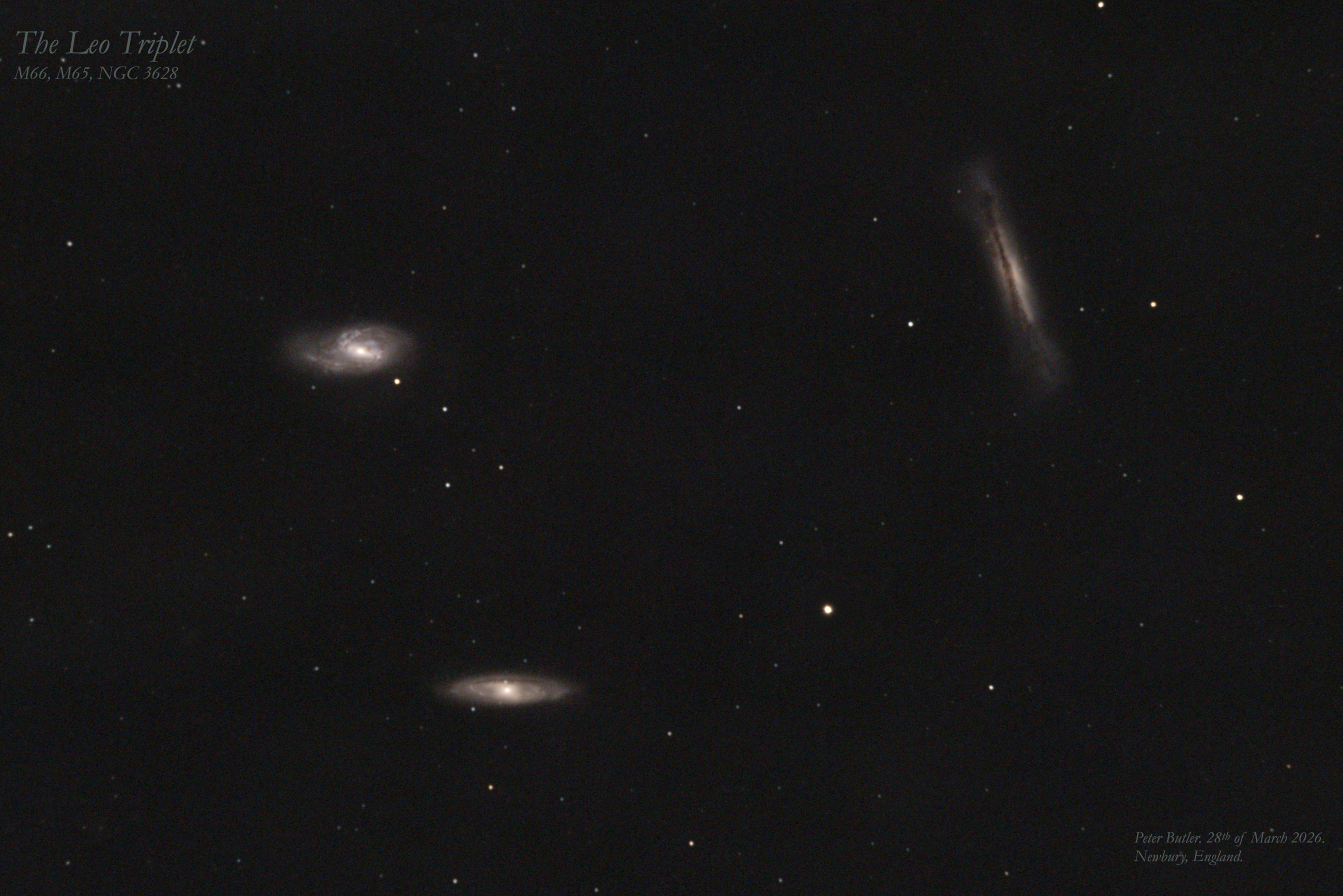
The moon was nearby and over 80% full, washing out galaxies from the night sky with its natural light pollution. But it was the first cloud-free night in what seemed like months, so I wasn't going to let that stop me from having a go. Four hours of careful light catching later, and I was able to pull this sight from the murky background. It's not perfect, but given the Moon's interference, I'm quite pleased.
 
The Leo Triplet is composed of three gravitationally interacting spiral galaxies, around 35 million light-years away. Proper deep space! They each show different orientations to us, with the edge-on one, NGC3628, often called the 'Hamburger Galaxy'.
 
My skies are Bortle 5/6, and with the bright moon so close by to my target, the effective Bortle level that night was far worse. I had hoped that ~4 hours of data would be sufficient to see detail in the 'Hamburger' galaxy's tail. Alas, despite Deep Sky Stacker doing a great job by making use of my light frames taken with the camera cooled to -10C, light flats, dark flats, and dark frames used, the murk of the combined light pollution put a stop to any hope of seeing NGC 3628's faint tail. Following a recommendation from someone at my local club (NAS), I tried Siril's Generalised Hyperbolic Stretch for my processing. I am impressed with how effective, quick and easy to use it is. This was my first galactic target for the year, but if the clouds permit, I look forward to seeing plenty more through the eyepiece, and on the sensor. 
Files associated with this observation
Like this image
Copyright of all images and other observations submitted to the BAA remains with the owner of the work. Reproduction of work by third parties is expressly forbidden without the consent of the copyright holder. By submitting images to this online gallery, you grant the BAA permission to reproduce them in any of our publications.