Observation by Nick James: Observation time calibration
Uploaded by
Nick James
Observer
Nick James
Observed
2026 May 08 - 22:31
Uploaded
2026 May 08 - 23:29
Objects
Spacecraft
Equipment
Planetarium overlay
Constellation
Hercules
Field centre
RA: 16h25m
Dec: +25°57'
Position angle: -2°40'
Field size
0°44' × 0°32'
Equipment
- ASI6200MM + Celestron HD11
Exposure
5x10s
Location
Chelmsford, UK
Target name
GPS Block IIIA satellite 2020-078A
Title
Observation time calibration
About this image
When doing astrometry of fast moving objects it is important to ensure that the observation time in the FITS header (i.e. when the exposure starts) is within a fraction of a second of UTC. I've just installed a new GNSS Stratum 1 NTP time server on my network and wanted to test it.
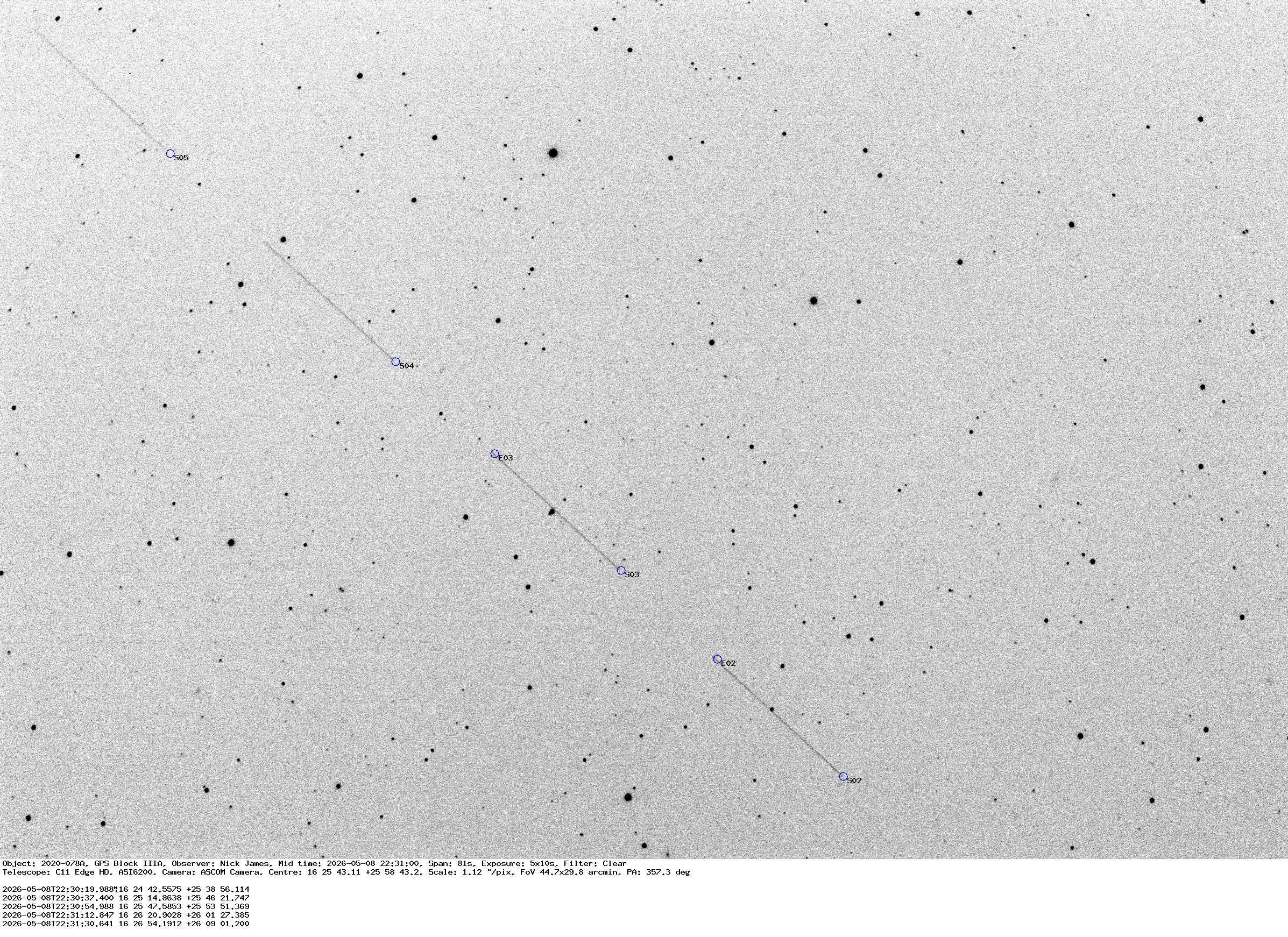
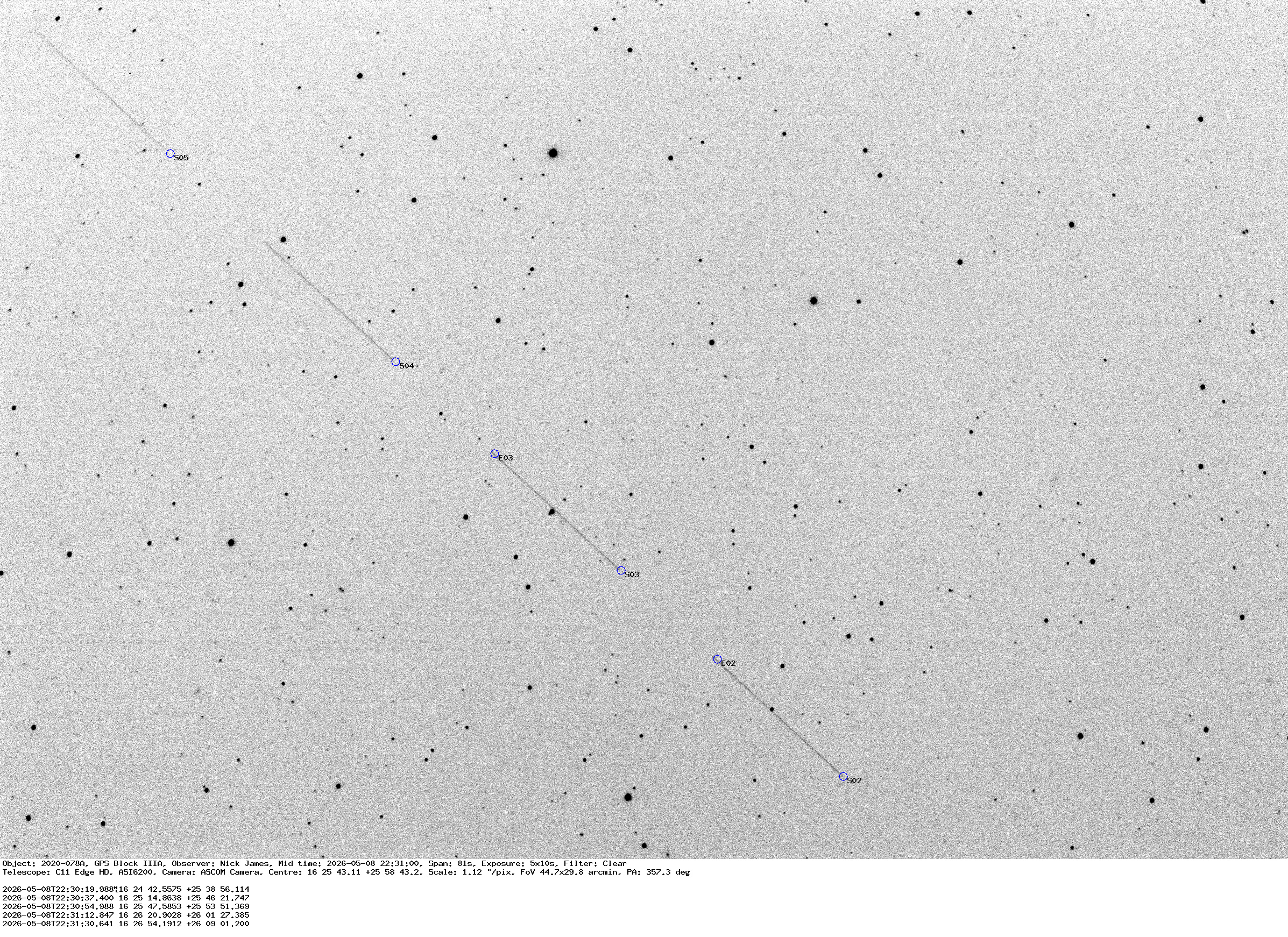
Bill Gray of Project Pluto has an online tool that can generate very precise ephemerides of GNSS satellites for your observatory. This image shows four successive 10s trails of GPS satellite 2020-078A. The blue circles labelled S.. are the predicted position at the DATE-OBS time reported in the FITS header. The blue circles labelled E.. are the positions at the calculated end time. I've measured the positions of the trail starting points and the exposure start time is within 0.1s of the true UTC time. The end times are off by around 0.3s though even though the FITS file claims the exposure time is 10.0s.
https://www.projectpluto.com/gps_find.htm
Files associated with this observation
Like this image
Comments
What software is being used to control the camera?
Might be worth trying other exposure lengths and seeing how the 0.3sec varies. With the satellite apparently moving 15 arc secs/sec against the background the resultant 4.5 arc secs error in trail end is bigger than you would want.
Presumably binning has a big impact?
Grant. Yes, some interesting experiments to do to get to the bottom of this. It is a ZWO camera using their drivers and API. The start of the exposure seems very good as far as I can tell. The exposure length not so much. The relevant API calls are:
rc = ASISetControlValue(info->CameraID, ASI_EXPOSURE, (unsigned) floor(0.5+exp*1e6), ASI_FALSE);
rc = ASIStartExposure(info->CameraID, ASI_FALSE);
The exposure attribute is in microseconds. I'll definitely do some more experimenting. I don't think binning will have any effect since on CMOS that is done after the readout.
Ah, yes. I've mainly used CCDs down the years. Apologies, slipped into old ways.
The important thing is presumably how consistent it is from day to day.
Theres no chance it is something as banal as single frame download time for your model and its looking at the clock when the function returns?
ASI_FALSE?
I assume you have the latest firmware update?
Copyright of all images and other observations submitted to the BAA remains with the owner of the work.
Reproduction of work by third parties is expressly forbidden without the consent of the copyright
holder. By submitting images to this online gallery, you grant the BAA permission to reproduce them in
any
of our publications.