
2026 November 3
Deep Sky Update – November 2026
Well it had to happen – I had a reasonably good clear night without the Moon and was able to get some observing done. It was a busy day, so I ended up just taking the Seestar out and do a few objects, but it was nice to get out under the stars. It wasn’t the best of transparency though, and mist did roll in, but I managed to get a bit of NGC 7000 (Gulf of Mexico), Hind’s VN NGC 1555, M 74, the October OOI NGC 7354 and NGC 147. As well as a bit of a view of Saturn.
Aurorae seem to have been a bit less frequent lately, as you would expect with the Sun passing solar-max, but we had a nice show rather hampered by cloud on October 10-11 which was well seen by many further south.
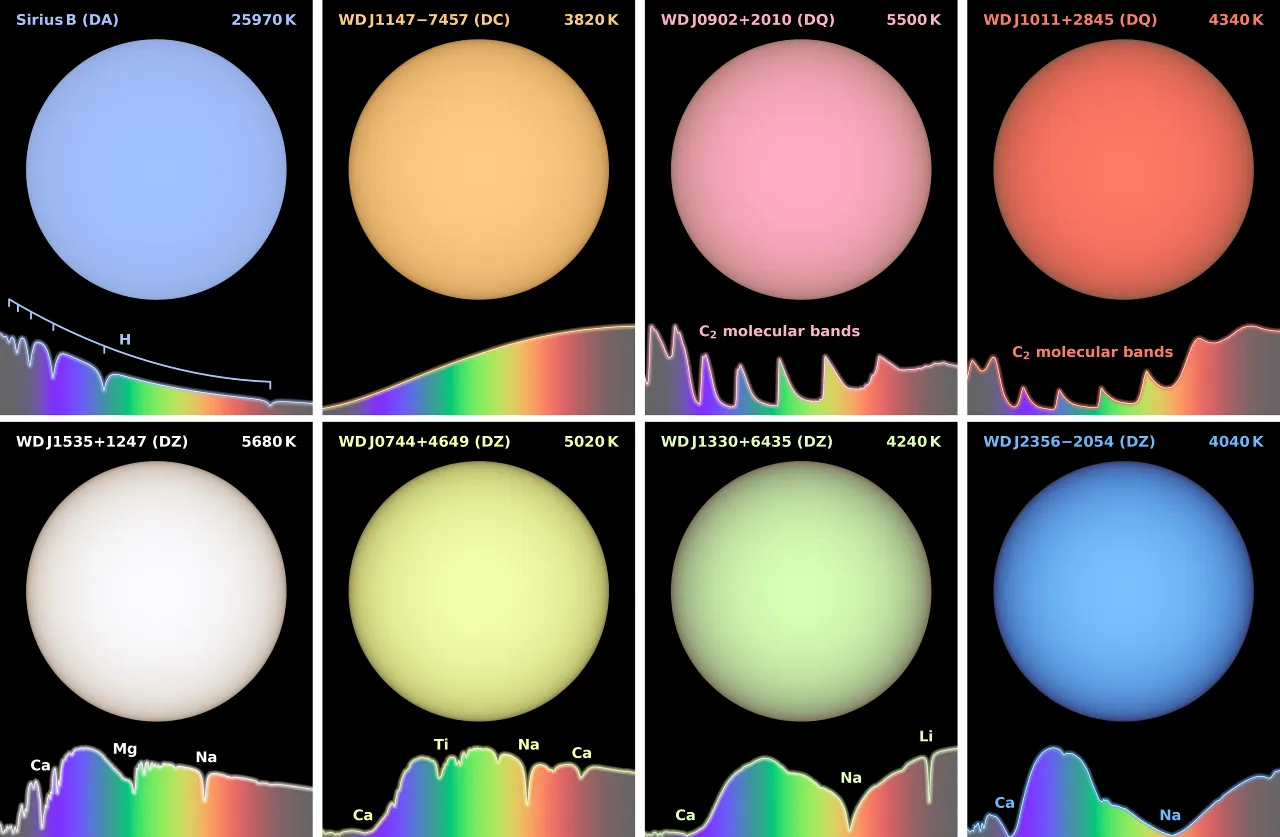
I got rather excited about the announcement of ‘Green Stars’ in a paper which appeared in the new RAS journal “RAS Techniques and Instruments”, Volume 5, 2026, https://doi.org/10.1093/rasti/rzag069
But on digging into the paper it reveals that the ‘green’ white dwarf stars in question are very faint (20-21 mag.) and deep in the professional realm.
I also got excited by the alert from The Astronomer – “E3915: Central star of planetary nebula PN K 5-35 in outburst”, but on hunting for this PN on DSS and SDSS images, I was not able to discern it. Possibly too small for these surveys to show. As a postscript I was going to check again but Simbad still seems to be unavailable following the PHP cyber alert.
Annual Meeting 2026
Progress on speakers for the March 2027 section meeting, Lincoln, has been made so hopefully I will have a full line-up arranged soon. If anyone would like to present a short talk on an area of interest I should be able to fit that in, so just let me know.
Double Stars for November – Peter Morris
This month I move down to the small constellation of Aries. The best-known double in Aries is Gamma Arietisor Mesarthim (STF 180). The primary is not particularly bright (magnitude 4.5), but is almost the same brightness as the secondary (4.6) which makes it easy to split. The current separation is 7.3 arcseconds and the position angle is 0.8° (almost due north). The main star (Gamma2 Arietis) is a A type subgiant and its companion (Gamma1 Arietis) is a main sequence A type star, hence they are usually both seen as white (perhaps a bluish-white or silver). It is considered to be a binary system by the Washington Double Star Catalog because of their similar proper motions, although the distance of the two stars are 166 light years (Gaia DR3) and 173 light years (Gaia DR2) are rather far apart.
The other prominent double in Aries is Lambda Arietis (H 5 12). The main star is about the same brightness as Gamma Arietis (4.8), but the companion star is dimmer (6.7). This is counterbalanced by a wide separation of 37.3 arcseconds; the position angle is 47.7°. The primary is a main sequence F-type star and the secondary is a G-type and although the difference is small, it is usually seen as yellow and blue (Webb saw the secondary as greenish). They are practically the same distance from us (according to Gaia EDR3), about 132 light years away, but the evidence for a physical system is considered weak by the Double Star Calculator because of the different proper motions.
1 Arietis (STF 174) is another interesting double in Aries. The two stars are magnitude 6.3 and 7.2, the separation is a tight 2.9 arcseconds and the position angle is 164.4°. The main star is a K-type giant and the companion is an A-type subgiant, which are usually seen as yellow and blue, sometimes presenting a strong contrast. The distances of the two stars are 604 (Gaia EDR2) and 608 (Gaia EDR3) light years, which is not very close, but they do have similar proper motions. Our final double in Aries is 30 Arietis (STF 5 AB) which is a fairly wide double (37.9 arcseconds) with similar brightnesses (6.5 and 7.0); the position angle is 274.7°. The main star is a main sequence F-type star and the companion is almost the same (F6 rather than F5). However, the observed colours are less straight-forward. I see them as white with tints, Sissy Haas as sun-yellow and blue-white, and other observers regard them as a yellowish pair. The two stars are close together (about 146 light years distant) and the proper motions also suggest this is a binary system.
The neighbouring small constellation of Triangulum has a well-known double, namely Iota Trianguli (STF 227). It is not dissimilar to 1 Arietis, the magnitudes are 5.3 and 6.7 and the separation is fairly tight (4 arcseconds); the position angle is 67.2°. As a binary with a period of 5,173 years, the separation is widening very slowly. The primary is a G-type giant and the secondary is a F-type main sequence star. The main star is always seen as yellow, but the secondary has been observed as grey, blue or in the case of Smyth, green.
From now on, I will also discuss a wide double, which can usually be seen in binoculars (or in some cases, even split with the naked eye) and easily imaged in a smart telescope. This month I have chosen 15 Trianguli(AG 304). The main star is magnitude 5.6 and the companion is 6.8. The separation is 142.4 arcseconds and the position angle is 16.4°. The primary is a red giant (and hence a pulsating variable), while the secondary is an A-type star, hence they are seen as orange and white. According to Gaia EDR3, the distances are 678 and 1103 light years which clearly rules out the possibility of a binary system.
October Object of Interest
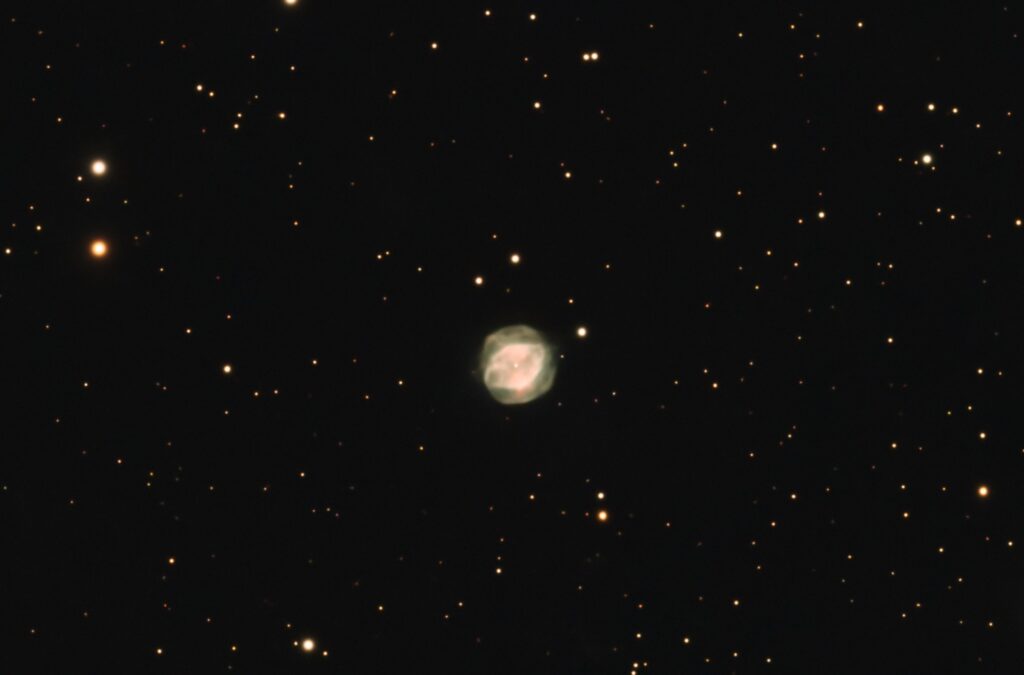
October’s target was the PN NGC 7354 in Cepheus. I managed to capture it as not much more than an extended star with my Seestar, but many others had better results. Many thanks to: Trevor Pitt, Mark Fairfax, Alan Thomas, Fred Stevenson, Brian Scott, Iain Cartwright, Richard Sargent, and David Strange
Here is Fred’s finely detailed image.
Object of Interest for November
November’s target suggested by Jim is the reflection nebula Sh2-168 in Cassiopaea. Should be a challenge for imagers and visual observers.
Deep Sky Picture of the Month
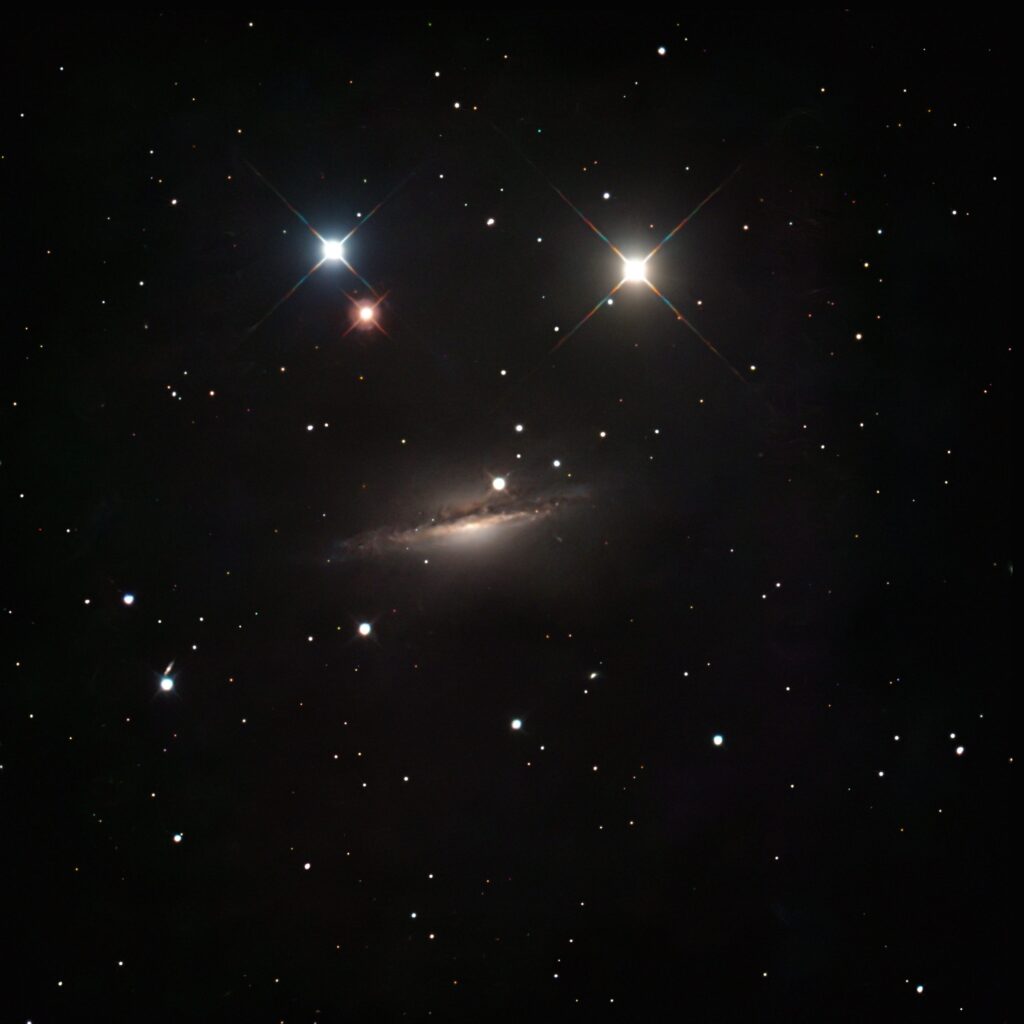
My pick of a Deep Sky POTM is of NGC1055 by David Strange. The galaxy is nicely accompanied by three bright stars.
And Finally
At the section meeting next year I will have been the director of the section for 14 years, and it feels like it is the right time to pass the baton on. Council has been advised and I have proposed Jim Latham to be the next Director – I am sure he will do a great job.
Clear, dark skies!
Callum
https://britastro.org/wp-content/uploads/2026/11/wd_colours_final_credit_mark-hollands_university-of-warwick.png.webp
| The British Astronomical Association supports amateur astronomers around the UK and the rest of the world. Find out more about the BAA or join us. |