
Sky notes for 2026 August & September
2026 August 1
(Written for 23:00 BST in the UK on September 1)
August begins with the Summer Triangle of Deneb, Vega and Altair overhead at 23:00 BST. Whilst the summer twilight precludes deep-sky observing, we can still enjoy the showpiece double star Albireo (beta Cyg), the quadruple star Sheliak (beta Lyr), first identified as having multiple components by William Herschel in 1779, and the Double Double (epsilon Lyr). The summer months also provide the only opportunity for UK observers to seek out the many beautiful deep-sky objects south of the celestial equator, in Ophiuchus, Serpens Cauda and Sagittarius.
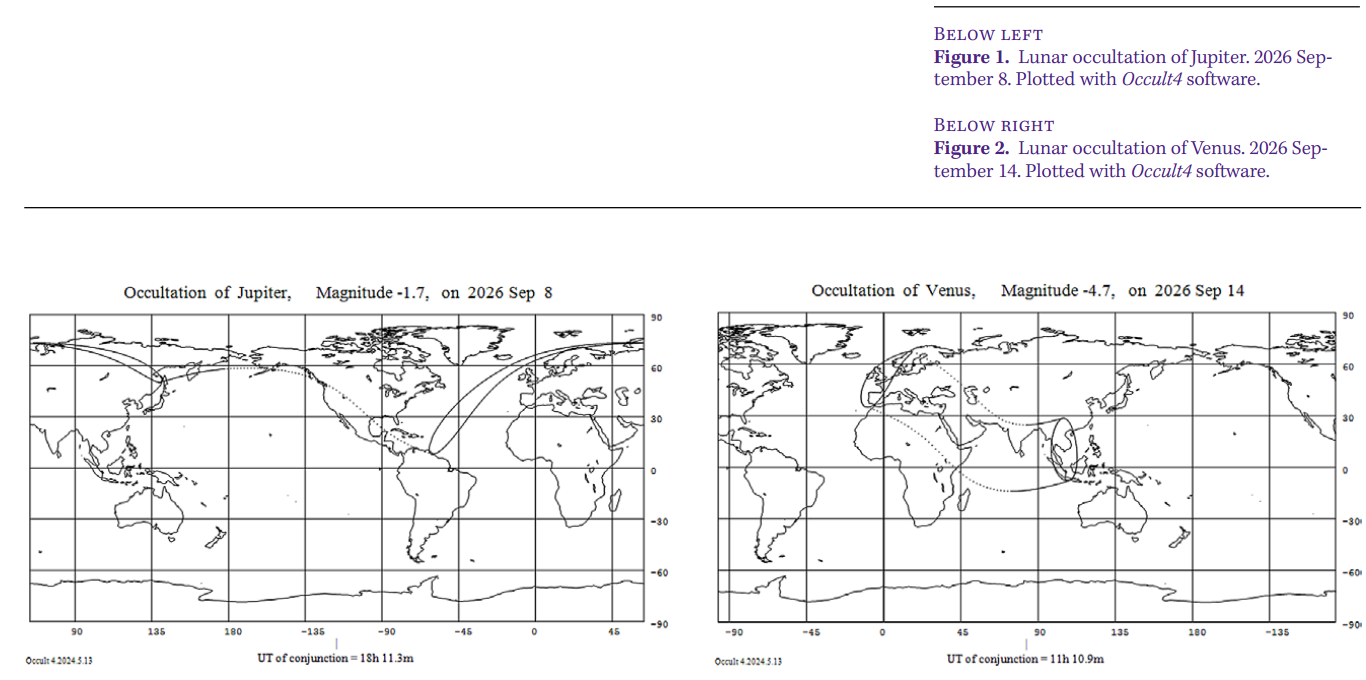
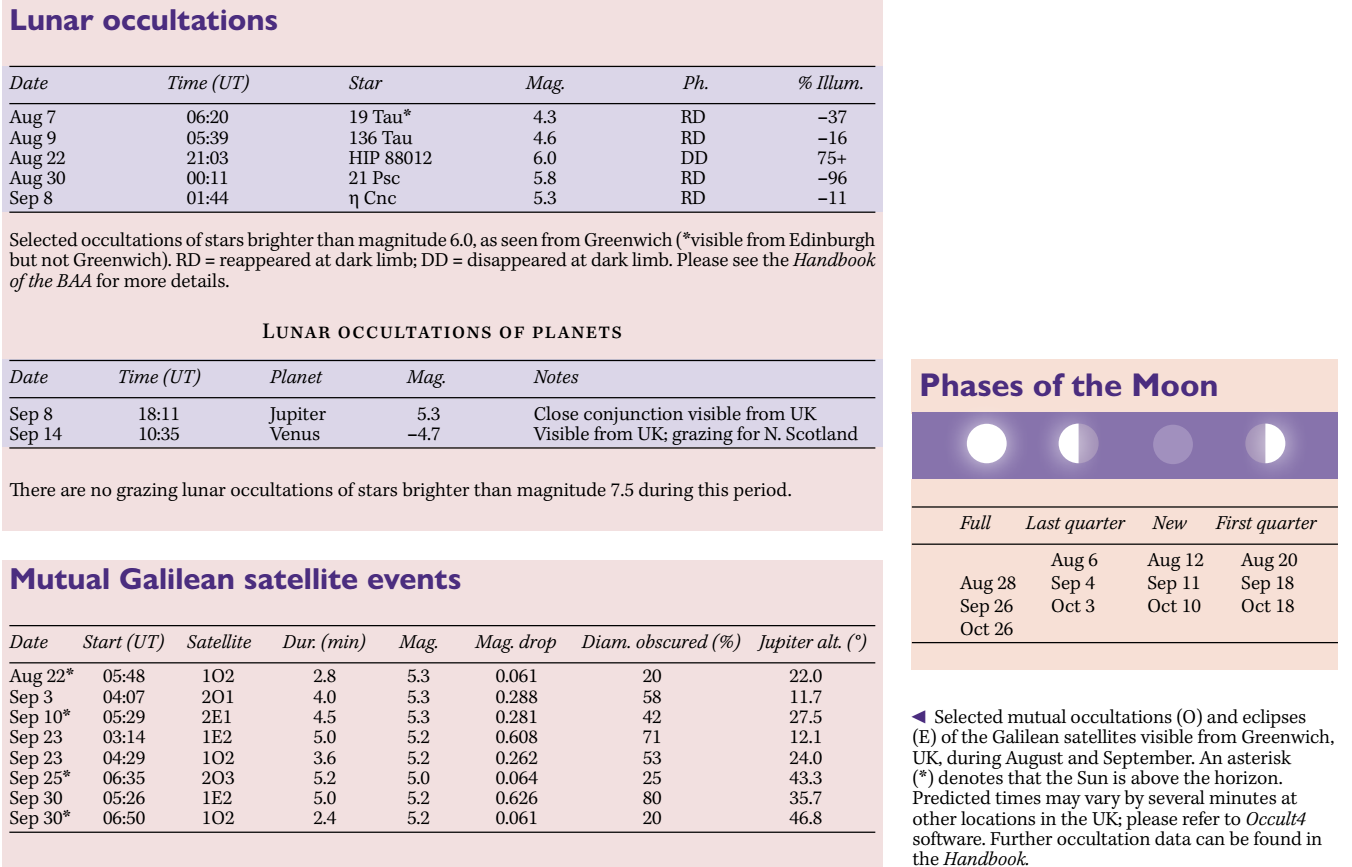
A total solar eclipse and a partial lunar eclipse occur in August, while Neptune reaches opposition in September, followed by Saturn in early October. There is a close conjunction between the Moon and Jupiter from the UK, while Jupiter is occulted from North America (Figure 1).Venus is occulted by the Moon for UK observers on September 14 (Figure 2). The Perseid meteor shower coincides with a one-day-old Moon, promising a rewarding night.
The deep sky
Warm August evenings are perfect for hunting the beautiful stellar nurseries and nebulae towards the centre of the Milky Way. Containing 14 Messier objects – mainly open and globular clusters, together with three bright nebulae – Sagittarius provides plenty of interesting targets for imagers and visual observers. At declinations of −20 to −40°, these objects require a good southern horizon from the UK and, ideally, a trip to southern Europe. For those travelling to Spain this summer, I highly recommend packing a pair of binoculars or a small refractor!
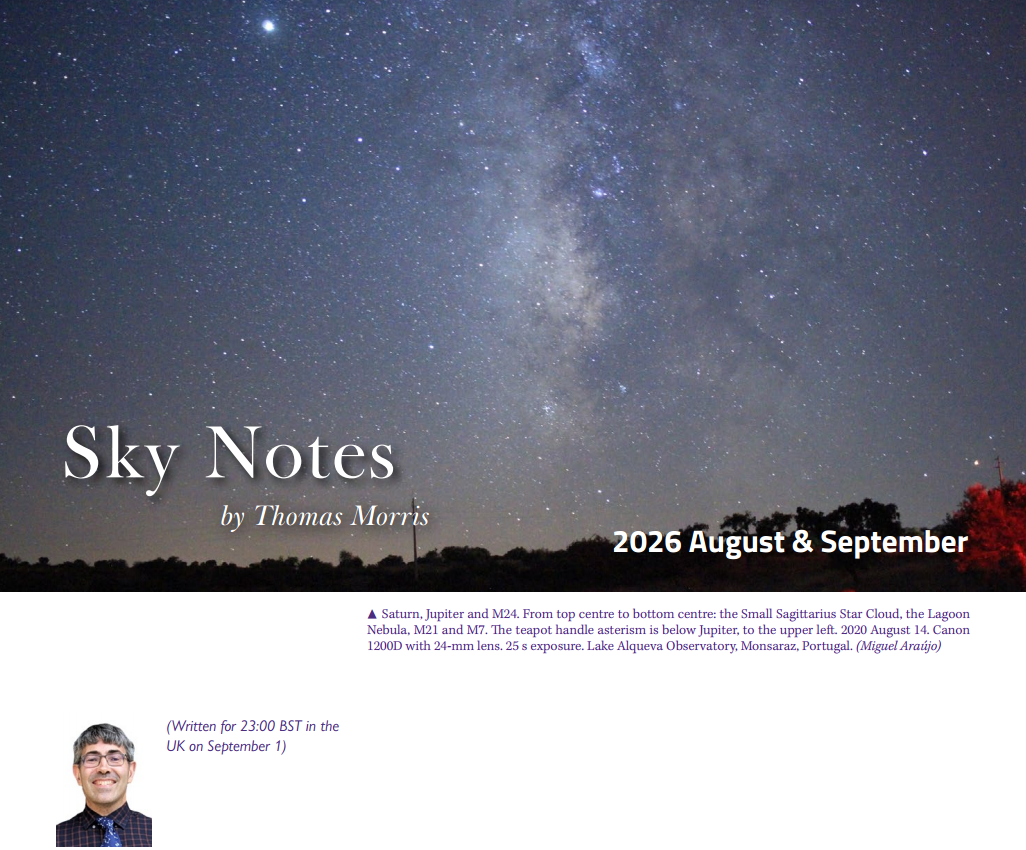
Starting from eta Oph, which marks the lower left-hand corner of neighbouring Ophiuchus, follow a line south-east, passing the bright globular cluster M9, to find the Small Sagittarius Star Cloud (see image at top of p. 270). Despite its name, it is a large star cloud, spanning some 1.5 degrees. Embedded within is the open cluster NGC 6603, discovered by John Herschel and rather less conspicuous at magnitude 11. To the south lies the spectacular globular cluster M22, which would rival M13 were it placed at a more favourable altitude for UK observers!
Sagittarius is rich in hot young stars, and the Lagoon (M8) and Trifid (M20) nebulae are among the finest emission and reflection nebulae in the sky. Both are ideal targets for imaging with smart telescopes. Their distances are not known precisely: M8 is thought to lie around 4,300 light-years away and M20 around 4,100 light-years, based on Gaia Data Release 2 parallax measurements. Both lie in the Scutum–Centaurus Arm of the Milky Way. The Trifid Nebula is illuminated by Herschel 36, a massive young stellar object of spectral type O8 V, corresponding to a mass of around 25–30 times that of the Sun.
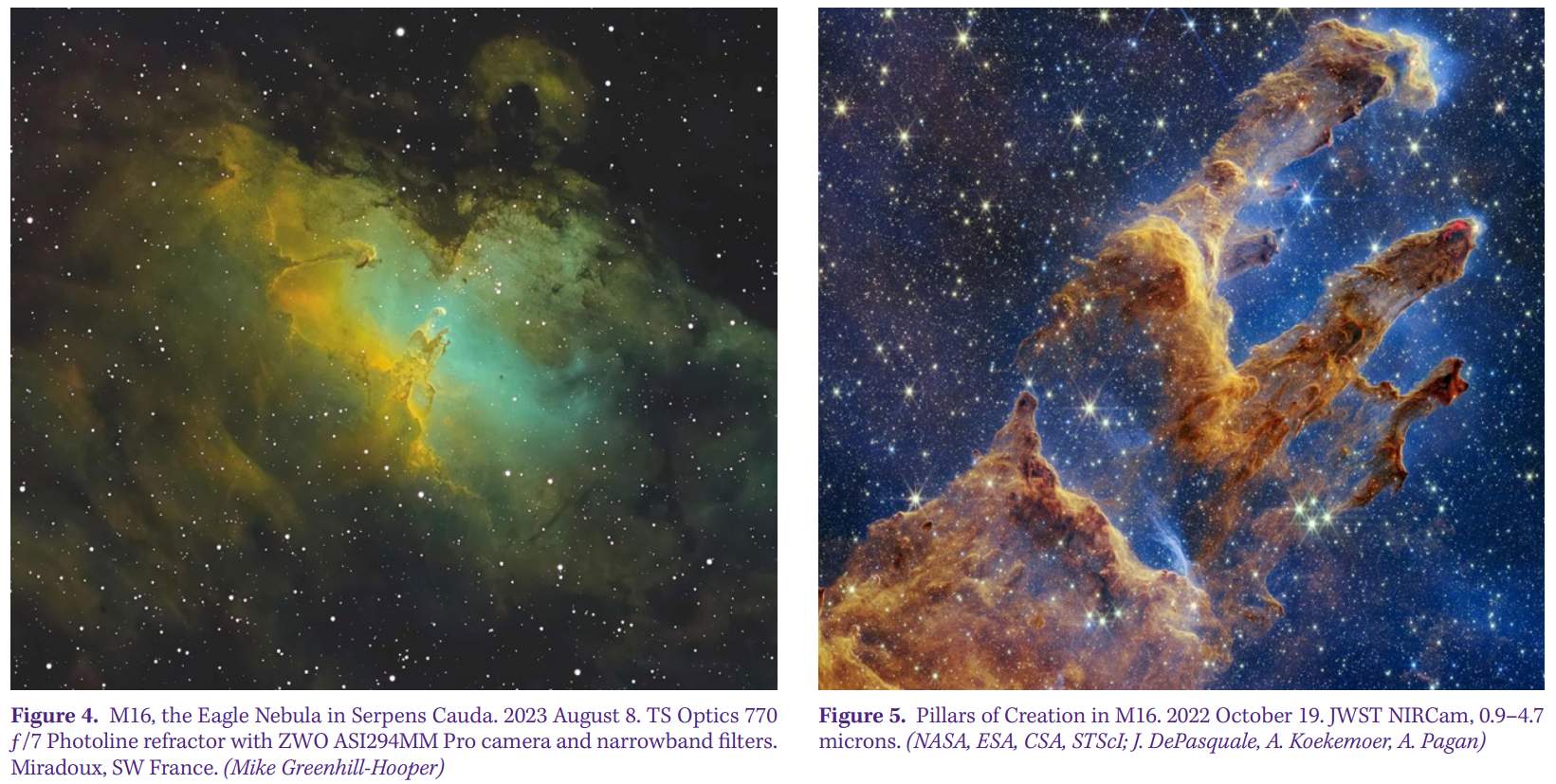
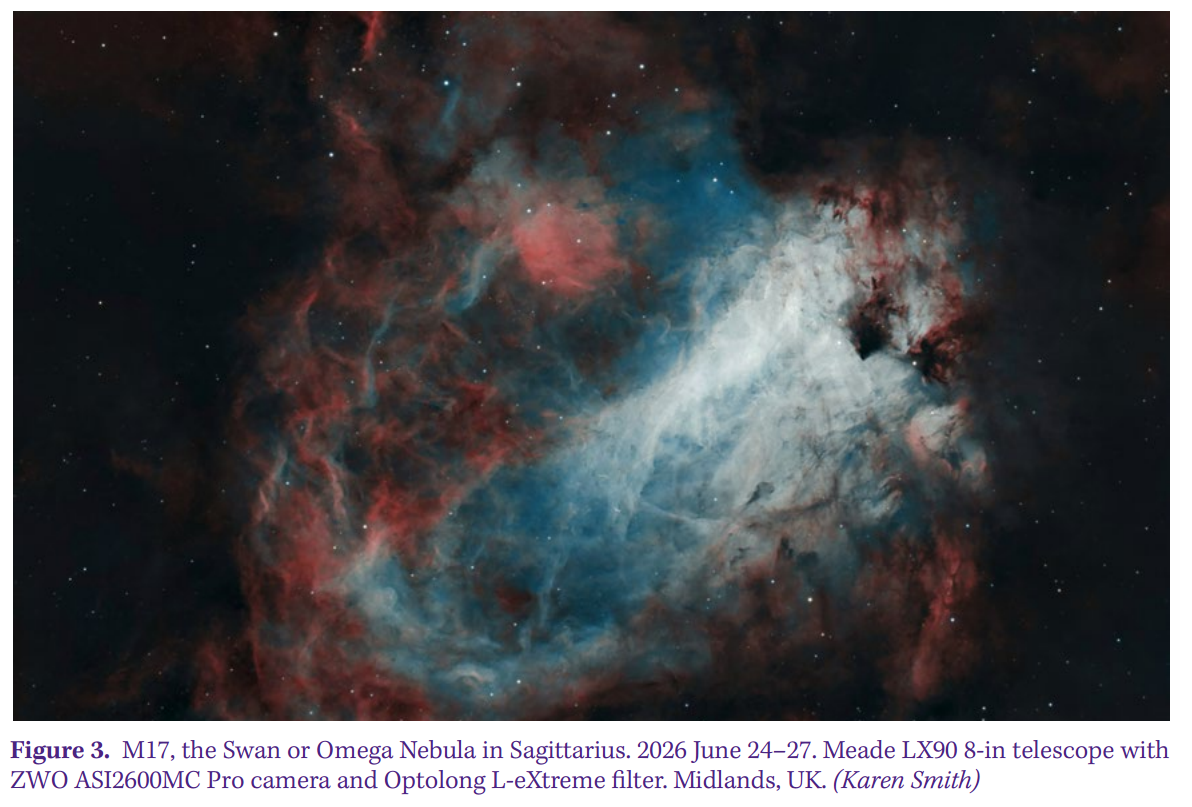
Continuing our journey north-east of the Small Sagittarius Star Cloud, we arrive at two of the finest deep-sky objects of the summer sky: the Swan, or Omega, Nebula (M17; Figure 3) and the Eagle Nebula (M16; Figure 4) in neighbouring Serpens Cauda, the body of the serpent carried by Ophiuchus, the Serpent Bearer. The iconic Hubble Space Telescope image ‘Pillars of Creation’ shows part of the Eagle Nebula, in which radiation and stellar winds from hot young stars have eroded the surrounding gas, leaving towering columns of opaque dust. These pillars shield the hydrogen gas within, allowing it to cool and form a new generation of stars. A more recent James Webb Space Telescope image of the same region is shown in Figure 5.
The solar system
Sun & Moon
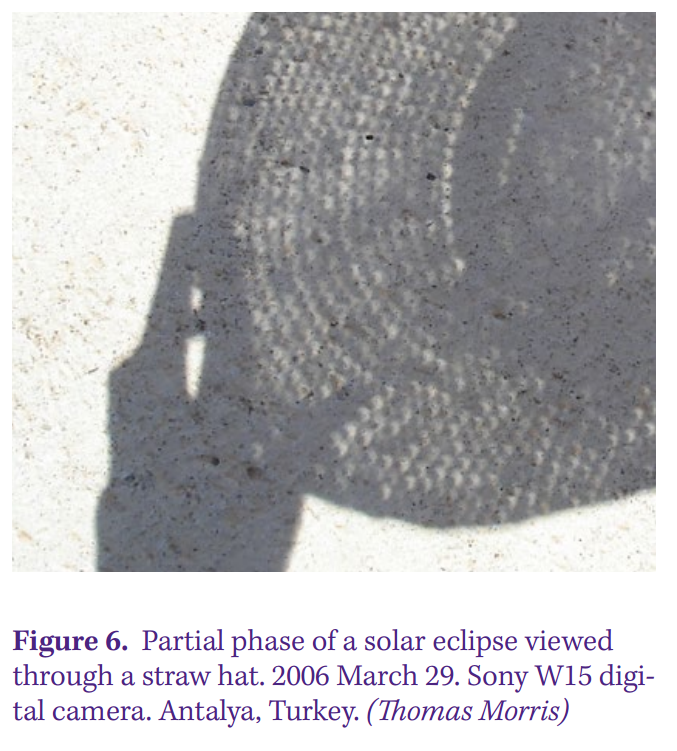
The main astronomical event of 2026 is the total solar eclipse on August 12 (Figure 6 ). Totality is visible from Iceland, Spain and the Balearic Islands. From London, the Moon blocks 92 per cent of the Sun’s disc at mid-eclipse (19:17 BST).
A partial lunar eclipse takes place on August 28, with greatest eclipse at 04:13 UT. From the UK, moonset (05:15 UT) occurs during the umbral phase.
The autumn equinox occurs on September 23.
Planets
The two inner planets are well placed in August. Mercury has its best morning apparition of 2026, reaching greatest western elongation on August 2 at magnitude −0.1.
Venus is an evening object throughout August and September, lying low in the southwestern sky after sunset. The planet is occulted by the Moon on September 18, during daylight in the eastern sky.
Mars brightens to magnitude +1.2 and moves into Gemini during August, although its disc is only 5 arcmin across, increasing to 5.6 arcmin by the end of September. The Martian northern spring equinox occurs at the end of September, with the planet’s northern hemisphere tilted towards Earth by 10 degrees. Mars’ disc appears noticeably gibbous throughout this period.
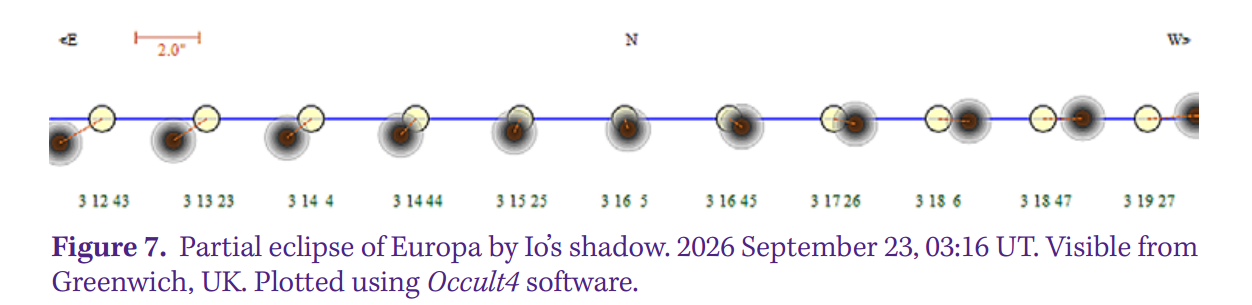
Jupiter has passed conjunction with the Sun and rises before dawn in September. The planet is approaching its equinox, when the Sun lies directly above the equator and therefore in the orbital plane of the Galilean moons. As a result, the moons may eclipse or occult one another: phenomena known as mutual satellite events. Events visible from Greenwich are listed in the table on p. 271, although these are unfavourable, with Jupiter low in the pre-dawn sky. Eclipses of Europa by Io on September 23 (Figure 7) and September 30 cover 71 per cent and 80 per cent of Europa’s diameter, respectively, and may be observable visually in the eyepiece.
Saturn is well placed in the early hours as it moves towards opposition on October 4. By mid-September, it culminates at an altitude of over 35 degrees at about 02:00 BST.
Uranus is well placed in Taurus in the early morning at magnitude 5.7.
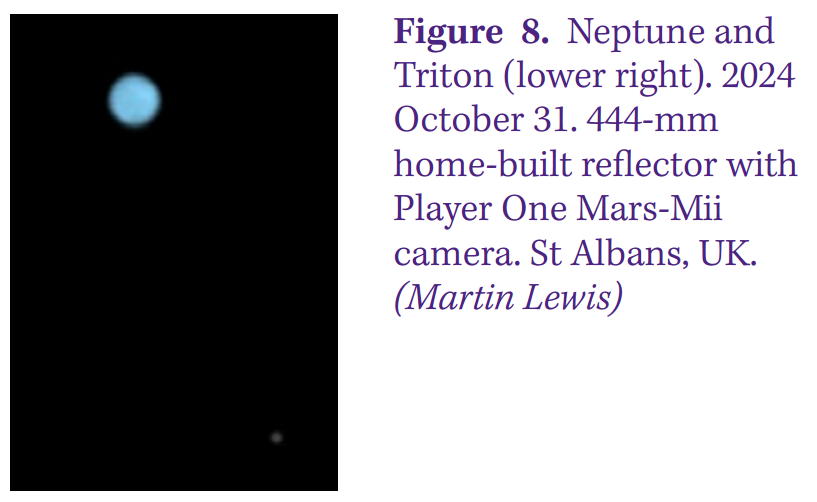
Neptune (Figure 8) is at opposition on September 26 in Pisces, close to the Circlet asterism. Following the planet with binoculars for a few weeks around opposition neatly demonstrates the movement of Earth, as Neptune’s mean motion is 0.2 degrees per month, while parallax due to Earth’s orbital motion is close to 1 degree per month near opposition. Neptune’s largest moon, Triton, discovered 180 years ago by William Lassell from his home observatory in West Derby, is remarkable for its geologically young surface despite its frigid temperature.
Dwarf & minor planets
Asteroids [9] Metis and [192] Nausikaa are at opposition in Aquarius on August 28 and in Pisces on September 30, respectively. [192] Nausikaa is the brighter of the two, visible in binoculars at magnitude 8.4. Its favourable opposition occurs at a distance of 0.81 astronomical units (au) from Earth, close to perihelion. [9] Metis reaches magnitude 9.2 during its closest approach, at 1.40 au.
Meteors
The Perseids are very favourable this year with peak activity on August 13, the day after the new Moon and total solar eclipse. The radiant is above 45 degrees after midnight, with a peak zenithal hourly rate of 80 meteors. This is the best opportunity for several years and well worth finding a suitably dark sky site to take full advantage.
Two minor meteor showers, the August Kappa Cygnids and the September Epsilon Perseids, are also favourable this year.
Comets
10P/Tempel 2 is currently the best prospect for a comet, expected to peak around magnitude 7.4 while low in the southeastern midnight sky in early August. No other comets are expected to be brighter than 11th magnitude during this period.
Comet 220P/McNaught is around magnitude 11.3 at the time of writing, after a large outburst in early June that produced a bright tail visible in images.
Ed. Our thanks to Thomas, the second of our guest authors for the Sky Notes. Regular author Nick Hewitt will return in October.
| The British Astronomical Association supports amateur astronomers around the UK and the rest of the world. Find out more about the BAA or join us. |