
Sky notes for 2026 October & November
2026 October 1
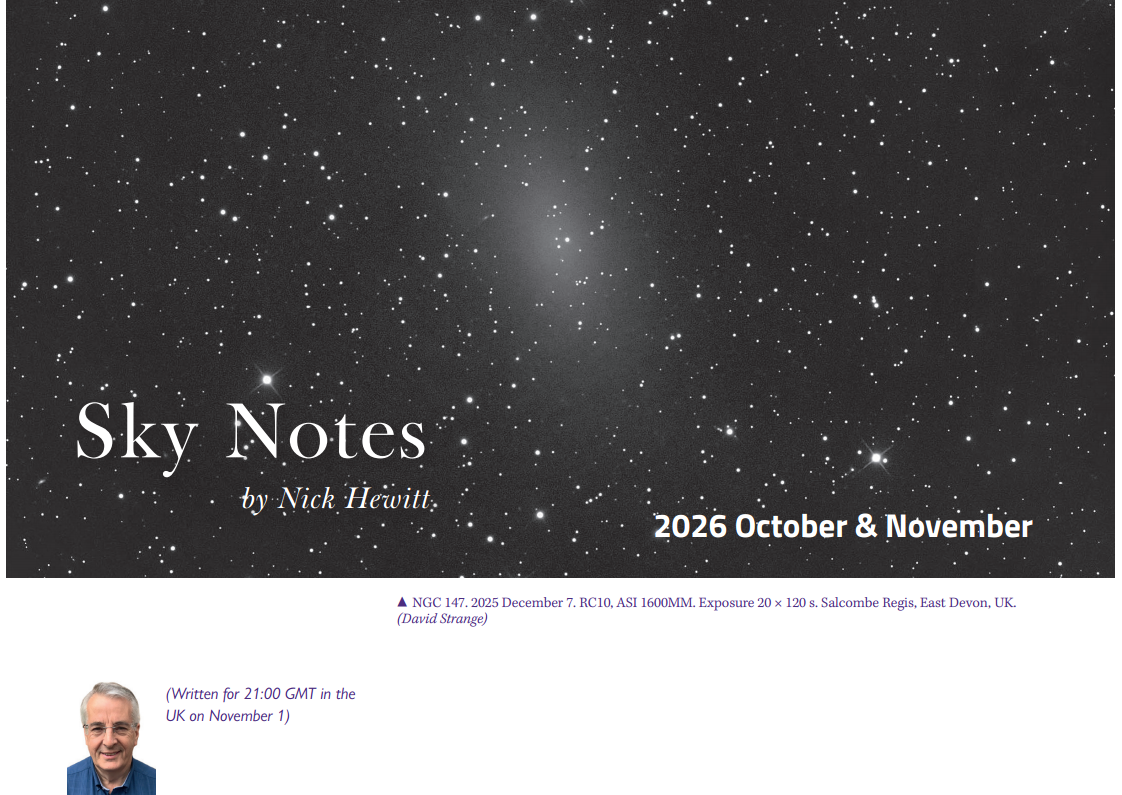
(Written for 21:00 GMT in the UK on November 1)
The weekend of October 25 sees the end of British Summer Time and the long, darker evenings of opportunity begin. Several planets become more available as autumn progresses, with Saturn being the most accessible during the mid-evening, its rings coyly opening again. The Milky Way arcs from west to east via the zenith, but it does not interfere with our view of our galactic neighbours, the so-called Local Group of galaxies. Whilst spring is the galaxy enthusiasts’ paradise, autumn allows us to get up close and personal with our fellow passengers in the Universe. It is one hundred years since Edwin Hubble began to classify the ‘extragalactic nebulae’, developing his so-called Tuning Fork diagram in 1926, much modified over the intervening years. Even the great man could not have envisioned how the nearby family of galaxies has grown during the century.
The Local Group contains at least 130 members and is a more varied bunch than you might think, although admittedly most are dwarves. They occupy a small cul-de-sac around 15 million light-years in diameter, off a long road out of the main nearby celestial city – the central Virgo cluster – but comprise a fairly typical example of a galaxy group within the current Universe. The Local Group consists of two lobes within a sphere 10 million light-years in diameter, one centred on the Great Andromeda Galaxy, Messier 31 (M31), and the other on our own Milky Way Galaxy. These are the two dominant spirals, each with its own family of smaller satellite galaxies, many of which are overlooked by amateurs despite being interesting in their own right. Due to the relative proximity of our Local Group neighbours, the brighter members have been studied in great detail, leading to important advances in our understanding of the Universe. Many have also become good friends of the amateur observing community, especially the two great spirals, M31 and the Triangulum galaxy, M33, whilst the Magellanic Clouds are a treat for observers in the southern hemisphere.
The deep sky
M31 and the smaller but still impressive M33 are very popular targets for visual astronomers and imagers alike. M31 in particular has benefitted from the relatively recent availability of fast, wide-field refractors and sensitive CCD/CMOS cameras. Wonderful and detailed views of this huge spiral can now be obtained, while only 40 years ago camera lenses were needed to show it, and then not to its best advantage. At 3 × 1 degrees across, it is just too large, making telescopic views a visual disappointment, and although it is fun to show the public the core of the great galaxy at star parties, the reaction is often muted despite being told that they are seeing across 2.5 million light-years. Now the galaxy can emerge on a screen after just a minute or two – things have moved on! M31 is still a fun target for naked-eye views, and the darkness and transparency of the evening can be judged by its availability without optical aid, being the furthest thing to be ‘easily’ seen with the unaided eye.
Through the eyepiece, pointing out M31’s two nearby elliptical companions, M32 and M110, can often excite more. Both are more interesting than they look. M32 is a satellite of M31 and an almost spherical dwarf elliptical, 8 × 6 arcmin in diameter and shining at magnitude 8, so easily seen as a fuzzy ‘star’. It is unusual in having its own black hole, so it is likely to have been a more impressive galaxy when badly disrupted by M31 two billion years ago. M110 is also a dwarf elliptical of 8th magnitude but much larger than M32 at 22 × 11 arcmin. Unusually for most dwarf elliptical galaxies, it contains dust and young stars.
T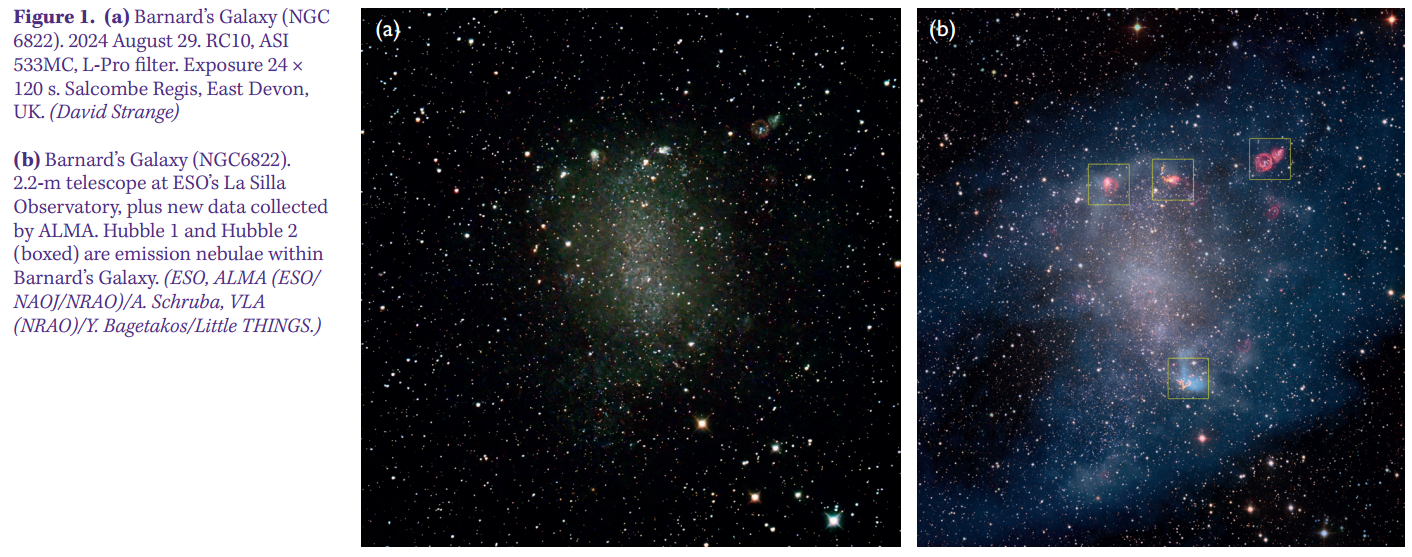
he first Local-Group target of the evening is Barnard’s Galaxy (NGC 6822; Figures 1a & 1b), which remains available in the early evening despite lying in Sagittarius. Compared with better-known Local Group members, it is low at −14°, but it lies well east of the Milky Way’s obscuring dust. It was noted visually by E. E. Barnard in 1884 and studied by Edwin Hubble in 1923 while he waited for M31 to become better placed. At 1.6 million light-years, the barred irregular galaxy is nearer than the two great spirals, and is rich in star-forming regions, two of which have Hubble catalogue numbers.
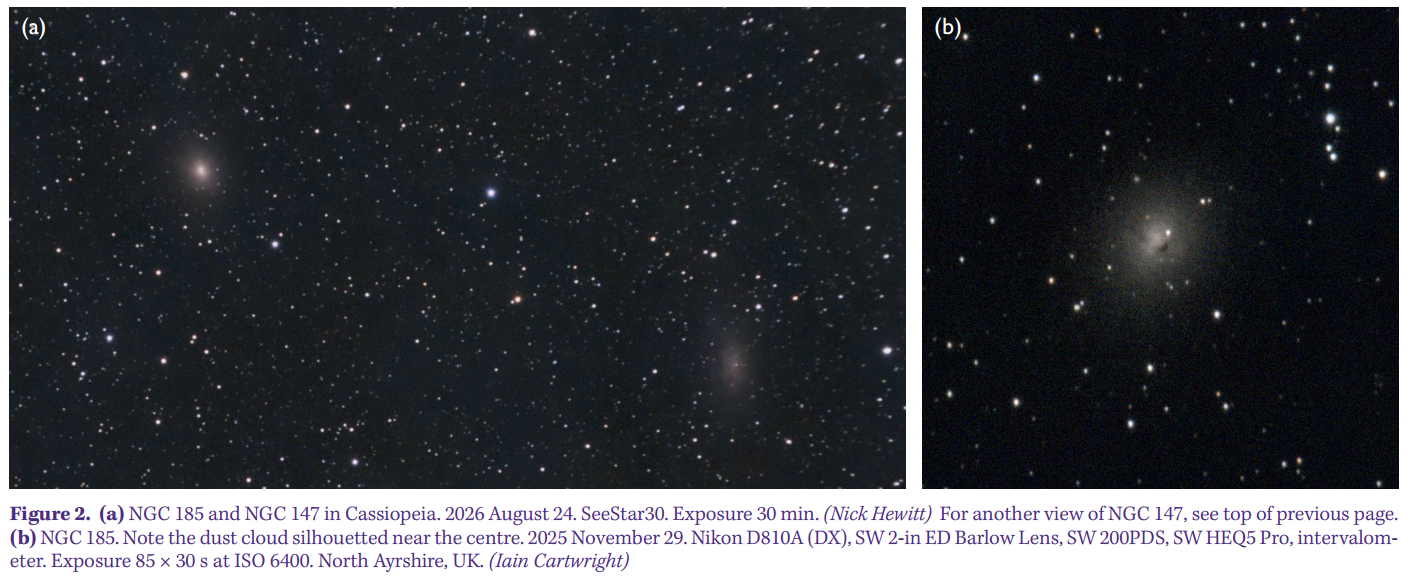
Better placed in the mid-evening are two more small members of the Local Group, both dwarf spheroidal galaxies in Cassiopeia. NGC 147 and NGC 185 (see top of previous page and Figures 2a & 2c, above) can be gleaned in a single wide field, as they are a mere 1.7 degrees apart, but neither is an easy visual target. Both are satellites of M31, some 7 degrees to the south, but show differences from one another. NGC 185 is brighter at magnitude 9.2 and, surprisingly for a dwarf elliptical, has not only young star clusters but also an active galactic nucleus. NGC 147 is harder to see unless a moderate-aperture telescope is used under pristine skies. Locate 4th-magnitude omicron Cassiopeiae and drift slowly west: NGC 185 will be seen first, followed by the elusive NGC 147 a similar distance further west.
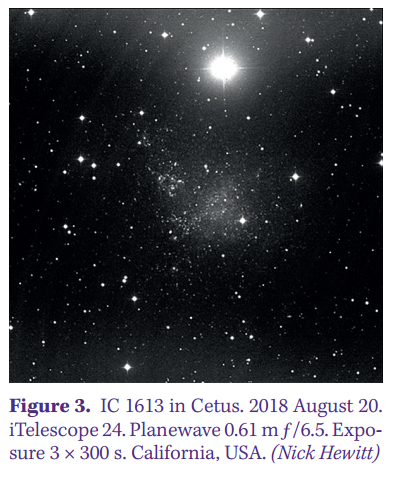
More challenging are two faint but important members of the Local Group, both hiding in Cetus: IC 1613 (Figure 3, above) in the west and the Wolf–Lundmark–Melotte (WLM; Figures 4a & 4b) galaxy to the east of the Whale. IC 1613 is an unusually ‘clean’ dwarf irregular galaxy, 2.4 million light-years from us and positioned well clear of the Milky Way’s plane. With very little cosmic dust between us, astronomers can explore the contents of IC 1613 with great clarity. Although at a similar distance to M31, it lies 40 degrees away from the larger galaxy, so is not a satellite. At magnitude 9.3, it is 16.2 × 14.5 arcmin in dimension and has a low surface brightness, yet is easily found – if not easily seen – near a 7th-magnitude star (HD 6375) to its north. It sits above the celestial equator, and dark autumnal, Moon-free nights are a great time to have a go at finding it.
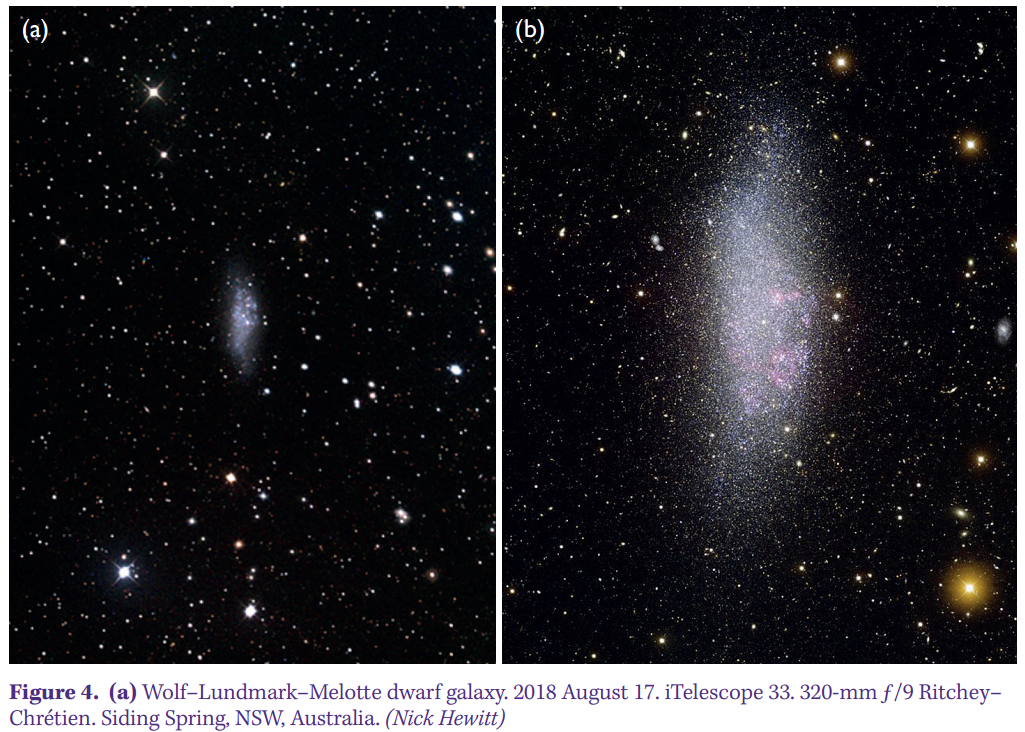
The last of my seven dwarves is the WLM galaxy, a barred irregular dwarf also located in Cetus, but lower in declination (−15° 27′). It too is isolated and farther out on the very periphery of the Local Group, at 3 million light-years. Its unusual designation came about through its discoverer, Max Wolf, who found it in 1909, and the researchers Knut Lundmark and Philibert Jacques Melotte (President of the BAA, 1944–1946), who later established its nature as a galaxy. It is in a barren region, most easily located by drifting west from 5th-magnitude 6 Ceti, and although fainter than many of the other dwarf galaxies mentioned, at magnitude 11.1 it is a little more compact and so has slightly higher surface brightness. The centre is dominated by blue stars, and some excited hydrogen daubs pink tints on professional images. The faint red stars in the periphery were only found and studied in 1995. It is only 8,000 light-years across and pretty shapeless, just an oval blur. But it probably had little interference from other galaxies throughout its existence, so we witness a slowly evolving but essentially pristine galaxy from the dawn of time.
Autumn is also a good season to examine galaxies beyond the Local Group. Fine examples include M74 in Pisces (see Stewart Moore’s ‘Observers’ Forum’), the superb edge-on spiral NGC 891 in Andromeda, and NGC 7331 and NGC 7479 in Pegasus.
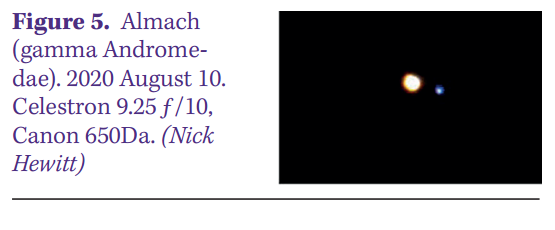
While in Andromeda, rest one’s eyes for a while after straining for galaxies and enjoy an easy double star – one of the loveliest, perhaps second only to Albireo (beta Cygni). Gamma Andromedae (Almach; Figure 5) is a magnitude 2.2 K-type star with a 5th-magnitude blue-green companion 10 arcsec distant. It is thus a much closer pairing than Albireo but still easily split with a small telescope. The B-type companion is itself a close double, but too tight for amateurs to resolve, with a separation of 0.5 arcsec at best.
This autumn has three well-known red giant variables reaching maximum and therefore becoming accessible to small telescopes or even binoculars. The first of these is chi Cygni, still well placed in the neck of the Swan. This Mira-type red asymptotic giant branch star should peak in October at around magnitude 5.2, although it can be brighter. Chi Cygni is a huge star, climbing up the asymptotic giant branch of the Hertzsprung–Russell diagram towards its final evolutionary phase. It has several claims to fame. It was the second long-period variable to be discovered, after Mira, by Gottfried Kirch in 1686, so it has been very well observed for over three centuries. It has an unusually large amplitude, ranging from a high maximum of magnitude 3.5 to a deep minimum of magnitude 14 over a period of around 400 days. At maximum, it is notably ruddy in a rich field.
W Andromedae is also a Mira star, found at the feet of the bound maiden as she awaits rescue by the approaching hero Perseus. The star lies a little northwest of the fine open cluster NGC 956 and northeast of the edge-on spiral galaxy NGC 891. It is a binocular target when at maximum, around magnitude 7.4, but fades to 13th magnitude at minimum. Its period is approximately 397 days.
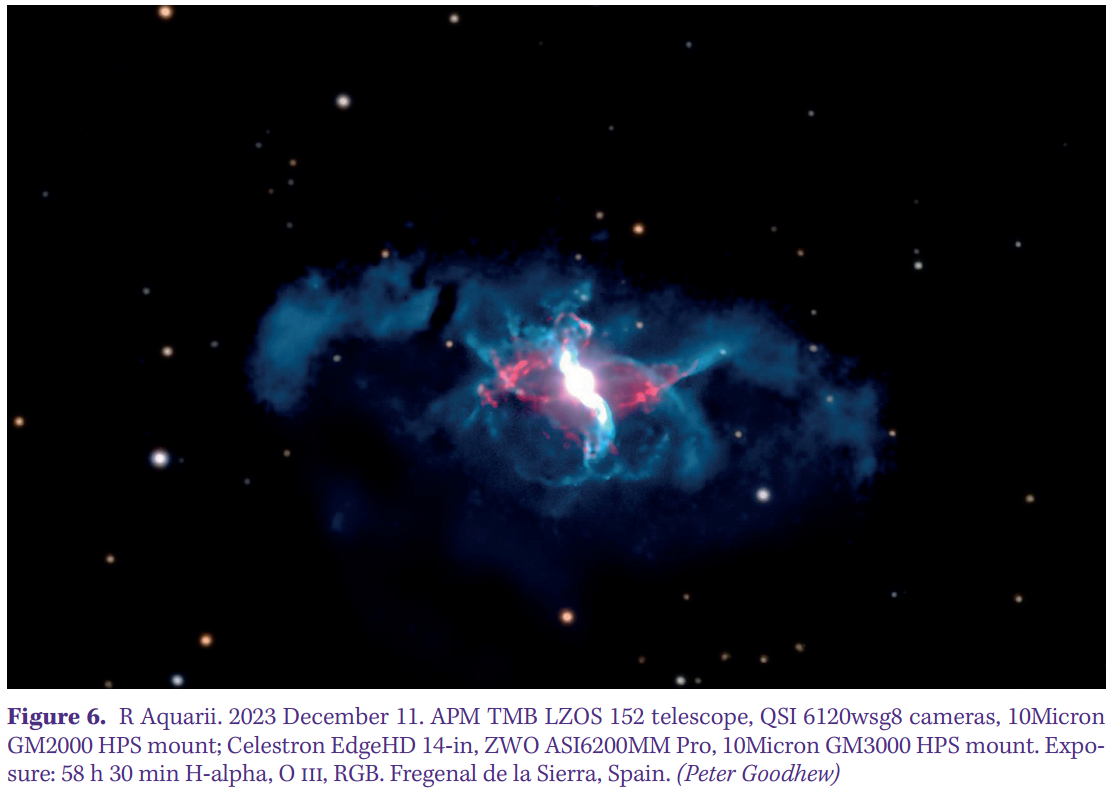
The third red giant peaking in brightness this autumn is R Aquarii (Figure 6), a symbiotic star with a white dwarf companion in a 40-year orbit. Its magnitude range can be from 5.2 to 12.4 over 390 days, but a range of 6.5 to 10.3 is more typical. The white dwarf pulls material from the tenuous outer envelope of the giant primary’s faint nebulous outflow and ejects some into the local environment as a faint nebula.
The solar system
The Sun steadily loses altitude as the winter solstice approaches on December 21, but still promises to remain active, and the seeing can be steadier in the autumn.
Planets
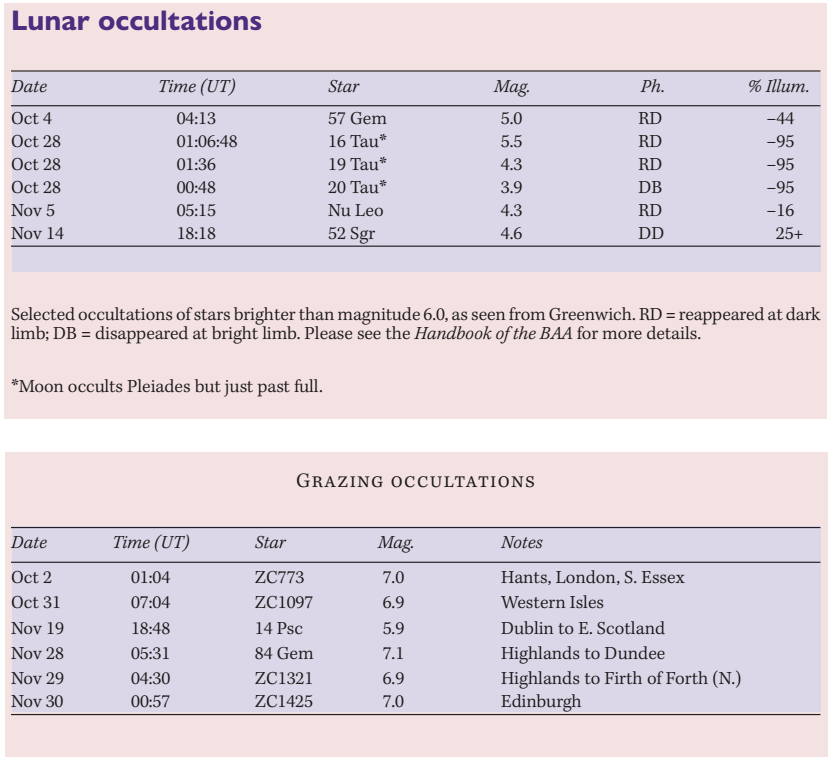
Mercury is at greatest eastern elongation on October 12, but it is poorly placed in Libra. A two-day-old crescent Moon lies below it and to its right on this day, but both will need a very good horizon. By early November, it is at inferior conjunction, then pulls out for a reasonable predawn showing at western elongation on November 21. It will be to the lower left of Venus and Spica.
Venus reaches inferior conjunction on October 24, passing south of the Sun, but rapidly pulls away, becoming a dazzling spectacle in the morning sky thereafter, achieving magnitude −4.7. Passing through Virgo in November, it will become lower as the months pass, slowly manoeuvring into the less favourable section of the ecliptic.
Mars is in Cancer in October, moving and slowly improving as it reaches Leo in November, brightening from magnitude +0.9 to +0.5 and swelling from 5.8 to 8 arcsec.
Jupiter is in Leo, so still a morning object. It has a close encounter with Mars on November 15, when they are 1.5 degrees apart.
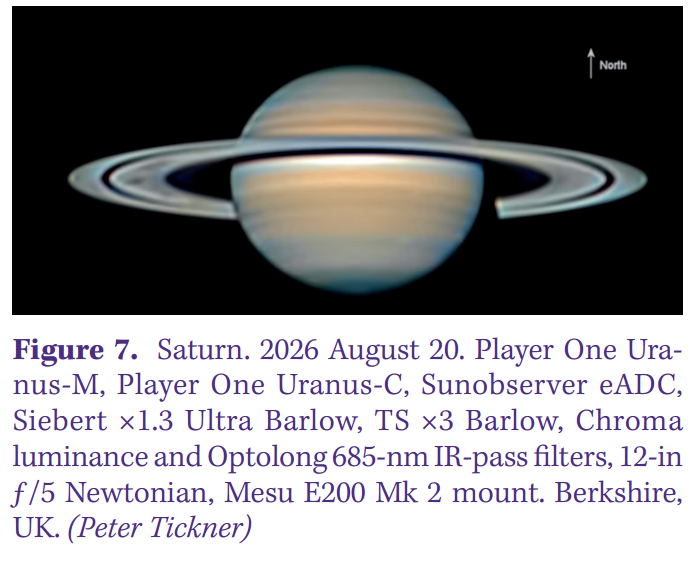
Saturn (Figure 7) is the best-placed planet for evening scrutiny, with opposition on October 4 when at magnitude +0.3 in Cetus. The southern hemisphere is still on show, but the rings are slowly widening. November evenings should hold even greater promise for mid-evening views as the planet, although dimming to magnitude +0.6, is over 35 degrees above the horizon, its best altitude for many years.
Uranus lies between the two famous open clusters in Taurus, the Hyades and the Pleiades, and reaches opposition on November 25.
Neptune is well placed in Pisces, some 10 degrees west of Saturn.
Two dwarf planets are at opposition this autumn: (2) Pallas on October 4 at magnitude 8 and (4) Vesta on October 13 at magnitude 6. Both can be found in Cetus by using big binoculars.
The dwarf planet Eris reaches opposition on October 18, also lying in Cetus. Discovered as recently as 2005, it is smaller but denser than Pluto and remains the second largest dwarf planet. This trans-Neptunian object may be imaged at magnitude 18.7 with larger telescopes and modern imaging equipment, as it has a highly reflective surface of methane and nitrogen ices. At opposition it will be found at 01h 48m, −0° 06′. See tinyurl.com/3hc46mxk.
Meteors
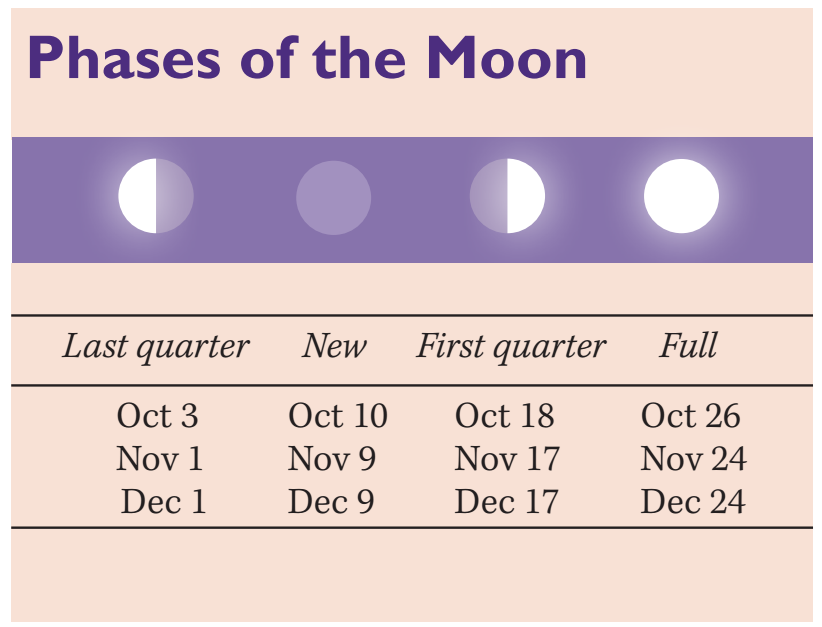
October and November are very favourable for this year’s autumnal showers. The Camelopardalids are at their best on October 6, and the Orionids will not be too compromised by the waxing Moon when they peak on the night of October 21–22, as it sets soon after midnight. These speedy meteors derive from comet 1P/Halley.
The Southern Taurids peak on November 5, and the Moon is absent for most of the night. The Northern Taurids also escape interference a week later, when the Moon is a thin crescent in the early evening. The showers derive from comet 2P/Encke and may be seen as slow but bright meteors at any time from late September until early December.
It is now 27 years since the famous Leonid storm of 1999 November, and it will be some years before another. This year’s shower peaks on the night of November 17–18, and the Moon should be well set, so any meteors that do occur should be readily visible. The shower is derived from comet 55P/Tempel–Tuttle.
Comets
No bright comets are anticipated during these months, but 161P/Hartley–IRAS may be glimpsed at magnitude 10 in Aquila and Sagitta, and 2P/Encke is well placed as it traverses Pisces via Pegasus and into Aquarius between October and 2027 January. It has the shortest known cometary orbital period, 3.3 years, and reaches perihelion on 2027 February 10. It should brighten during the autumn but at this time it will still be around 13th magnitude.
| The British Astronomical Association supports amateur astronomers around the UK and the rest of the world. Find out more about the BAA or join us. |