Observation by Simon Kidd: New moon discovered orbiting Asteroid
Uploaded by
Simon Kidd
Observer
Simon Kidd
Observed
2025 Dec 03 - 00:24
Uploaded
2026 May 13 - 09:23
Objects
50142 2000 AY129
Lightcurve
Equipment
- Celestron C14, 0.6 reducer, ZWO ASI432 camera
Exposure
0.044s, (SER 23fps)
Location
Hertfordshire, UK
Target name
Asteroid (50142) 2000 AY129
Title
New moon discovered orbiting Asteroid
About this image
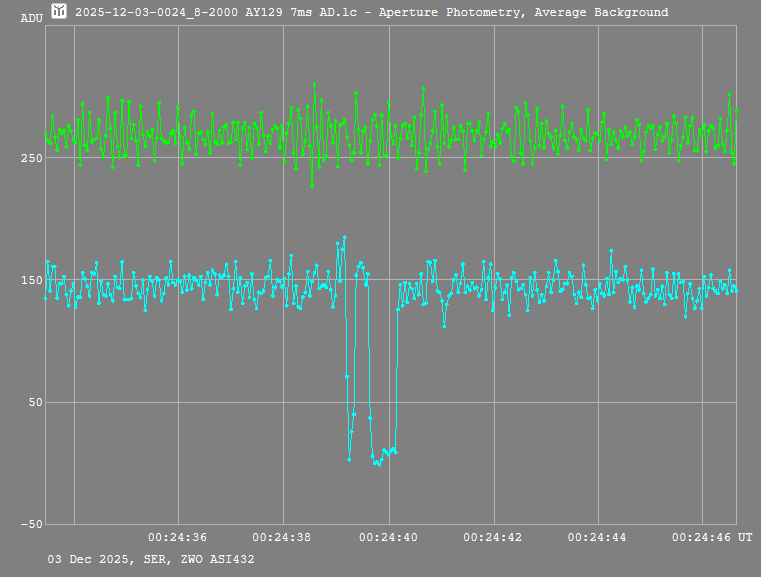
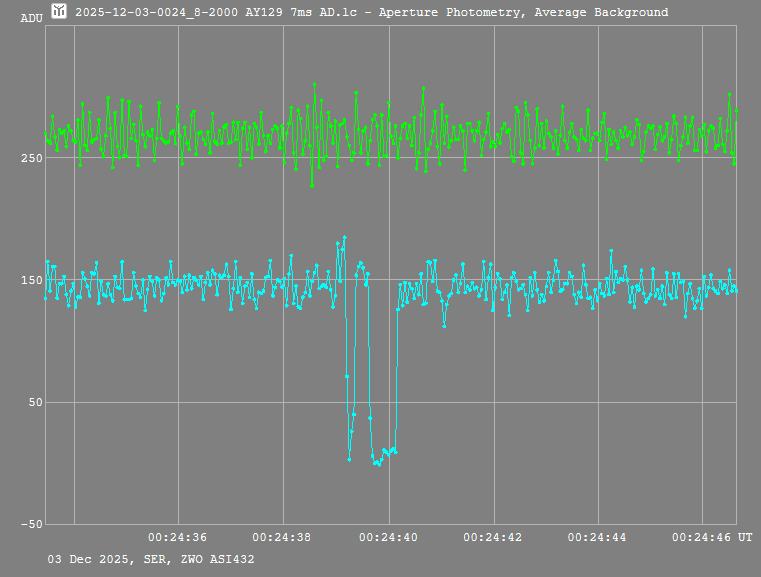
Discovery plot of the light from star UCAC4 541-014802, being occulted by asteroid (50142) 2000 AY129, 03/12/25 at 0024:42
The green trace represents a nearby reference star. Conditions were good.
The double dip ultimately confirmed the presence of a previously unknown moon orbiting the asteroid.
Here is the link to the discovery 'Telegram' issued by CBET at Harvard. This contains a description of the analysis.
http://www.cbat.eps.harvard.edu/iau/cbet/005600/CBET005656.txt
This is the 19th (I think) asteroid satellite to be discovered by occultation, and may be the first from UK soil.
Thanks to the BAA team (T. Haymes, A. Pratt) also C.Weber, D.Gault and D.Herald (IOTA)
Files associated with this observation
Like this image
Robin Leadbeater,
Andy Wilson,
Mark Fairfax,
Dominic Ford,
Steve Knight,
Grant Privett,
Graham Winstanley,
Ian Jarrett,
Alex Pratt,
Mike Harlow,
Peter Tickner
Comments
Remarkable ! Given the constraints on the orientation of the system for companions to be seen and the number of discoveries, does that give a clue to what percentage of asteroids are likely to be binary ?
I believe it helps. As you say, orientation is critical; also the 'shadow-width' on earth for detecting both components may only be a kilometer or so wide (as in this case). So it might imply they are reasonably common, as we would 'miss' seeing many of them. However, occultations may introduce a bias across geometries/sizes...so best used as just part of the evidence.
One estimate for main-belt objects having moons is a few percent. For small NEOs the figure is higher (15%?)
Despite observing over 250 positive occultations, I thought my chances were still vanishingly small that I'd ever detect a 'double'. I certainly dont expect to observe another! But you never know...
Copyright of all images and other observations submitted to the BAA remains with the owner of the work.
Reproduction of work by third parties is expressly forbidden without the consent of the copyright
holder. By submitting images to this online gallery, you grant the BAA permission to reproduce them in
any
of our publications.