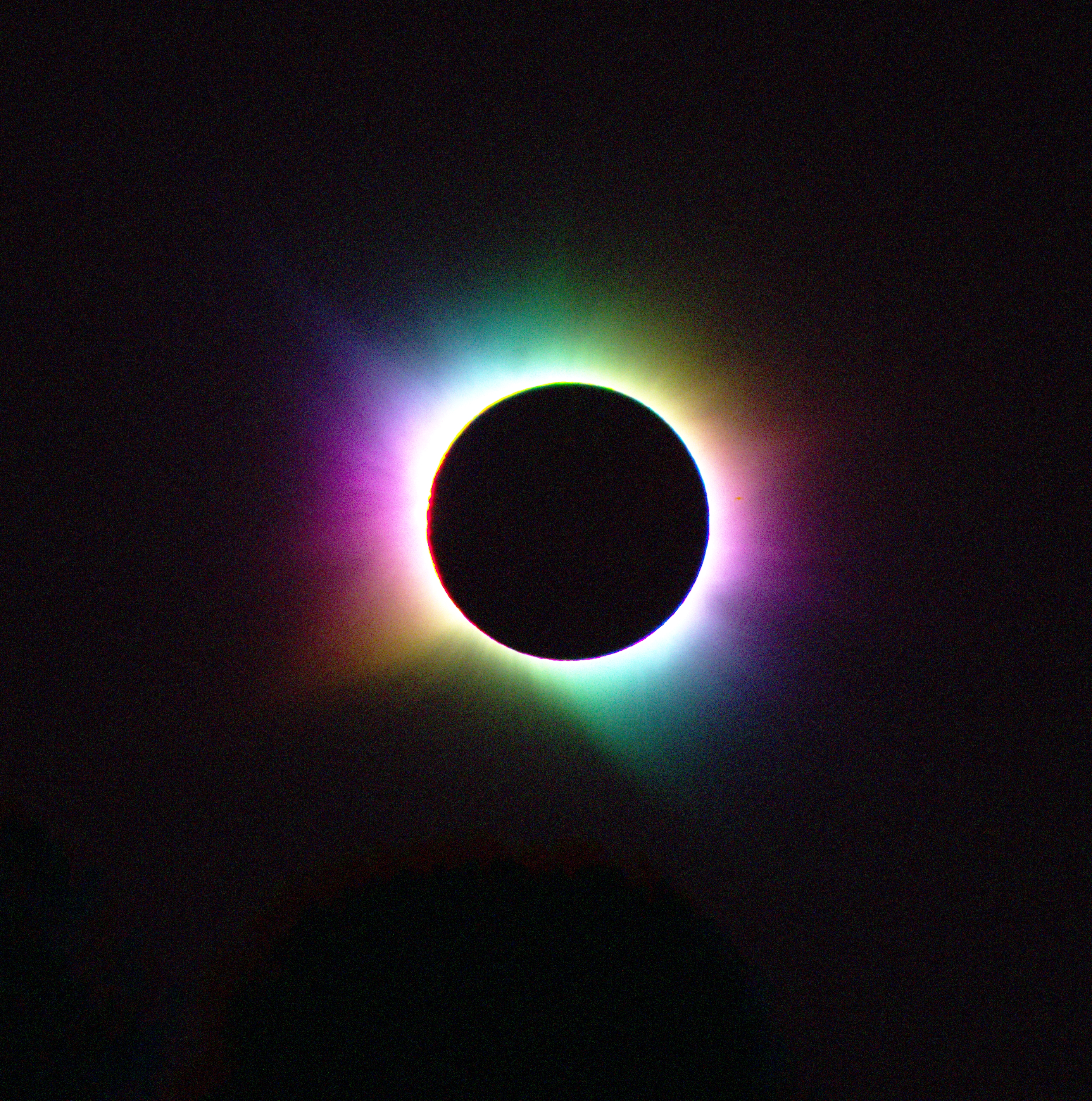
Observation by Grant Privett: Corona in Polarised Light

Uploaded by

Grant Privett

Observer

Grant Privett

Observed

2026 Aug 12 - 18:31

Uploaded

2026 Aug 17 - 21:02

Objects

The Sun
Eclipse

Equipment
  • Canon M5 with Canon FD 100-300mm zoom
  • Linear polarising filter
  • Tripod+Gaffer tape
Exposure

All images 1/80th ISO1600

Location

Lebrancon, Spain

Target name

The Sun Eclipsed

Title

Corona in Polarised Light
About this image

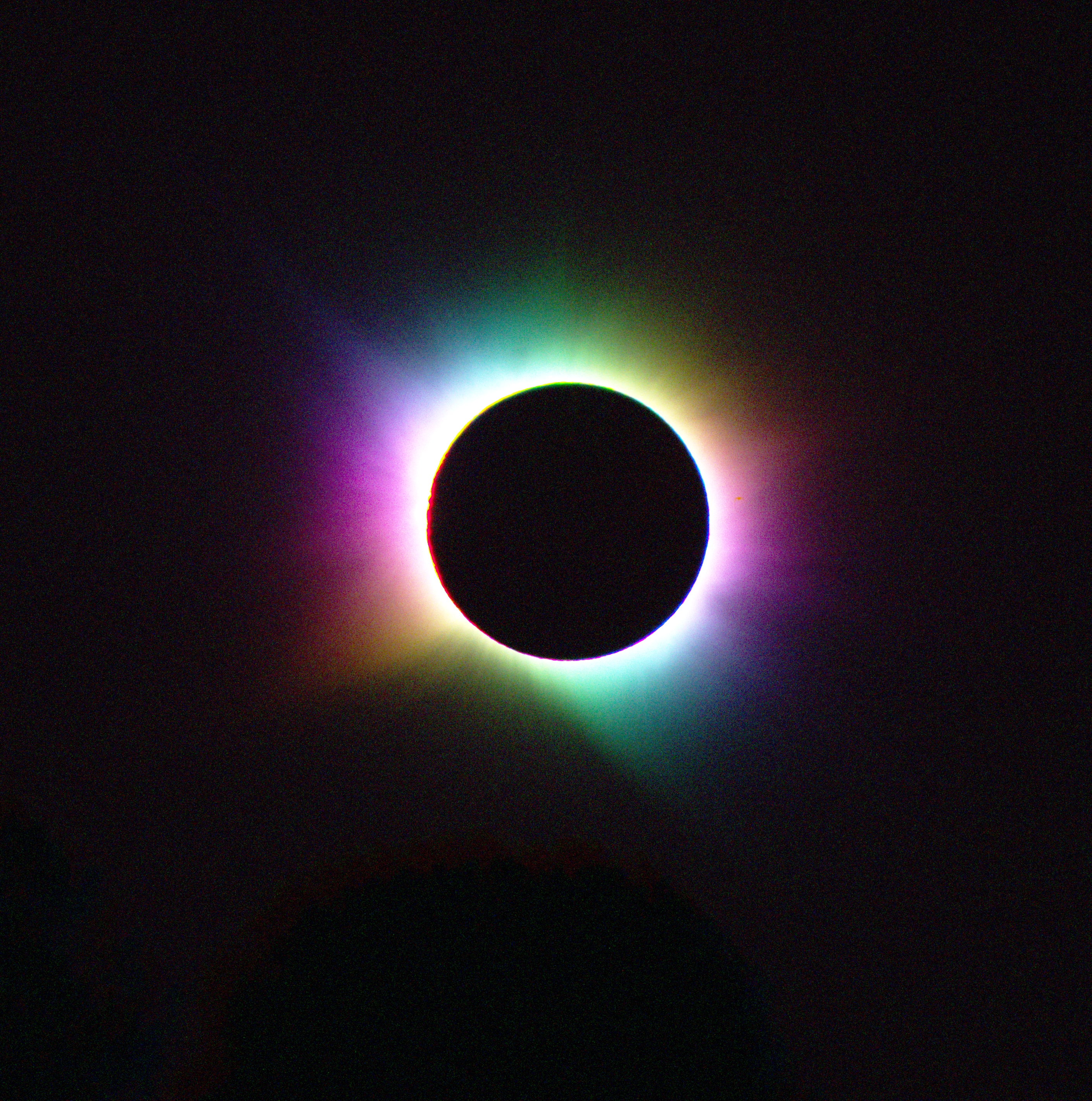
This image is how a squid, shrimp or some types of fish might have perceived the eclipse from Spain as they don't detect colour but do see polarisation. However,  it must be said that Spain in a heatwave was perhaps a little dry for them.

Okay, this takes a little explaining...

If you image the Sun's corona through a linear polarising filter it looks different in extent and intensity compared to an unfiltered normal image. The differences vary as the angle of the polariser relative to the polar axis of the Sun is varied. 

I believe this occurs because the presence of an intense magnetic field can polarise light. Plasmas also generate circularly polarised light, but thats another story...

So, I took pictures of the Sun at a variety of different linear polariser angles and converted each into a luminance image. I then assigned one each as R, G, B images and combined them in AstroArt just like people do with H-alpha, S-II and O-III images in deep sky observing. Just to add to the fun I created a master luminance frames from my 20 or so non-blurred images and created a crude LRGB image - its not easy as the Moon is moving across the Sun and its corona.

The result gives an idea of both the extent of the corona and also the direction of the the magnetic field within it.

Ideally, I should have taken 4 images at 0, 45, 90, 135 degrees orientations and done a full calculation of the Stokes parameters and gained estimates of stuff like DoLP and polarisation angle*, but - as I found in 2017** - it was too dark to tell how the filter was orientated, so I just settled for a bunch of different angles and looked for images that appeared very different when I selected the R, G, B components.

And what you see is the result... Its not as clean as my result from 2017 but the corona was dimmer and the dust, atmosphere and smoke will have diminished the signal. I may process the data like I did in 2017, but that would mean converting code from IDL to Python and I'm a bit busy currently.


* See Fundamentals of Polarimetric Remote Sensing by Richard Schott, SPIE Press or Wiki

** https://britastro.org/observations/observation.php?id=20170821_212900_2719fa19455c8db4

Files associated with this observation
Like this image
Comments
Nick James
Nick James, 2026 Aug 18 - 06:51 UTC

That's great. The main cause of the polarization is Thompson scattering of sunlight off free electrons in the K-corona. The predominant linear polarization from this cause is tangential to the limb. I've done the same thing the easy way using a camera sensitive to polarized light. I need to find some time to pull the images off my laptop and process them but it will be interesting to compare with yours when I'm done.

Grant Privett
Grant Privett, 2026 Aug 18 - 07:10 UTC

Ah, that was it. I forgot the details. Thank you. Will be interested to see what your camera gives you. I saw some results from a commercial Sony polarimetric imaging camera in about 2016, but that was only 10 bit.

Your images should be rather better than mine. The offsets in mine probably arise because I had to align the images on the tip of a tiny prominence and some images were too blurry - also, its not a cooled sensor and I underexposed (dumb!).

You can play lots of games with the DoLP and angle of polarisation when processing those in slow time! You've 350 days until the next.

Copyright of all images and other observations submitted to the BAA remains with the owner of the work. Reproduction of work by third parties is expressly forbidden without the consent of the copyright holder. By submitting images to this online gallery, you grant the BAA permission to reproduce them in any of our publications.