Last year I gave a presentation at the Solar Eclipse Conference in Leuven, Belgium on my plans to use a Sony polarization sensitive camera to do polarimetry on the solar corona during this year's eclipse. I'm pleased to say that the preliminary results look encouraging.
Light from the solar corona is strongly polarized due to Thomson scattering from free electrons. This leads to a dominant linear polarization which is tangential to the Sun's limb, i.e. horizontal polarization above and below the disc and vertical polarization either side. Sony produce a range of sensors which have 0, 45, 90 and 135 degree micro-polarizers in front of each pixel in groups of four. This is similar to a colour camera with the RGGB filters replaced by the polarizers. This allows real-time imaging with sensitivity to polarization. By processing these pixels it is possible to determine the dominant polarization angle (from 0 to 180 degrees) and the degree of polarization (from 0 for no polarization to 1 for fully polarized). These parameters are called AOLP (Angle of Linear Polarization) and Degree of Linear Polarization (DOLP).
The camera that I used is a Lucid PHX050S1-PC which is a very small GigE camera which uses a Sony IMX264MZR sensor. This sensor has 3.45um pixels in a 2448x2048 array with a global shutter. For optics I used a RedCat 51 (51mm, f/4.9) which has a focal length of 250mm. All of this was driven using an AM-3 mount. The system gives a resolution of 2.84”/pixel and a field of view of 1.93x1.61 degrees.
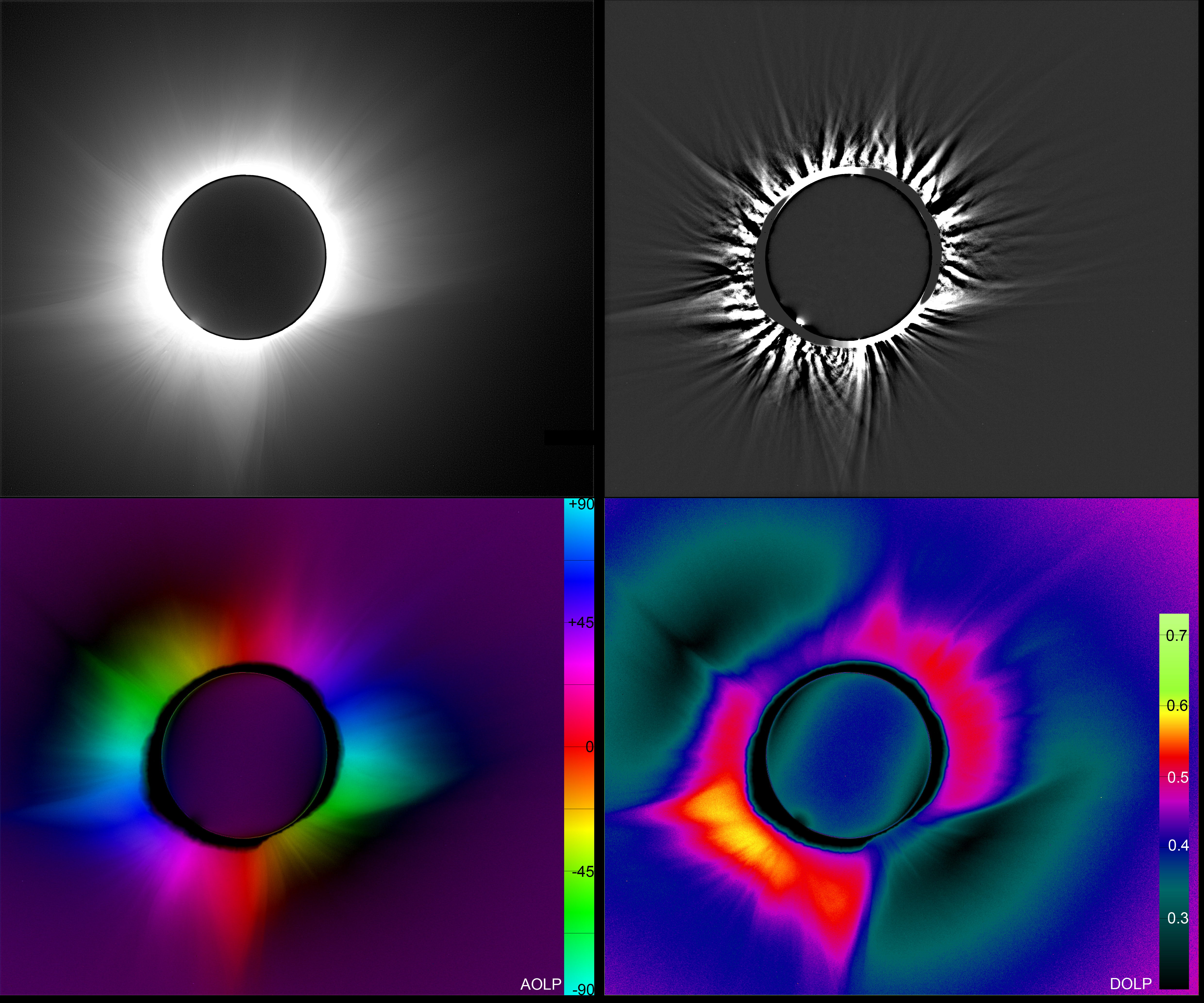
The panels in the image show the luminance frame (technically the Stokes S0 data) upper left. This has been wavelet processed to bring out some fine detail in the corona. I had to guess the exposure to use beforehand and I used 50ms, 0dB gain. This was a bit too much and the inner corona is saturated. The basic data is a stack of 100 frames at 5fps, so 20s duration. The upper right hand panel is the median subtracted version of the luminance frame.
The lower two panels are the AOLP and DOLP respectively. As expected the AOLP shows that the dominant polarization is tangential to the limb. The DOLP shows that the maximum coronal polarization is around 0.6. This is highly polarized. The Moon does show some polarization in in the maria but the DOLP is only 0.25 or so. I think the corona is therefore the brightest astronomical source with a significant DOLP.
I'm really pleased how this has turned out and I have a lot more analysis to do on the images but that will have to wait a while.