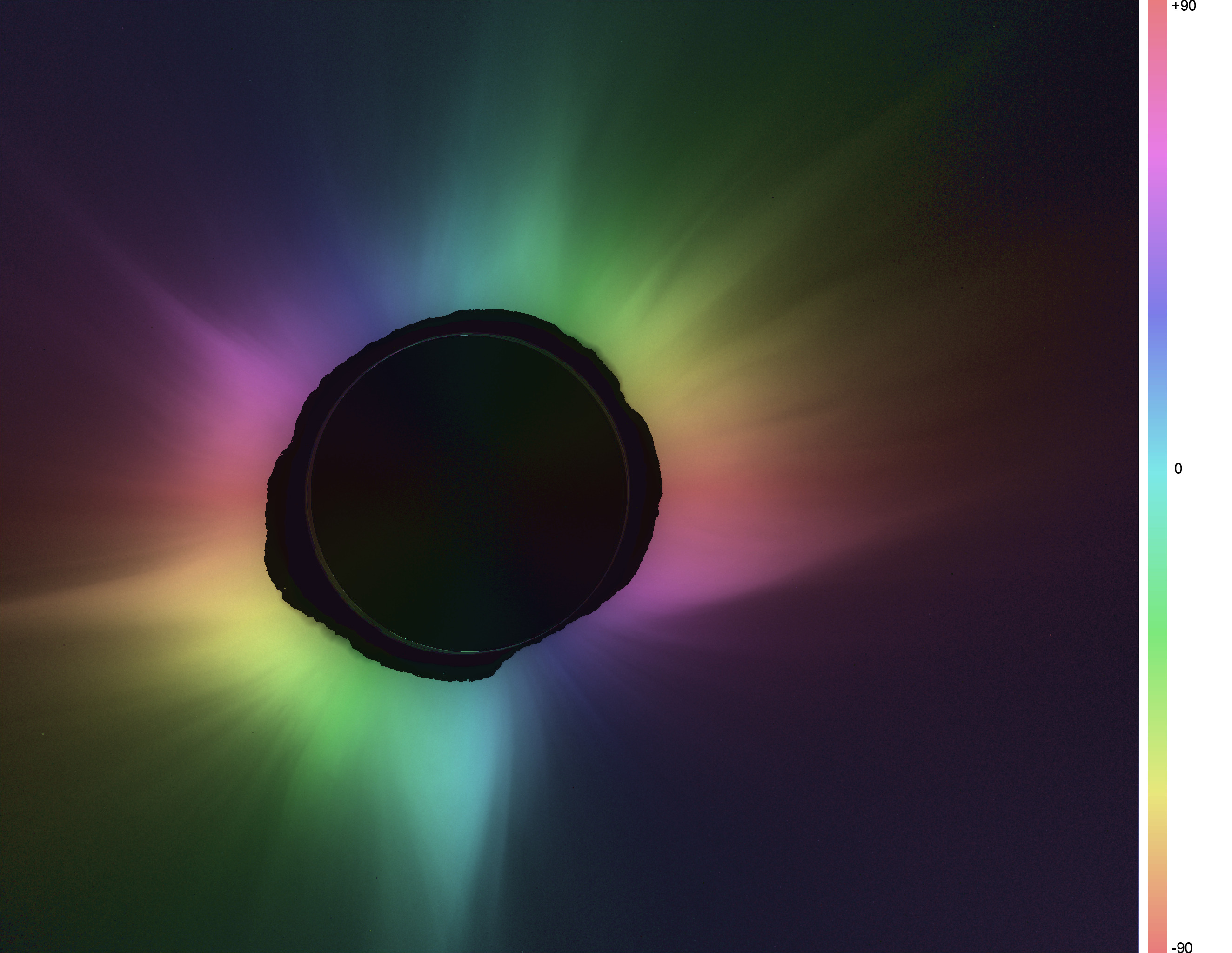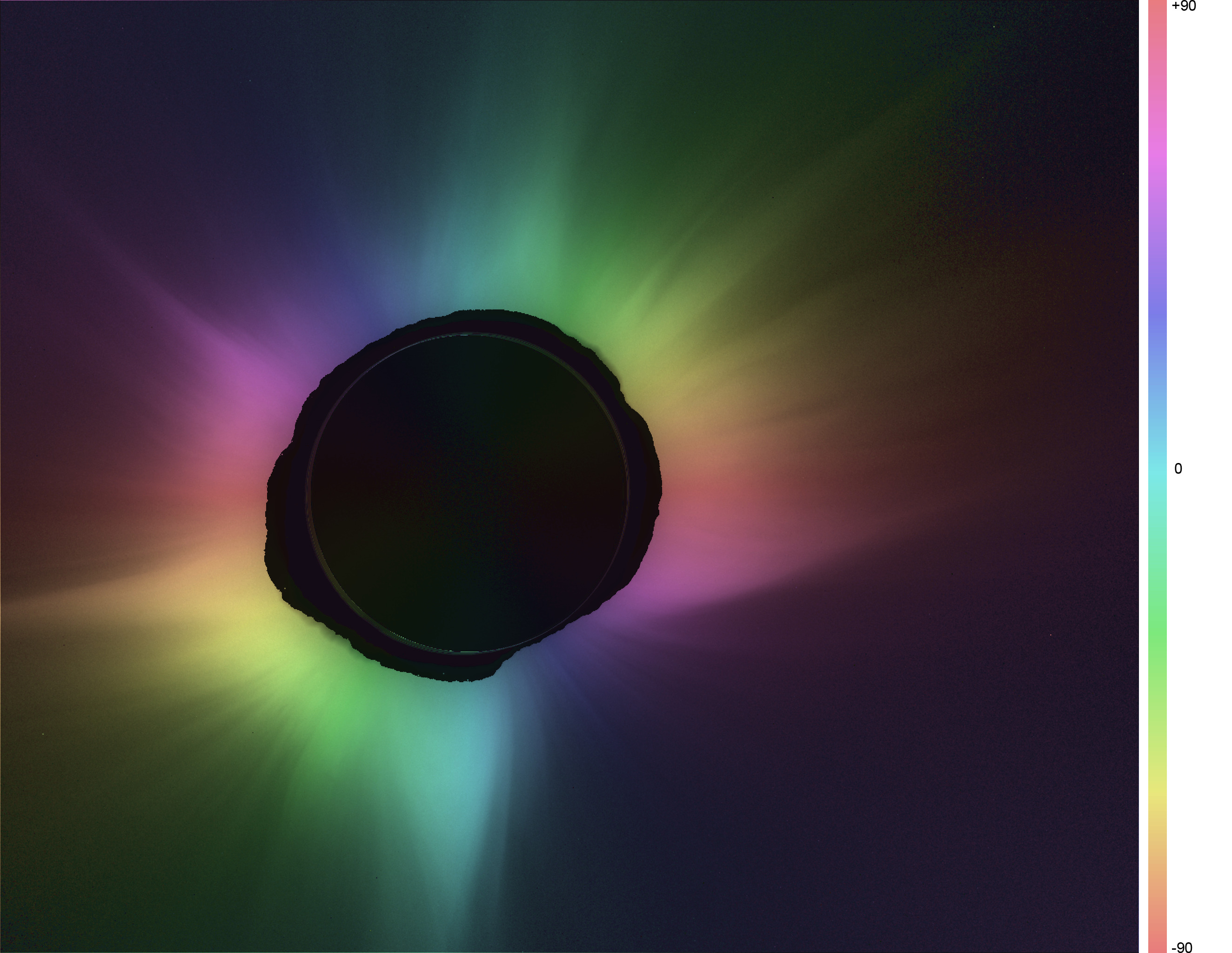
This image shows the K-corona during the total eclipse of 2026 August 12. Most of the light from the K-corona is due to Thomson scattering of photospheric photons off free electrons. This leads to the corona being strongly polarized in an orientation which is tangential to the solar limb. This means that the corona is much brighter when the polarizer is aligned tangential to the limb compared with the radial alignment.
I used a camera which is sensitive to the polarization of light. This camera allows software to synthesise a polarizer with arbitrary orientation for every pixel in the image. The colours in this visualisation represent the Angle of Linear Polarization (AOLP) from -90 degrees (vertical, red) through 0 degrees (horizontal, light blue) and then to +90 degrees (vertical, red). This shows clearly that the dominant orientation of of the polarization vector is parallel to the sun's limb.
The ratio of the intensity detected using a polarizer that is tangential to the limb compared to the intensity using a polarizer that is radial to the limb provides the luminance element of this image. Since the light is strongly polarized this ratio approaches two in the bright region around 8-9 o'clock on this image. Further out the corona fades into the sky and the ratio approaches unity.
The irregular black area around the Sun's disc is a region where the camera pixels were saturated.
Camera: Lucid PHX050S1-PC. This camera uses a Sony IMX264MZR sensor which has 3.45um pixels in a 2448x2048 array with a global shutter. The camera was running at 5 fps during totality.
Optics: RedCat 51 (51mm, f/4.9) which has a focal length of 250mm. The optics and sensor have an overall resolution of 2.84â€/pixel and a field of view of 1.93x1.61 degrees.
Mount: AM-3
Stack of 470 x 50ms exposures spanning 94s from 18:28:56 - 18:30:29 UTC.
Location: La Revilla, Spain. Observer: Nick James.