
2026 September 3
Deep Sky Update – September 2026
I hope you had a good solar eclipse on August 12th. I organised an event for our islanders, and although the sky was by no means clear, we did manage to see some of the eclipse through gaps in the clouds. Likewise the Perseids were similarly obscured, though the meteor-cam picked up a few. And the weather was also poor for the lunar eclipse. So not the best observing month, but at least the nights are darker now, and fingers crossed may get a couple of clear nights in September.
I suppose the big news of August was the announcement of the Seestar S50 Pro – an upgraded version of the S50. There seems to be a lot of controversy and debate about the sensor in the new model, and although there seem to be a few early release versions in the hands of ‘influencers’ I expect when it starts shipping to real customers we’ll find out a lot more as it is put through its paces.
I am just starting my volunteer week at the Orkney International Science Festival, so I’m not sure I will get much of a chance for observing, though I do have my Seestar with me, so you never know.
Double Stars for September – Peter Morris
I now move over the constellation of Cygnus, which is actually better seen in early autumn than the summer. Mu1 Cygni (STF 2822) forms the outermost tip of the south-eastern wing. This is a binary with a period of 692 years which is gradually narrowing and currently has a separation of 1.4 arcseconds; the position angle is 328.7°. The magnitude of the primary is 4.8 and the secondary is 6.2. They are both main sequence F-type stars and are both seen as yellow. There is a very wide and bright companion (D), with a magnitude of 6.9 and a separation of 197 arcseconds; the position angle is 43°. It is an optical double and is also a main sequence F-type star, but I see it as white.
Another relatively bright double is 16 Cygni (STFA 46) on the north-western wing, close to the Blinking Planetary Nebula (NGC 6826). The two stars are magnitude 6.0 and 6.2 and the separation is 39.8 arcseconds; the position angle is 132.9°. It is a binary star and the orbital period is 13,513 years. They are both main sequence G-type stars (like our Sun). I see them as white, but they have been described as being goldish-white. There is a third member of the binary system (PAT 48 C) with a separation of 18.2 arcseconds from B and a position angle of 70°, but it is very faint (mag. 11.9).
STF 2486 is fairly close to 16 Cygni. It is a binary with a period of 3,100 years and is slowly narrowing. The current separation is 7.0 arcseconds and a position angle of 202°. The magnitudes of the two stars are 6.5 and 6.7 and they are both G-type stars (so again like our Sun). I see them both as yellow-white.
Moving down the neck of the Swan to the neighbourhood of Eta Cygni, we reach STF 2578. This is an optical double with stars of magnitude 6.4 and 7.0. The separation is 14.9 arcseconds and the position angle is 123.8°. The main star is a B9.5-type main sequence star and the companion is an A0-type, so effectively the same in spectral terms. I see them as white and purple, but Sissy Haas records them as being pale lemon and greenish-white. It is curious we both see a difference in the colours of the two stars which are practically the same and different colours at that, but that is double stars for you .
We now travel to the rear of Cygnus, almost to the border with Cepheus, and arrive at STF 2687. The stars are magnitude 6.4 and 8.3, with a separation of 26.7 arcseconds; the position angle is 118°. In spectral terms, they are almost identical to STF 2578, being main sequence B9 and main sequence A2. This time, however, I see them as white and blue which is perhaps more in keeping with their spectral types, but Sissy Haas observed them as whitish banana yellow and pale blue-green. The nature of this double is uncertain. The main star is 723 light years distant and the secondary is 733 light years away according to Gaia EDR3 and on the basis of their proper motions it seems unlikely that they are physically connected (PM-RA for A is 13.881 and 12.455 for B).
August Object of Interest
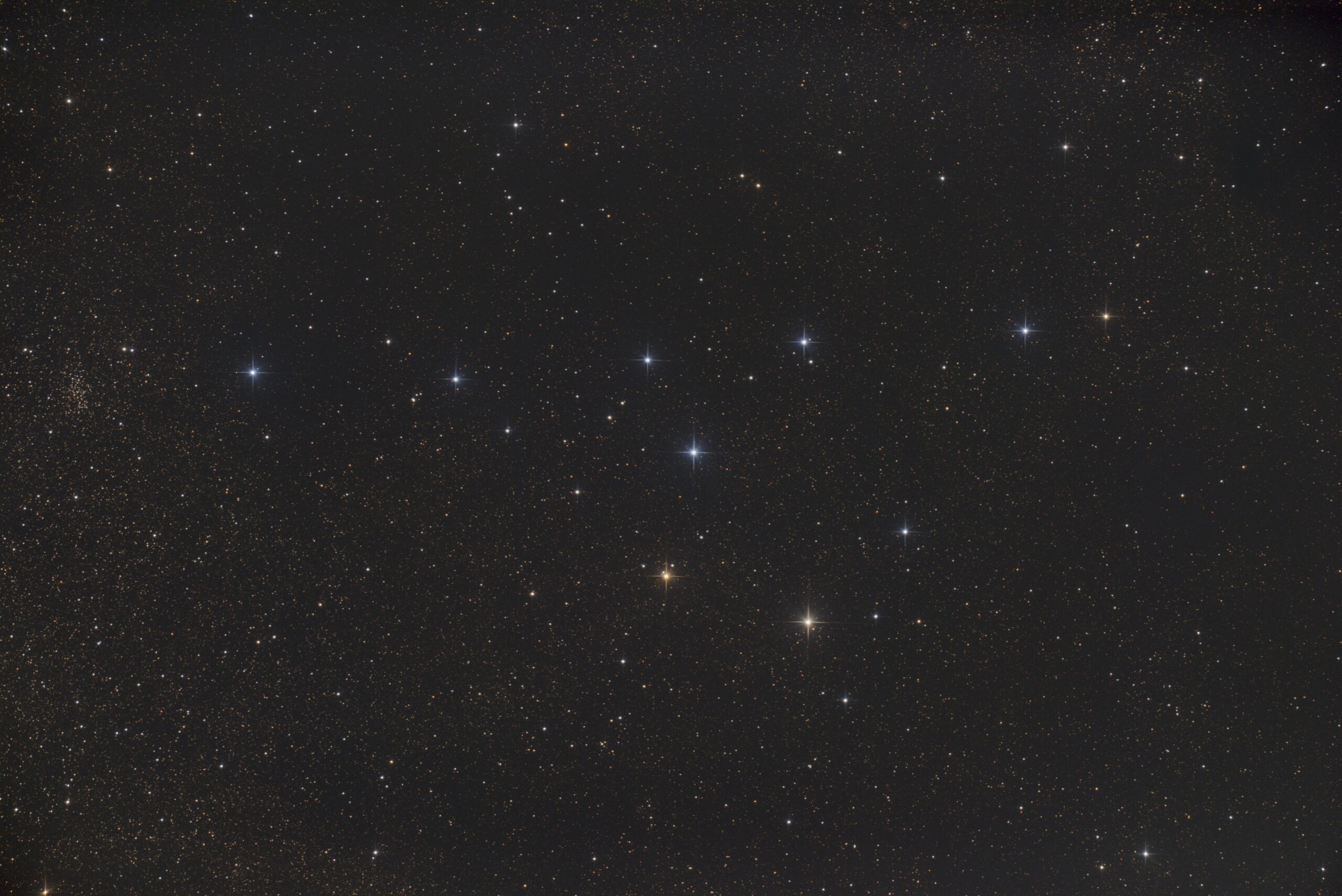
August’s target was the open cluster NGC 6802 in Vulpecula at one end of the Coathanger.
Many thanks to the many observers that reported; Peter Morris, Ivan Walton, Fred Stevenson, Iain Catrwright, John Yule, David Davies, Alan Thomas,
Here is a nice image showing NGC 6802 and the Coathanger by Iain Cartwright.
Object of Interest for September
For September the target is galaxy NGC 7469 in Pegasus which forms a pair with IC 5283, and together listed as Arp 298. NGC 7469 is an intermediate spiral galaxy, and a type I Seyfert galaxy. At 12th magnitude should not be too hard with a medium or large aperture telescope. For imagers who go deep, there is a wealth of background galaxies as well as the companion.
Deep Sky Picture of the Month
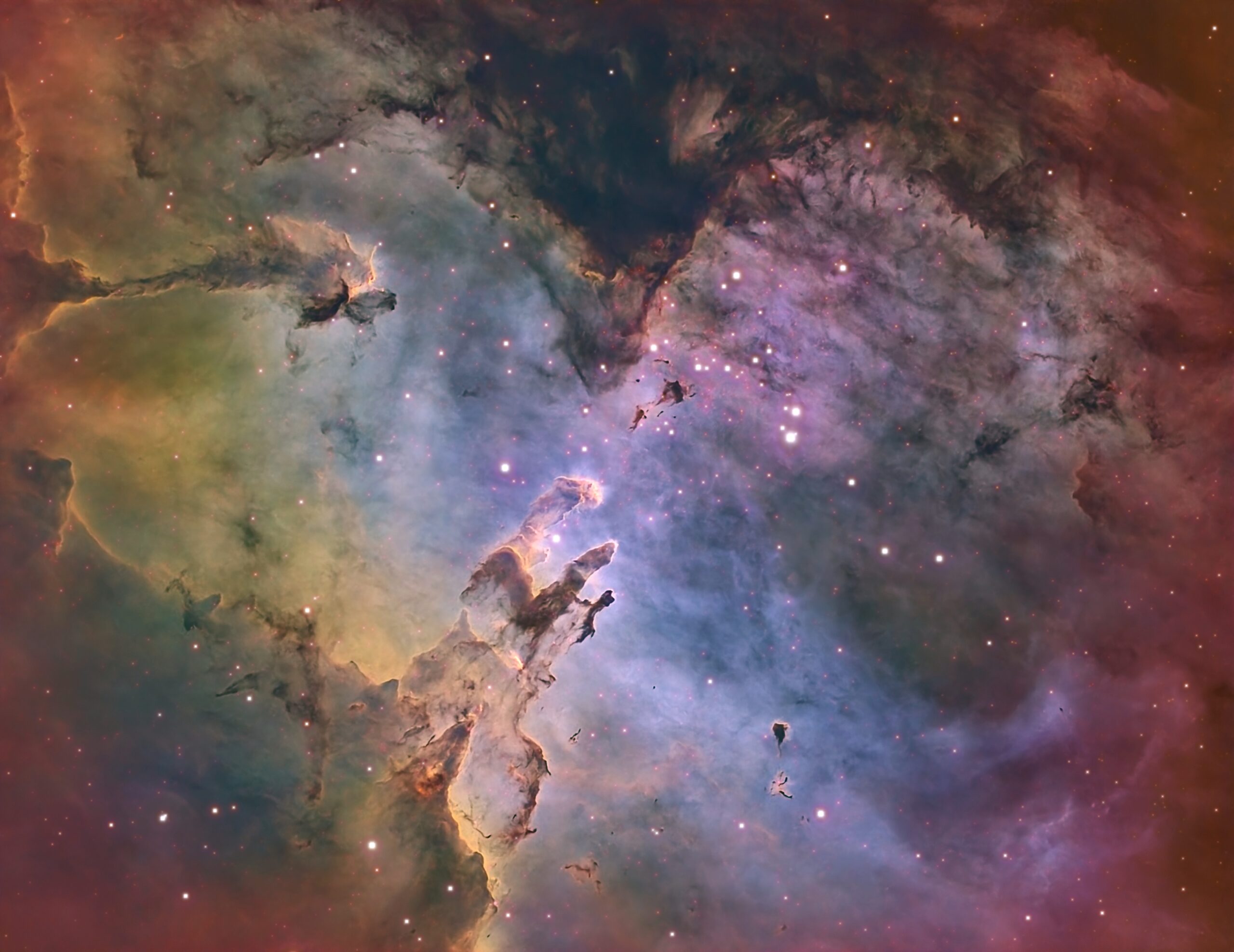
Lots of super pictures taken in August making a choice difficult, but I’ve plumped for this splendid image of The Eagle Nebula, M16, taken by Kevin Gurney in France.
And Finally
Not long now till the Autumnal Equinox when the hours of darkness become longer than those of the light. Always makes observing a little easier if you don’t want to stay up late into the night.
I’m hoping for some better observing weather in September, and maybe some displays of the northern lights.
Clear, dark skies,
Callum
| The British Astronomical Association supports amateur astronomers around the UK and the rest of the world. Find out more about the BAA or join us. |