
2026 November 16
Mars Opposition Blog 2026 November 16
Today Ls has reached 23o, almost a quarter of the way through northern spring (Ls= 0-90o). The north polar cap is starting to retreat, and one or more bright spots (representing areas subliming faster?) have sometimes been seen upon its southern parts in addition to the slightly darker annular rift denoting the edge of the dune field that later will surround the summer cap remnant. White clouds have been seen at the edge of the polar cap.
Evening orographic clouds are now observable over Ascraeus, Pavonis and Arsia Mons, and upon Alba Patera in the north. Clyde Foster took a nice image of the Alba cloud in early afternoon on November 7. It is good if observers are able to get a short series of daily images with not too many gaps. Here is a nice example from Foster, in which his November 7 image is included. These clouds are most conspicuous in blue or green light images; a green light image has been added to this collage.
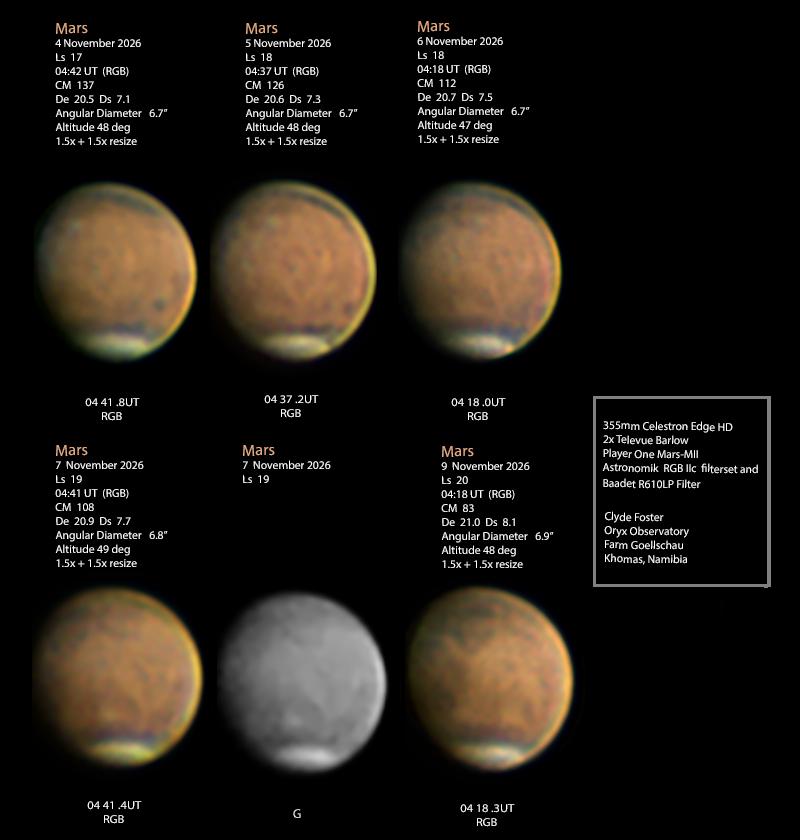
Equatorial cloud in general has increased. Frank Melillo has sent images that show the Syrtis Major fainter and bluer towards the evening limb, when it was almost invisible in the blue images, and white evening cloud was noticed in Libya/Isidis Regio as well as across part of Mare Tyrrhenum. (If we were closer to opposition, good blue-violet images would surely better show the equatorial cloud belt extended along the equator, although it does not become complete till around Ls = 45o. As it is we have to contend at present with a disk diameter of just over 7 arcseconds!)
A bright spot in NW Hellas has been seen from mid-October, as well as a bright area at Argyre. These seem to be frost deposits. The Hellas basin as a whole does not brighten up due to more widespread frost deposition till much later in the martian year, although diurnal cloud may be seen at other times.
Nice images of the Solis Lacus region have been taken, and these show the continuing presence of Phasis and Gallinaria Silva to the west. See for example Foster’s November 9 image.
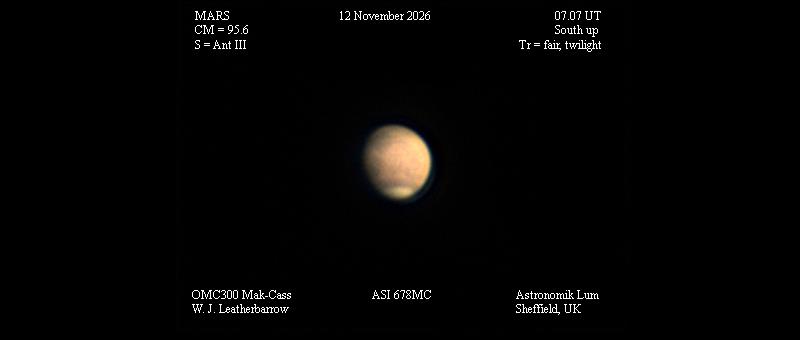
Observers are doing a very good job in keeping the planet under observation. Every day in October was covered by at least one observation, and only two days were missed in each of September and August. A revised (and ever-growing) list of 40 contributors appears on the front page. We welcome back as observers both Sussenbachs, father and son, and also Bill Leatherbarrow, whose November 12 image is included here.
| The British Astronomical Association supports amateur astronomers around the UK and the rest of the world. Find out more about the BAA or join us. |