
2026 August 3
Perfect conditions for this year’s Perseid meteor shower
With Last Quarter occurring on 6th August and New Moon on the 12th, dark skies coincide with the peak of the Perseid meteor shower this year. Conditions are also good for several other lesser showers active at this time. These include the Alpha Capricornids, Southern Delta Aquarids, and the Kappa Cygnids, all of which may be observed without interference from moonlight.
One should also mention that the New Moon on August 12th causes an eclipse of the Sun late that afternoon/early evening; a very significant partial eclipse from Britain and Ireland (the best since March 2015) and a total eclipse from locations elsewhere in Europe such as Greenland, Iceland, Spain and the Balearic Islands.
The Perseid meteor shower is expected to peak this year between 01h and 04h UT (02h and 05h BST) on Thursday, August 13, excellent timing for observers in European longitudes. This means that for visual and video observers in the British Isles the early morning hours of August 13 before dawn will probably produce the highest rates. The shower peak is quite broad, however, so with virtually no interference by moonlight watches carried out on the three nights of August 11-12, 12-13 and 13-14 are all likely to yield good observed rates. Let’s hope the weather cooperates!
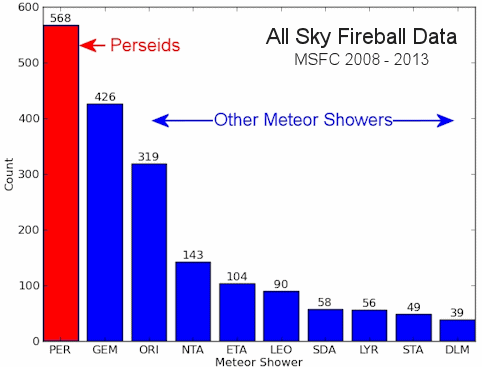
Dust grains from the Perseid shower hit Earth’s atmosphere at a speed of 58.6 km/sec – that’s about 131,000 mph! The Perseids are one of the most reliable meteor showers of the year, producing an abundance of fast, bright meteors, many with persistent trains – and there is a high percentage of fireballs. Indeed, a 6-year study by NASA’s Meteoroid Environment Office (reported on www.spaceweather.com) found that the Perseids produce more fireballs than any other annual shower:
When to observe
Perseid meteors are detected as early as late July and until about August 21. There is a noticeable ‘uptick’ in the shower’s activity around August 8-9. Steadily increasing observed rates can be expected in dark skies from this date until the peak on August 12-13. Under cloudless skies from a dark viewing site, observers can expect to see between 50 and 70 meteors an hour at the peak, but considerably fewer from light-polluted locations. It is hoped that, weather permitting, observers will cover shower activity even on nights away from the maximum of the shower.
Observed Perseid rates improve as the radiant altitude increases from 27° at 21h, to 43° at midnight and 66° by 03h. Although few in number, Perseids seen in the evening when the radiant is low will last longer and travel a much greater distance across the sky than those observed in the early morning hours. Some of these ‘earth-grazing’ Perseids can be spectacular if they happen to pass more or less overhead.
All else being equal, the best observed rates are found when the Perseid radiant is highest in the sky during the pre-dawn hours. Even from light-polluted towns or cities observed rates may still be around ten an hour near the peak in the early morning hours when the radiant is high.
European observers watching after midnight on August 12-13 (Wednesday-Thursday) should experience increasing activity towards dawn, as the shower radiant at RA 03h 11m, Dec. +58°, near the Double Cluster, on the Perseus-Cassiopeia border, climbs higher in the eastern sky. It doesn’t matter in which direction you look, because Perseids may be seen in any part of the sky. Near the radiant the trails will tend to be short, whereas on the other side of the sky the meteors will appear as streaks with long paths.
The popular Perseid meteor shower is associated with the stream of dusty debris strewn along the orbit of periodic comet 109P/Swift-Tuttle. The comet was independently discovered by Lewis Swift and Horace Tuttle in July 1862 and we now know that there are historical records of the comet in 69 BCE and 188 CE. It was also observed by Ignatius Kegler in July 1737. The comet’s nucleus is quite large, having a diameter of about 25km. The comet was last seen in 1992 and won’t be back again until 2126, but meteoroids from the comet can be seen every year as they burn up in the Earth’s atmosphere as Perseid meteors.
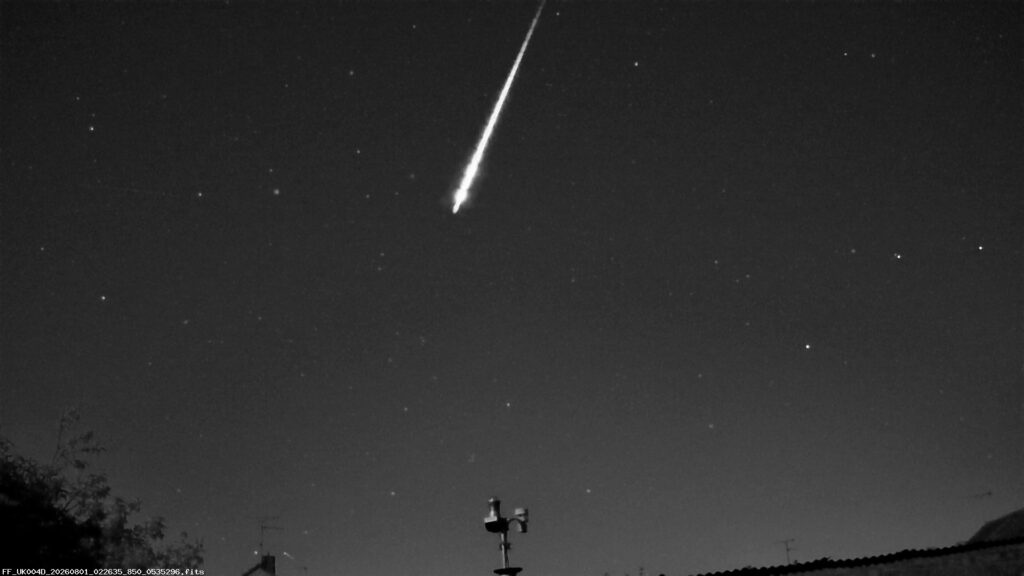
Enjoy the Perseids this year
Observations in recent years have revealed noticeable variations in Perseid activity from year to year and we shall just have to wait and see what is in store for us in 2026. Meteor observing can be carried out by individuals, or by groups of observers working together. The element of teamwork makes meteor observing particularly attractive to local astronomical societies and the Meteor Section of the British Astronomical Association (BAA) welcomes reports from such groups as well as individual observers. The BAA’s visual meteor report forms are available as downloads in both pdf and Excel formats.
Meteor observing should be viewed, first and foremost, as a source of enjoyment for the observer(s). Whatever the approach and specific techniques applied, meteor observing can still produce unexpected results, and the only way to make sure you don’t miss out is to go out and observe!
To get the best view you must try to find a dark viewing site, preferably with an unobstructed horizon, away from city lights – the darker the better. Then you must hope that the weather behaves! Clouds could completely spoil the show. Do wrap up warm because it can get quite chilly late on August nights.
By whatever means you observe the Perseids this year, please submit your results to the BAA Meteor Section via meteor@britastro.org. Good luck!
Dr John Mason
Director, BAA Meteor Section
email: docjohn@dircon.co.uk
2026 August 2
| The British Astronomical Association supports amateur astronomers around the UK and the rest of the world. Find out more about the BAA or join us. |