
2025 December 11
No interference from moonlight for the Geminids this year
The maximum of the 2025 Geminid meteor shower coincides with a 25-day old waning crescent Moon, so there will be zero interference by moonlight this year, which is very good news for observers. Active from December 4-17, with a slow rise to maximum activity and a steeper decline, the Geminids are now the richest of the regular annual meteor showers.
Under good observing conditions the shower produces plenty of bright meteors, with rates easily exceeding those of the August Perseids for a 24-hour interval centred on their maximum during the early morning hours of December 14 this year. The shower is certainly rewarding for any observers prepared to brave the early winter wind, cold and damp. The Geminid maximum is quite broad and respectable Geminid rates may be expected throughout the nights of December 12/13, 13/14 and 14/15.
This year, the time of Geminid maximum is very favourable for observers in Britain and Ireland with peak activity expected between 02h and 07h, in the pre-dawn hours of Sunday, December 14, when the Zenithal Hourly Rate (ZHR) may again reach 100 to 120 meteors per hour. The radiant of the Geminid shower (at RA 07h 34m, Dec +32.3o, just north of the first magnitude star Castor) rises early in the evening and reaches a respectable elevation above the horizon (> 40o) well before midnight, so observers who are unable to stay up late can still contribute very useful watches. However, the early morning hours of Sunday, 14th December are likely to yield the greatest Geminid activity for imaging and visual observers, when the radiant is high in the sky and rates are near their peak.
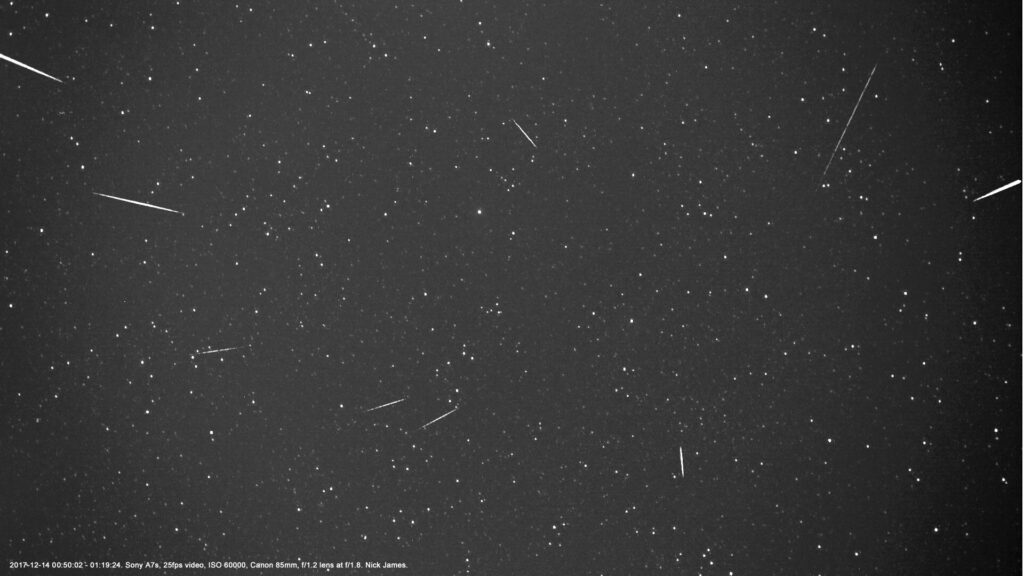
In recent years from Britain and Ireland, the Geminids have shown typical peak observed rates of 70-80 meteors per hour in good skies, but such rates may only be expected under the clearest, darkest skies away from town and city lights. Past observations have shown that bright Geminids become more numerous some hours after the rates have peaked, a consequence of particle-sorting in the meteoroid stream.
As with any meteor shower, when observing the Geminids it is best to look at an elevation of 50o (about the same altitude as the Pole Star from southern parts of the UK) and 40-50o to either side of shower radiant, rather than looking directly at the radiant itself, although Geminid meteors may appear in any part of the sky. December nights can be quite chilly, especially in the early morning hours when activity is likely to be highest, so wrap up well with plenty of layers of warm, dry clothing and make sure that you wear a hat, gloves, thick socks and sensible waterproof footwear.
Geminid meteors enter the atmosphere at a relatively slow 35 kilometres per second, and thanks to their robust (presumably more rocky than dusty) nature tend to last longer than most in luminous flight. Unlike swift Perseid or Orionid meteors, which last only a couple of tenths of a second, Geminids may be visible for a second or longer, sometimes appearing to fragment into a train of ‘blobs’. Their low speed and abundance of bright events makes the Geminids a prime target for imaging.
The Geminid shower has grown in intensity over the past 50 years as a result of the stream orbit being dragged gradually outwards across that of the Earth. A consequence is that we currently encounter the most densely-populated parts of the stream. This happy situation is unfortunately only temporary – in a few more decades, Geminid displays can be expected to diminish in intensity.
The BAA’s visual meteor report forms, available as downloads in both pdf and Excel formats, enable observers to record the details of each meteor seen. These include: time of appearance (UT); apparent magnitude (brightness); type (shower member, or random, ‘background’ sporadic); constellation in which seen; presence and duration of any persistent train. Other notes may mention flaring or fragmentation in flight, or marked colour. Watches should ideally be of an hour’s duration or longer (in multiples of 30 minutes). Observers are reminded to carefully record the observing conditions and the stellar limiting magnitude. Wrap up warmly and enjoy what should be a great show!
By whatever means you observe the Geminids this year, please submit your results to the BAA Meteor Section via meteor@britastro.org.
Dr John Mason
Director, BAA Meteor Section
email: docjohn@dircon.co.uk
| The British Astronomical Association supports amateur astronomers around the UK and the rest of the world. Find out more about the BAA or join us. |