
2026 February 4
Deep Sky Update – February 2026
January has not been the best for deep sky observing in Orkney, with no observing sessions at all. We did have two splendid aurorae visible, one of which was as nice as the May 2024 one. Easterly winds have set in, so we’ll need a real change in the weather before there are clear skies up here.
I was sad to hear of the passing of two well known figures in UK astronomy in January. Dr. Allan Chapman the renowned historian of science who many will have seen giving talks in his inimitable style, and author of the Victorian Amateur Astronomer. Perhaps slightly less well known is Pete Drew of the Astronomy Centre in Todmorden, though I first encountered him when he owned AstroSystems of Luton in the 1980’s.
Recently I have seen some images of supernova 2026acd which was discovered by ATLAS on 2026/01/14.538. It lies in NGC 4168 (Virgo) but is quite a distance out, located 65″.9 west and 59″.6 north of the center. Currently magnitude 13.9, it has a distinct blue hue in colour images. Worth a look out for if you get a clear sky after midnight. I have not seen any images of it in the BAA members gallery (probably due to the poor weather).
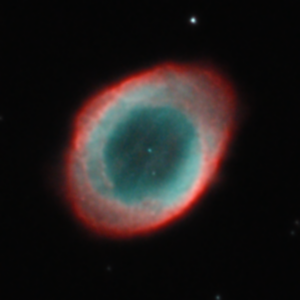
I was also reading an interesting paper in Monthly Notices about an ‘iron bar’ in the centre of the Ring Nebula. It was discovered using the remarkable WEAVE imaging spectrograph on the William Heschel Telescope in La Palma. The paper is open access for all to read “WEAVE imaging spectroscopy of NGC 6720: an iron bar in the Ring”
Deep Sky Section Meeting
The programme for the day is now published on the event page, so please have a look at it there. SHA Books and the Webb Deep-Sky Society will have tables at the meeting.
Bookings will close on March 15th.
For all the latest please see https://britastro.org/event/deep-sky-section-meeting-2026
Double Stars for February – Peter Morris
Continuing along the horizon, I now reach Puppis, only part of which can be seen from the UK. Some of the double stars in this constellation suffer common mistakes in their naming, which is a result of Puppis having historically been part of the huge constellation Argo Navis. When Argo Navis was finally broken up in 1928 to form Carina, Puppis, and Vela, the Bayer letters remained as they were and no new Bayer letters were created. Eta Argûs, for example, became Eta Carinae and there is no Eta Puppis or Eta Velorum. Perhaps the best double star in northern Puppis is n Puppis which is sometimes called Eta Puppis. The reason for this seemingly bizarre confusion is the old version of the Norton Star Atlas which showed the Greek letter Eta in a way which makes it look a small n with a long tail. Hence when observers saw the n they assumed it was in fact Eta. But it gets worse. Instead of being a nice simple Struve (STF) double star or even a South-Herschel (SHJ) double, it is a fiddly Herschel double star, namely H N 19, the nineteenth double in William Herschel’s “new” catalogue, which is sometimes incorrectly written as HN 19 or H 19. Herschel first observed it on 20 November 1784, probably around 3 am.
The two stars in n Puppis are almost the same magnitude (5.82 and 5.85) and it has a good separation of 9.9 arcseconds; the position angle is 117.6°. It is however, at the low declination of almost 23.5 degrees south and you will need a clear view of the southern horizon. The two stars are almost the same spectral type, being F5 and F6, and they are indeed a binary pair, although the orbital period is seemingly unknown. Their spectral types would suggest that they are both yellow and this is how they are usually seen or as yellowish-white. A brown dwarf was discovered in this system in 2022. Just below n Puppis one can observe another double star just 15 minutes away and hence probably in your telescope’s field of view, namely HWE 18 discovered by Herbert Alonzo Howe at the Cincinnati Observatory in Ohio in 1876. This is a dimmer and a much tighter double, so you will need a higher magnification. They are magnitude 8.1 and 8.9 with a separation of 1.9 arcseconds and a position angle of 204.1°. They are both spectral type B and usually seen as white. It is still uncertain if it is a binary system.
Below n Puppis is another victim of nomenclatural confusion, k Puppis, which has an even lower declination of almost 27 degrees south. It is often called Kappa Puppis or even Kappa1 Puppis, but it is not Kappa Puppis and cannot be Kappa Puppis as Kappa Argûs is now Kappa Velorum. Even the usually reliable Stella Doppie is confused on this point. Furthermore, the double star designation for k Puppis is unusual, being a William Herschel designation, namely H 3 27. The three refers to the degree of separation of the two stars, being the 27th star of the third class, but in modern computer-based catalogues, the 3 has been (confusingly in my view) tacked on to the 27 to make it H 327. Herschel first observed it on 15 February 1781, simply noting that the two stars were equal.
k Puppis is a fine optical double but difficult to see in the UK, as it is one of the most southerly doubles we can see. Even when it crosses the meridian, it is only 11.5 degrees above the horizon or roughly the height of the house at the bottom of your garden so you will need a clear view to the south. The two stars in k Puppis are about the same magnitude (4.4 and 4.6) and have a moderate separation of 9.9 arc seconds; the position angle is 318.1°. They are both B stars so they should be the same colour (either white or blueish). I see them as white but with possible bluish and reddish tints which may be a result of the low altitude. The secondary is an odd star with a strong magnetic field and a peculiar chemical composition with a lack of helium, but an overabundance of iron and rare earths. It is also variable.
In the more comfortable northern reaches of Puppis is the optical double S 550, catalogued by James South in 1825, but first observed in 1797 by Jérôme Lelande (thanks to Bob Argyle and Brian Mason for their help with this point). It is sometimes stated to be in Canis Major, but is just barely over the boundary in Puppis. The magnitudes are 6.9 and 7.6 and a separation of 39.6 arcseconds; the position angle is 115.3°. They are a blue giant (B9II) and a blue supergiant (B9I) which is a pulsating variable; they are both seen as white.
Finally, I cannot leave Puppis without mentioning KNT 4 which is even further north, not far from the star cluster Messier 47. It was discovered in 1864 by George Knott, using a 7.3-inch Clark refractor which had previously belonged to William Rutter Dawes, an even more famous double star observer. It is a wide double, and has been considered to be a binary on the basis of their almost identical proper motions, but the Gaia-measured distances are 10,202 and 2,294 light years which emphatically rules this out. The magnitudes are almost identical (6.60 and 6.54) and the separation is 128 arcseconds; the position angle is 312.6°. The main star is a red supergiant and the secondary is a variable red giant and they are both seen as yellow-orange or orange.
January Object of Interest
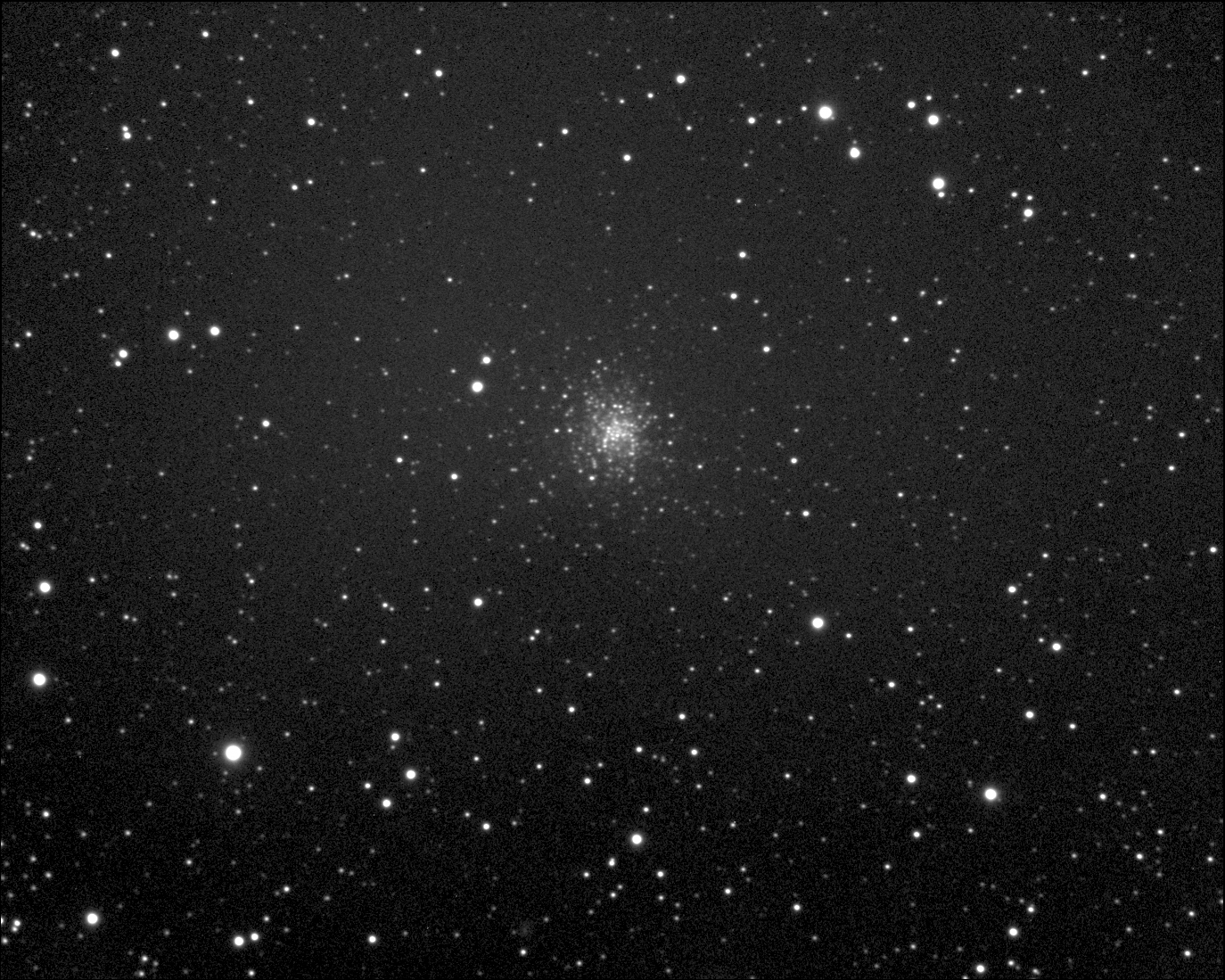
The globular cluster Palomar 2 was the target for January, and there were observations from Paul Leyland, Alan Thomas, Richard Sargent, Iain Cartwright, Duncan Hale-Sutton, Jonathon Elliott, and Brian Scott. I think that Alan Thomas has imaged all 15 of the Palomar Globulars, and with thanks to Dominc Ford the catalogue has been added to our image database. So a good challenge to try them all.
And here is Richard’s image:
February Object of Interest
Paul Leyland suggested February’s target, or targets. The main target is the local group galaxy Leo II. The secondary targets are Leo I (which was a previous OOI), and the much fainter and harder Leo A. Good luck!
Deep Sky Picture of the Month
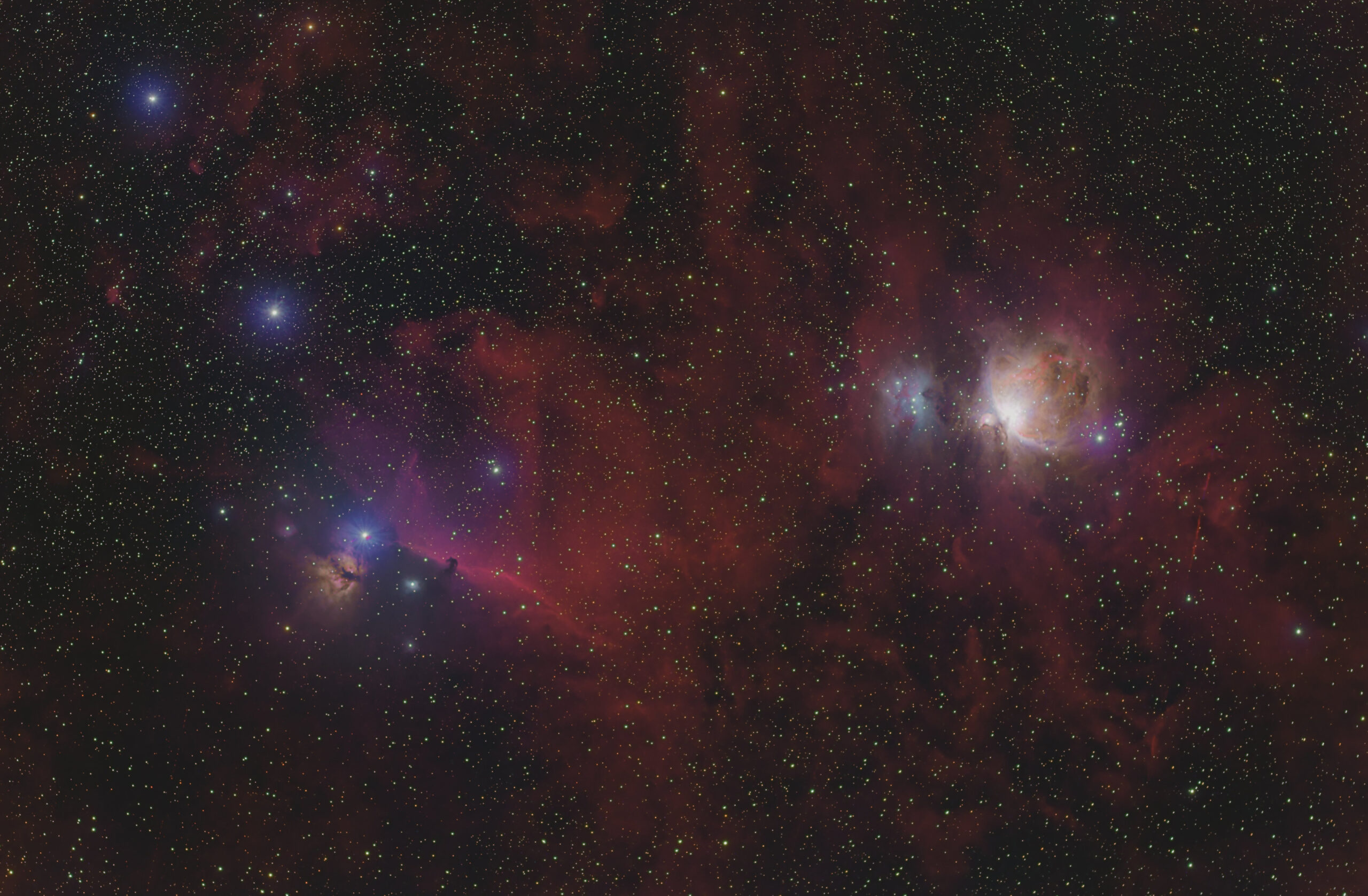
A lovely widefield of Orion using a 135mm lens, by Mike Greenhill-Hooper: A 135mm Samyang lens (f/4) paired with a ASI294MMPro all on SkyWatcher NEQ6, from Miradoux, SW France.
Clear, dark skies,
Callum
| The British Astronomical Association supports amateur astronomers around the UK and the rest of the world. Find out more about the BAA or join us. |