
2026 May 3
Deep Sky Update – May 2026
Well April has been a strange month. Although we had some decent dark skies, it was also quite windy, so not very good for observing without the wind-shield of an observatory. Hopefully the observatory will go up over the summer in preparation for the next season.
Owen Brazell’s funeral and memorial was held towards the end of April. The funeral was a private woodland burial, but the memorial was held at Jodrell Bank and was well attended by the astro-community. Sadly I was not able to make it down for it.
The Webb Deep-Sky Society (of which Owen was President, of course), will be holding its annual meeting at the Institute of Astronomy in Cambridge on June 20th – speakers will include Gerard Gilligan, Keith Venables, Peter Maasewerd, and Mark Stuart with others to be confirmed. I have travel and accommodation booked for this so hope to see some of you there.
I expect more details will be posted on the Webb Deep-Sky Society website in the near future.
I was reminded to let people know about the BAA Spring Meeting in Leicester on May 22/23. Sadly no ‘deep sky’ topics but you might find it entertaining. Here is the link to the event
And it has been a while since the BAA had polo shirts and hats available to buy. We now have an ‘apparel partner’ from whose shop you can order online. Note these are made to order so you might have to wait a little while for delivery. More details here.
Double Stars for May – Peter Morris
This month I stay above the horizon and move to Boötes. A delightful triple in Boötes is Alkalurops (which means a club or staff in Greek) or Mu1 Boötis (STFA 28). The main pair (AB) is very wide (separation 109 arcseconds) and the two stars are magnitude 4.3 and 7.1; the position angle is 170°. It is a binary but it must have a long orbital period. The stars are stellar types F and G and unsurprisingly they are both seen as yellow. B is itself a binary star (STF 1938) with a period of 256 years. The gap is narrowing, having reached its maximum in 2005, but remains a manageable 2.2 arcseconds. The magnitudes of Ba and Bb are 7.1 and 7.6; the position angle is currently exactly 360°. The spectral type of Bb is not known, but they are usually seen as yellow and a deeper yellow or orange (possibly because it is dimmer). Both pairs were seen by William Herschel on 30 July 1780.
Moving west of of Alkalurops to a remote corner of Boötes above the handle of the Plough where we can find Kappa2 Boötis (STF 1821) and half a degree to its east (or following) Iota Boötis (STFA 26) just above Eta Ursae Majoris (Alkaid). They form a triangle with Theta Boötis, which is itself a binary (STT 580) with a faint companion. The stars in Kappa2 are magnitude 4.5 and 6.6 with a nice separation of 13.7 arcseconds; the position angle is 236.4°. The spectral types are A and K and they are usually seen as white and light blue. It is a long-period binary (the orbital period is around 6,000 years) and it was observed by Herschel on 27 September 1779 when he also saw Iota Boötis. The stars in Iota are magnitude 4.8 and 7.4, and at 38.8 arcseconds, it is much wider; the position angle is 33°. It is also a binary star with a presumably long orbit. The stars are A and K spectral types and are seen as white and lilac.
Dropping down to the middle of the kite asterism, we reach Epsilon Boötis or Izar (STF 1877). This is one of the most famous double stars alongside Albireo, Mizar and Kaffaljidhma as Wilhelm Struve called it “Pulcherrima” (most beautiful), because of its contrasting colours (seen as either orange and green or yellow and blue) and its close but not excessively tight separation (3.0 arcseconds). The magnitudes of the stars are 2.6 and 4.8 and are thus easily seen; the position angle is 347°. It is a binary with an orbital period of over a thousand years. The spectral types are an evolved K and a main sequence O, hence its celebrated colours. It was observed by Herschel, well before Struve, on 9 September 1779 and he saw the two stars as reddish and faint lilac.
We now drop further down on the direction of the constellation of Libra to arrive at Xi (or Ksi) Boötis (STF 1888). It is a binary star with an orbital period of only 152 years, but fortunately it is only 22 light years away so we can easily resolve it. The magnitudes of the stars are 4.8 and 7.9 and the current separation is 4.7 arcseconds and it is narrowing, by 2033 the gap will be only 4 arcseconds; the position angle is currently 287.4°. The spectral types of these main sequence stars are G and K and they are seen as yellow and orange (or purple). Herschel recorded it on 9 April 1780 and saw them as pale red and a deeper red.
Finally, we move just over a degree west (or preceding) to Pi1 Boötis (STF 1864). The stars are magnitude 4.9 and 5.8 and the separation is 5.4 arcseconds; the position angle is 114.3°. It is a binary and the two stars are about 540 AU apart. The main star is an evolved B type star while its companion is a main sequence A type. Unsurprisingly, they are both usually seen as white. Herschel observed the pair on 20 September 1779 and remarked that it had been noted previously by Christian Mayer.
April Object of Interest
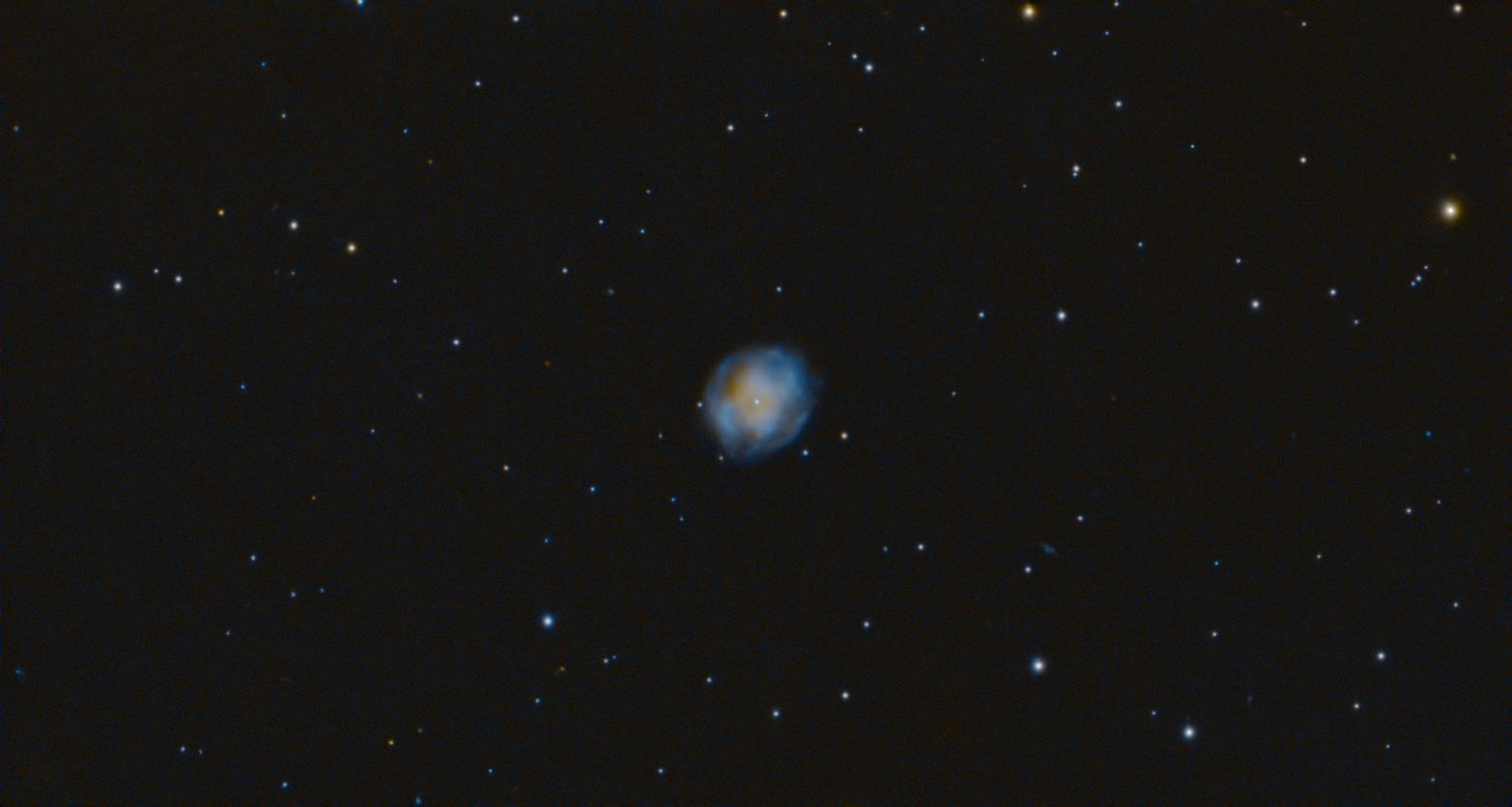
April’s target was the planetary nebula NGC 4361 in Corvus. Many thanks for observations from Karen Smith, Alan Ferguson, David Davies, Brian Scott, David Strange, Ivan Walton, and Paul Downing sent me one from his archive.
Here is Alan’s nice image, taken from Oxfordshire using a ZWO 107 FF APO, ASI 2600MC Pro Duo, Optolong L Enhance Dual Band Filter.
Object of Interest for May
The May target selected by Jim Latham this month is Seyfert’s Sextet in Serpens, a tight galaxy group around NGC 6027. The light nights will make this tricky, but it is high up in Serpens near the Hercules and Corona Borealis boundaries and at its highest at local midnight, so might not be too hard.
Deep Sky POTM
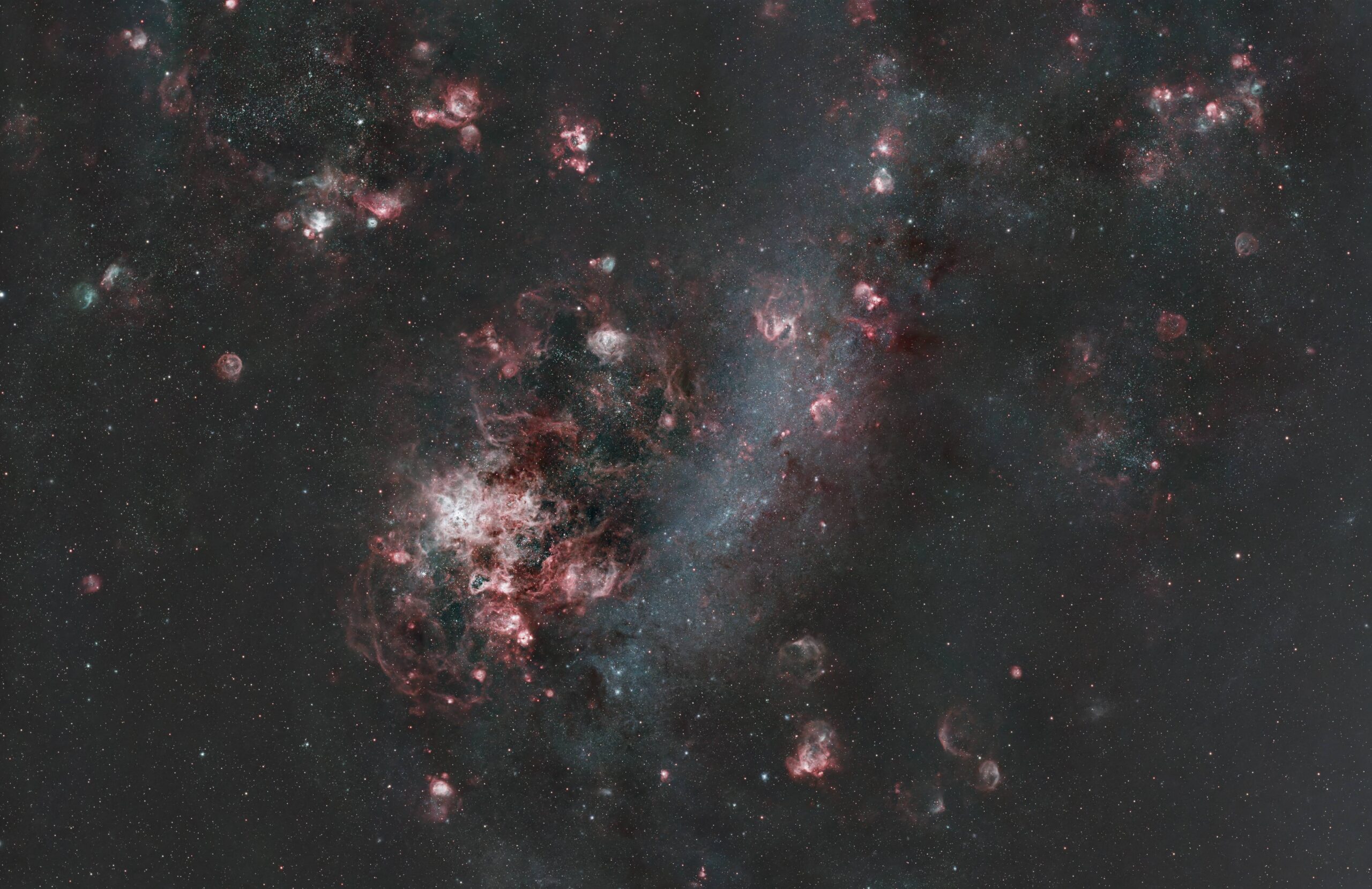
My pick for deep sky picture of the month is this really fine image of the Large Magellanic Cloud, taken by Oliver Hext from Sydney, Australia. Really nice to see something from the southern hemisphere.
And Finally
With the summer months nearly upon us, and night-time observing having reduced hours, it’s a good time to take stock, check out the kit, do repairs and maintenance, and think about projects for the next season. And maybe you’d like to write a short article for this update, or to post on the website. I would certainly welcome all contributions.
Clear, dark skies,
Callum
| The British Astronomical Association supports amateur astronomers around the UK and the rest of the world. Find out more about the BAA or join us. |