
2026 June 8
Mutual events of the Galilean satellites 2026-27
Jupiter passes through its equinoxes twice in every 12-year orbital period, when the Sun lies directly above the equator. At this time, the shadows of Jupiter’s moons coincide with Jupiter’s equatorial plane. The last Jovian equinox occurred on May 2nd, 2021, and the next one is due on December 16th, 2026.
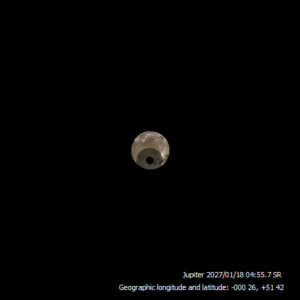
For a few months either side of equinox, the Galilean satellites are involved in mutual occultations (when one satellite passes behind another) and eclipses (when one satellite passes into the shadow of another). These events may be total, annular or partial.
Upcoming events are tabulated below for Greenwich, filtered by Jupiter’s altitude above 15 degrees. Note that some events occur during daylight or twilight. The method of Lainey [1], [2] is used for the satellite ephemeris.
Mutual occultations have been observed by the BAA since 1907/08 and eclipses since 1920 [3]. Useful measurements of the drop in brightness can be made with a small telescope, but to resolve the occultation or eclipse at least 12-inches aperture is required [4]. Eclipses are more prominent in small telescopes and most occur between October and January 2027, with Jupiter’s elongation improving from 57° W to 167° W during this period.
Observations would be welcomed by both the Jupiter and Computing Sections and will provide important constraints on dynamical theories of the Galilean satellites.

References
[1] V. Lainey, L. Duriez and A. Vienne (2004) A&A vol. 420, pp. 1171-1183
[2] https://www.sai.msu.ru/neb/nss/html/multisat/nsszph5he.htm
[3] J. H. Rogers (1995) “The Giant Planet Jupiter”. Cambridge University Press, Cambridge.
[4] B. M. Peek (1958) “The Planet Jupiter”. Faber and Faber, London.
| The British Astronomical Association supports amateur astronomers around the UK and the rest of the world. Find out more about the BAA or join us. |