
Sky notes for 2026 June and July
2026 June 1
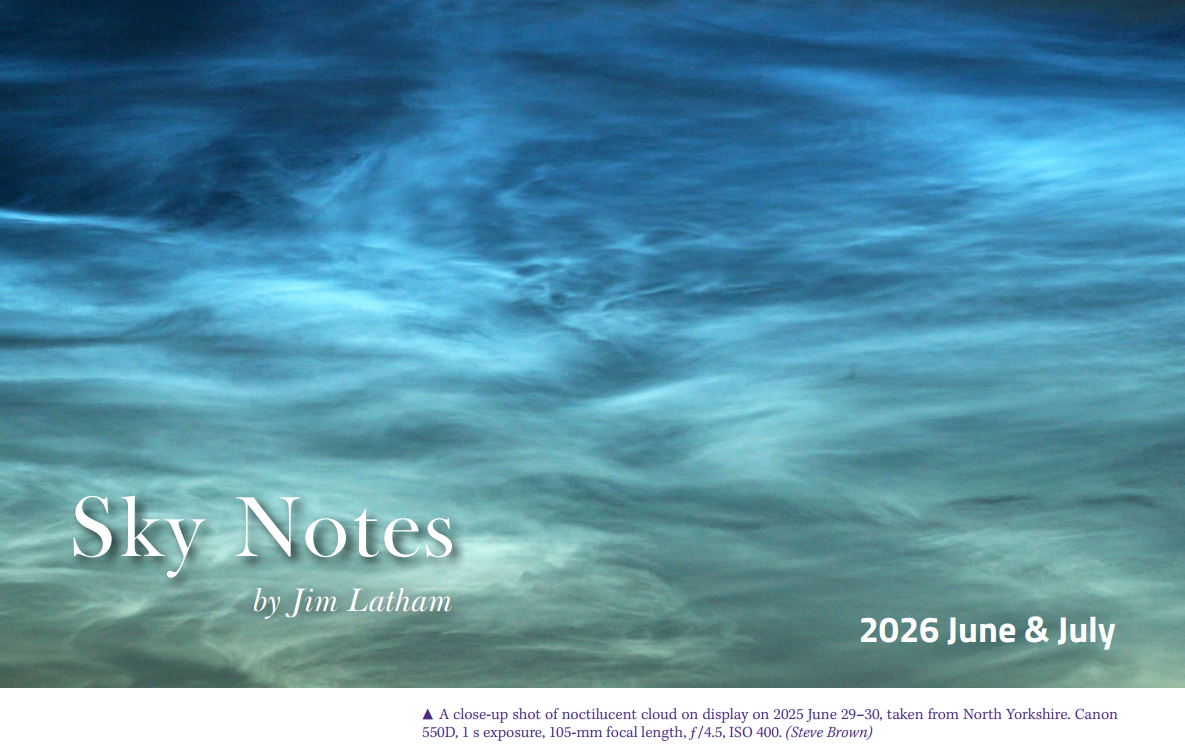
We reach the summer solstice on June 21, when the Earth’s axis is tilted most towards the Sun. It is easy to think of the solstice as simply the longest day, and something of an inconvenience for night-time astronomy, as it never truly gets dark. But that undervalues what it really represents – an extraordinary astronomical moment when the Earth’s orbital characteristics are clearly manifested. Stand outside on a clear midsummer night, and you can sense the tilt of the Earth and the plane of the Solar System: the northern horizon remains bright, with the Sun just a few degrees below it, whilst the ecliptic arcs low along the southern horizon. This is nicely demonstrated by the full Moon on June 29, lying within the Teapot asterism of Sagittarius and climbing little higher than 10 degrees even from the south of England. Life on Earth is fundamentally tuned to these orbital cycles, and our blue, twilit nights can feel lush, scented with honeysuckle and alive with flitting moths, with bats in pursuit. Or at least they should do – our wildlife is in serious decline, and light pollution is increasingly recognised as a contributing factor, affecting our ecosystems in many ways. It is far more than just the bane of astronomers.
The deep sky
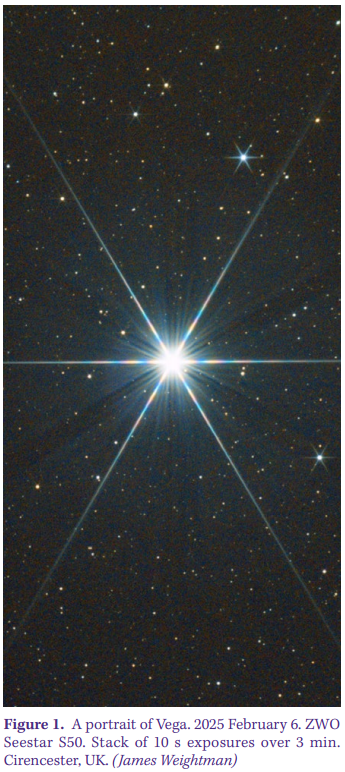
In June and early July, you will have to wait until late evening to even see a star. The first to appear may well be Vega in Lyra, a brilliant blue-white pinprick high in the southeast, sometimes known as the ‘summer sapphire’ (Figure 1). Vega (Alpha Lyrae) is a hot main sequence star of spectral type A0V and is a neighbour, relatively speaking, just 25 light-years from Earth. It is roughly twice the Sun’s mass and diameter, and some 40 times more luminous. Vega is the fifth brightest star in the sky and, because of its accessible position, has been extensively studied. Historically, it was defined as magnitude 0, thus providing a calibration point for the magnitude scale. It is now known to be slightly variable, with a mean magnitude of +0.03. Vega was the first star to be photographed, in 1850 July by William Cranch Bond and John Adams Whipple (Figure 2).

The other star to make an early appearance is Arcturus in Boötes. At magnitude −0.05, Alpha Boötis is the fourth brightest star in the sky. High in the southwest, its position provides a counterbalance to Vega, with a contrasting orange hue. Arcturus is also close to us by stellar standards at some 37 light-years, and is an ageing red giant of spectral type K. Its mass is similar to that of the Sun, but it is bloated to around 25 times its diameter and around 170 times more luminous.
By 11 pm, sufficient stars are visible for the constellations to be properly picked out. The classic patterns of spring – Leo and Virgo – are low in the west, with Boötes following after. A succession of large, sprawling constellations runs from the zenith down towards the southern horizon, from Draco overhead, through Hercules, Serpens and Ophiuchus. Below them is Scorpius on the southern horizon. There is a splash of brighter stars here as we meet the Milky Way, including the vividly red, first-magnitude Antares (alpha Scorpii). The familiar summer constellations of Lyra, Cygnus and Aquila, with their brightest stars forming the Summer Triangle, are gaining altitude in the southeast. Ursa Major is dipping towards the northwest; the northern horizon remains bright, with magnitude +0.08 Capella peeping through the glow. Pegasus is rising in the east, as a foretaste of autumn.
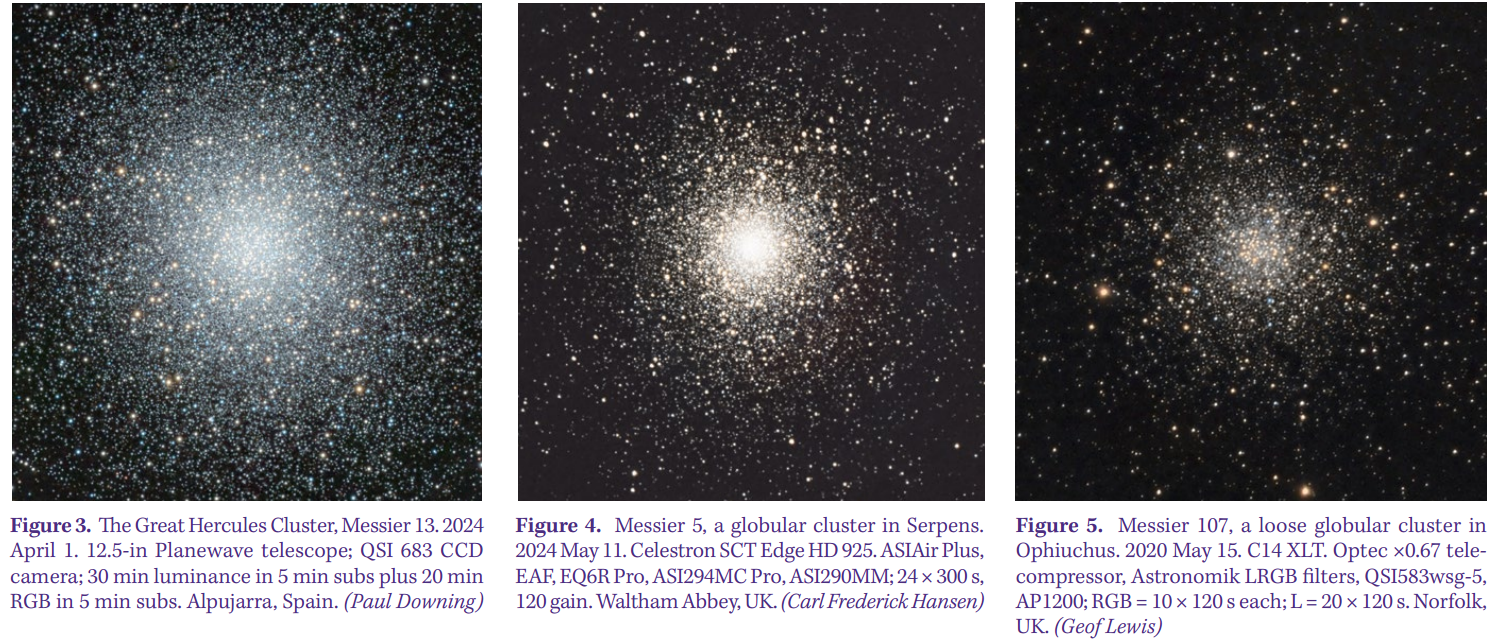
The twilight restricts deep-sky observation, but there is still a lot to be seen by an adventurous observer. It is a particularly good time for globular clusters, some of which can stand up well to brighter skies. These spheroidal balls of stars form a swarm around the central bulge of our galaxy, and our line of sight to the south, which is just above the galactic centre, brings many into view. Messier had something of a field day with this swathe of sky, with the Great Cluster M13 (Figure 3) and M92 in Hercules, M5 in Serpens (Figure 4), M10, M12, M14, M19, M62, M9 and M107 in Ophiuchus (Figure 5), and M4 and M80 in Scorpius. There are also numerous NGC-listed clusters, most within reach of small telescopes.
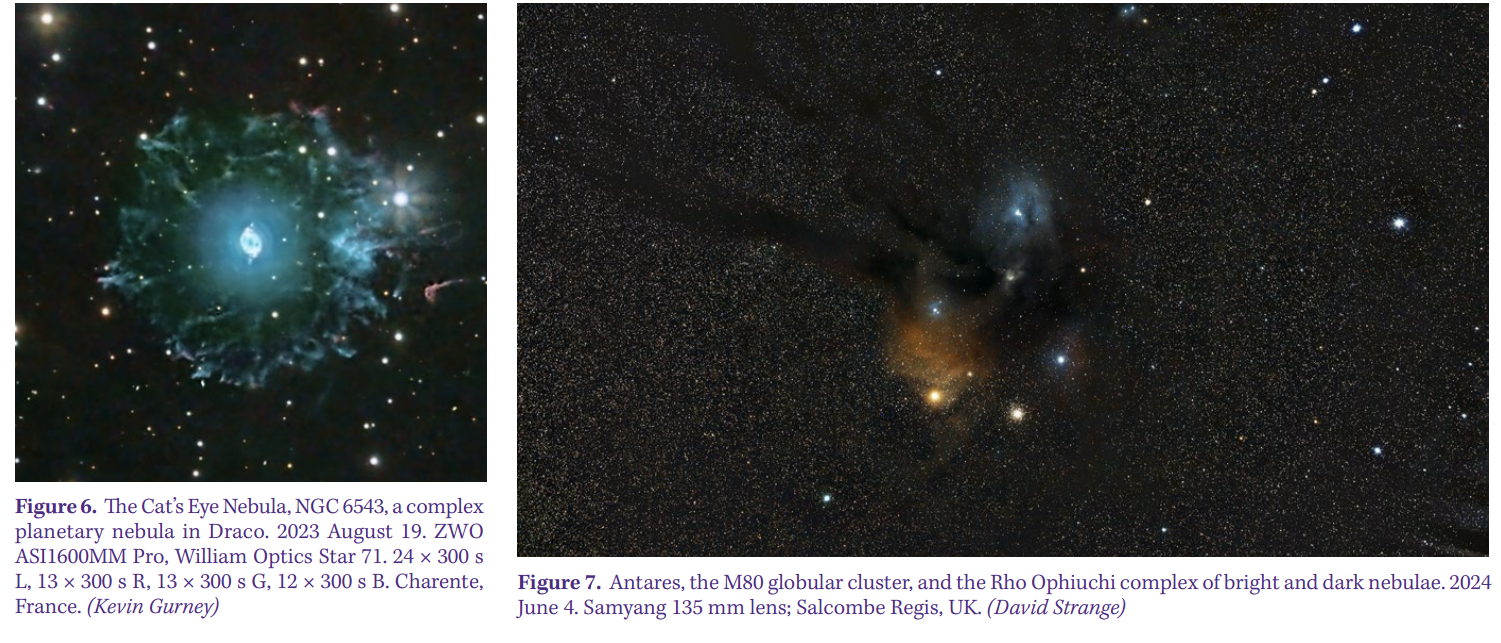
Planetary nebulae are also well represented, and the higher surface brightness examples are rewarding to explore (see Latham 2025, ‘Deep-Sky Observers’ Forum’, Journal June issue). High in the sky, just on the poleward side of the zenith, is NGC 6543, the Cat’s Eye Nebula (Figure 6). It is certainly better under darker skies, but at magnitude +8 and being so well placed, it is worth seeing what can be made out of this extraordinary, complex planetary nebula. Use an Oiii filter and as high a power as you can to enhance the contrast against the sky. Imaging will reveal much more in the summer skies, and a very fine area to explore is the complex of bright and dark nebulosity around rho Ophiuchi, between Ophiuchus and Scorpius (Figure 7).
At the time of writing, we are still waiting for the eruption of the recurrent nova T Coronae Borealis. If this has taken place, it will be high in the southwest and well placed for observation. There are, of course, numerous other variable stars accessible at this time of year. Nearby S Coronae Borealis is a Mira-type variable, ranging between magnitudes +5.3 and +13.6 over about a year, and expected to be close to maximum brightness in July. Another on view is X Ophiuchi, with a magnitude range +5.9 to +9.2, again over about a year, and predicted to be a little past maximum brightness at that time.
Double stars can make good targets as they are less affected, and may even be enhanced, by a brighter background sky. Nu Draconis is high above in the head of Draco. This is a 4th-magnitude star to the naked eye, but can be split into a glorious pair of white stars with a small telescope. 95 Herculis is another easily split double, with components of magnitudes +4.5 and +5.3. Historically, wildly different colours were noted for this pair, and it would be interesting to see how they appear to a modern observer. Finally in this short tour is 70 Ophiuchi, again easily split into a pair of colourful stars of magnitudes +4.2 and +6.2, often reported as shades of gold and orange-red respectively.
The solar system
Moon & Sun
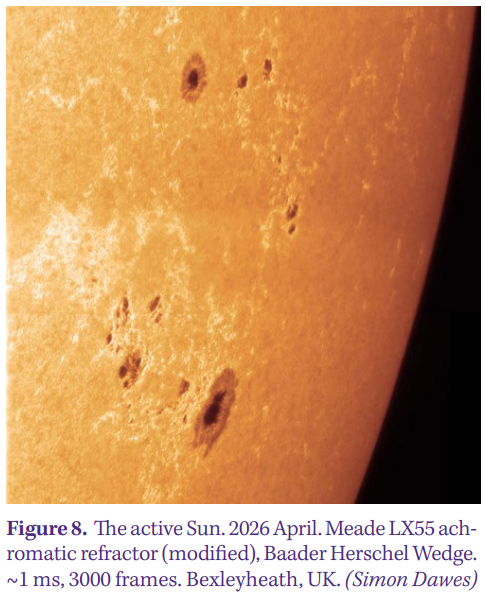
The Sun reaches as high as it can in our skies in June, and whilst still close to solar maximum, is expected to be relatively active (Figure 8). Auroral displays remain a possibility.
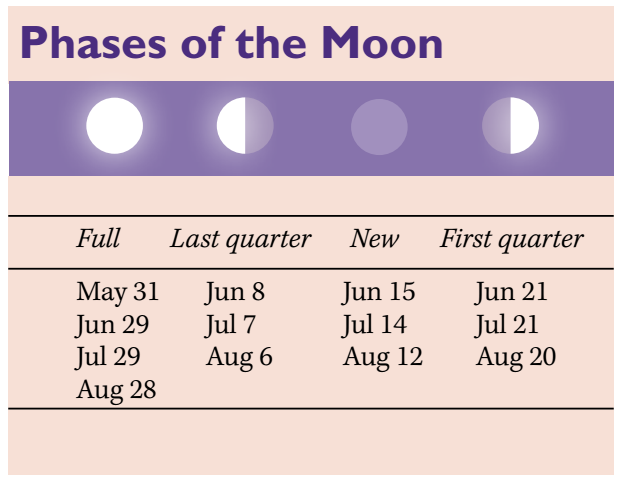
The Moon is low in the sky at full, making it poor for serious observation but exceptionally beautiful to the naked eye. I am generally unimpressed by the popular predilection for naming the Full Moons of each month, but the title of Strawberry Moon for June does feel fitting.
There are no solar or lunar eclipses in June and July.
Planets
Mercury, Venus and Jupiter are all low in the northwest after sunset in June. Their positions shift from night to night, giving an opportunity to appreciate their relative orbital speeds and characteristics.
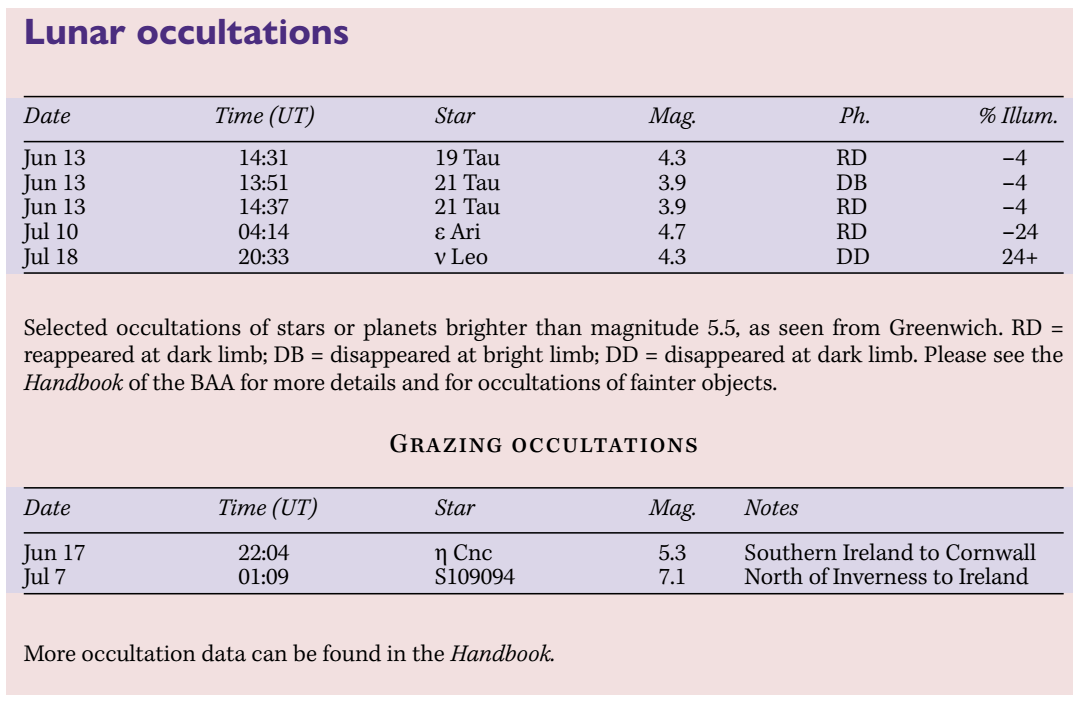
Mercury reaches eastern elongation, its greatest angular distance from the Sun, on June 15, when it will be magnitude +0.5. There will be a narrow window of opportunity to catch it just after sunset, when the sky is dark enough and Mercury not too low.
Venus is in the same area of sky and is dazzlingly bright at magnitude −4. It continues to draw away from the Sun and brighten through this period.
Jupiter steadily sinks in the northwest and is lost by July. It lies less than 2 degrees from Venus on June 9, when the conjunction should be a splendid sight for those with a good, clear horizon.
The remaining planets form a loose grouping in the early morning sky in July.
Mars is in Taurus, rising by 2 am at the end of July; it is relatively inconspicuous at magnitude +1.3, with a small disc of under 5 arcsec.
Saturn is in Pisces, rising by midnight at the end of July. The rings are now opening following their edge-on alignment to Earth last year.
Uranus is in Taurus, just below the Pleiades. It has a close conjunction with Mars on July 4, the two being just 0.1 degrees apart, low in the east before dawn. There is also a loose conjunction of Uranus, Mars, the crescent Moon and the Pleiades on July 11, which is worth a look for early risers.
Neptune is in Pisces, just 10 degrees further west than Saturn.
Dwarf planet [134340] Pluto is at opposition on July 26 in Capricornus, at magnitude +14.5. It is very slowly appearing higher in the sky than in recent years, and more accessible than ever with modern amateur telescopes. A nice project would be to image it over a series of nights to make a video of its progress against the stars. [18] Melpomene and [8] Flora are both at opposition on July 9, in Capricornus and Sagittarius respectively, and both at magnitude +8.9. [3] Juno is at opposition on July 24 at magnitude +9.1 in Aquila.
Comets, meteors & noctilucent cloud
The second half of July sees the start of the summer meteor season, with a number of streams active, although all will be affected by bright moonlight. The Alpha Capricornids peak on July 30, with the low number of meteors compensated by the frequency of bright, slow-moving ones. The Southern Delta Aquarids peak on July 31, and the Perseids will begin ramping up activity in advance of their maximum in August.
Currently, the best prospects for comets during this period are 10P/Tempel 2, possibly reaching 8th magnitude low in the southeastern sky around midnight in July, and 88P/Howell, which may reach 10th magnitude in the early morning eastern sky at that time.
Other transient summer phenomena are also worth watching for. Noctilucent cloud displays (Figure 9) are possible at any time through June and July and are the epitome of summer nights. They are beautiful to photograph as well as to observe.
Our thanks to Jim, the first of two guest authors for the Sky Notes. Nick Hewitt will return in October. – Ed.
| The British Astronomical Association supports amateur astronomers around the UK and the rest of the world. Find out more about the BAA or join us. |