
2026 August 11
Mars Opposition Blog 2026 August 11
No further information has come to light about the dust storm reported last time, but there has been further dust activity, and more observers have joined in.
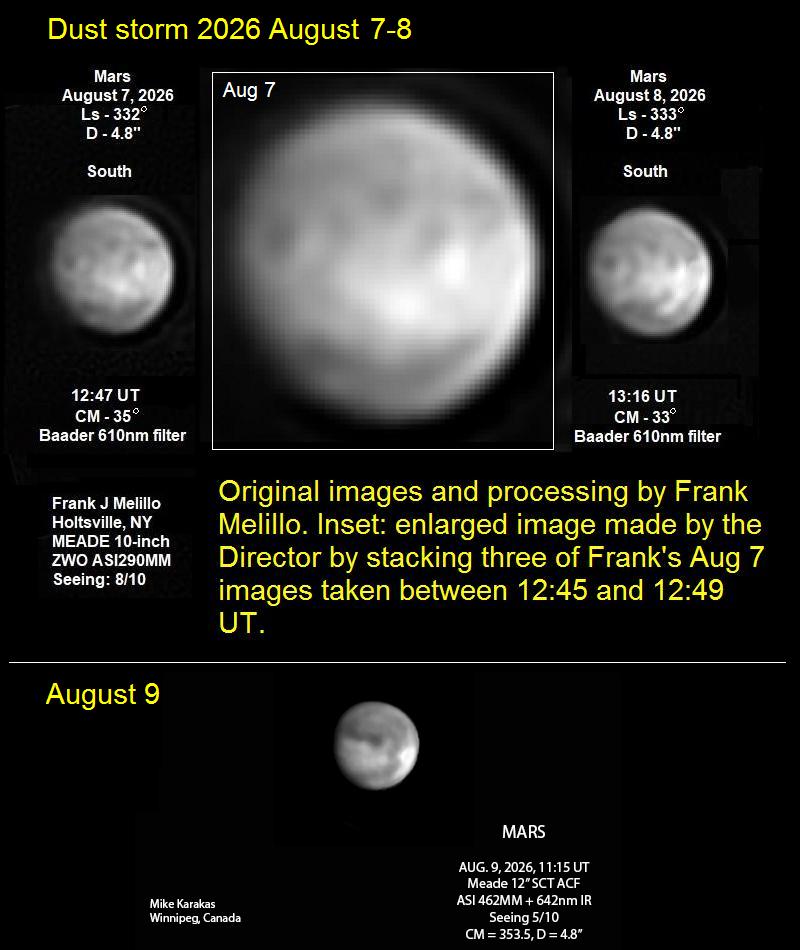
Two sets of near-IR images by Frank Melillo (USA) show new and changeable bright dust clouds across central and northern Chryse-Xanthe on Aug 7 and 8. There appears to have been dust at Ophir-Candor too, while on the second date the main cloud extends as far north as Chryse Planitia, the frequently dust-storm active basin bordering Mare Acidalium and Nilokeras. (I have taken the liberty of stacking and enlarging three of Frank’s Aug 7 images together to show the initial clouds more clearly.) Upon receipt of the report, I rapidly contacted all of our contributors in America and Canada (none of whom had yet observed the event) and then posted an alert on the BAA Forum. Mike Karakas (Canada) subsequently obtained a confirmatory lower resolution near-IR image on Aug 9 that clearly shows Chryse filled with bright dust, at the morning limb.
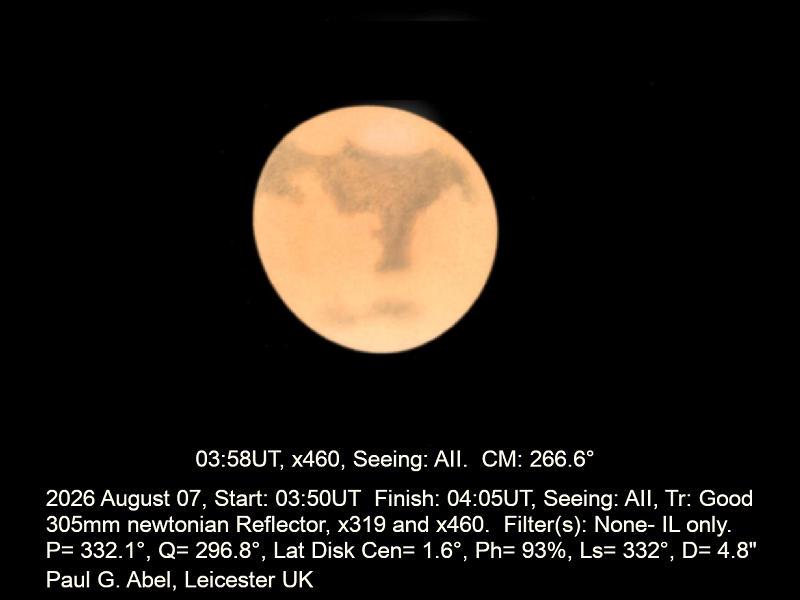
Unfortunately the storm is not observable from the longitude of the UK, and will probably have died out before the region becomes accessible, but sometimes dust activity can occur at the polar hood boundary in the longitude of Utopia, an area which is now visible from the UK, and shown in Paul Abel’s (normal) drawing of Aug 7.
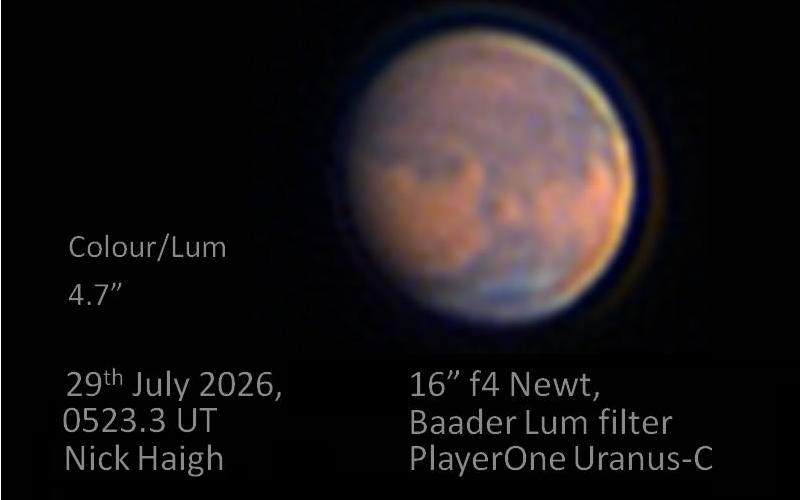
An image by Nick Haigh for Jul 29 shows an E-W elongated belt of white cloud crossing Mare Acidalium, which is a pretty typical appearance for the season.
The western end of this or a similar cloud belt can be seen near the evening terminator in a very high resolution image by Tom Williams taken on Jul 22. On Jul 22 the cloud appears slightly warm-toned, suggesting dust activity could be involved. To be certain of distinguishing white clouds from dust, a set of RGB filter images is desirable.
Furthermore, the polar hood exhibits partial transparency to the north of Mare Acidalium, giving rise to a dark rectangular patch of albedo marking nicknamed “Dawes’ slit” after the 19th century observer who first recorded it clearly. Another extraordinarily detailed image by Tom Williams from Jul 29 shows this effect very clearly despite the disk diameter still remaining below 5 arcseconds.
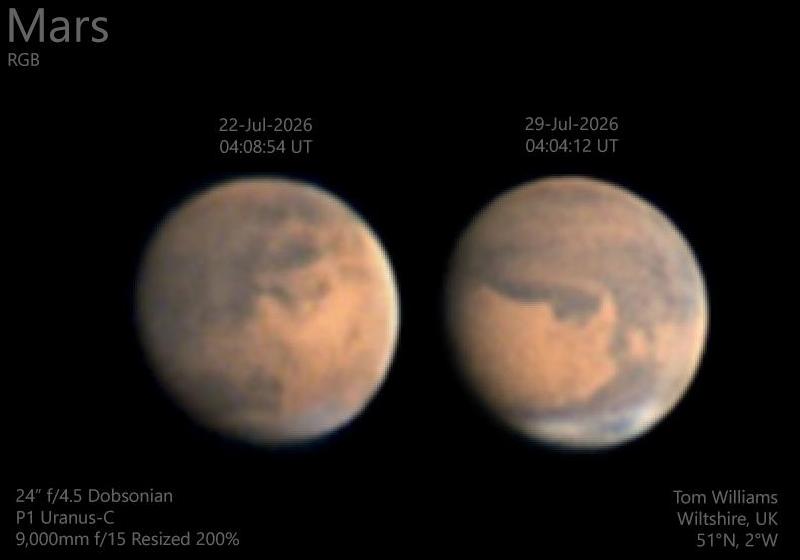
Of the surface features, Nepenthes remains invisible, the Oxia Palus-Indus development (2018-) remains prominent, and Solis Lacus is still large and conspicuous (see the image by Tom Williams on Jul 22). All the observations referred to above have been posted here, orientated with south up.
I have not been able to produce the current full list of observers for the front page yet, but hope to do so soon. Good observing!
| The British Astronomical Association supports amateur astronomers around the UK and the rest of the world. Find out more about the BAA or join us. |