
- This topic has 4 replies, 4 voices, and was last updated 9 hours, 14 minutes ago by
 Robin Leadbeater.
-
AuthorPosts
-
16 September 2026 at 9:47 am #642946
 Connor BradleyParticipant
Anyone observed and study the change of a supernova over time? Like its brightness, distance and location of the supernova?
16 September 2026 at 12:40 pm #642947 Mr Ian David SharpParticipant
Hi Conner,
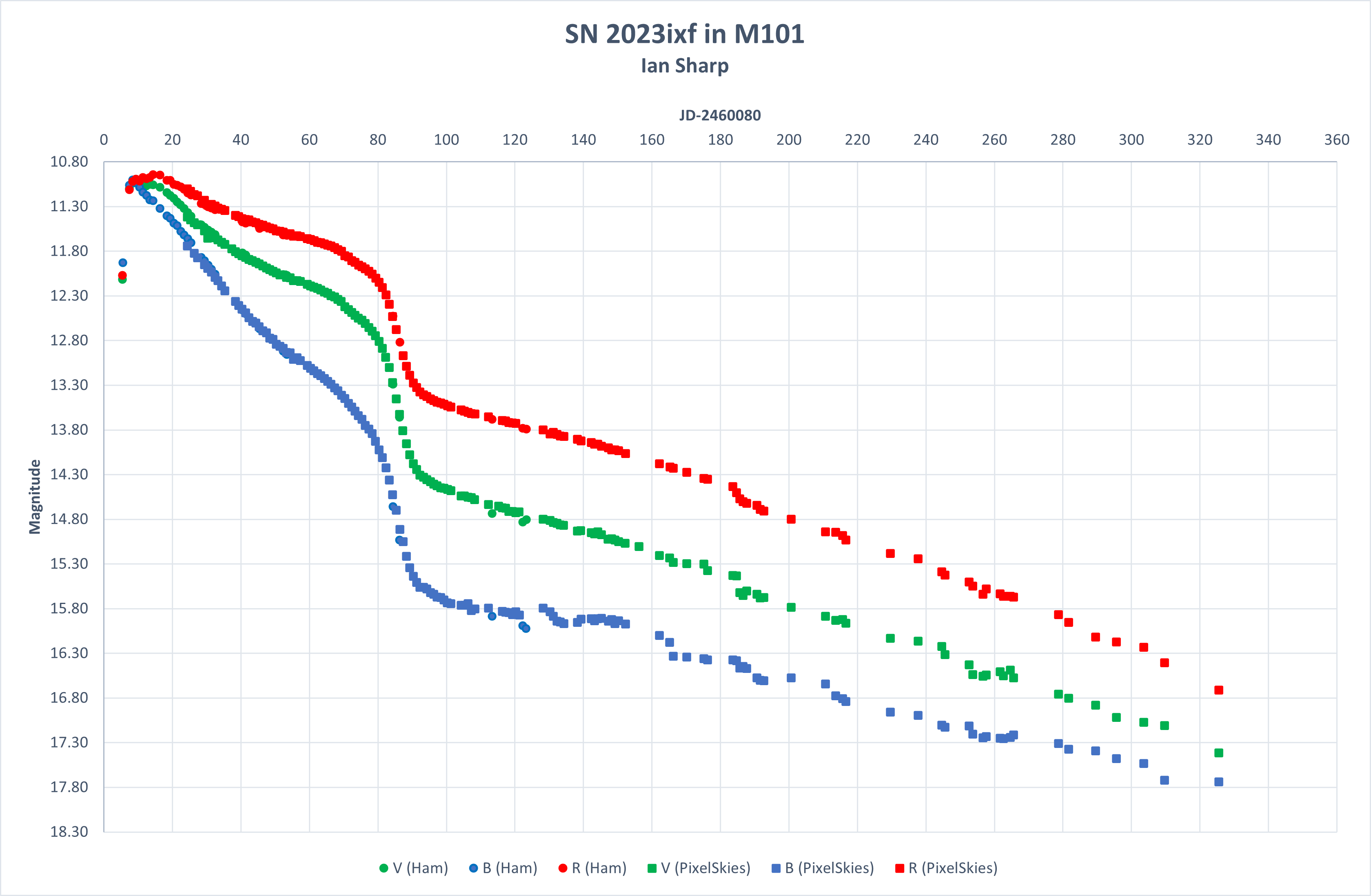
Yes, I did an extensive photometric study of SN 2023ixf in M101. See the attached light curve. This work got published here https://arxiv.org/abs/2307.05612
Cheers
IanAttachments:
16 September 2026 at 1:11 pm #642949 Andy WilsonKeymaster
Hi Connor,
Supernova are too distant for any change in their distance or location to be measured. Though monitoring the changing brightness and spectra of brighter supernova is frequently done by members of the BAA Variable Star Section.
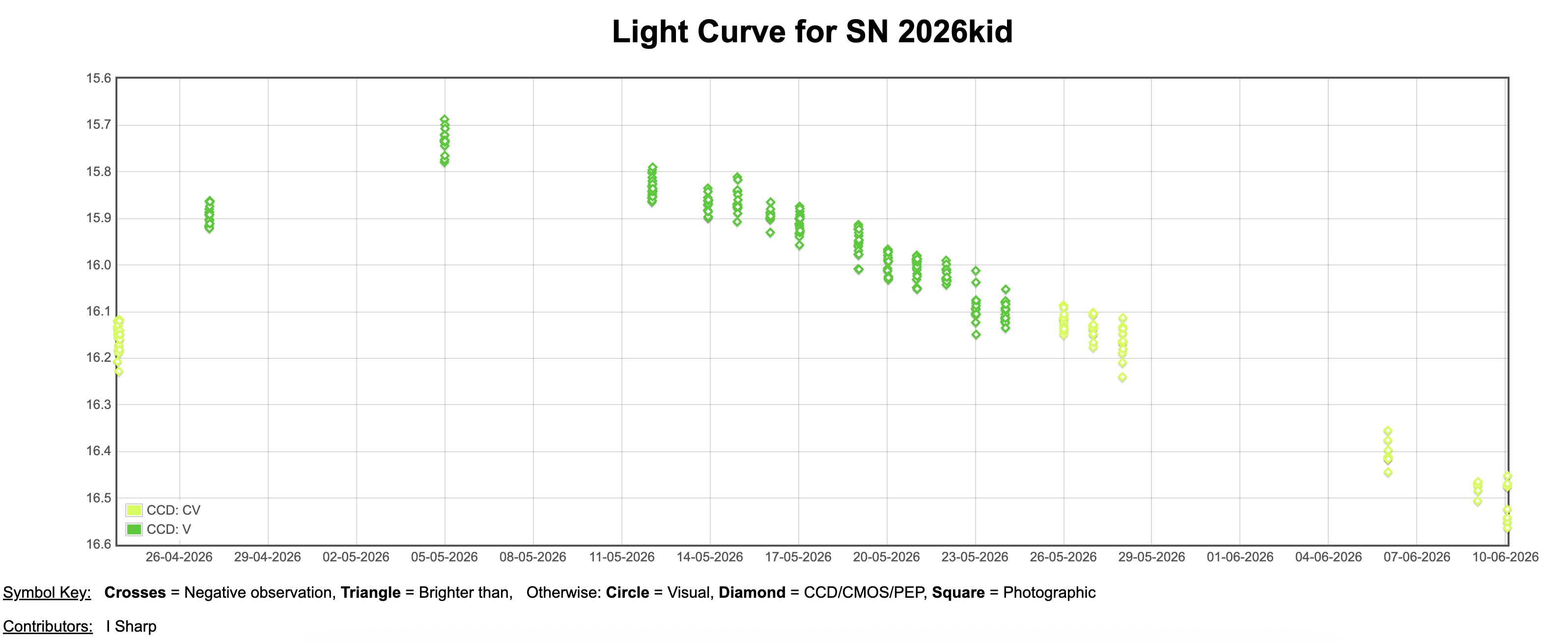
I attach a plot from the BAA Photometry Database of SN 2026kid, photometry again by Ian Sharp.
Robin Leadbeater is an expert at obtaining spectra of supernova. This is tough for amateurs as supernova are faint and typically require large telescope to obtain usable spectra. Here are a couple of spectra from the BAA Spectroscopy Database of SN 2026kid by Robin.
https://britastro.org/specdb/data_graph.php?obs_id=20917%2C20670&multi=yes&mix_flux=no&plot=Plot+up+to+20+SpectraCheers,
Andy-
This reply was modified 16 hours, 50 minutes ago by
 Andy Wilson.
-
This reply was modified 16 hours, 49 minutes ago by Andy Wilson.
Attachments:
16 September 2026 at 4:48 pm #642955Andy WilsonKeymasterHi Connor,
There are also longer term changes to older nearby supernova remnants that are studied.
The best example is M1 the Crab Nebula. This was created by a supernova in our galaxy in 1054. Images taken over several decades reveal the expansion of the nebula.
There is also the more recent supernova 1987A in the Large Magellanic Cloud. A bright ring of material that was ejected prior to the supernova was illuminated by the explosion. Though professional observatories are needed to observe it.
Andy
16 September 2026 at 8:47 pm #642958 Robin LeadbeaterParticipant
Hi Connor,
Here is a series of animations showing the spectroscopic evolution of a typical type II supernova SN 2023ixf over a period of a year
https://britastro.org/observations/index.php?page=1&page_size=40&sort_order=0&library=1&folder=163&obj1Type=0
Click on each one to see the details
I also summarised them in an article for the Variable Star Section Circular here
https://britastro.org/vss/VSSC199.pdfI am currently following the evolution of SN 2026sqf very unusual type Ia-CSM. Here are the spectra I have so far
https://britastro.org/specdb/data_graph.php?obs_id=21462%2C21370%2C21485%2C21269%2C21261%2C21235%2C21233%2C21231%2C21207%2C21202&spec_id=0&obs_observer_id=none&multi=yes&mix_flux=no&r_c=0&f_c=0&o_comment=&std_spectra_id=None&legend_pos=neCheers
Robin -
AuthorPosts
- You must be logged in to reply to this topic.