
2026 October 18
Mars Opposition Blog 2026 October 18
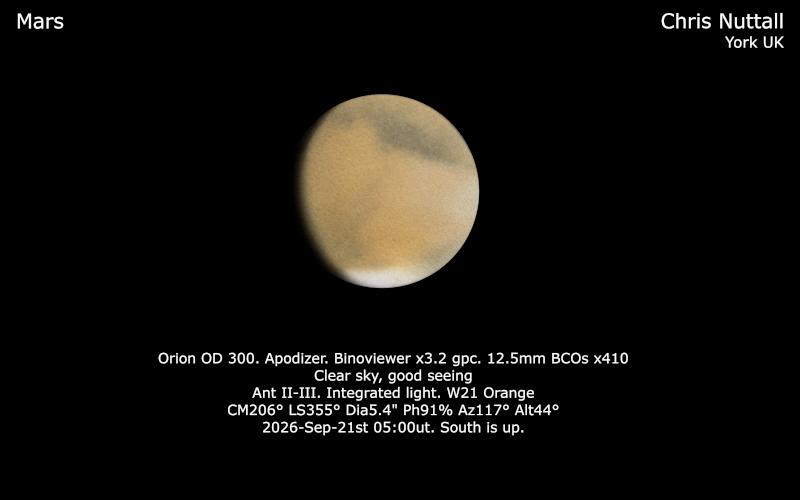
As of 2026 Sep 30, Ls reached 0 degrees, marking the start of spring in the N. hemisphere. Now 29 observers have contributed their work. The polar hood has largely cleared away; earlier a portion had lingered in the mornings, particularly in the longitude of Mare Acidalium. A sign of haziness in the NPC contour, as on the morning side in this Sep 21 drawing by Chris Nuttall, is an indicator of residual hood. (As usual, all drawings and images here are posted with south at the top.)
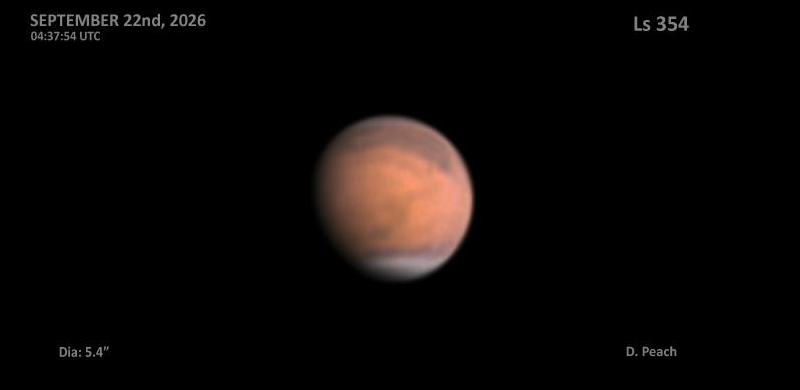
Upon the still distant martian disk, when imaged at sufficient resolution, the N. cap now shows a darker region towards the limb, marking the place of the unresolved annular cap rift that will become more apparent later as the cap is turned more towards us. See for example the image posted here by Damian Peach for Sep 22; Gary Walker’s images also show this clearly from Sep 26.
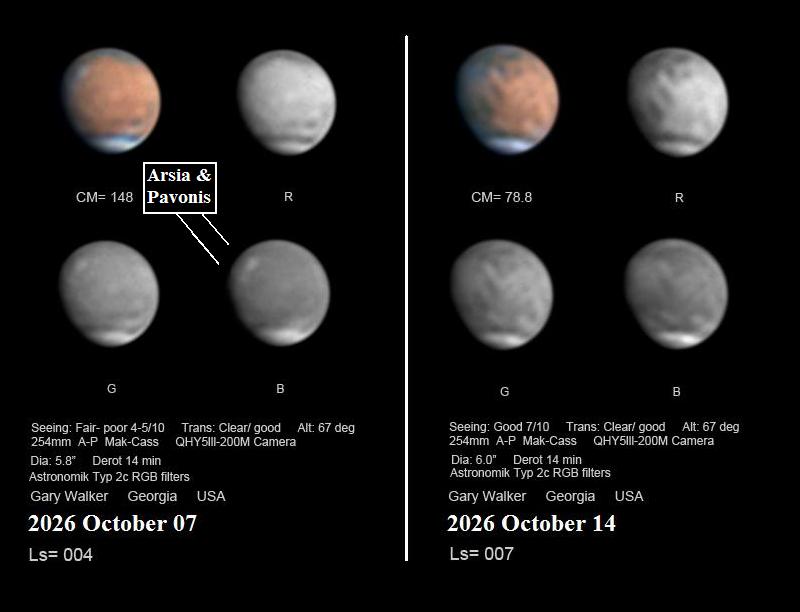
Arsia Mons shows its orographic evening cloud. In these images by Gary Walker on Oct 7 it is striking, and we can also see a weak evening cloud at Pavonis Mons (just to the north of Arsia). Observers with suitable blue-violet filters should now be looking for the seasonal commencement of the equatorial cloud band (ECB). The effect often begins in the longitude of Chryse-Xanthe, where an evening cloud such as the one imaged by Walker on Oct 14 becomes extended along the equator in the following direction to form the ECB.
Of the surface features I do not have much to write, but I have suspected slight changes in albedo in the regions of Nilosyrtis and Nodus Alcyonius. These slow changes have been ongoing for some time.
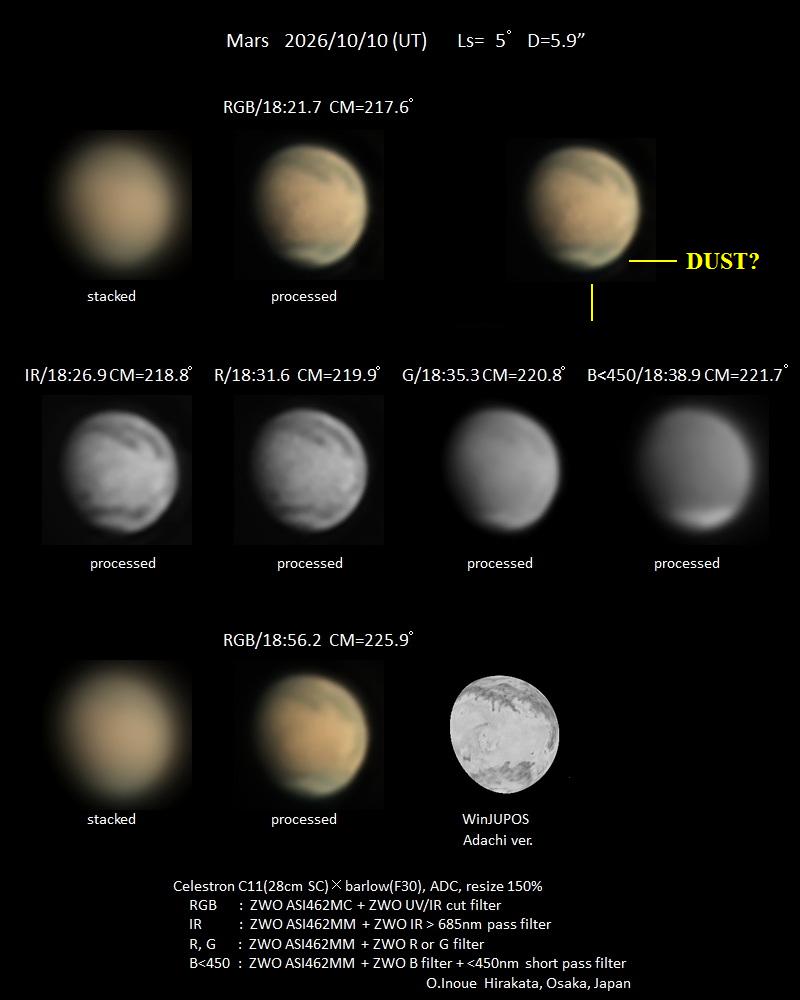
Very recent images from Japan have suggested some dust crossing the southern NPC. The disk diameter is still too small for fine details, but examining the images by Inoue for Oct 10 (posted here) I noticed that a faint dark streak appeared to run from the darker northern part of the cap (mentioned earlier) across the bright part on the morning side in the longitude of Utopia. This must have been dust (of lower albedo) crossing the cap, and it can be seen the next day in images by both Inoue and Ito (and maybe others).
An illustrated note about the 2027 opposition will be appearing in the December Journal.
And finally, I was saddened to have read on the Hampstead Scientific Society’s website that Doug Daniels, a contributor of visual observations to the Section since the 1950s, had passed away earlier this year. Together with his late wife Julia, he was a stalwart of the Society’s Astronomical section, and for many years looked after its observatory on Hampstead’s covered reservoir. The 6-inch refractor was intensively used many years ago by the late Henry Wildey for his own planetary work. Like Henry, Doug was an excellent artist, and an example of one of his drawings can be found in our 2003 report.
| The British Astronomical Association supports amateur astronomers around the UK and the rest of the world. Find out more about the BAA or join us. |