
2026 October 20
P/2026 T1 (ATLAS). A new short-period comet discovered in outburst
Most newly-discovered Solar System objects are faint but on 2026 October 12.82 the ATLAS survey detected a 14th magnitude object in Aquila. The discovery was made using a 0.56-m, f/2.2 astrograph on Mt. Teide, Tenerife. This appears to be four parallel 0.28-m Celestron RASA telescopes with four QHY600 cameras with the images coadded to give the stated total aperture. The object was listed on the Possible Comet Confirmation page as A11InDq. Shortly after the discovery and after a prompt from Maik Meyer, Sam Deen reported on comets-ml that no objects brighter than 19th magnitude were visible in the ATLAS archive as late as October 10.75. It seemed that the object was a previously unknown comet undergoing a significant outburst.
A large amount of astrometry has been collected in the last few days and, surprisingly, this indicates that this is a short period comet with a period of around 12.8 years and a perihelion distance of 3.5 au. The orbital period is notably close to that of Jupiter and it is possible to force the period to 11.86 years with hardly any effect on the astrometric residuals. The fact that it has not been discovered before by the deep surveys implies that it is inherently very faint. The orbit uncertainty is still quite large but within a month or two it should be good enough to project back to the last perihelion and do some searches of historical images.
Thanks to Helen Usher and her team of BAA students (Sam Brown and Aanya Anand) I have been able to process and measure some images taken using the 2.0-m LCOGT telescope at Haleakala. These show an obviously asymmetric coma offset to the east with a diameter of around 38 arcsec.
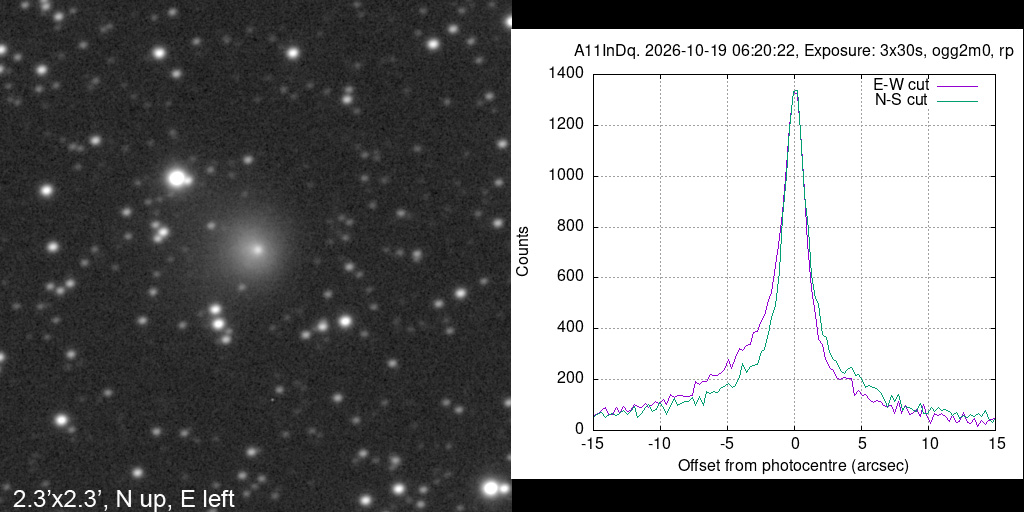
The distance from Earth at the moment is around 3.4 au so a 38 arcsec coma corresponds to a physical diameter of around 100,000 km. If the outburst occurred around the time of discovery (Oct 12.82) the expansion velocity is around 100 m/s which is within a factor of two of velocities that we have seen previously with 29P and 12P.
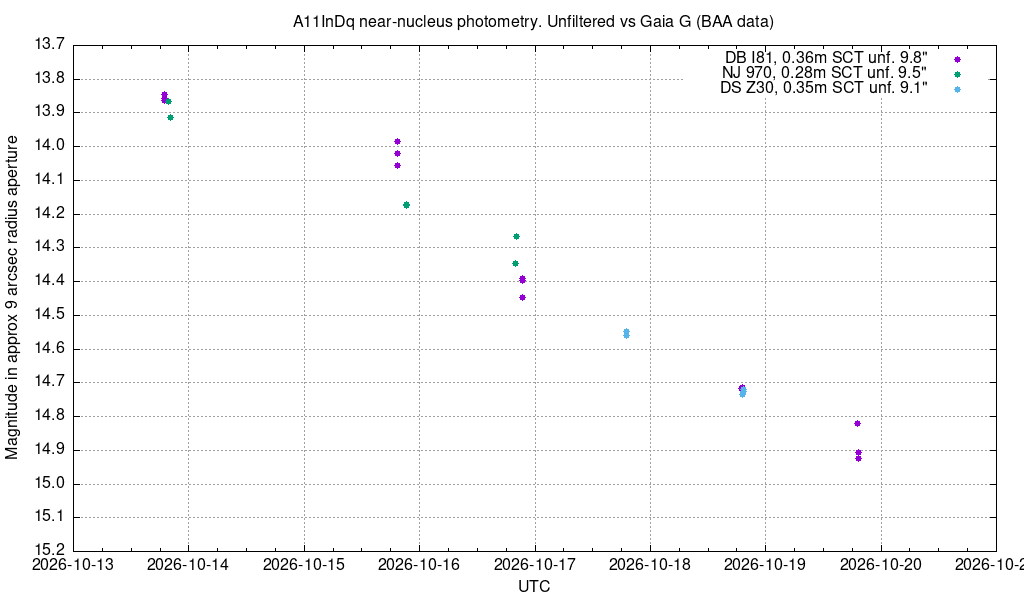
A number of observers have been submitting standardised 9 arcsec radius photometry of the object and this clearly shows the magnitude fading in that radius as the coma expands.
CBET 5761 reports that the comet has now received an official designation, P/2026 T1 (ATLAS).
The BAA image archive for this comet is here.
Please observe it if you can. This is an unusual opportunity to measure an outburst from a previously unknown object. It is currently well placed in the evening sky with the elongation slowly reducing over the next few months. An ephemeris based on the current astrometry is here.
| The British Astronomical Association supports amateur astronomers around the UK and the rest of the world. Find out more about the BAA or join us. |