
WALTER GOODACRE AWARD – J. Shears
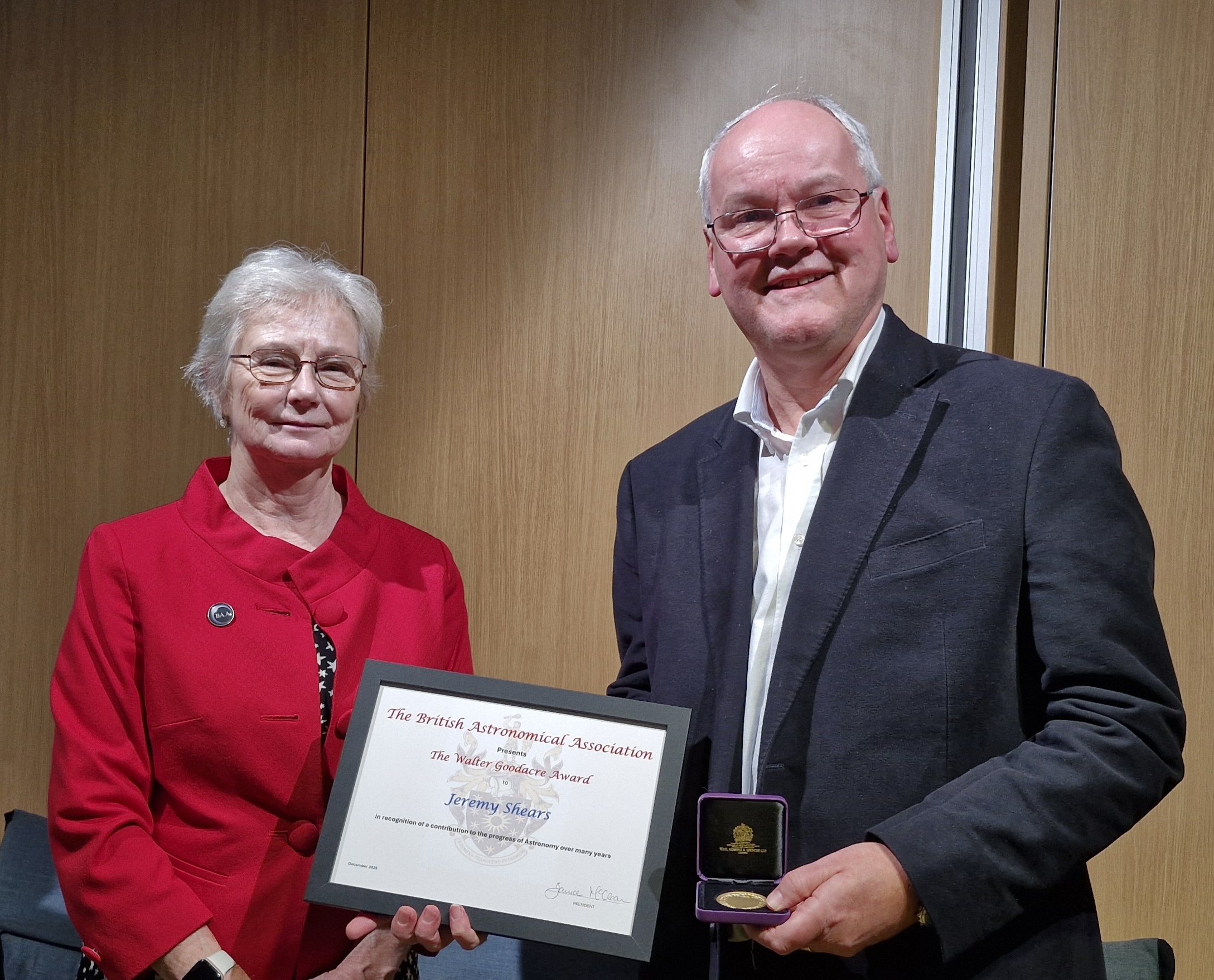
As an observer and author, as well as in terms of his overall contribution to the BAA over many years, Jeremy Shears has more than fulfilled the criteria for the Goodacre Award, the Association’s most senior award.
After his return to the UK in the early 2000s, Jeremy established an observatory at his new home in Cheshire and quickly began contributing CCD observations to the BAA Variable Star Section. His main interest is in Cataclysmic Variables, and he quickly began to make important outburst detections, and arguably more important time series observations of dozens of newly discovered CV suspects detected by the Sloan Digital Sky Survey, as well as patrols and surveys of established CVs being observed by the BAAVSS. At this time, Jeremy was at the forefront of this type of observing, and he is responsible – alone and with others – for establishing orbital periods of many SDSS stars for the first time. Some twenty years later, Jeremy continues to make a valuable contribution to CV research with his CCD patrols, outburst detection and follow-up observations of poorly studied stars, as well as providing confirmation observations for other observers around the world. His contribution to the BAAVSS database runs into tens of thousands of CCD measures. His outstanding contribution to observational astronomy was recognised in 2008 when he received the Steavenson Memorial Award.
One of Jeremy’s strengths lies in his communication skills, and this is shown by the large number of papers on Variable Stars he has written for the BAA Journal, either as a single author or co-author. Analysis of section observations has always been important to the BAAVSS, and Jeremy has authored and co-authored more papers on variable stars in the last twenty years than had been seen for decades before. But in addition to his VSS work Jeremy has also communicated many papers to the BAA Journal on some of the Association’s most significant historical figures, and here he has shown a deep and nuanced understanding of the BAA’s history and values.
In 2019 Jeremy was a natural choice to follow Roger Pickard as VSS Director. Under his leadership, the BAAVSS has been represented by him at several variable star meetings in Europe and the USA, forging strong links with other national VS organisations in the process. Jeremy is a committed supporter of BAA meetings, regularly attending ordinary meetings, the Winchester weekend and gatherings of the VS and Deep Sky Sections, often to give talks on variable star observing or historical variable star topics.
Jeremy has always been sensitive to the values and importance of the BAA, and nowhere is this more evident than in the judgement, skill and willingness with which he has contributed to the administration and management of our Association. Apart from his VSS duties, he has served as a Council member, Trustee, Papers Secretary, President and Vice-President. To all these roles he has brought fairness, firmness, good judgement and persistence. As an outstanding President he did not shrink from difficult decisions and he steered to Association through some difficult times, while always remaining accessible and approachable.
MERLIN MEDAL & GIFT – R. A. Garfinkle
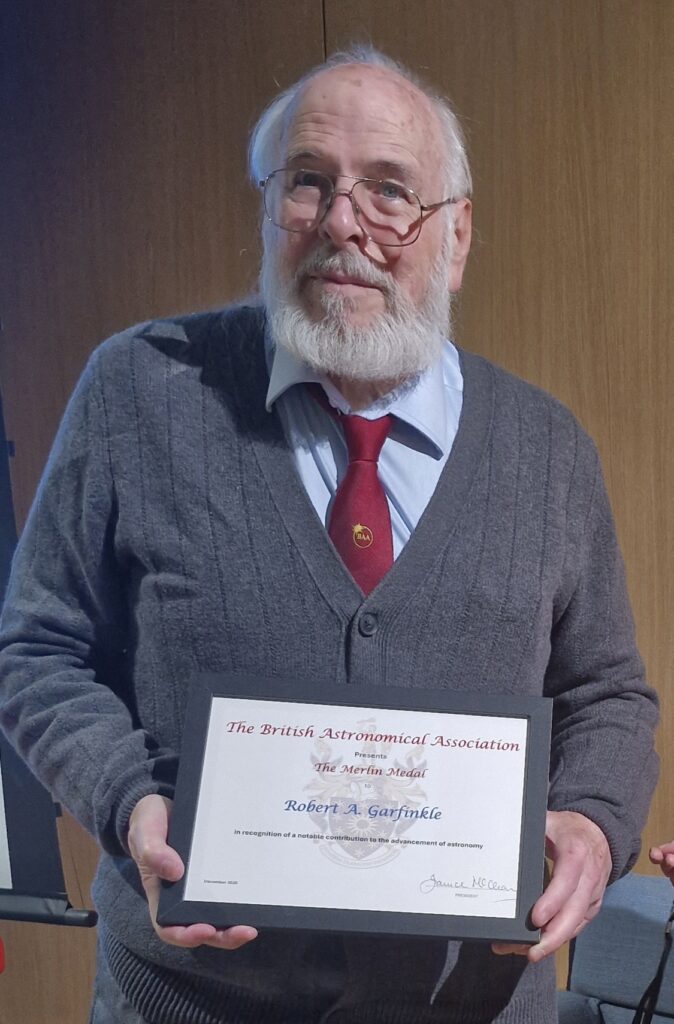
Robert A. Garfinkle is a well-known American amateur astronomer who has long been a member of the BAA and the historical advisor for our Lunar Section. He is recognised internationally as an independent scholar on the history of astronomy and has published astronomy history articles over the last 40 years in various national and international journals and magazines. Since 2004 he has been the Book Review Editor of the Journal of the Association of Lunar and Planetary Observers. As well as being the historian for the BAA Lunar Section, he is also a longtime member of the Antique Telescope Society, the East Bay Astronomical Society, the San Jose Astronomical Association, The Fremont Peak Observatory Association, and the Society for the History of Astronomy. In 1998, he was elected a Fellow of the Royal Astronomical Society. In 2018 the International Astronomical Union renamed Minor Planet 2000 EY70 as 31862 Garfinkle in his honour.
Bob has also authored several books, including popular introductions to astronomy such as Star-Hopping: Your Visa to Viewing the Universe (1994) and, as co-author, Advanced Skywatching (1997). This latter book has been translated into German and Spanish language editions. Since the mid-1980s, Bob has also given many talks to local astronomy and community groups in the USA and has presented ZOOM talks to
the Society for the History Astronomy.
But the jewel in the crown of Bob Garfinkle’s contribution to astronomy was the publication in 2020 of his definitive handbook for the advanced lunar observer, Luna Cognita. By any standards this is a remarkable piece of work, a magnum opus in the fullest sense. First conceived in 1989, it finally saw the light of day as three substantial, large-format volumes – a total of around 1400 pages weighing in at over five kilos. It immediately established itself as a classic, drawing outstanding reviews(including one in the BAA Journal) and was embellished with an introduction by the
Apollo 17 astronaut Dr Harrison Schmitt and a foreword by the late Dr John E. Westfall. Luna Cognita was an audaciously ambitious undertaking for a single author – truly a lifetime’s work by this BAA member – and the result is an essential reference publication that cannot be ignored by anyone with an interest in our Moon.
STEAVENSON MEMORIAL AWARD – I. Sharp
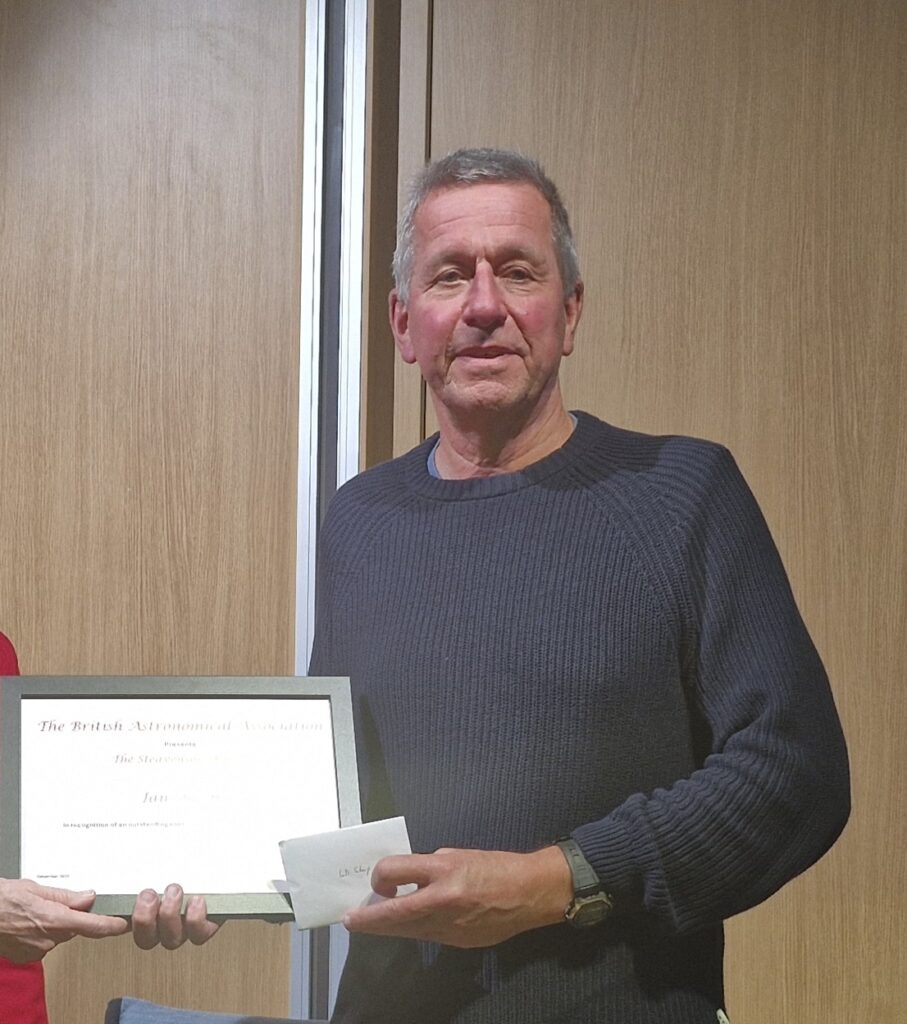
lan has been a BAA member for many years (he was a teenage member in 1970’s, followed by a hiatus in the 198O’s due to his career, but re-joining in 1990’s).
lmaging
Ian’s significant contribution of images and observations covers a wide range of astronomicaI areas such as the Ptanets (Sotar System), Deep Sky, Comets, Meteors and Supernovae. As of 2024, September lan has uptoaded 1 13,617 variabte star observations, on 51 different objects, to the BAA Photometry database and since 2019 he has been invotved in severat BAA and AAVSO campaigns and aterts. His images are of particutarl,y high quatity and have been selected severattimes as Picture of the Week on the BAA website.
Articles
Regarding his many activities in support of the Association he has contributed artictes in the JBAA and the BAA VSS Circutar. He is a regutar contributor to the BAA Forum and has given tatks at BAA Section meetings and to various other AstronomicaI Societies.
Speciality Research
A particular current interest is that since August 2019 lan has been conducting research in severaI areas of Variable Star astronomy, especially Ectipse Time Variations in Post Common Envetope Binaries, with the work having been pubtished in MNRAS and JBAA. His highly technical and detaied observations are published on the websites of the BAA and AAVSO.
Knowledge Sharing
lan enjoys sharing his knowledge and skills with other astronomers, preparing and sharing detaited informationaI and training videos for the various computer software programmes used in operating telescope equipment, image capture and image processing. By sharing his skills in this way he is helping to ensure that observers and imagers just starting out on their journey can reap the benefit of his years of experience.
HORACE DALL MEDAL & GIFT – B. Adcock
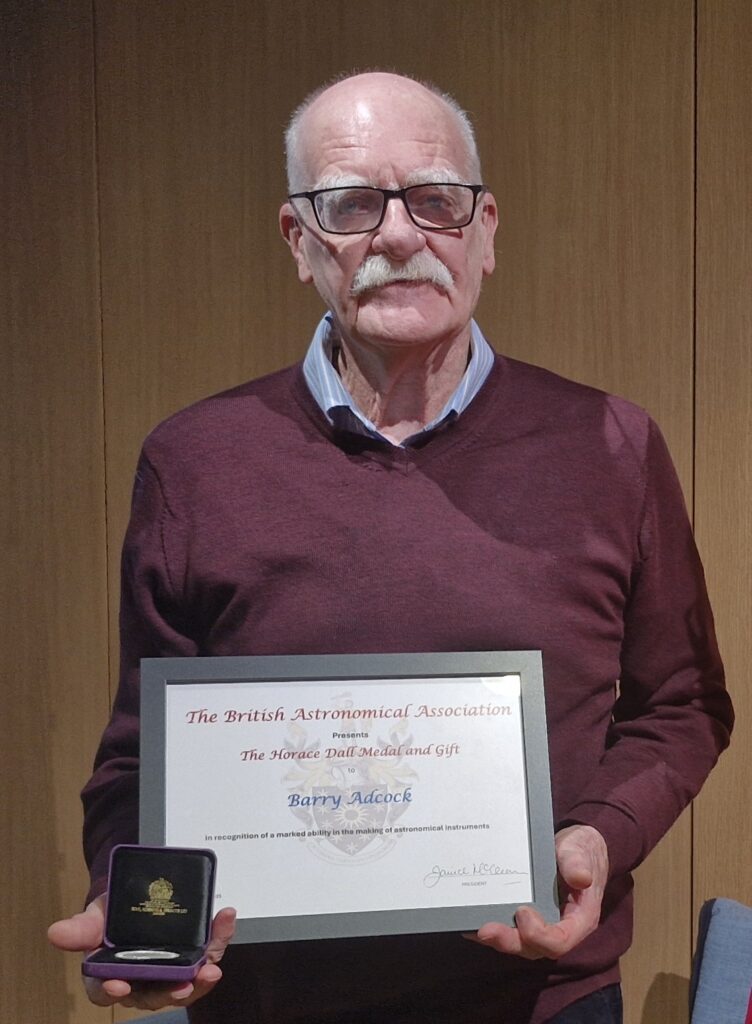
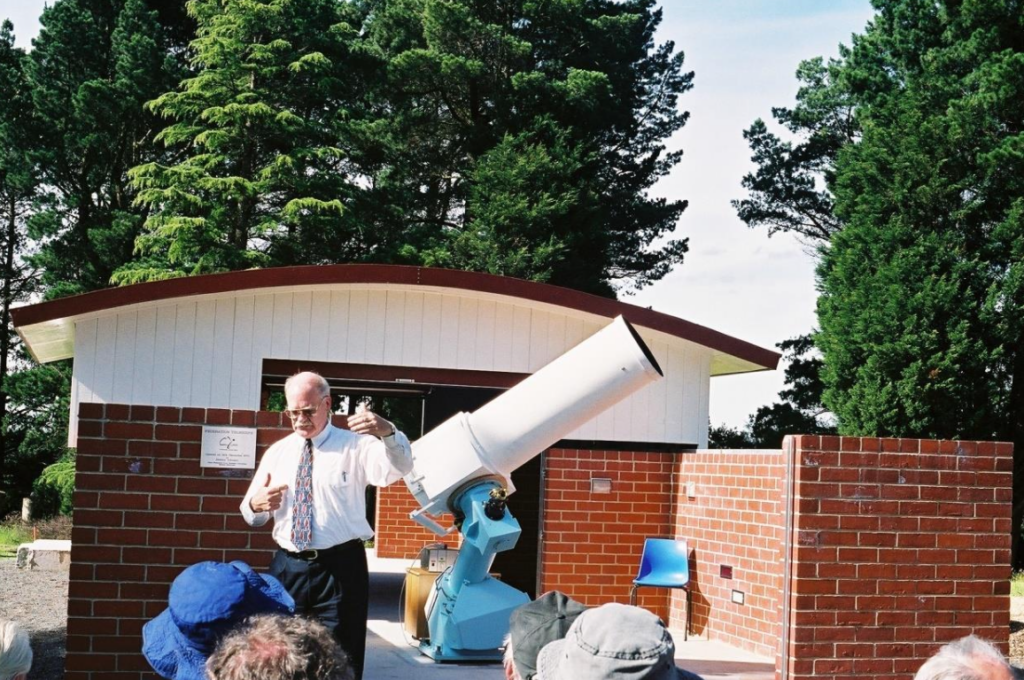
Barry S. Adcock is a long-time BAA member, Honorary Life Member of the Astronomical Society of Victoria Inc (Australia); formerly ASV Curator, Melbourne Observatory; Honorary Associate, Museums Victoria in connection with the Great Melbourne Telescope Reconstruction Project 2008-present; Honorary Life Member Ballaarat Astronomical Society, former Curator Telescopes Ballarat Municipal Observatory.
Examples of Barry Adcock’s Achievements:
- Long-term amateur telescope maker and solar system observer reporting to the BAA;
- Maker of a 330-mm Schiefspiegler, the world’s largest, and its domed observatory;
- Maker of a Cassegrain secondary and Newtonian-Cassegrain changeover fittings for the ASV’s 500-mm Le Marquand telescope;
- Maker of a 300-mm aperture coelostat feeding a 225-mm fluorite apochromatic refractor inside two levels of his house;
- Maker of the 400-mm Federation -Adcock telescope (2/5th funded by the Australian Government) providing stationary eyepiece viewing for wheelchair users at the Ballarat Municipal Observatory; reinstatement of the Brittain 300-mm and refurbishment of the Oddie 200-mm Newtonian Heritage Listed telescopes; maintenance of the Heritage Listed Jelbart 127-mm Refractor telescope;
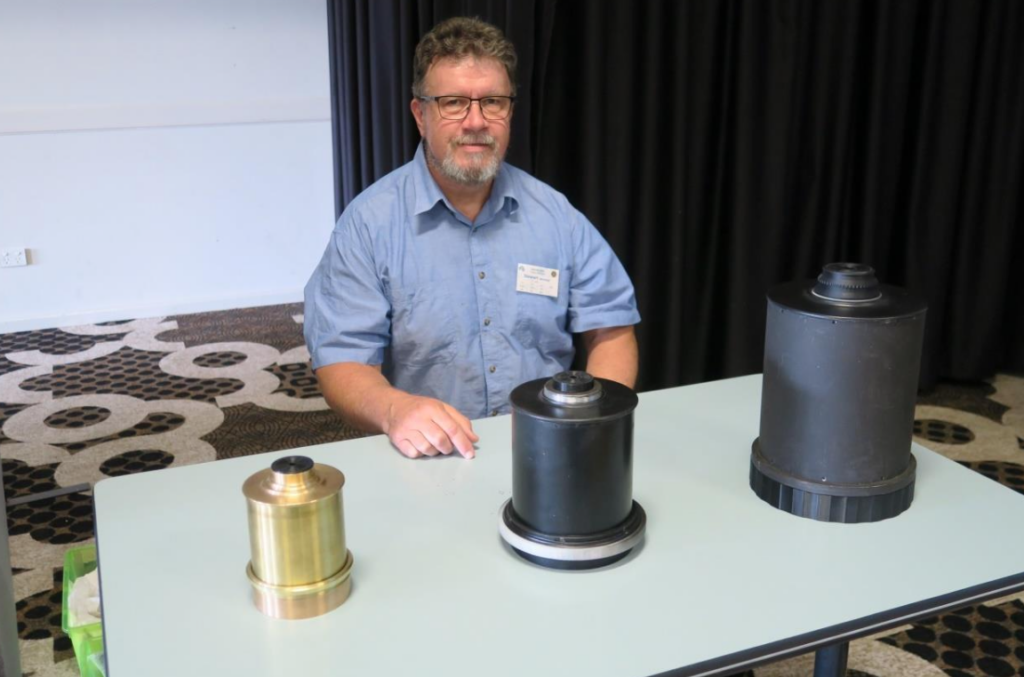
- Maker of three exact replica eyepieces for the Great Melbourne Telescope so that the surviving original eyepieces can be kept safely on display in the GMT’s future public astronomy role at Melbourne Observatory. (The field lens of the lowest power eyepiece is about 200-mm diameter. All of the lenses match the original glass types.)
SIR PATRICK MOORE PRIZE – M. Whipp, J. Roberts & C. Higgins
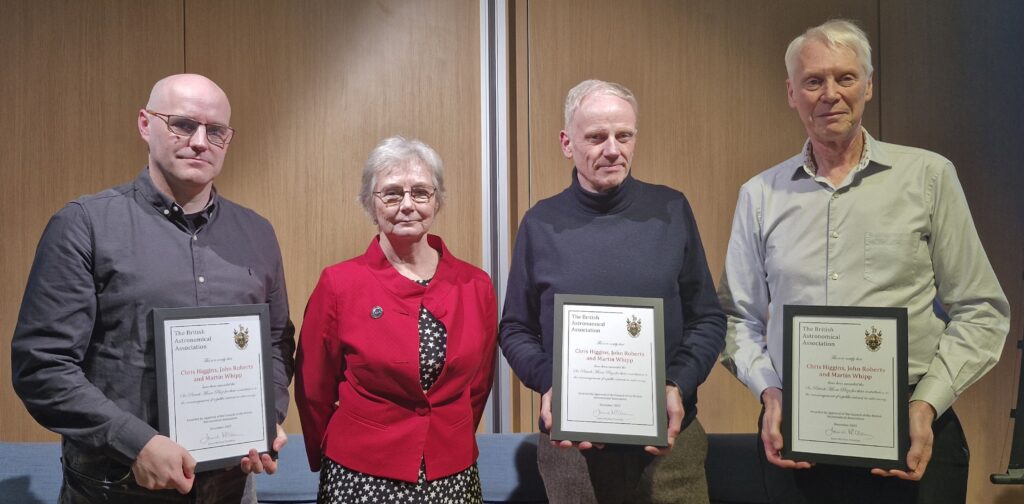
Martin Whipp, John Roberts and Chris Higgins are volunteers at Lime Tree Observatory, North Yorkshire, for the 2025 Prize, in recognition of an exceptional contribution over a number of years to the encouragement of a public interest in astronomy, and of their tireless efforts to inspire the young.
Lime Tree Observatory was established in Grewelthorpe, near Ripon, in 2012, by members of the York Astronomical Society (YAS). The project began as an operation to rescue a 24-inch refractor belonging to Crayford Manor House Astronomical Society (CMHAS), built by John Wall. After learning that it faced an uncertain future, Martin, John and other YAS volunteers rehomed the instrument in the dark-skied Nidderdale Area of Outstanding Natural Beauty, where it was enthusiastically hosted by farmer Peter Foster. Following the telescope’s installation, Martin, John and Chris made further improvements to the instrument and the observatory, including the addition of a presentation room. They opened the building to the public in 2016, and 300 people passed through its doors in the first season.
In 2018, work began on a 25-seat planetarium on the same site. Martin, John and Chris designed, built, furnished and decorated this almost entirely themselves, within a disused barn which they converted into a welcoming space for talks and other events. Even the fibreglass dome was self-built: they fabricated all but one segment on site. The project took countless hours of voluntary work over several years (as well as significant amounts of clothing set alight during welding) and relied on the team’s extraordinary skill and resourcefulness; many of the materials were reused or recycled. The planetarium was completed in 2023.
By the end of 2019, Martin Whipp alone had given over 1,000 public talks at the observatory, all alongside a full-time job in the NHS. Around two hundred events were held by the team just in 2020–2022, a hundred of which were in 2022. The three volunteers, who are all expert amateur astronomers, have given their time to host Brownies and Cubs, and have also hosted coaches of school pupils for day-long experiences at Lime Tree. They have ventured beyond the observatory, too, with outreach activities including events at Aysgarth Falls and Stump Cross Caverns, and paying home visits to help set up first telescopes.
Many of the public evening events make use of both the observatory and the planetarium; on cloudy nights visitors are treated to a tour of the constellations augmented by spectacular fish-eye animated films produced entirely by Martin using computer graphics software. These are the most immersive and fun planetarium films that PJ has ever seen, and on introducing friends to the planetarium in summer 2025, they have told him they are amazed the shows are not more widely known. In 2022, Martin single-handedly began work on his most ambitious show yet: an immersive 43-minute animated film setting astronomical facts to the sound of the Pink Floyd album Dark Side of the Moon. The result, ‘Dark Side of the Dome’, took 10 months to complete. It takes the viewer on an educational journey through the eyepiece of a telescope, flying through Saturn’s rings, witnessing galactic mergers, and much more.
This year has seen two exciting developments at Lime Tree. Firstly, the installation of a new 16-inch telescope in a beautiful dome observatory entirely of John’s design, with hundreds of hours devoted to its construction and meticulous finishing touches. And secondly, the first-everescape room at the planetarium. ‘Escape from Adrastea’ is a 90-minute educational experience featuring the solar system, Messier catalogue, optics, infra-red radiation, the Apollo landings and more. With dry ice and a three-dimensional spacecraft interior projected within the planetarium, PJ can confirm through experience that it is an outreach experience like no other.
The team have made Lime Tree a welcoming and inspiring place for all age groups and backgrounds. They keep the cost of booking the planetarium to a minimum, to ensure as many people as possible can make use of it. The trio share a rare gift for science communication, and an extraordinary generosity in donating their time and many talents in its name.
Above all, they bring a sense of fun and excitement to everything they do. When PJ visited the to give a rather dry talk about the Moon in 2019, it soon transpired that there were going to be more children in the audience than expected. No matter: with his typical resourcefulness, Martin hurriedly put together a crater-making activity for the kids, and enthusiastically threw himself into ensuring they all left feeling excited, inspired, and looking up.
Martin, John and Chris have shown truly exceptional dedication to sharing their passion for astronomy. And they have done all the above with a seemingly boundless supply of enthusiasm, energy and ambition: attributes which Sir Patrick Moore embodied and would have been delighted to see alive and well in Grewelthorpe. Lime Tree Observatory is an extraordinary place, and it exists because of the hard work of these three inspiring and innovative people.
CICELY BOTLEY PRIZE – H. McGee
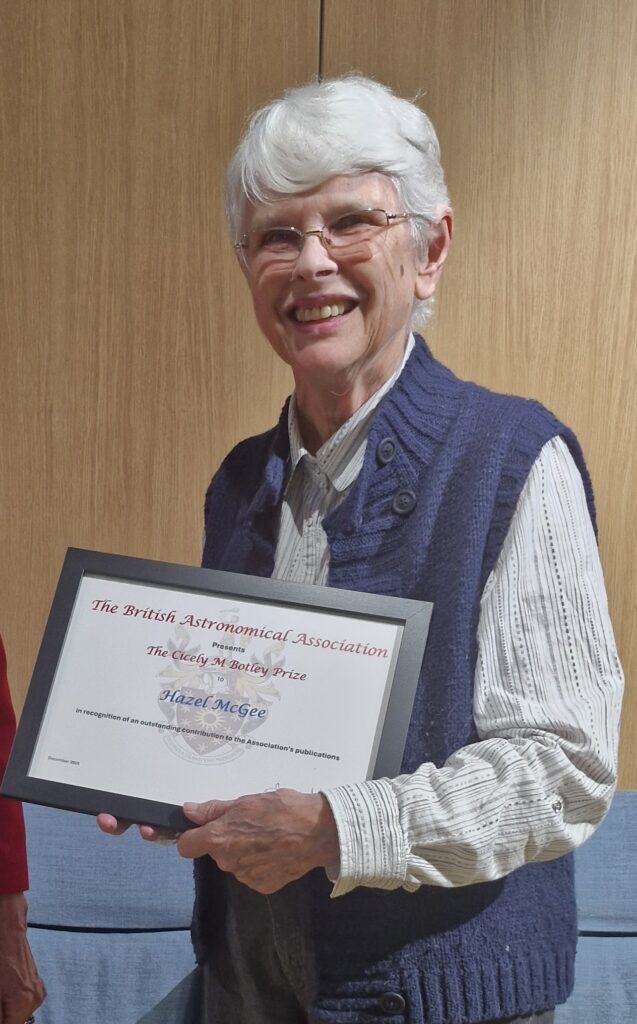
Hazel is well known to many members as a past President (2013–2015) and Meetings Secretary (1988–1993) of the BAA, and for her transformative editorship of the BAA Journal from 1994–2018: a tenure eclipsed in longevity only by that of Colin Ronan. In 2011, she received the Lydia Brown Medal in recognition of her exceptional services to the Association. However, it is perhaps less widely known that in the years since her retirement from editing the Journal, she has continued to engage in active but much less visible work as the Journal’s indexer: work which has not been recognised by an award.
A largely thankless role, indexing involves uploading JBAA papers and associated metadata to the NASA Astrophysics Data System (ADS) archive, and compiling the annual index for every volume since the current editor took over the reins: no small feat and enormously appreciated by the current editor. She has also been of tremendous help to him on numerous occasions with his queries as he got to grips with the new job, and went above and beyond in her training of him in 2018 by providing a full set of instructions for every part of the Journal’s production.
While editor, Hazel also assisted with producing other, non-Journal publications in a voluntary capacity, such as documents distributed to members as part of the administration of the organisation (e.g., the Memorandum & Articles of Association, etc.), and pages on the website. Hazel McGee continues to be a vital part of the team that drives the BAA Journal, but her important contributions since retiring as editor have not gained wide recognition.