› Forums › Comets › 3i anti-tail › Reply To: 3i anti-tail
 Nick James
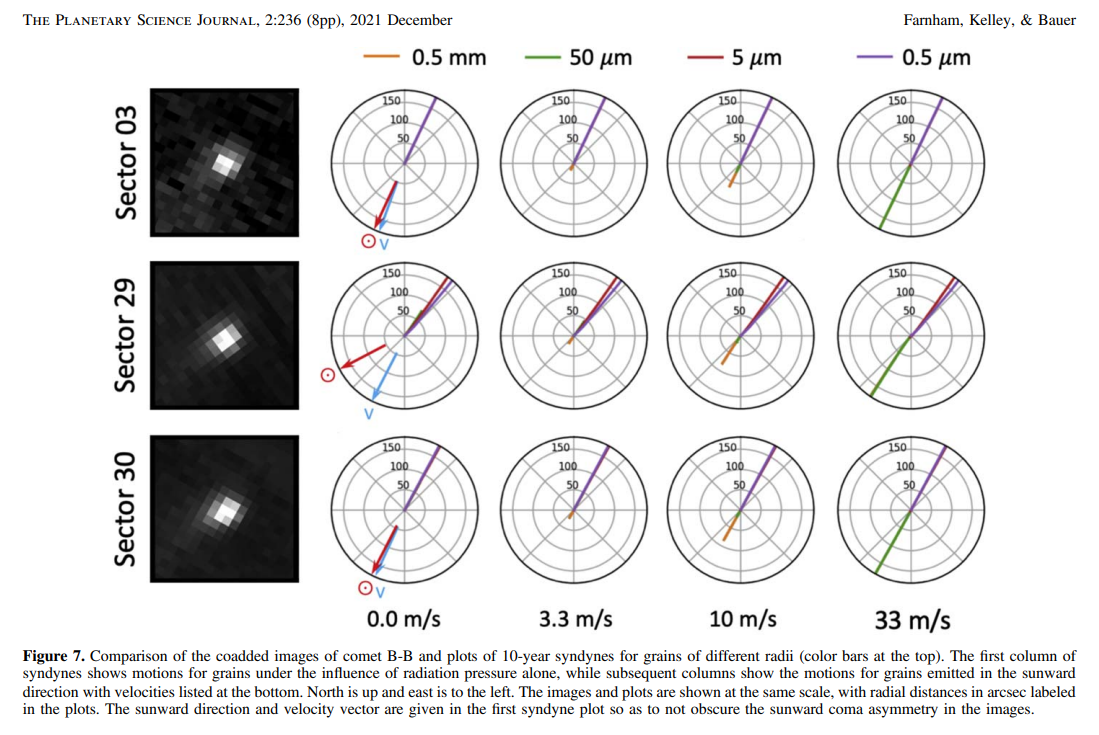
Conventional modelling of the dust tail of a comet assumes that the dust grains are small and emitted from the nucleus in all directions at low velocity. Solar radiation pressure is then sufficient to accelerate the grains in the anti-Sun direction to form the dust tail. In the case of 3I one explanation for the “anti-tail” is that some of the dust grains are large and that they are emitted preferentially in the sunward direction at a higher velocity. It then takes more time for the solar radiation pressure to turn them around and push them back in the anti-solar direction.
This mechanism was postulated for the anti-tail of C/2014 UN271 in this paper by Farnham et al:
https://iopscience.iop.org/article/10.3847/PSJ/ac323d
The attached graphic is figure 7 of that paper. It shows modelled dust tail syndynes for different particle sizes and emission velocities and it demonstrates how an anti-tail can form in these circumstances.