
› Forums › Variable Stars › New supernova SN 2026aaiv in NGC 7331
Tagged: SN 2026aaiv
- This topic has 3 replies, 3 voices, and was last updated 1 month, 1 week ago by
Adam Rawlinson.
-
AuthorPosts
-
6 September 2026 at 12:38 pm #642793
 Michael BuechnerParticipant
On Tuesday, September 1, the ATLAS System discovered the new supernova SN 2026aaiv in NGC 7331 in Pegasus. It is a Type 1a supernova, and at the time of discovery, it had a magnitude of 15.7.
Most people probably remember that a supernova was discovered in NGC 7331 just last year: SN 2025rbs in July 2025.
The new SN found at 22:37:05.618 +34:24:35.37 and is closer to the centerObservation on September 4th
https://britastro.org/observations/observation.php?id=20260906_113344_57bb2dd3c9c77f916 September 2026 at 7:30 pm #642801 Robin LeadbeaterParticipant
A quick spectrum last night between breaks in the cloud.
https://britastro.org/specdb/data_graph.php?obs_id=21438
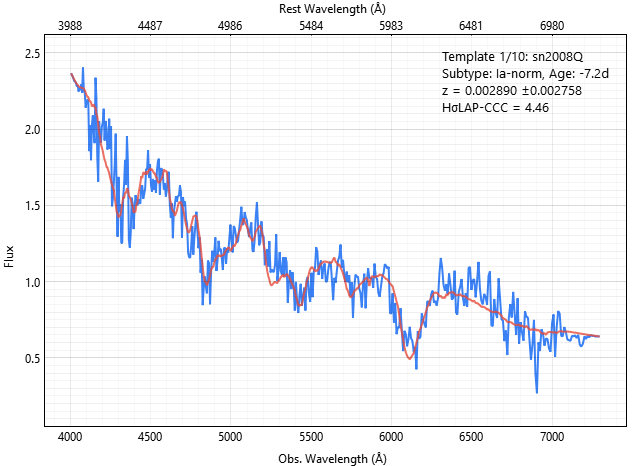
Noisy but clearly a type Ia with a good match to several templates using SNID-SAGE at ~ one week pre maximum. (example attached).
The 6355A Si II absorption is at ~6135A giving an explosion velocity of ~ 9500km/s + 900km/s galaxy redshift = ~10500km/s significantly lower than ~13000km/s two nights earlier from spectra in TNSCheers
Robin-
This reply was modified 1 month, 1 week ago by
 Robin Leadbeater. Reason: added TNS link
10 September 2026 at 6:39 am #642844Michael BuechnerParticipantThe supernova is getting brighter. It was measured yesterday at 12m.9 with a G-filter. What are others measuring??
10 September 2026 at 5:18 pm #642864Adam Rawlinson
ParticipantHi,
I have been observing the SN when i can since 5th. I am recording magnitudes after basic calibration and reduction and using aperture photometry.
So these are “instrumental” magnitudes and i am acutely aware I did not use my photometry filters. So are blunt readings.
I’m recording when i can through the cloud simply to derive a consistently produced light curve for educational use.
That said, these are the measurements so far.
All integrated at approx 22.00UTC from South East UK5th Sept – m13.7
8th Sept – m12.9
10th Sept – m12.7So yes, getting brighter, but by my reckoning it might be levelling off. Which is what we might expect with a T1a.
The next few nights will be interesting.I have been uploaded images of each observation in the britastro gallery.
Adam -
This reply was modified 1 month, 1 week ago by
-
AuthorPosts
- You must be logged in to reply to this topic.