
› Forums › Variable Stars › Photometry with a Seestar
- This topic has 22 replies, 13 voices, and was last updated 3 days, 12 hours ago by
 Jeremy Shears.
-
AuthorPosts
-
15 October 2026 at 10:51 am #643389
 David ConnerParticipant
For info, the latest version of the Seestar app, version V3.4, has just been released. I have yet to try it, but among its many new features it now includes one specifically for photometry.
https://bbs.zwoastro.com/d/27324-seestar-v34-has-been-released
David Conner
15 October 2026 at 12:12 pm #643392 Andy WilsonKeymaster
Interesting. This has great potential, though to understand whether the results can be used for scientific analysis and for example contribute to the VSS database, I hope they publish information about how it is doing the photometry. Things like does it check for saturation and keep the counts within the linear response region of the chip, is it using the green channel to approximate V, what comparison star magnitudes are being used and how are the comparison stars chosen. Without this it is still a fantastic innovation and could get more people into variable star observing.
Andy (BAA VSS Database Secretary)16 October 2026 at 4:04 pm #643411 Mr Ian David SharpParticipant
I think here is an analogy here with the Seestar’s automatically stacked results versus the vastly superior results one can get by processing the raw files oneself. The photometry mode looks pretty but I suspect I shall carry on using ASTAP or similar which is well suited for Seestar photometry where we have proper control.
Ian.
16 October 2026 at 10:04 pm #643412 Steve KnightParticipant
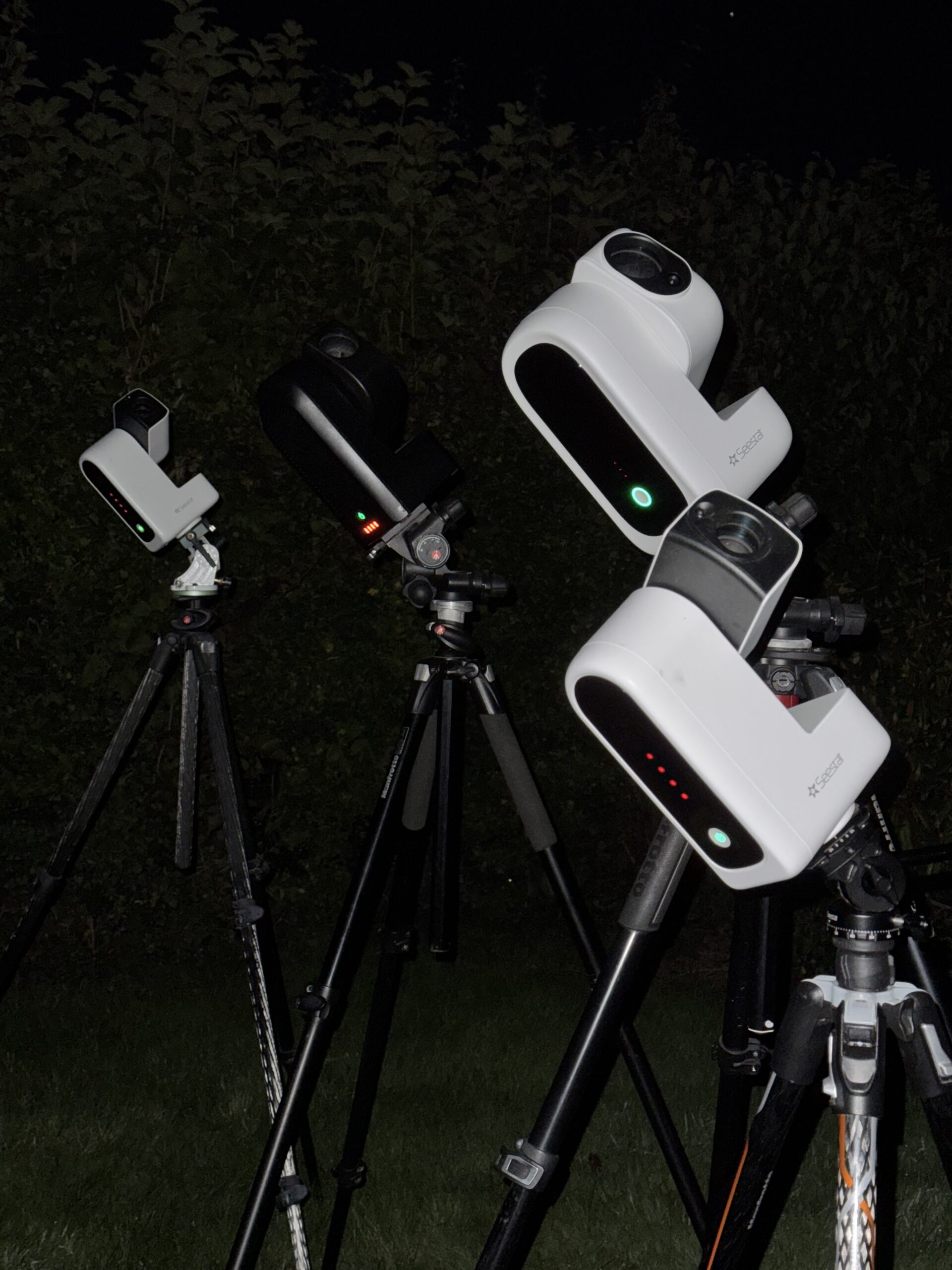
Currently have 4 Seestars on T CrB, the one in middle is in photometry mode. AstroImageJ vs ZWO. We will see.
Attachments:
17 October 2026 at 8:33 am #643414Christopher Curtis
ParticipantIf this catches on, doesn’t it become a new standard? There are a LOT of Seestars out there. Using standardised optics, sensor, filter and app could be an alternative to trying to conform to existing standards.
I’ve dabbled with photometry using my Vespera 2 smart scope, but the current tools and especially the tutorial material and advice available makes it feel like an arcane dark art rather than using modern computer power and interface design to do interesting citizen science. It would be good to see a very warm welcome for a low cost, easy access approach to photometry. A large number of quick and dirty measurements can be valuable.
17 October 2026 at 12:48 pm #643419Steve KnightParticipantIt saves a csv for every frame, seems to have identified 15 reference stars using Gaia G magnitude. Here row 6 is AAVSO reference star 98, V magnitude is 9.8, listed here as 9.55 which matches. T CrB is row 21, calculation is mag 9.74 which I guess is what it thinks Gaia G magnitude is.
Impressive that it is calculating magnitude of a total of 64 stars in 1,195 frames real time and logging it. That’s 76,480 “observations” last night.
I’m sure someone with much better Python expertise than I could do something useful with this.
Used S50 for test, 5 sec exposures.
-
This reply was modified 1 week, 6 days ago by
 Steve Knight.
Attachments:
17 October 2026 at 1:01 pm #643422 Jeremy ShearsParticipant
Christopher,
more and more people are using Seestars and other smart scopes for photometry effectively (e.g. David Conner has written about it in recent VSS Circulars). This is a good thing. However, as Andy pointed out, we do need to ensure the photometry is reliable. We know from Steve Knight’s extensive work on T CrB that at some point dodgy photometry was produced when software was updated – he spent a LOT of time digging into the reasons.
It also depends on what the photometry is subsequently used for. “Quick and dirty measurements” might have their place in some projects, for example detecting a nova eruption, but problems start when unreliable data are uploaded into databases from which the data are subsequently extracted for analysis. We need to ensure that the databases containing amateur photometry, like the VSS database, retain their high reputation in the astrophysics community, including by professional astronomers.
Go well!
Jeremy-
This reply was modified 1 week, 6 days ago by Jeremy Shears.
17 October 2026 at 5:49 pm #643436Andy WilsonKeymasterTo avoid any misunderstanding, I am very pleased to hear ZWO have done this. I hope they have done it in a way that is applicable to general scientific research projects, meaning the results can be added to the BAA VSS database. If not then it still provides an excellent introduction to photometry and it will be useful as a science education tool.
ZWO may be following an existing standard, or they may be trying to do something different, we simply don’t know at this time. Several members already submit Seestar photometry to the BAA VSS database using results from the green filter pixels calibrated with V-band comparison magnitudes (either from a V-band survey or Gaia G transformed to V). This follows standards developed for DSLRs and other colour cameras. Thanks to Steve’s investigations it seems ZWO may be doing something different, possibly a kind of G-band approximation. This could be fine, but we need to know what it is to record it in the database. A new filter might need to be added to the database if they are combining all 3 filters in a ‘white light’ G approximation, something like “WG – combined tricolour RGB with Gaia G comparison magnitudes”.
There is the separate issue of whether the software checks for saturated stars and whether the stars remain within the linear range of the chip pixels. If not then that is something observers need to be aware of with an easy way for them to check this for themselves.
Best wishes,
Andy-
This reply was modified 1 week, 6 days ago by
 Andy Wilson.
18 October 2026 at 10:07 am #643438 Lars LindhardParticipant
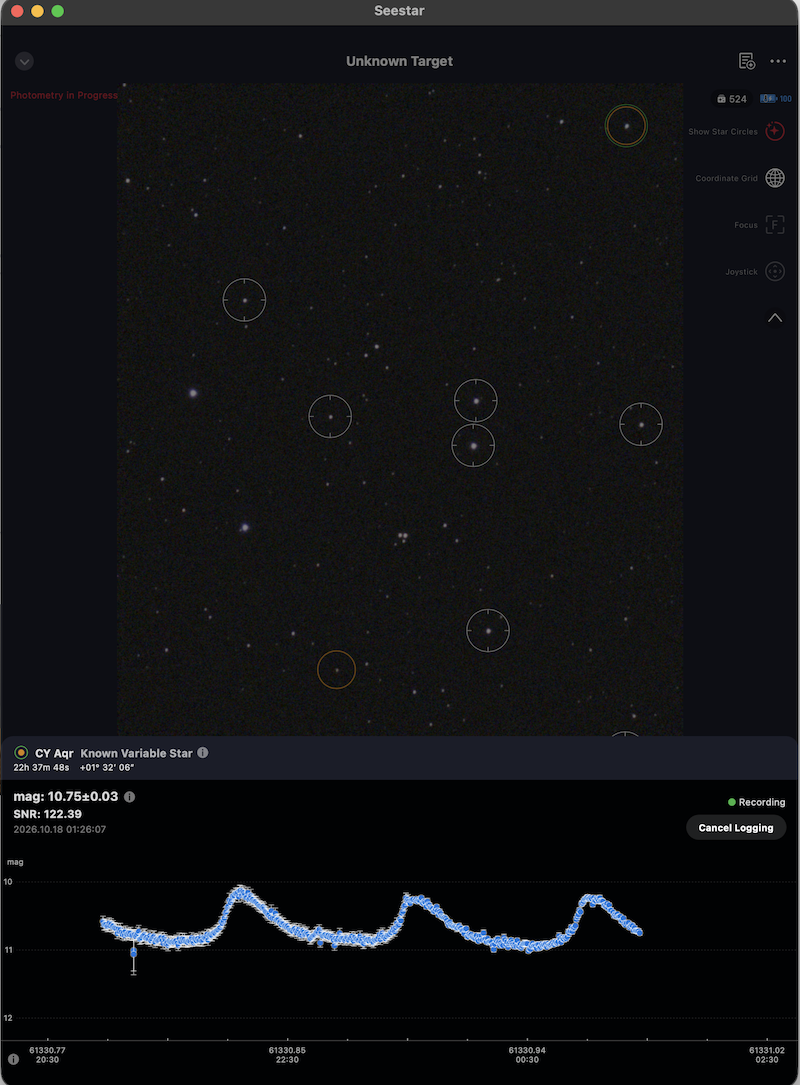
I tried the new photometry function last night.
I am not sure that I did everything correct, but it worked.
Here are 4 1/2 hours on CY Aqr.
Attachments:
18 October 2026 at 10:37 am #643440Andy WilsonKeymasterThat is a great result Lars. Thank you for sharing it.
Andy18 October 2026 at 10:37 am #643441 Robin LeadbeaterParticipant
If the results are used in publications what are you going to use as a reference to the method? It would be helpful if ZWO were to write up exactly what they are doing and submit it for peer review. Without that it is just reverse engineering and guesswork.
Cheers
Robin18 October 2026 at 8:30 pm #643457Robin LeadbeaterParticipantSomeone has just posted a “Seestar brightness” measurement of T CrB on Cloudy Nights
https://www.cloudynights.com/forums/topic/932002-blaze-star-t-coronae-borealis-starting-to-blow/page/16/#findComment-14867872
even allowing for the rather wide uncertainty of +-0.2 quoted (much larger than the stochastic uncertainty based on the claimed SNR of 58) the 9.2 magnitude is significantly brighter than the current V,CV,TG from the AAVSO data which is running around 10Cheers
Robin-
This reply was modified 1 week, 5 days ago by
 Robin Leadbeater.
19 October 2026 at 6:33 pm #643480 Sonia TurkingtonParticipant
That’s great news, thanks for the heads up about V3.4. It’s exciting to see ZWO leaning further into the “serious science with a smartscope” direction. The addition of a dedicated photometry mode could be a real game changer for anyone wanting to try variable star measurements or light curve projects without needing extra software. I’m looking forward to giving it a try and seeing how well it integrates with the existing workflow once I figure it out as variable stars is not my field. It might be now, owning all the seestar family.
19 October 2026 at 11:50 pm #643494 Alex PrattParticipant
Not wanting to provoke the ire of the experienced VS photometrists working to 0.02 mag or thereabouts, out-of-the-box ‘uncalibrated’ Smartscope photometry could provide light curves to estimate the minima of eclipsing binaries, to record when/if T CrB goes pop, etc.
All to get them interested in VS observing whilst the Smartscope developers and user base work on fine-honing their mag estimates.
Alex.
20 October 2026 at 8:00 am #643495 Nick JamesParticipant
Images from a Seestar S50 have been used to produce pretty good comet visual equivalent photometry although the process is currently quite complex. See, for example, the article by Andrew Pearce in Comet’s Tale 44 here:
20 October 2026 at 10:05 am #643496 Michael HatherParticipant
It sounds very innovative, and it’s good that ‘smart scopes’ are evolving. But surely the key in any scientific result is the process used to get there. If we are not sure how it’s arriving at its results then surely it should be inadmissible on that alone.
20 October 2026 at 10:19 am #643498 Melvyn JoslinParticipant
I have been a visual variable star observer and added my observations to the BAA database over a period of several years. I have now unfortunately have failing eyesight and this is only going to get worse, not better. So I thought it would be a great idea if I turned my attention to photometry instead. So over the past two years l have been trying to get to grips with the whole process. I have even attended a workshop on the subject but I left in a very confused state of mind and I have still not recovered from the experience. I have persevered since to no avail and have not added one observation to date to anything. So perhaps photometry is not for me. I admire the members who contribute their photometry observations to the BAA data list who have the skills to do so. Unfortunately the variable star membership is in decline so if there is a way of encouraging new membership to the section that must be great news. Now a telescope that not only finds an object but processes all the information and allows me to post my results to a database at the push a button is just fantastic news for me. Now should I get one or not that is the big question
20 October 2026 at 12:03 pm #643499Andy WilsonKeymasterUsing the photometry to derive eclipse timings or to issue alerts is a good idea, as long as sense checks have been done on the data. At this time, the magnitude estimates themselves would not go into a database like the BAA VSS, as it is important to know what they represent, as for example researchers may use the results to analyse long term trends. That could change if ZWO publish what the information about what the photometry represents.
From what I have seen, the new Seestar functionality does not produce a light curve, it creates a data file which you can use to create a light curve. So it is not quite an all-in-one package. I’ve seen posts where the data file has been fed into generative AI to create a light curve. For a fun exploration and basic education that is fine. However, as I am sure many on this forum are aware, gen AI processing cannot be trusted for scientific analysis as it may alter the data to match expectations or hallucinate. Using a spreadsheet is a better approach.
The number of variable star observers is holding up well and is not in decline. The number contributing does fluctuate from year to year, but they have stayed around 50-55 over the past few years and increased during the 2010s by around 10-20 observers. We see members contributing a variety of visual and digital photometry, with both remaining strong. As mentioned already, there is a need for easier to use software. Hopefully this will come, but good scientific software that is easy to use is often hard to come by.
20 October 2026 at 1:41 pm #643500Robin LeadbeaterParticipantAlthough I am not an active photometrist just mainly a user of the data, don’t AAVSO’s on line VPhot and Tonny Vanmunster’s Phoranso for example fully automate this process from images if that is what people prefer to do ?
If absolute values are needed though these would still need the input to be in some form of recognised passband or able to be transformed to some accepted system and to generate the raw data the user still needs to have some sort of understanding of what is important which could be harder to automate.
For example wouldn’t wide field photometry of seestar images need a flat field correction? (This would even affect photometry where only a relative measurement is needed if the target and reference stars are placed in different positions in the field) if so is this done and how ?27 October 2026 at 3:18 pm #643602Robin LeadbeaterParticipantConcerning the Seestar photometry feature, there is a bit of feedback from the AAVSO smart telescope working group on what they have determined so far
https://forums.aavso.org/t/status-update-from-the-aavso-smart-telescope-working-group/3073/111
Uses (the effectively unfiltered) gaia G as the reference and just the Seestar G channel apparently, (no colour corrections) and does not check for saturation of comp stars.
D- needs to improve ?
Robin
-
This reply was modified 3 days, 17 hours ago by Robin Leadbeater.
-
AuthorPosts
- You must be logged in to reply to this topic.