
Stargazers’ Almanac 2026
| By Callum Potter | Reviewed by Philip Jennings |
| Floris Books 2025 | 28 pages |
| Price £14.99 | ISBN:978-178250-945-5 |
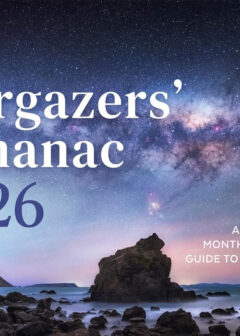
Jostling for space each winter among a small but impressive crop of astronomical guides, calendars and sky diaries, the annual Stargazers’ Almanac is of particular appeal in two respects. Firstly, it is targeted almost solely at the naked-eye observer. Secondly, it is beautiful, with large-format pages (42 × 30 cm) and pretty renderings of each month’s evening sky.
It is also, though, a publication that has long been synonymous with one man, being a product of the sparklingly energetic mind of Bob Mizon. A friend to many in the BAA, Bob was long-time Coordinator of our Commission for Dark Skies. His sudden death in 2023 was a blow to the Association, and to readers of his Almanac. Could it have a future without him?
Judging from the edition for 2026, produced by Floris Books and now under the stewardship of Callum Potter – Director of our Deep Sky Section – Bob would be delighted to see it in such good hands.
The big format remains. (Being untamable by most bookcases, it must either join those feral books that wander surfaces in the home that are meant for other things, or be hung on the wall – for which there is a hole in each page.) However, the layout has been updated, with a new introduction providing an excellent short guide to stargazing. Meanwhile, the old plastic wrapper has been replaced by a sturdy card envelope that offers better protection if the Almanac is ordered through the post.
For each month, there are star charts looking north and south, daily Moon phases, lunar and planetary rising and setting times, and helpful notes highlighting objects, events or facts of special interest. Occasionally, the brighter of the targets requiring optical aid receive a mention, highlighted by a binocular symbol.
The charts are as beautiful as ever, with the stars afforded colours and diffraction spikes. First-time stargazers will benefit from only naked-eye stars being shown, while the lines delineating the constellations are subtle enough to avoid making the patterns appear more obvious than they are. A particularly nice feature is that two horizons are rendered: one for the latitude of the southern UK (52°) and another for the northern USA and southern Canada (47°).
‘Realistic’ star charts such as these, with light-coloured stars against a dark sky, always suffer from being difficult to read under a dim or red light. But inverted charts, being less attractive and liable to confuse beginners, would be poorly suited for the Almanac, which is in any case better suited for reference in the warm than use in the field.
The Almanac’s perennial accessibility owes as much to what it contains each year as to what it does not. Well-meaning discussions of equipment in beginners’ guides can quickly lead to a bog of puzzling jargon, whereas here any such novice-traps are completely done away with. I therefore would not hesitate to recommend the 2026 Almanac not only to beginners, but as a gift idea for those poor lost souls who have shown no prior interest in astronomy and require a gentle steer in the right direction. A mere penchant for evening walks, or interest in the passing seasons, would be qualification enough to enjoy the Almanac and have an interest ignited.
Equally though, there is much for the more experienced observer to enjoy. The delights of naked-eye astronomy can all too easily be forgotten in the thrill of finding deeper views. But to treat it as solely the territory of the beginner is to dismiss every astronomer prior to the invention of the telescope. Looking up at the stars and seeking to understand them is a fundamental human experience, and for many telescopic observers, how their interest began. The Almanac continues to capture this simple joy of, to invoke the words of the poet Mykhailo Petrenko, ‘watching the sky and thinking a thought’. And that, I am sure, would gladden Bob’s heart.
Primarily a visual lunar and planetary observer, Philip is an astronomical writer and speaker who has been Editor of the BAA Journal since 2018
| The British Astronomical Association supports amateur astronomers around the UK and the rest of the world. Find out more about the BAA or join us. |