
Wood & Collins: Extreme Illumination Atlas of the Moon
| By Charles A. Wood & Maurice J. S. Collins | Reviewed by Barry Fitz-Gerald |
| Independently published 2025 | 187 pages |
| Price £44.75 (Hbk) | ISBN:979-8323588909 |
The golden age of visual selenography is well and truly a thing of the past. Few amateurs still press their eye to a cold eyepiece in an attempt to discern subtle topographic features of the lunar surface. And in 2025, why should they? The Moon has been besieged by fleets of robotic as well as manned spacecraft, and the high-quality imagery available should have rendered visual observations redundant. That was certainly the view amongst many in the BAA Lunar Section post-Apollo.
But now, with the prospect of renewed manned exploration, interest in our nearest neighbour has undergone a resurgence. This is reflected in a proliferation of lunar books, mostly in the form of atlases. Many of these are based on high-resolution imagery from the NASA Lunar Reconnaissance Orbiter (LRO) satellite, showing the surface as seen visually or topographically.
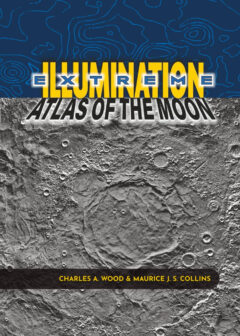
This latest addition to the lunar bookshelf is authored by veteran lunar authority Chuck Wood and Maurice Collins, a regular contributor to the Lunar Section Circular. Their previous collaboration, 21st Century Atlas of the Moon, featured mostly LRO and telescopic images, but one section included surface representations constructed from LRO Wide Angle Camera (WAC) mosaics re-projected using Jim Mosher’s Lunar Terminator Visualization Tool (LTVT) software, which emphasised low-amplitude topography such as mare ridges and swells. Their new offering builds on this by using the same technique to recreate the lunar surface, but with the simulated angle of illumination reduced to an outrageously low value of 0.1°, and from impossible directions such as north and south. This serves to throw the surface into grotesquely exaggerated relief, revealing features imperceptible in conventional imagery, and opening a new window to understanding surface processes and the connections between what would otherwise appear to be unrelated structures.
Veteran readers will recall the many ephemeral and sometimes suspect features recorded in the past by visual lunar observers, many examples of which can be seen in drawings in the pages of The Moon: 1950–1967, in the publications section of the Lunar Section web page. Many of these ‘features’ are not visible in any spacecraft imagery, leading to the original observations being questioned. But you only have to look at the BAA online Gallery to find images taken under grazing illumination that show subtle topographic features, as recorded visually. Often the reason such surface features are not seen in spacecraft images is that these tend to be taken at higher illumination, when they are invisible. Hence, the continued value of amateur imaging or visual observation – and the relevance of this publication.
After a brief introduction to the techniques used and a quick geological primer, the authors divide the book into sections which cover specific areas on the near and far side, using the low-angle and novel illumination directions to reveal features of extremely low amplitude. This highlights the complex forms of wrinkle ridges, as well as their relationship to each other and submerged features such as basin rings. Less well-known landforms such as lunar swells are also particularly well visualised; these may represent evidence for subsurface volcanic intrusions, or other as-yet-undetermined geological processes.
The areas covered vary in extent from broad regions such as the maria and basins to individual craters and volcanic regions. Many of the simulated images are accompanied by an LRO WAC image, which serves to orientate the reader and also shows that most of what is revealed is virtually undetectable in the conventional views. Apparently unremarkable plains, such as the maria or the floors of flooded craters such as Ptolemaeus, are shown to be anything but, some having a surface texture contorted into something reminiscent of elephant hide. The low-angle illumination also serves to reveal links in otherwise apparently separate graben, and identify areas of flat, featureless terrain indicative of young surface lava flows.
The illustrations, due to the technique used, appear ‘grainy’ compared to the high-resolution LRO images we are used to, but the wealth of detail is impressive, and the resolution is at an appropriate level to show the features discussed. The authors have avoided cluttering the images with annotations, instead locating features by use of grid coordinates. I found identifying features under discussion in the accompanying text a bit tricky, but if you have ever played ‘Battleships’ this should not be an issue! Each area’s newly revealed landforms are described, with potential geological interpretations of what we see. This analysis is of course aided by Wood’s profound knowledge of the Moon, its history and geological processes.
The Contents page contains a numbered list of the areas illustrated and discussed – 90 in total, with the predominance of these being on the near side or in the libration zones. The far side, lacking the vast tracts of mare that are particularly well visualised using this technique, receive less attention, but some particularly interesting areas there such as basins are included. There is an index of features at the end of the book, as well as a bibliography.
Who is this book for? Not, I would think, the casual observer, but the dedicated amateur lunar geologist, or someone wishing to gain a deeper insight into the structure and evolution of our nearest neighbour. Those with a working knowledge of lunar surface processes, as well as the more advanced selenophile, will gain a lot from the images, which achieve the aim of revealing the subtlest of topographic features, often relating to deeper subsurface structures which are forever hidden from view. The analysis provided is detailed but allows the reader to draw their own conclusions, as the views are still quite novel and their interpretation, as always, is a work in progress that you can contribute to.
Obviously, it is not meant for use as a visual atlas in any way, and someone looking for such a resource would be better served by Wood and Collins’ previous publication or the numerous other photographic lunar atlases based on the LRO images. Similar low-amplitude surface features can be visualised using the various ‘Terrain’ widgets in the extremely useful ‘Quickmap’ tool hosted by the Lunar Reconnaissance Orbiter Camera website (lroc.im-ldi.com/), but the Extreme Illumination Atlas of the Moon reveals topography that is many times more subtle. This book will withstand multiple visits due to the sheer volume of information.
The title is published independently but is available from Amazon at £44.75: a price which may deter but is not unusual for something of this specialist nature. The review copy was well bound in glossy hard-cover boards, and the illustrations and text were clear and sharp.
Barry Fitz-Gerald is a member of the BAA Lunar Section and researches the Moon’s geology using spacecraft data. He is a regular contributor to the Section publications.
| The British Astronomical Association supports amateur astronomers around the UK and the rest of the world. Find out more about the BAA or join us. |