
Sky notes for 2026 April & May
2026 April 1
April still has acceptably long nights, and they tend to be warmer than earlier in the year. By May, however, the ‘silly season’ is well underway. More comfortable observing must then be balanced against the prospect of a shortened night’s rest. To add insult to injury, the Solar System is proving awkward to nigh impossible for observers, with only Venus and Jupiter offering much to enjoy.
The deep sky
Despite British Summer Time’s arrival at the end of March, April still offers good opportunities for rewarding deep-sky observing. The Milky Way is largely absent, allowing us to probe the Realm of the Galaxies, near and far. The Virgo Galaxy Cluster dominates the season, but several nearer galaxy groups are also on show and are arguably more rewarding for those seeking detail in these star cities.
South of Virgo lies Corvus, the Crow, marked by four stars forming a distinctive trapezoid. Although low from the UK, it is worth exploring for the fine planetary nebula NGC 4361, and the fascinating merging pair of galaxies NGC 4038 and NGC 4039.
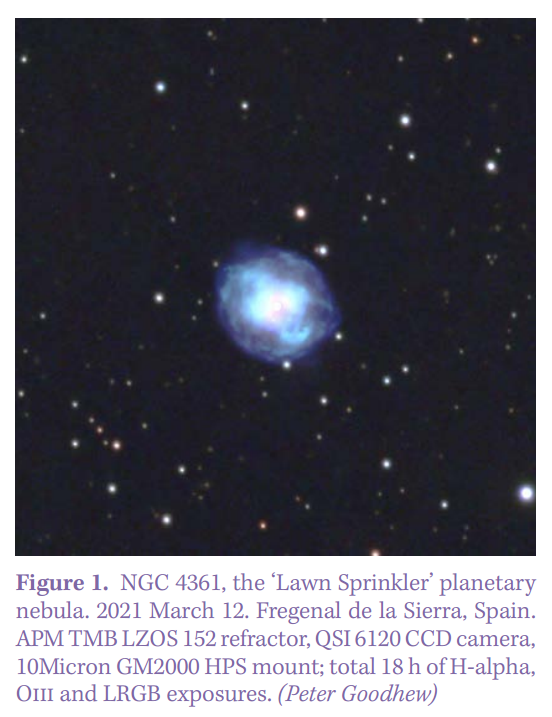
NGC 4361 is sometimes known as the ‘Lawn Sprinkler’ planetary (Figure 1). It can be overlooked amid the rich galaxy fields of spring, but it is well worth seeking out as it is both reasonably large and fairly bright. Its round disc, measuring 1.9 × 1.9 arcmin, shines at magnitude 10 (V) and lies within the keystone of central Corvus. It forms a triangle with delta and gamma Corvi and could easily be mistaken for a galaxy, as two curved extensions within a faint halo may resemble spiral arms surrounding a bright core. This ‘core’ is in fact the 13th-magnitude central star. William Herschel discovered the nebula in 1785 but did not place it in his planetary nebula class (IV). No colour is seen.
While in the vicinity, take a look at delta Corvi for stimulation of your rods – a neat double star with a separation of 24 arcsec. The primary is of 3rd magnitude, its companion 9th, making the pair easy enough for small telescopes. They appear white and orange, the secondary being of type K, although lilac has also been recorded (Webb, 1907).1
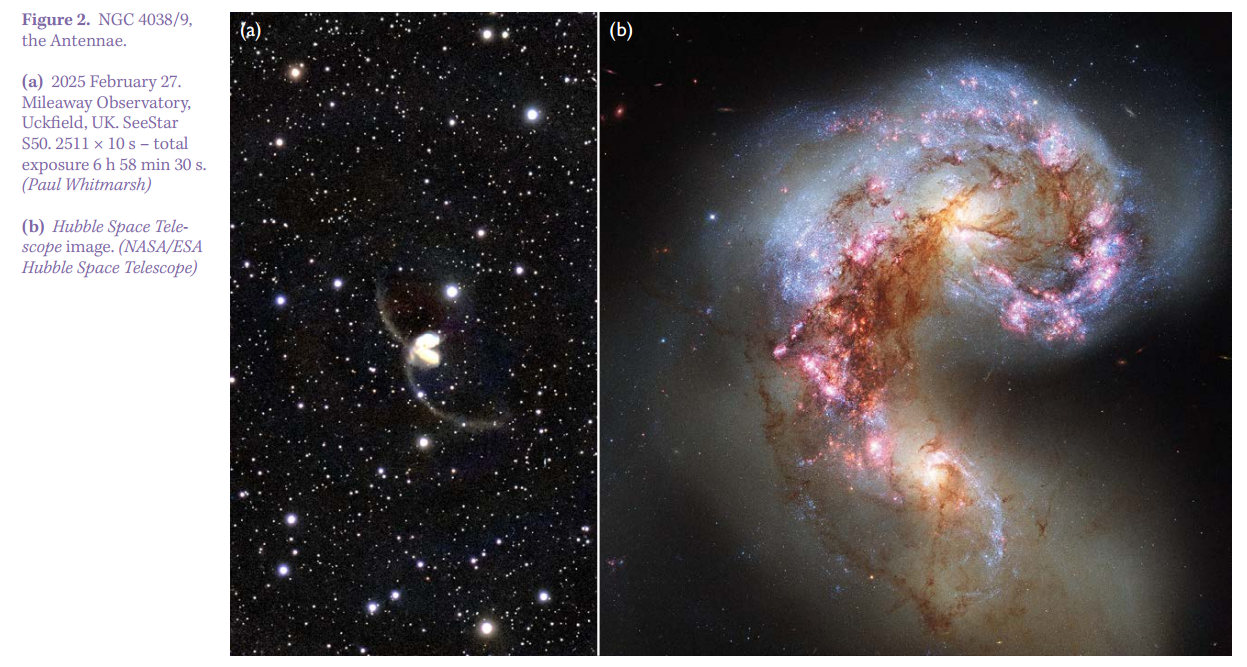
The Antennae (NGC 4038/9; Figures 2a & 2b) are among the finest examples of interacting galaxies in the heavens, undergoing extraordinary starburst activity as a result. Located west of Corvus’ trapezoid and forming a triangle with gamma (Gienah) and epsilon Corvi, they are around 10th magnitude. In telescopes with adequate aperture, they appear as an irregular mass with a hollow toward the southwest. NGC 4038 is marginally brighter and larger than NGC 4039 and has bright knots in its periphery, the starburst activity being spectacular on detailed images. The two tidal streams that give the pair their nickname have been ejected during the interaction and consist of gas and stars.
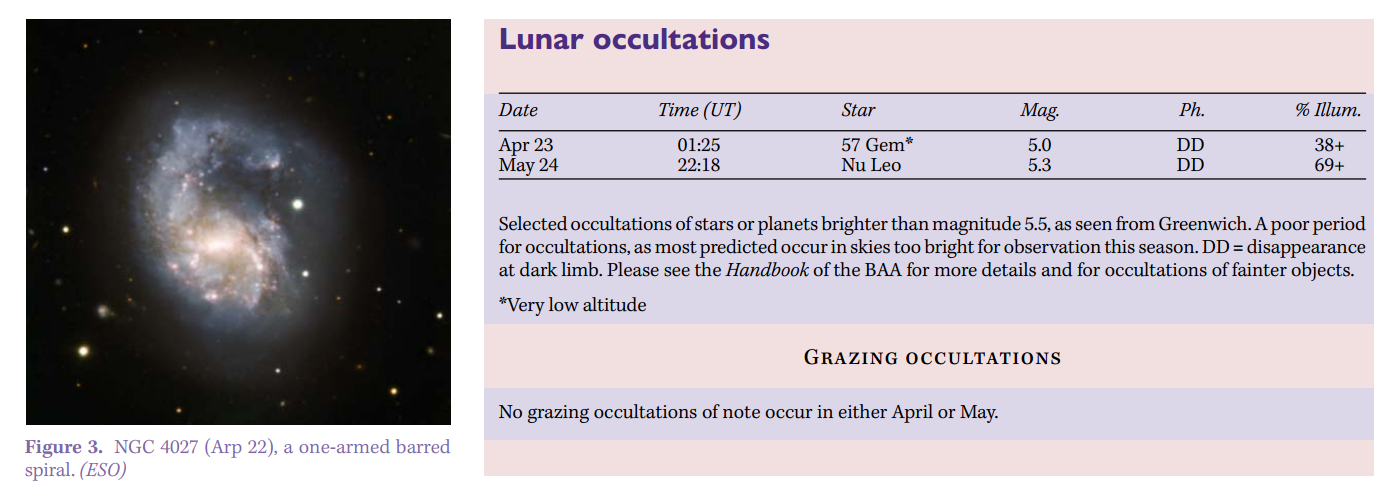
Just to the southwest lies the fine barred spiral NGC 4027 (Figure 3). Its strongly asymmetric, almost single-armed appearance is probably the result of an encounter with the tiny, faint companion NGC 4027A, about 5 arcmin to its south. The system appears in Halton Arp’s Atlas of Peculiar Galaxies as Arp 22. The main galaxy is magnitude 11 and measures 3.2 × 2.7 arcmin. It is worth a look visually with large telescopes, and a rewarding imaging target.
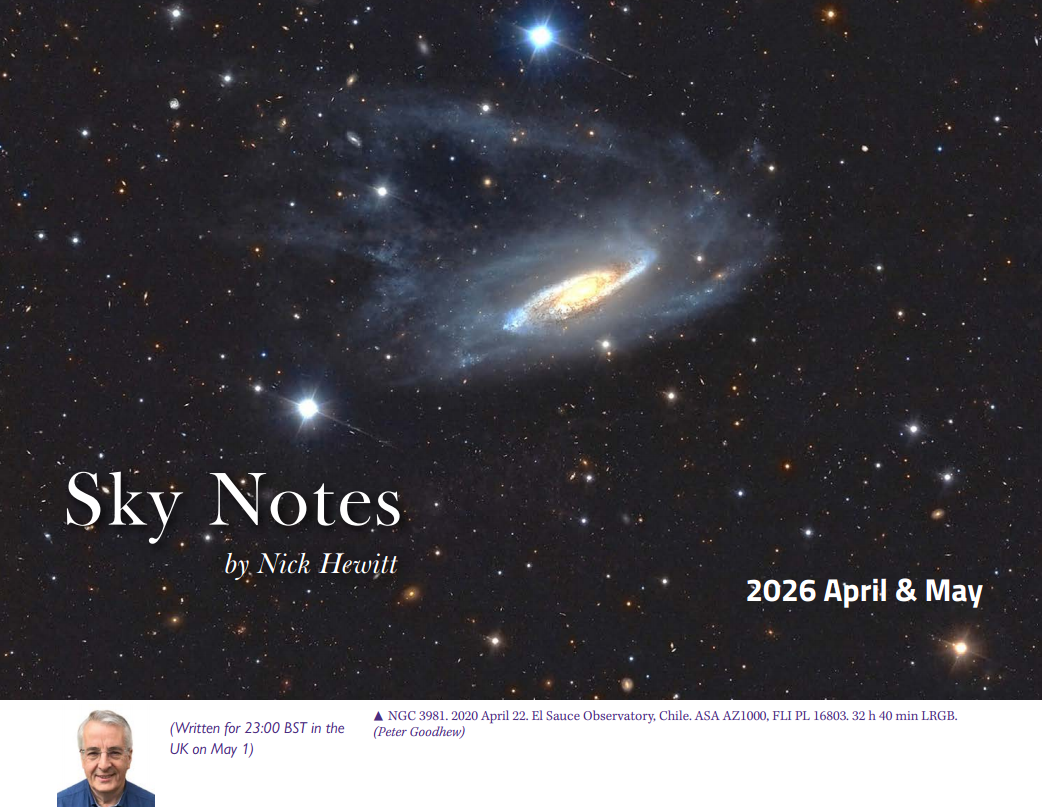
Extend a sweep a short distance further and you will enter the faint constellation Crater, the Cup. It is indeed shaped like a goblet – although this cup is more than half empty, almost drained completely of interest. The finest galaxy in Crater is NGC 3981 (see image on p. 137), discovered by William Herschel in 1785 and part of the NGC 4038 group within the Virgo supercluster. The great sweeper of galaxies found a total of 26 in Crater, although all are around 11th magnitude.
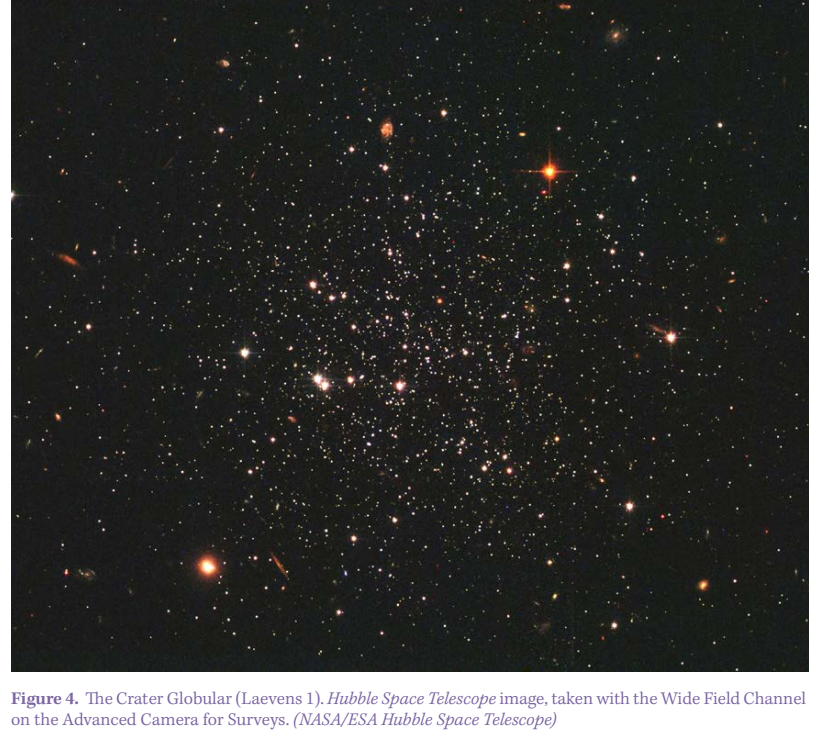
Crater does contain one of the Milky Way’s more recent discoveries: a globular cluster, Laevens 1 (Figure 4), known as the ‘Crater Globular’. It was discovered only in 2014 by the VST ATLAS Survey – a wide-field optical survey carried out with the VLT Survey Telescope in Chile. It is relatively young by globular-cluster standards, perhaps about 7.5 billion years old, and only about 10,000 solar masses. It remains under study and could yet prove to be a dwarf galaxy, as it is very distant at 470,000 light-years. Being extremely faint, it is unlikely to interest the amateur observer.
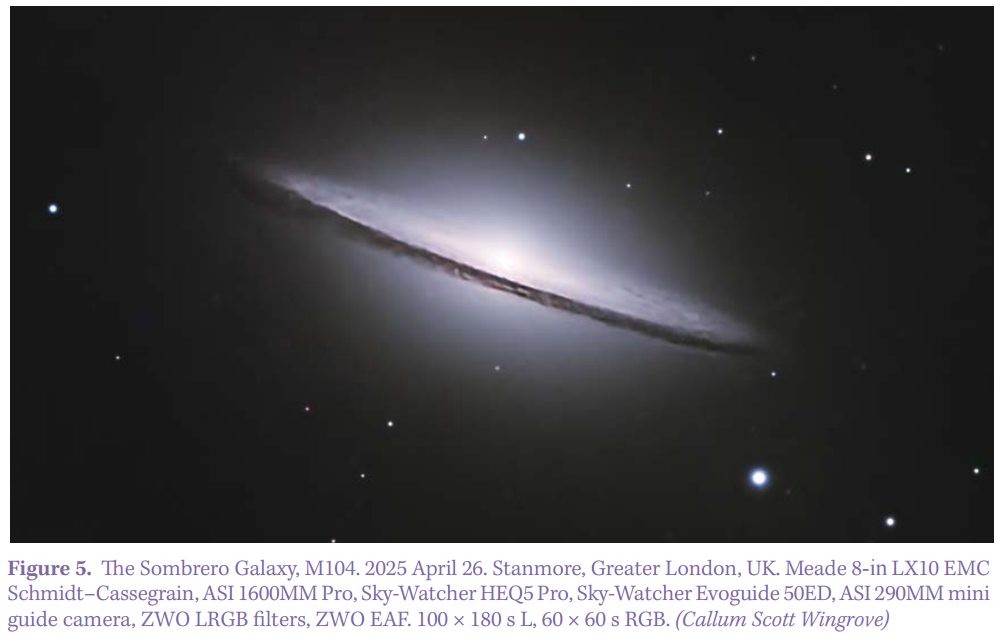
Southern Virgo straddles Corvus and is stuffed with NGC galaxies, but the best in the vicinity is Messier 104, the Sombrero Galaxy (Figure 5), lying 11.5 degrees west and slightly north of first-magnitude alpha Virginis (Spica). At 8th magnitude it is bright, and identification is helped by a stubby arrow of 7th- and 8th-magnitude stars pointing the way. It is unusual in many ways. Its thin but obvious dust lane is about 2,500 light-years thick and traverses a bright, prominent bulge that conceals one of the most massive black holes in our galactic neighbourhood, estimated at one billion solar masses, at a distance of 30 million light-years. Even now its classification is unclear; most recently, it has been suggested that the galaxy may be in transition from spiral to elliptical.
Sweeping north from the Sombrero, we reach Porrima (gamma Virginis), the famed binary that is currently quite easily separated and slowly widening, the pale-yellow pair being almost identical at magnitude 3.5. They orbit each other over 168.93 years and were impossible for amateurs to split in 2011. Porrima marks the lowest point of a large imaginary arc running from nu Virginis in the northwest to Vindemiatrix (epsilon Virginis) in the northeast, forming the southern aspect of the so-called Bowl of Virgo. Within this region, we encounter the lower reaches of the giant Virgo Galaxy Cluster proper.
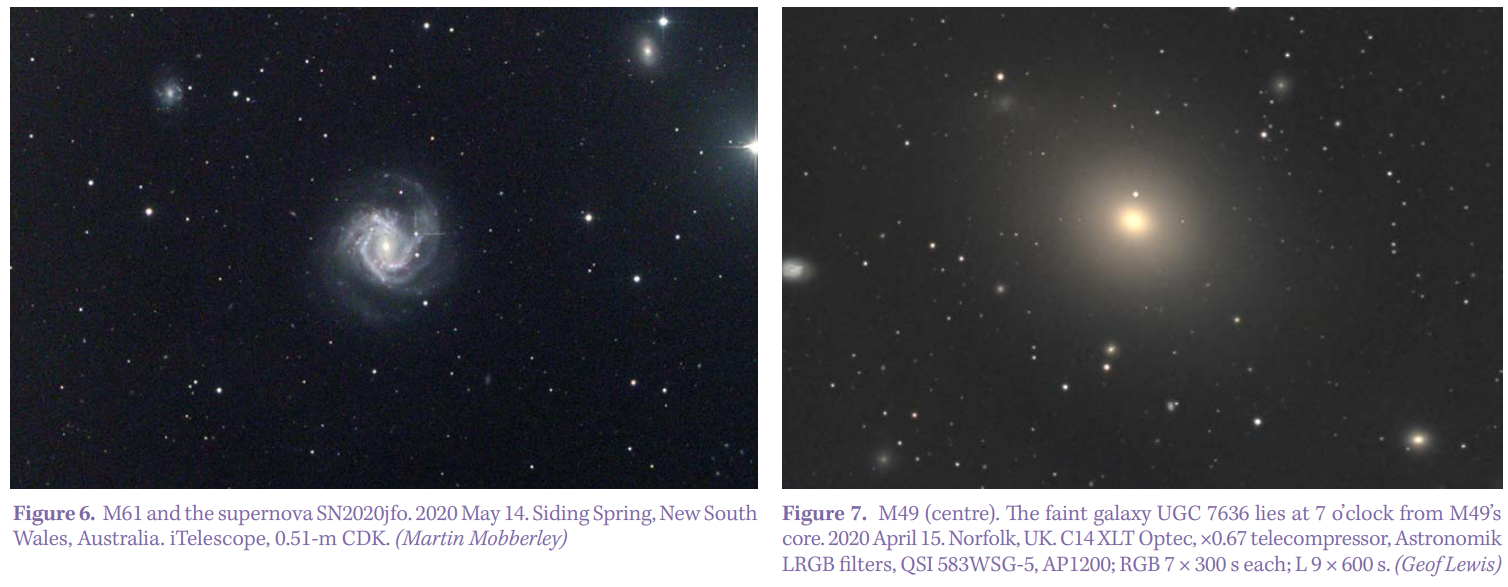
There are so many galaxies to choose from in the Bowl, but we will focus on just two from Charles Messier’s catalogue: M61 and M49. M61 (Figure 6) is a face-on spiral just northeast of 16 Virginis and at magnitude 9.6, is fairly straightforward to locate. It spans 6.5 × 5.6 arcmin and has a small bright core, with prominent spiral arms visible in larger telescopes. It has hosted eight supernovae in the past century, the first being 1926A. It shares the field with NGCs 4303 and 4292.
About 3 degrees northeast of M61 lies M49 (Figure 7), an elliptical galaxy often regarded as visually dull and hence ignored. Yet here we enter a richer field, with many fainter galaxies swarming around this 8th-magnitude dominant beast, the second most massive in the Virgo Cluster after M87 and regarded as the southern centre of the cluster. It was the first of the Virgo Cluster galaxies to be observed when Messier spied it on 1771 February 19. M49 may be in the process of absorbing the very faint galaxy UGC 7636 to its southeast. A tidal tail associated with this interaction was discovered in 1994, leading to M49’s inclusion in Arp’s catalogue as Arp 124. Even so, the interaction is a pale shadow of the drama seen in the Antennae!
Further north, the Bowl overflows with a veritable froth of galaxies forming Markarian’s Chain and beyond, with its rich population of much-observed and frequently imaged favourites.
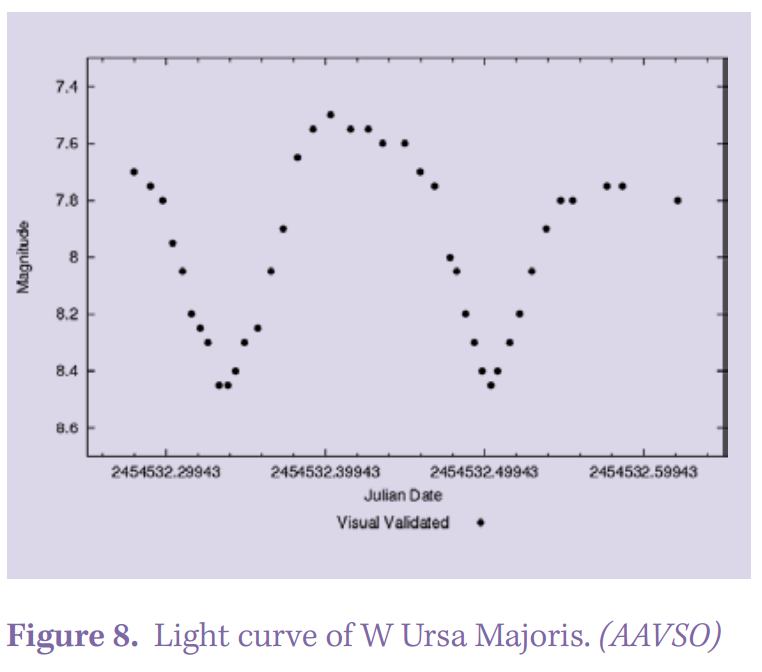
If you become weary of galaxies, remember that the BAA’s Variable Star of the Year is well placed high in the east by April in Ursa Major: W Ursa Majoris. This extraordinary star is easy to find, preceding the Pointers, Dubhe and Merak. Small telescopes or large binoculars will reveal the 7.9-magnitude star and allow you to follow its continual change in brightness over its 8-h period (Figure 8). This very short-period eclipsing binary has both components in contact! See the BAA Handbook 2026 pp. 106–7 for more details.
The solar system
Moon & Sun
Our star climbs steadily higher as summer approaches. It remains very active, so keep an eye out for aurorae, with spectacular displays possible, as was the case on 2024 May 10.
There are no eclipses of either the Sun or Moon during these months.
Planets
Although Mercury is at greatest western elongation on April 3, it is far too low for observation from the UK. It reaches superior conjunction on May 14, then remains very low in the evening twilight at the end of May. It may be glimpsed to the right of Venus, and by early June will be visible at magnitude 0.6 if a very flat horizon can be found. Its disc is 8 arcsec and shows a crescent phase at eastern elongation on June 15.
Venus, our shrouded, enclouded twin, appears low in the western sky in the early evenings of April but, at magnitude −3.9, is easily seen. By May, it is a splendid sight between the horns of the sinking Taurus. By early June, it has climbed to shine brilliantly on the borders of Gemini after sunset, its gibbous disc subtending 13 arcsec. Its rather small apparent size makes features in its atmosphere difficult to discern. It has a close encounter with Jupiter in early June soon after sunset.
Mars remains in too bright a morning sky in April and is then too low during May.
Jupiter is still quite well positioned in April but lingers in a bright sky during May before its close conjunction with Venus in early June.
Saturn is slowly emerging into the dawn sky but remains too low, and thus poorly placed in May. It has moved into Pisces and should be nicely placed by its October opposition, although by then it will have wandered into Cetus – just to confuse the astrologers. Its rings will be opening a little by then.
Uranus lies near Venus in April but is hardly worth seeking in the bright twilight before it reaches conjunction on May 22.
Neptune remains mired in the pre-dawn sky during April and May, so is not worth attempting this season.
Dwarf planet 3 Juno is in the morning sky in southern Aquila at magnitude 11.
Meteors
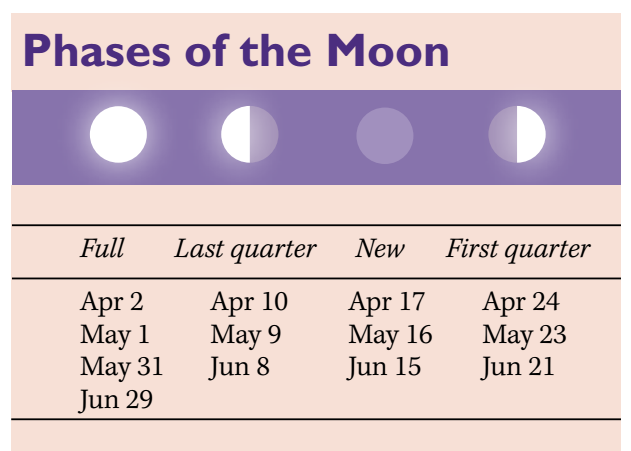
The April Lyrids start the spring meteor showers with a maximum on April 22. A waxing crescent Moon should not interfere significantly, despite setting late. Although the shower is rarely rich, there have been good years, such as 1922 and 1982. Now in Hercules and ten degrees west of Vega, the radiant is high in the eastern sky at midnight. The Lyrids have a typical Zenithal Hourly Rate of 15, but the shower can occasionally surge to a ZHR of 100. Dust from long-period comet C/1861 G1 (Thatcher) is responsible, and the Lyrids are thought to be the longest-known meteor shower, with records dating from 687 BCE.
The Eta Aquariids are the best meteor shower of this period, with maximum activity between May 5–7. These meteors originate from debris left by comet 1/P Halley and form the spring equivalent of the autumnal Orionids. The shower is best seen an hour before morning twilight, but the low Moon in Sagittarius, in a waning gibbous phase, compromises the display.
Comets
Two objects may perform well in April, but one never can tell with comets! The more promising of the two is C/2025 R3 (PanSTARRS), a long-period comet that reaches perihelion on April 19 and could reach 3rd magnitude when nearest to Earth on April 26. It is a morning target, but quite low from the UK, as it moves from Pegasus, through Pisces, into Cetus from mid-April to early May.
By the time this April Journal reaches you, we may already know how the other comet will behave. C/2026 A1 (MAPS) is a Kreutz-family comet that reaches perihelion on April 4, passing less than 200,000 km from the solar surface. Kreutz-family comets often break up near the Sun and can be spectacular as they do so – or fizzle out in a whimper. C/2026 A1 MAPS was discovered on January 13 in the constellation Columba and is heading north, but it will always be a challenging target from the UK. In early April, it could be wonderful, although best seen from locations further south than the UK. See Nick James’ blog on the BAA website for updates. Let us hope it survives!
1 Webb T. W., Celestial Objects for Common Telescopes, 5th ed. (revised Espin T. E., 1894), Longmans, Green & Co., London, 1907
| The British Astronomical Association supports amateur astronomers around the UK and the rest of the world. Find out more about the BAA or join us. |