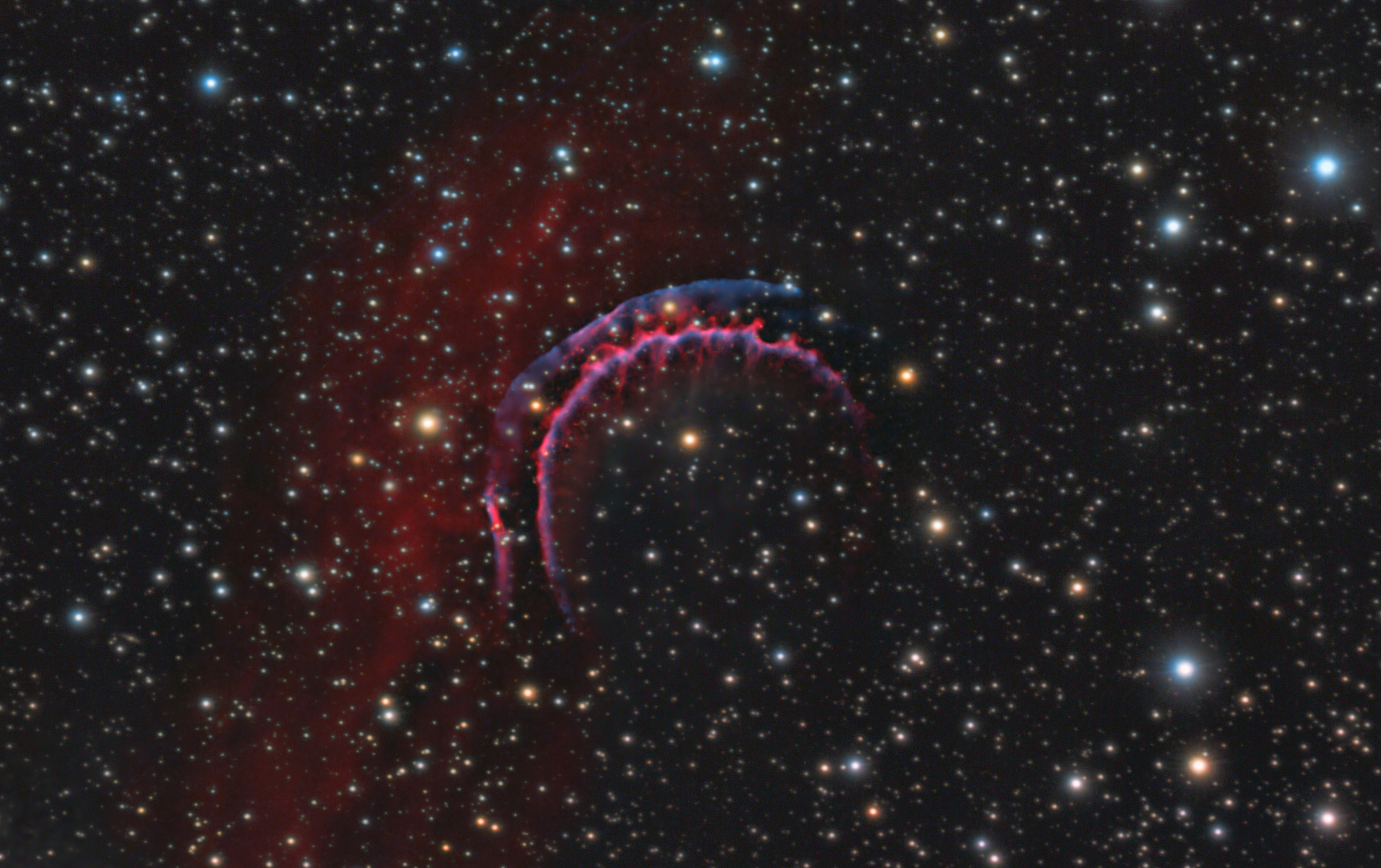
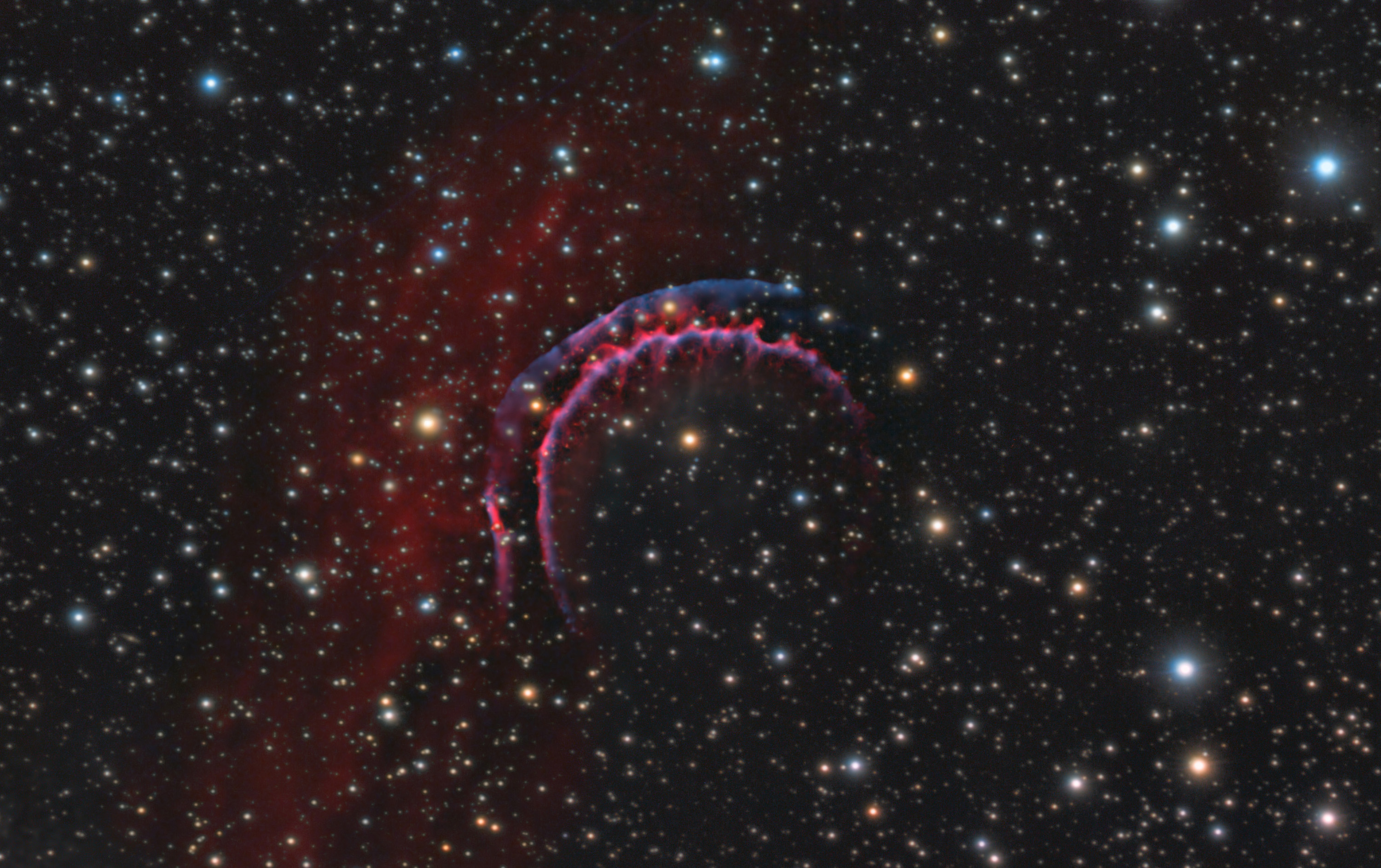
Observation by Peter Goodhew FRAS: Hartl-Dengel-Weinberger 3 (HDW 3)
Uploaded by
Peter Goodhew FRAS
Observer
Peter Goodhew FRAS
Observed
2019 Dec 08 - 17:55
Uploaded
2019 Dec 16 - 17:58
Planetarium overlay
Constellation
Perseus
Field centre
RA: 03h27m
Dec: +45°25'
Position angle: -3°42'
Field size
0°36' × 0°22'
Equipment
- APM TMB 152 LZOS refractors
- QSI6120wsg8 cameras
- 10Micron GM2000 HPS mount
Exposure
HaOIIILRGB 71.5 hours total integration
Location
Fregenal de la Sierra, Spain
Target name
Hartl-Dengel-Weinberger 3 (HDW 3)
Title
Hartl-Dengel-Weinberger 3 (HDW 3)
About this image
Hartl-Dengel-Weinberger 3 (HDW 3, PK149-09.1, PNG149.4-09.2) is an extremely faint ancient planetary nebula in the constellation Perseus. It is so faint that it is very rarely imaged.
The progenitor star is the small blue star at the 5 o-clock position just below the large yellow star in HDW 3. The progenitor is not, as one would expect, in the centre of the nebula. This is because it is moving rapidly in a north-westerly direction. It is moving through a dense area of interstellar medium (ISM). This ISM is slowing down HDW 3, creating a shock front and the unusual "braided" appearance. As the star isn't slowed by the ISM it has continued to move and is thus no longer at the centre of HDW 3 and is slowly overtaking HDW 3. This causes the shock front to be brighter as it's getting more ultraviolet radiation, whereas of opposite side of HDW 3 is getting less UV radiation and has become invisible. This movement of the star causes differential excitation of the shell. OIII emission, which requires higher energy of the ionizing radiation than HII emission, only happens close to the star.
Files associated with this observation
Like this image
Jeremy Shears,
Mike Foylan,
David Basey,
Andy Wilson,
Mr Michael Alan Frost,
Graham Winstanley,
Callum Potter,
Tim Haymes,
Honor Wheeler,
Peter Carson,
Andrew Dumbleton
Comments
Intriguing object.
I'm curious, what software are you using to process these images?
Hi Grant, I use CCDSTACK2 for pre-processing (calibration, registration, data rejection and stacking) and then Photoshop CS2 for processing. Peter
Thanks.
I was just struck by the relative sharpness of the highly coloured curved bits of nebula compared to the stars. Wondered how that came about.
Two ways Grant:
1. Capturing lots and lots and lots of data. Around 60 hours of narrowband data to get a strong enough signal-to-noise ratio.
2. The use of edge-detection filters in Photoshop (High Pass filter in this case) to bring out the clarity needed. I first removed the stars to prevent them from disturbing the High Pass filter using the healing brush, and then added them back in afterwards..
Copyright of all images and other observations submitted to the BAA remains with the owner of the work.
Reproduction of work by third parties is expressly forbidden without the consent of the copyright
holder. By submitting images to this online gallery, you grant the BAA permission to reproduce them in
any
of our publications.