
2026 February 22
C/2026 A1 (MAPS) – A Kreutz group sungrazer
See the latest update below.
Predictions for this comet are starting to appear in the main-stream media so I thought that it would be a good idea to provide some detail for BAA Members.
The comet was discovered by the MAPS team (Alain Maury, George Attard, Daniel Parrott and Florian Signoret) on 2026 January 13 using a telescope near San Pedro de Atecama in Chile. Their discovery system uses four Celestron 0.28m, f/2.2 RASA telescopes each with a 60 Mpix ASI6200MM at the focus. The overall system has a field of view of 3.3 x 8.8 degrees and analysis is performed using Tycho Tracker. The discovery was announced on CBET 5658 when the comet was designated C/2026 A1 (MAPS). At the time of the discovery the comet was in the southern constellation of Columba. It is moving slowly north towards its encounter with the Sun in early April. The BAA archive of images for this comet is here.
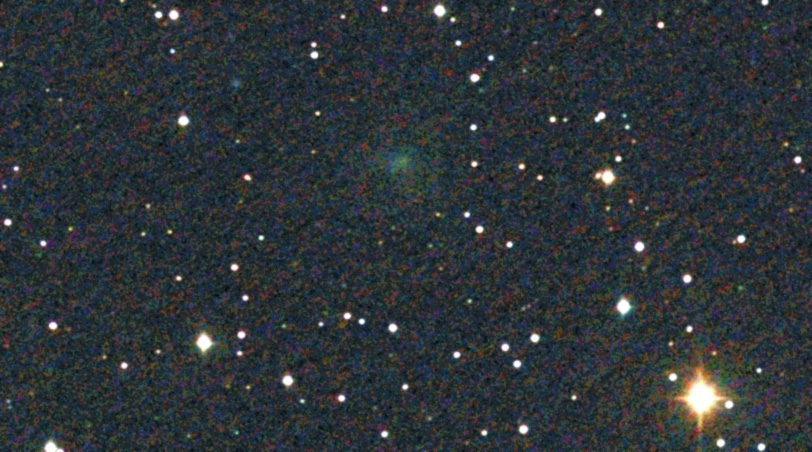
The initial orbit indicated that this comet was a member of the Kreutz group of sungrazers. This is a family of cometary nucleii that may have originated from the break-up of a huge comet seen by Aristotle in 371 BC. All the Kreutz comets have similar orbit orientations and very small perihelion distances. This discovery is the earliest that a Kreutz comet has been discovered with discovery occurring 81 days before the April 4 perihelion. The latest orbit shows that this comet has a perihelion distance of 0.0057 au or 855,000 km. Since the Sun’s radius is 696,000 km this comet will skim only 158,000 km above the photosphere at around 13:30 UT on 2026 April 4.
Kreutz comets have been some of the most spectacular in history. The Great Comet of 1882 (C/1882 R1) came to perihelion in 1858 September and was visible in broad daylight near the Sun’s limb. More recently, Comet C/1965 S1 (Ikeya-Seki) came to perihelion on 1965 October 21 and it was a spectacular sight in the morning sky in late October and early November. Both comets were observed to break up after perihelion and this is a frequent fate for Kreutz comets due to the fierce solar heating and tidal disruption that they encounter that close to the Sun. A recent paper on Arxiv by Sekaninia provides some interesting background on how C/2026 A1 compares with other Kreutz comets.
At the moment we don’t really know what C/2026 A1 will do. Early indications are that it is brightening rapidly and that it is a reasonably large fragment. It is currently around 13th magnitude but it is very difficult to predict how bright it will become. In any case it will be very close to the Sun at its brightest. It you can access the comet at its current southern declination it would be valuable to make total magnitude estimates and submit these to COBS. Nicolas Lefaudeux has produced a very useful comparison of this comet with other Kreutz members here and the post-perihelion evening sky charts here are based on his tail simulations. Unfortunately, even if the comet does perform it will be a challenging target from UK latitudes. Much better views will be had the further south you can get. Potentially, though, we might have a display similar to C/2011 W3 (Lovejoy) in 2011.
At the moment we have no idea how this comet will perform but things will become clearer over the next month. In any case it is worth being prepared. I’ll update this page in a few weeks when we have a better idea of the magnitude evolution.
Update 2026-03-23: Recent observations using JWST indicate that the comet’s nucleus is around 400m in diameter. This is quite small and towards the lower end of estimates for C/2011 W3 (Lovejoy). The initial rapid rate of brightening has slowed down and the comet is currently around magnitude 10. At present the activity is gas dominated and this brightness, together with the nucleus diameter, indicates that a lot of the outgassing is already coming from fragments which is probably bad news. The comet is currently 0.56 au from the Sun. Magnitude estimates are becoming increasingly difficult as the elongation drops but observations over the next 10 days will be critical. If it survives for the next week we would expect dust to start making a significant contribution to the magnitude as the comet passes 0.3 au inbound. The most likely scenarios at the moment is fragmentation well before perihelion, in which case we see nothing post-perihelion, or fragmentation at perihelion, in which case we may see something like C/2011 W3 (Lovejoy) in the western evening sky starting around April 9. The latest images of this comet are in our archive here.
Update 2026-04-08: The comet didn’t survive perihelion so there was nothing to see in the western evening sky.
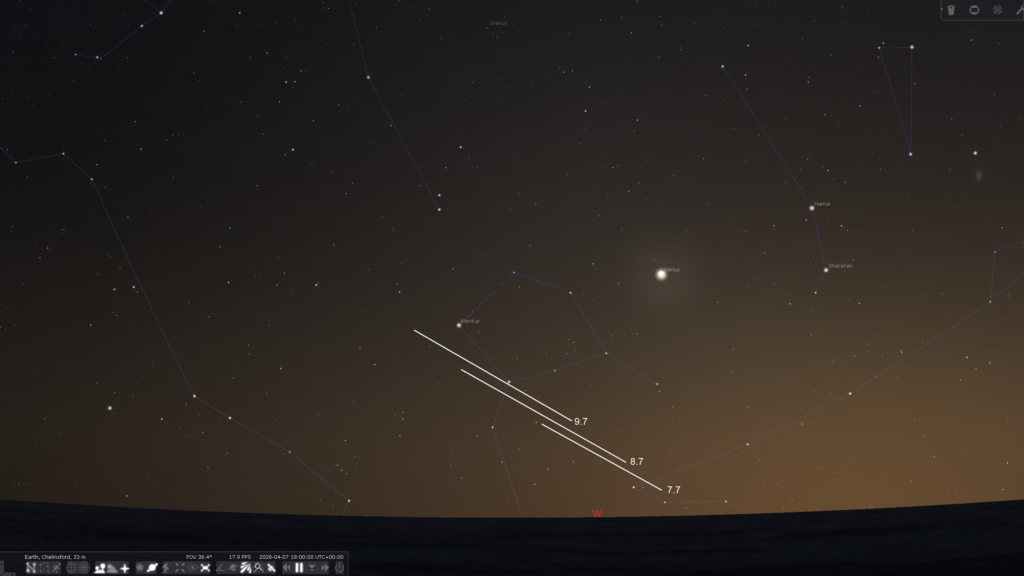
Post perihelion tail orientation in the evening sky April 7,8 and 9 from 52N. 20 minutes after sunset.
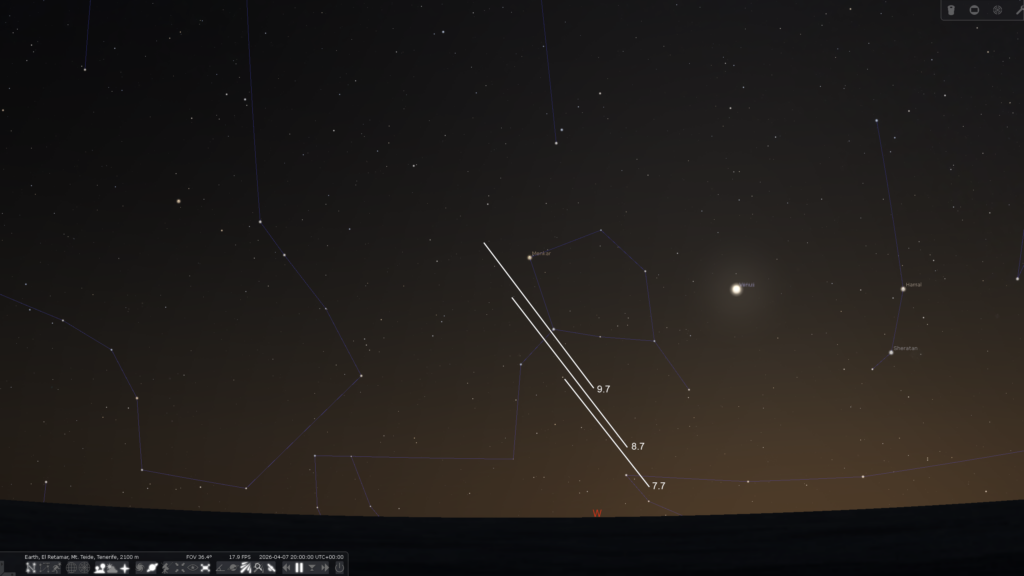
Post perihelion tail orientation in the evening sky April 7,8 and 9 from 28N. 30 minutes after sunset.
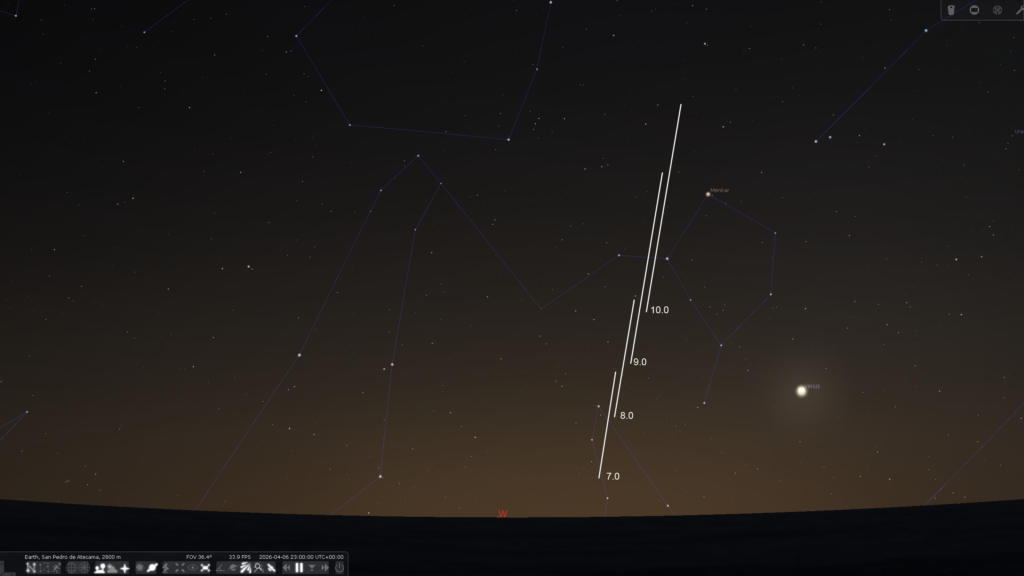
Post perihelion tail orientation in the evening sky April 7,8,9 and 10 from 22S. 30 minutes after sunset.
| The British Astronomical Association supports amateur astronomers around the UK and the rest of the world. Find out more about the BAA or join us. |