
2026 April 4
Deep Sky Update – April 2026
I was lucky to get a couple of hours observing with the Seestar S50 in March, and a couple of evenings aurora observing. Aside from those, it was another windy month without much in the way of clear skies. With the lighter nights now upon us, up here in Orkney April will be about it for deep sky observing until later in August, when we start to get some astronomical darkness again.
Owen Brazell (1957-2026)
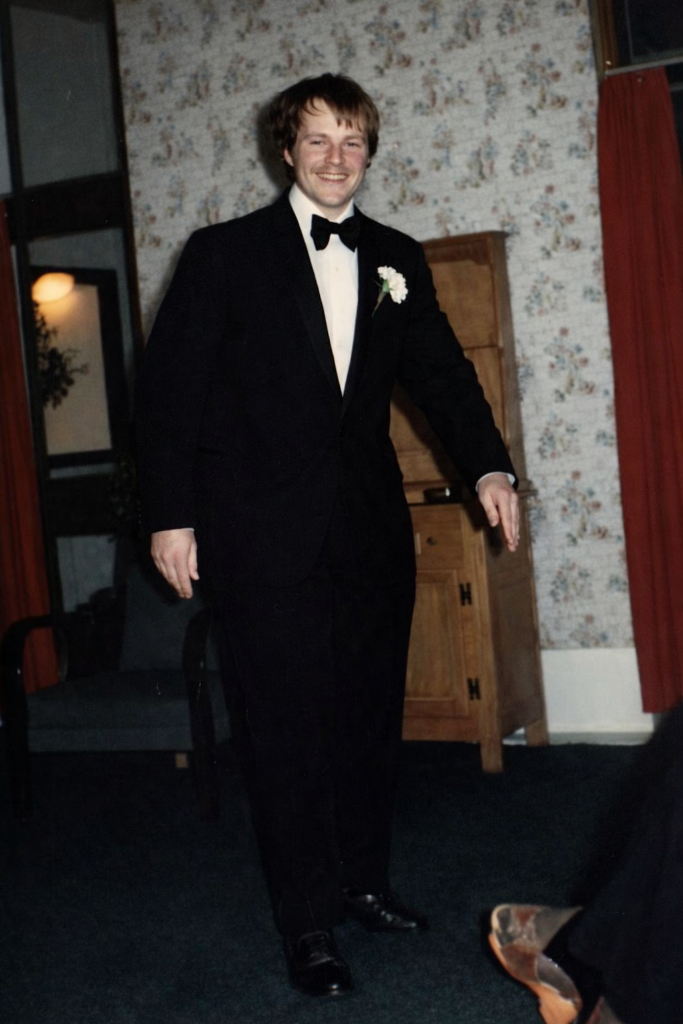
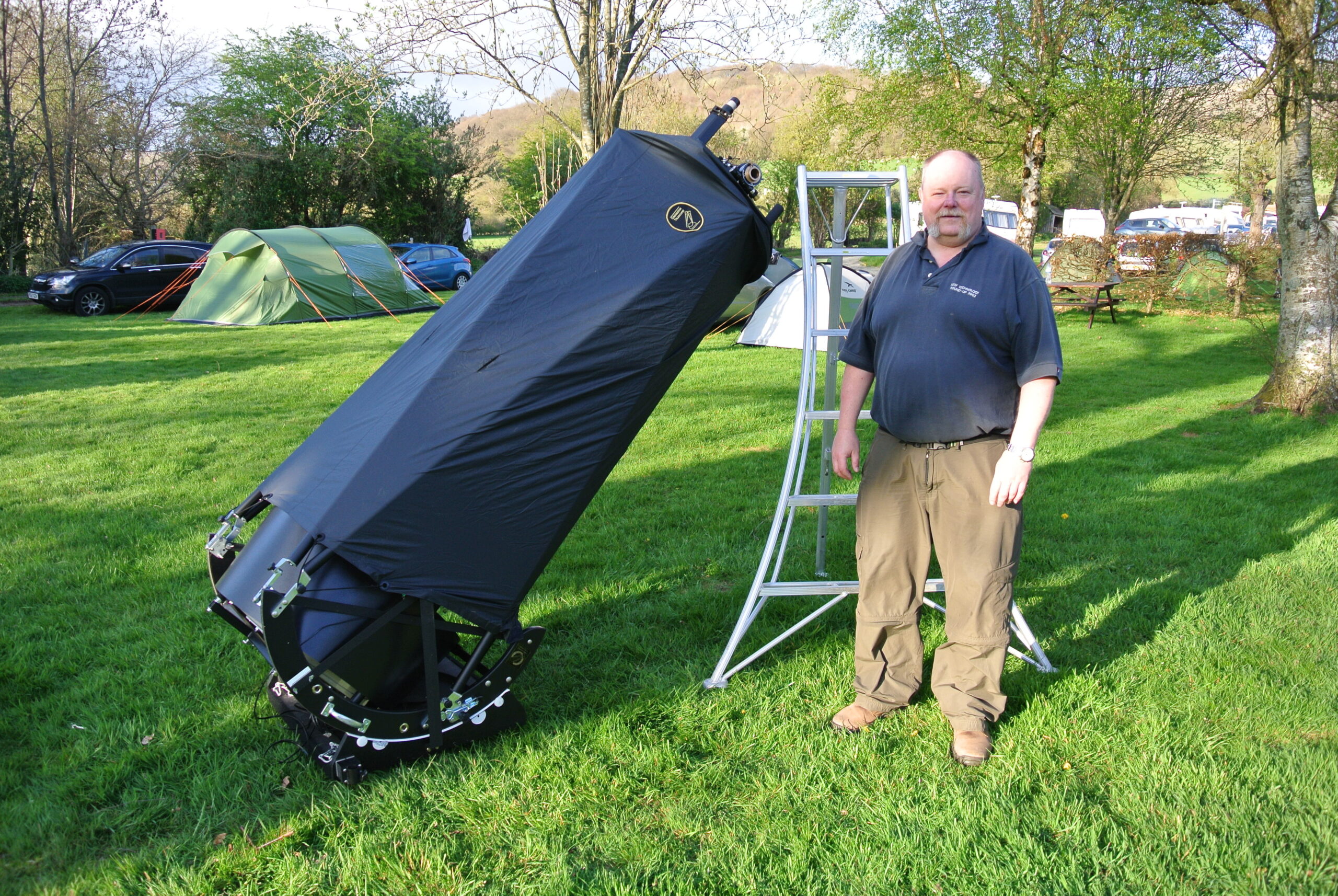
I expect most will have heard that Owen died in a car crash on his way to Kelling Heath Star Party on 16th of March, just a few miles from his home in Faringdon. I first became friends with Owen in 1977 when I started my studies at St. Andrews University. Owen was in second year and already a fixture of the astronomy club, which I naturally gravitated too. Over the years he has always been a reliable friend, meeting up from time to time, or at meetings or star parties. I bought his old Dark Star 20” Dobsonian from him, as he upgraded to an Obsession.
Owen’s thing was visual deep sky observing, and he was probably the UK’s leading observer. He had encyclopedic knowledge of deep sky objects, and although he might need to refer to a logbook on occasions, if you ever asked him about observing something in particular he invariably had.
He was a big part of the astronomy scene, having been Assistant Director of the Deep Sky Section, on the BAA Council, the FAS council, President of the Webb Deep-Sky Society and editor of its Deep Sky Observer magazine for many years, amongst many other roles he has held.
Owen rather eschewed imaging, but lately he had joined the smartscope fraternity to image dso’s and comets.
He spoke at many BAA meetings I had organised and I always had a sense of jeopardy, wondering if he could resist a put-down on the incumbent BAA President, the BAA in general or any other segment of the astronomy world.
At the section meeting we just had, most people had been touched by him in some way. Words of encouragement, suggestions on direction, and general help with anything.
There is so much to say about his life, but that will be for another time. There will be an obituary in the BAA Journal that I will coordinate/write – so if you have any thoughts or memories of Owen’s life please do send to me.
It is still hard to think we won’t see or hear him again. There will be a private burial and a memorial open to his friends later in April. I will share details when I have them.
Section Meeting 28th March 2026
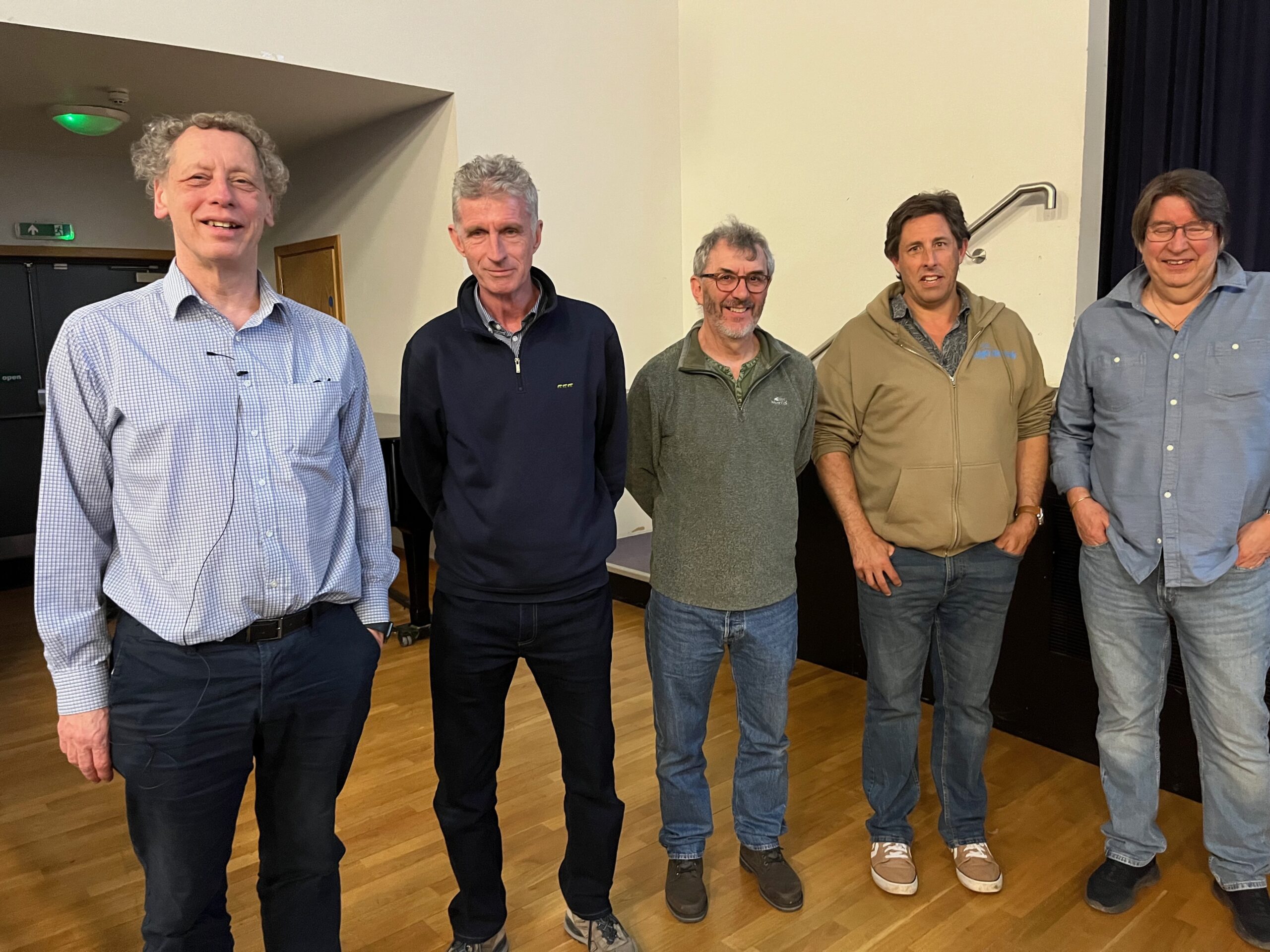
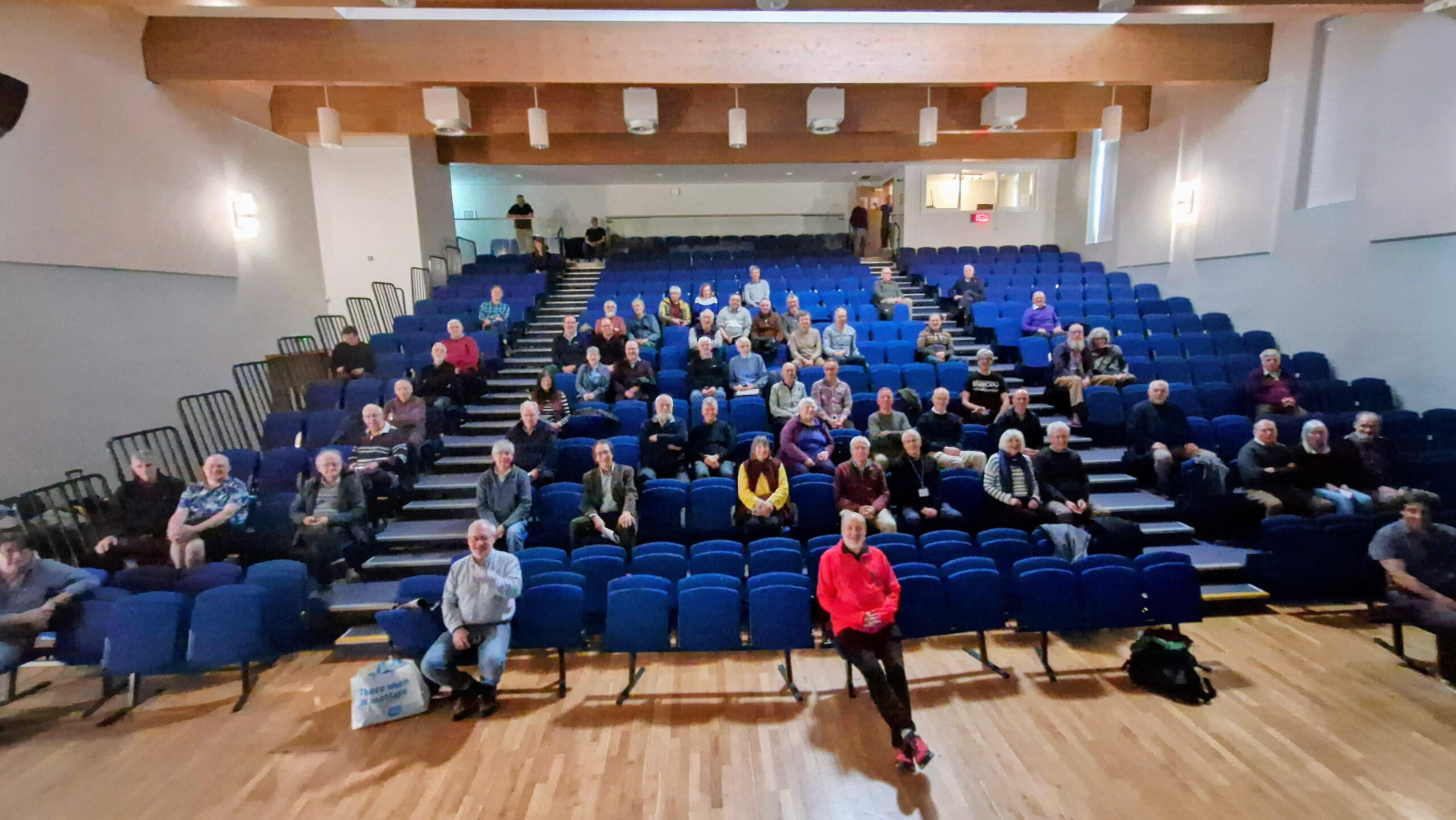
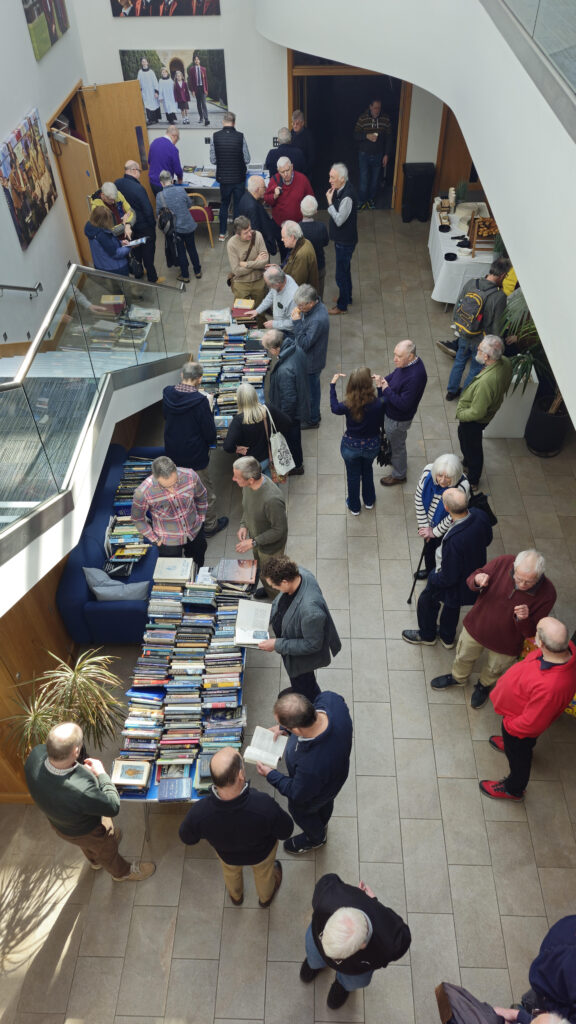
We held the section meeting on 28th March at Dean Close Preparatory School in Cheltenham with around 80 booked in to attend. Many thanks to all those that came along – feedback has been that the day was enjoyed by all. Much thanks goes to Cotswold Astronomical Society who did the local organising, and specifically to Simon Harris who looked after the AV, and Neil Havard and Graham Kent who helped on the door, and generally made things go smoothly.
Many thanks also go to the speakers; Mike Greenhill-Hooper, Bryan Lawrence, Mark Radice, Andy Stephens and Albert Zijlstra. Owen was scheduled, but of course we could not replace him, so the programme was rejigged.
I expect to hold the 2027 meeting again next March but the date and venue is still to be determined. If you or your local society can help find a venue and support the meeting please let me know.
Variable Nebulae
Richard Sargent gave an excellent talk about Variable Nebulae at the BAA Meeting on March 25th. If you’d like to see this, a recording has been posted on the BAA YouTube Channel
Double Stars for April – Peter Morris
Having travelled along the horizon for the last three months, I now move up the sky to Leo. The best-known double in Leo is Gamma Leonis or Algieba (STF 1424) in the middle of the sickle of stars in Leo which has Regulus at its base. It is a multiple star, but here I will concentrate on the AB pair which has a separation of 4.8 arcseconds at present and it is slowly widening; the current position angle is 127°. The orbital period is 554 years so the annual change in the separation and position angle is small (but also erratic) because the secondary is at the far end of its orbit. The two stars are magnitude 2.4 and 4.8 and they are spectral types K and G and are usually both seen as golden yellow. It was observed by William Herschel on 9 February 1782.
In the northern part of the constellation is 54 Leonis (STF 1487). Like Algieba, it is a binary star, but the orbit must be very large. The magnitudes of the stars are 4.5 and 6.3 and they have a separation of 6.6 arcseconds; the position angle is 113.1°. They are main sequence A type stars, but they are often seen as yellow and blue rather both being white as one would expect. It was first observed by Christian Mayer in 1777 and seen by Herschel on 21 February 1781.
In the south of Leo, three degrees below the Leo Triplet, lies Iota Leonis (STF 1536), which has been given the Chinese name Tsze Tseang, or more accurately 西次將 (Xīcìjiāng), by IUPAC, which means the Second General. It has a relatively short orbital period of 186 years and the separation of 2.4 arcseconds is gradually widening; the current position angle is 88.7°. The stars are magnitude 4.1 and 6.7 and they are both F type stars. Their colours have been variously described as pale yellow or white and white or light blue.
Leaving Leo, we move south-west to 35 Sextantis (STF 1466) which lies between Leo and the small constellation of Sextans. The stars are magnitude 6.2 and 7.1 and the separation is 6.8 arcseconds; the position angle is 239.3°. It appears to be a binary as the two stars are 687 and 718 light-years distant according to the latest Gaia data and an orbital period of 23,302 years was proposed in 2008. They are both evolved K type stars and have been seen as orange (or yellow) and blue (or yellow). It was seen by Herschel on 2 February 1786. There is an easily seen third companion, which is magnitude 8.1 and a separation of 334 arcseconds; the position angle is 210.3°. It is however an optical double as it is only 448 light years away.
Finally, we move south-east towards the horizon and reach Delta Corvi or Algorab (SHJ 145) in the small constellation of Corvus. The magnitudes of the stars are 3.0 and a relatively dim 8.5 and one wonders if it would be well-known it was not in the Astronomical League’s list of 100 double stars. The separation is an easy 24.2 arcseconds and the position angle is 215.6°. The separation and position angle have not changed since it was observed by Herschel on 17 November 1782, although it also appeared in the catalogue of 1824 compiled by his son and James South. It is considered to be a binary with an orbital period of at least 9,400 years. Their stellar types are A and K, but they are seen as pale yellow and grey (or purple).
March Object of Interest
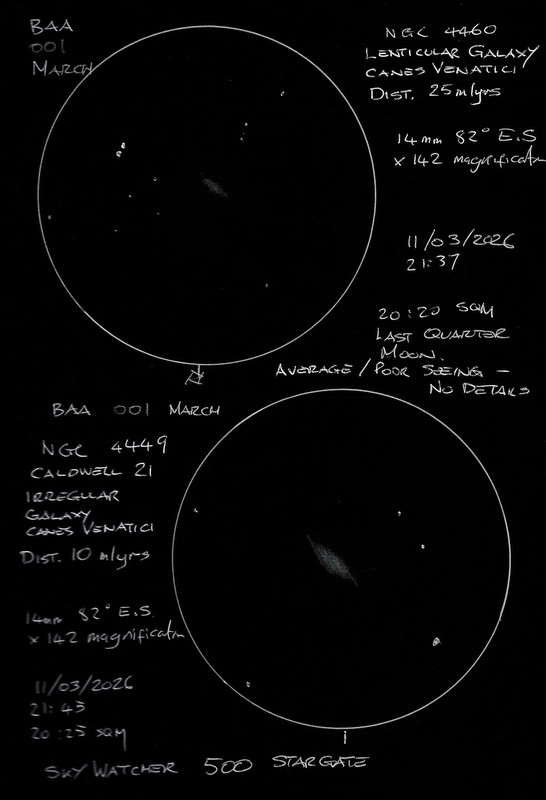
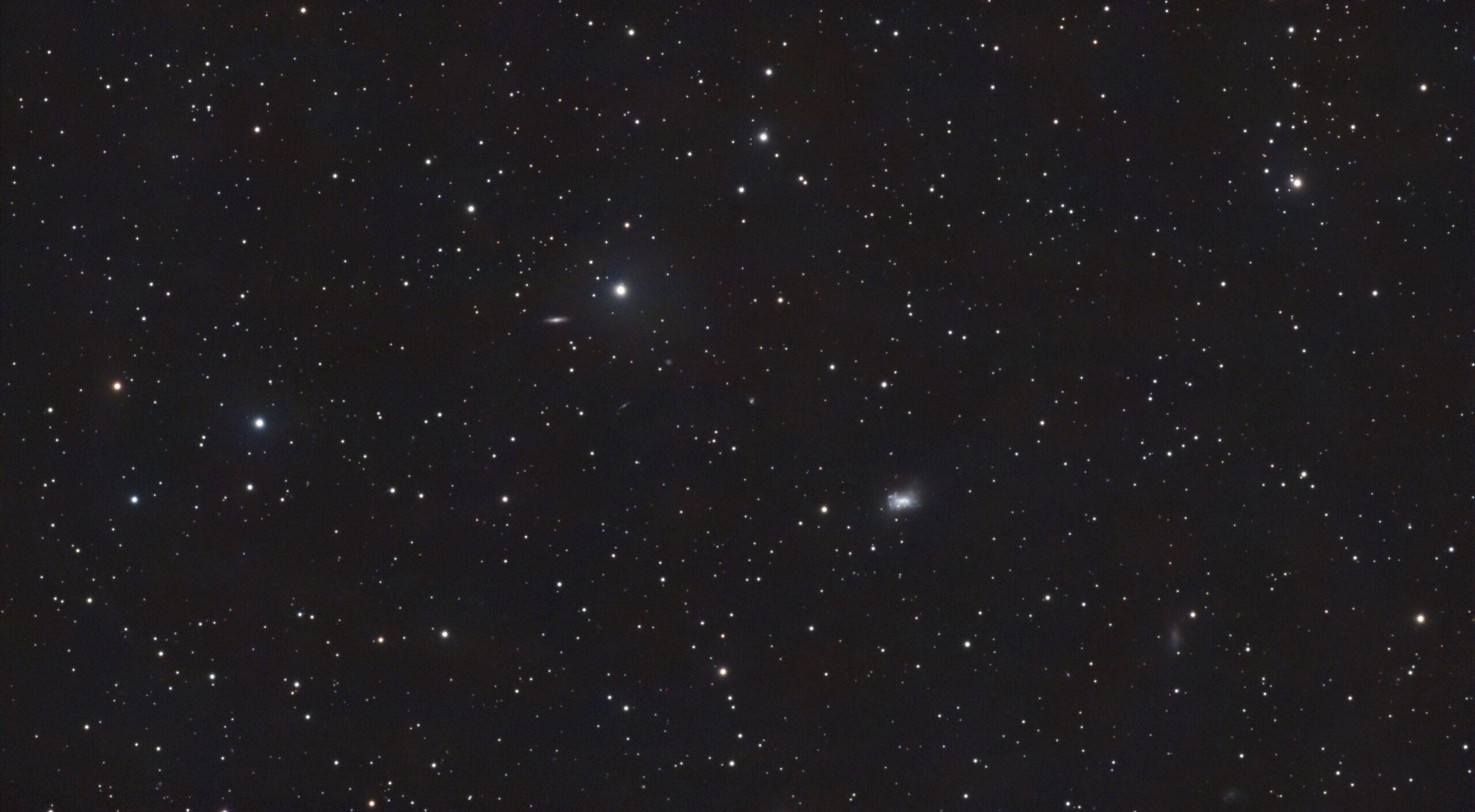
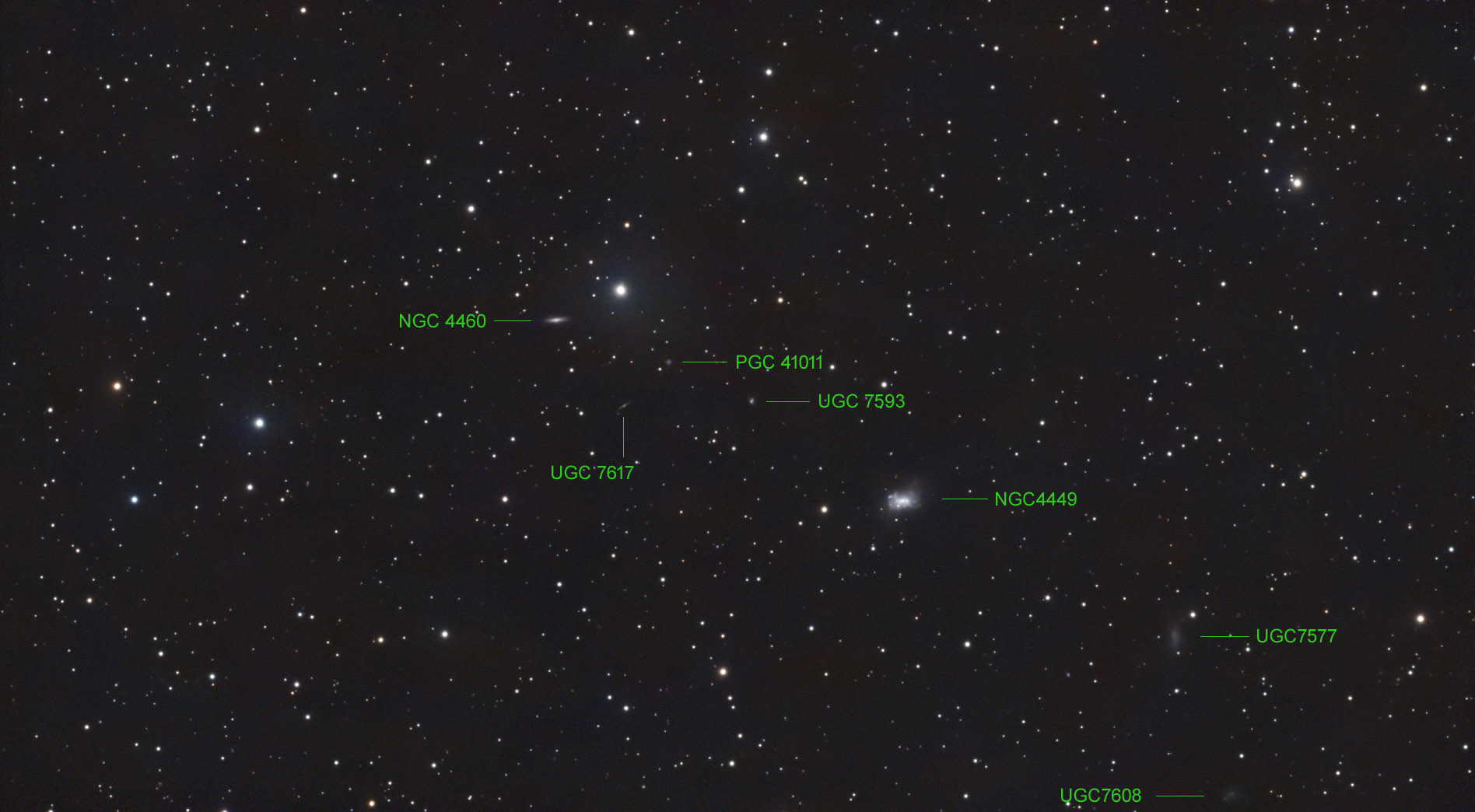
The March target was the lenticular galaxy NGC 4460 in Canes Venatici. And a secondary target was the irregular galaxy NGC 4449. I actually managed to capture both, though not in the same field, with my Seestar. Images were received from Jonathon Elliott, Alan Thomas, Brian Scott, Duncan Hale-Sutton, Iain Cartwright, David Davies, Simon Davis, and Callum Wingrove.
I was also pleased to receive a sketch of the two by Martin Foad:
This is a nice image of the pair (and friends) taken by Duncan Hale-Sutton using a Dwarf 3 smartscope.
And annotated
April Object of Interest
Jim Latham’s pick for the April target is the planetary nebula NGC 4361 in Corvus. It seems to have an interesting structure, almost a spiral, which is the source for its name the “Lawn Sprinkler Nebula”
Deep Sky Picture of the Month
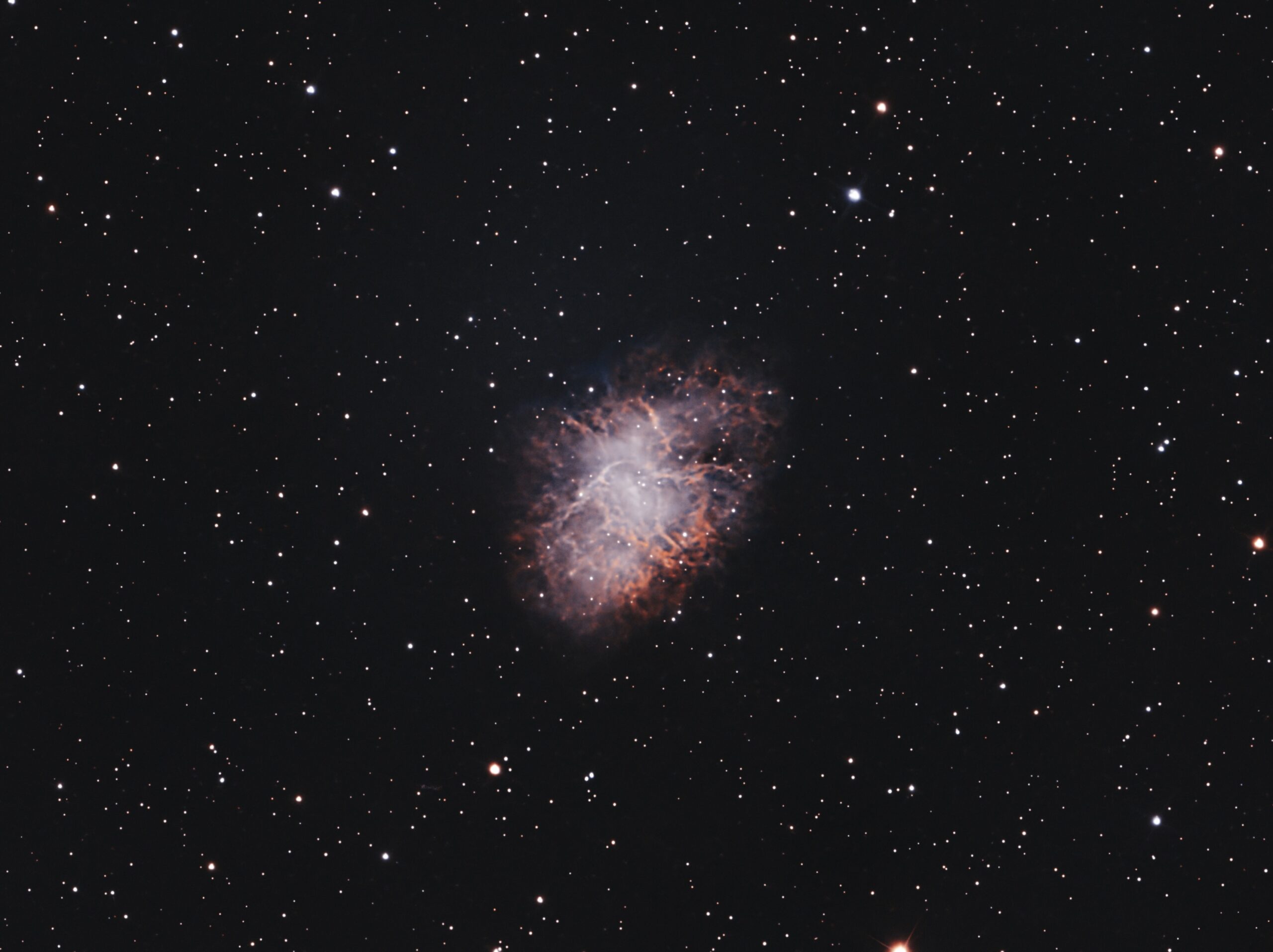
My pick for this month’s POTM is of the Crab Nebula by Matthew Terrell, A nice high resolution image using a Stellalyra 250mm RC scope.
And Finally
As I mentioned in my intro at the section meeting, feedback from members is always appreciated, so if there are things you’d like to see from the section, or if you’d like to get more involved, please do get in touch.
Clear, dark skies,
Callum
https://britastro.org/wp-content/uploads/2026/04/IMG_5743-scaled.jpeg
| The British Astronomical Association supports amateur astronomers around the UK and the rest of the world. Find out more about the BAA or join us. |