
2026 August 4
Deep Sky Update – August 2026
July proved to be a poor weather month on Orkney. No nights of anything that could be described as a clear sky. On a couple of nights noctilucent clouds were seen in patches between the tropo-clouds by the aurora-cam. Of course the weather was not very relevant as we don’t see astronomical darkness return until around August 19th and the sky is too bright for any serious work.
However we are well placed for the partial eclipse, and hope to see some sun that evening. And of course the maximum of the Perseids is the same night, so will keep fingers crossed for decent weather.
Section Meeting 2027
March 20 2027 is confirmed for the next section meeting at The Venue @ Navenby, Grantham Road, Navenby. Lincoln LN5 0JJ, which is just outside Lincoln. Many thanks goes to Graham Winstanley and Lincoln AS for hosting us.
If you’d like to give a talk at the meeting, or would like to hear talks on any specific topics, please let me know.
From the Journals
I’m indebted to Jeremy Shears and Mark Stuart who highlighted a couple of papers this month. And both on globular clusters.
From Jeremy, “The complex stellar system M 22…”
https://arxiv.org/abs/2607.14065
From Mark the article, “One idea, two cosmic mysteries—linking Little Red Dots and globular clusters”
https://phys.org/news/2026-07-idea-cosmic-mysteries-linking-red.html
Both well worth a look at.
Double Stars for August – Peter Morris
This month, I move up to the small constellation of Lyra. The most famous double star in Lyra is the “Double-Double”, Epsilon Lyrae (STFA 37), which is easily found east (following) of Vega. The two main stars (Epsilon1 and Epsilon2) are magnitude 4.7 and 4.6 and the separation is 209.4 arcseconds which means it should be resolvable by the naked eye (I have not succeeded myself so far) and is easily split in binoculars. The position angle is 171.8° and Epsilon2 is the lower of the two. They are both A-type main sequence stars and I see them as a pale greenish-white. Epsilon1 (STF 2382 AB) is a tight double with a separation of 2.2 arcseconds and the position angle is 343.5°. The magnitude of A on its own is 5.2 and B is 6.1. B is the only non-A-type star in the quadruple (it is main sequence F), but I see them both as greenish-white. Epsilon2 (STF 2383 CD) is also a tight double with a separation of 2.4 arcseconds and the position angle is 72.9°. The magnitudes are 5.3 and 5.4. I see them both as pale greenish-white. The combination of the three position angles means that B is above A and D is to the left of C (although it is difficult to distinguish which is C and D). This permits an experiment: is it easier to resolve a pair which is vertical or horizonal? In practice, I find CD much easier to resolve, mainly I suspect because of the almost identical magnitudes (and perhaps also because of the slightly wider separation). The Double-Double was first noted by Christian Mayer in 1777 and was observed by William Herschel on 29 August 1779 (although he did not comment on the double-double aspect).
Remarkably there is another “double-double” in Lyra which is less well-known, namely STF 2470 and STF 2474 which lie between the parallelogram of Lyra and Cygnus. The two pairs are 622 arcseconds apart, with STF 2474 to the south-east (following) and unlike Epsilon Lyrae, the secondary stars are both to the right of their main stars. The stars in STF 2470 are magnitude 7.0 and 8.4; it is an optical double. The separation is 13.8 arcseconds and the position angle is 267.3°. The main star is a B type and the secondary is an A type. I see them both as white. The stars in STF 2474 are magnitude 6.8 and 7.9; it is a binary but the orbit is presumably large. The separation is 16 arcseconds and the position angle is 262°. The main star is a G type (with a very close K companion, separation 0.1 arcseconds) and the secondary is an G type. I see them both as white, but Sissy Haas sees them as yellowish-white. STF 2474 B has an exoplanet.
Zeta1 Lyrae (STFA 38 AD) is to the south-east (following) of Vega and directly below Epsilon Lyrae; it is the top right-hand star in the parallelogram. The magnitudes of A and D are 4.3 and 5.6 and the separation is a wide 43.9 arcseconds; the position angle is 149.8°. It is a binary star with an orbital period of roughly 50,000 years and there has been little change since the separation and position angle were first measured in 1779. The main star is a peculiar star, but it is basically an F-type and the secondary (Zeta2) is a main sequence F-type. They are usually seen as white, but greenish and yellowish tints have been reported. Herschel observed it on the same day as Epsilon Lyrae.
My final double in Lyra is a bit of a misnomer. It is invariably called STT 525, but like most Otto Struve doubles, it is rather tight and the secondary is faint. The easier pair is actually SHJ 282. The magnitude of STT 525 AB are 6.1 and 9.2 and the separation is 1.8 arcseconds; the position angle is 130.1°. It is often taken to be a binary star, but apparently this is not certain. According to Gaia (EDR3), the main star is 1,482 light years away, but B is 1,268 light years distant. The magnitude of C is 7.6 and the separation is a wide 45.4 arcseconds; the position angle is 349.1°. This is described as a binary system, but the distance of C is 1,152 light years according to Gaia. The main star is a G supergiant with a A-type spectroscopic companion. B and C are both A-type stars. I see them all as white, but A has been described as yellow.
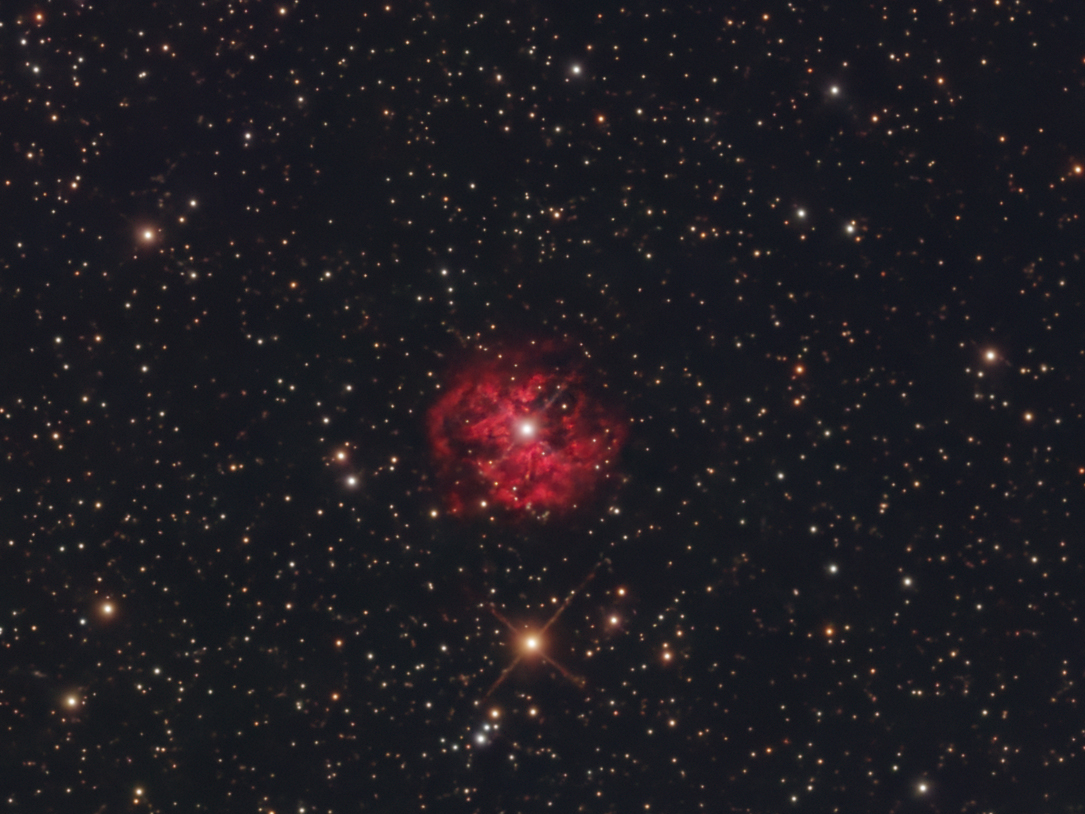
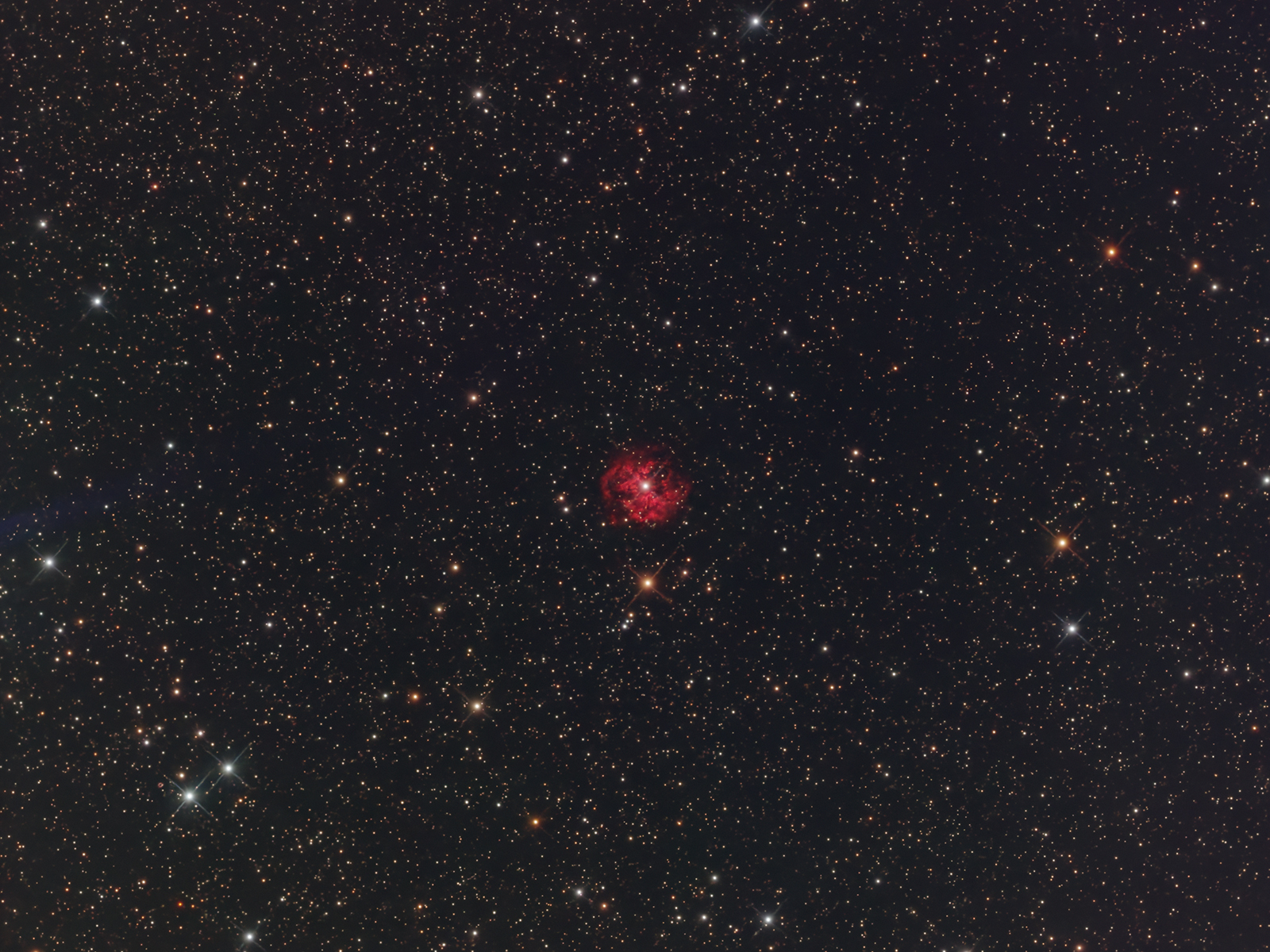
July Object of Interest SH 2-80 – Merrill’s Star
July’s target proved very popular with imagers – many thanks to all that had a go. Jim Latham reports that he tried to view visually with his 14 inch Newtonian. He writes “The central star was obvious, but I couldn’t confidently detect any nebulosity around it. I may return to it when the skies are darker.”
Images were submitted by Carl Hansen, Jonathan Elliott, David Davies, Paul Whitmarsh, Fred Stevenson, Richard Stevenson, Des Middlemass, Karen Smith, David Strange, Brian Scott, and Iain Cartwright (sorry if I missed anyone).
Here are David Davies’ crop and full frame images
 |
 |
Object of Interest for August
Jim’s pick for August is the open cluster NGC 6802 in Vulpecula. Perhaps it does not immediately come to mind, but it is located at the eastern end of Brocchi’s cluster and easy to overlook. Jim writes “It’s quite interesting in that low power it looks like an elongated nebulous patch, not unlike a galaxy, but resolves into a pleasingly dense cluster at higher power. It’s in a well observed area of sky, but I wonder how many have passed it by, hidden in plain sight by Brocchi’s cluster?”
July Picture of the Month
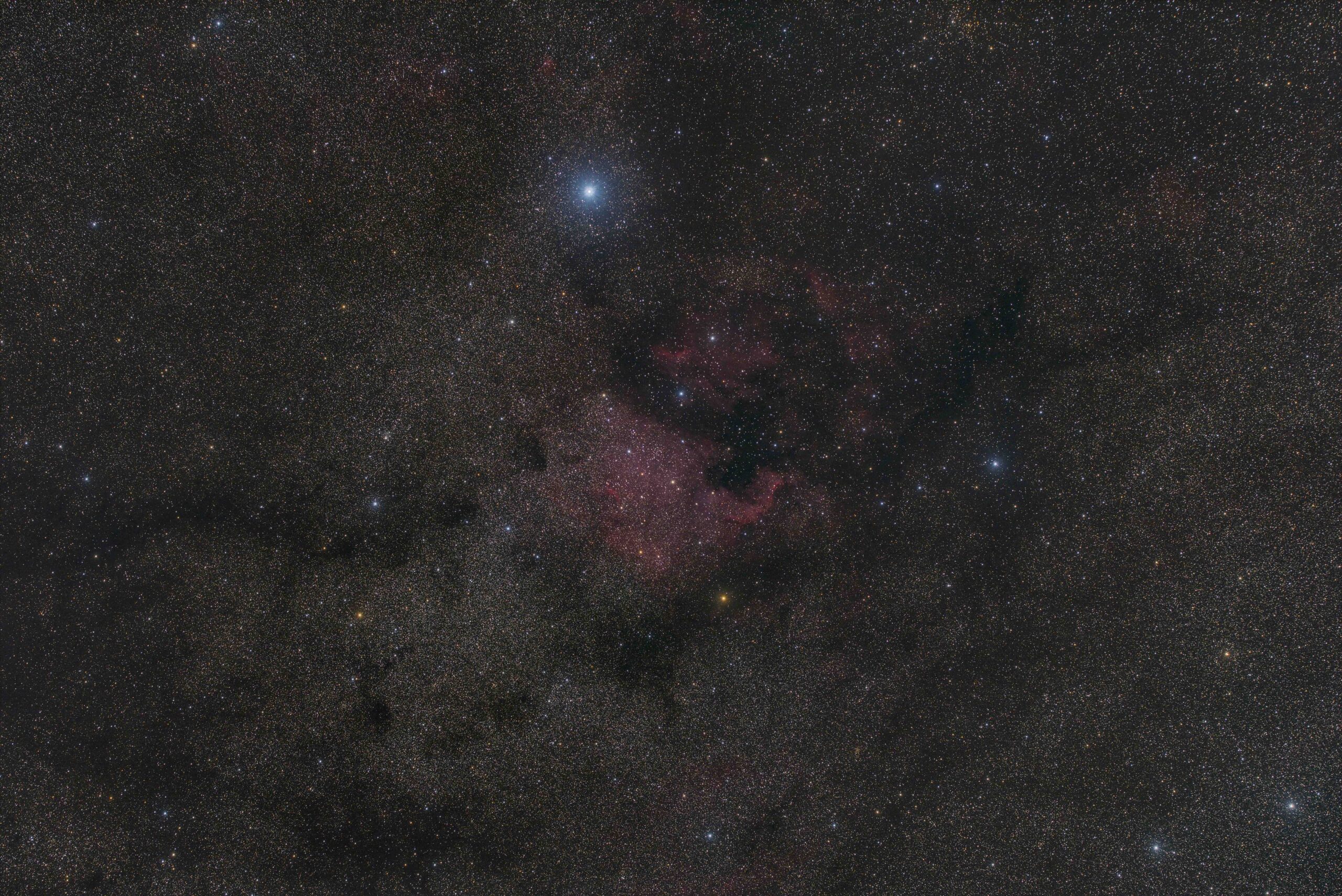
There have been a couple of images of the North America Nebula in July, which is a little prescient, as I’ve written a forum article on it for the August JBAA.
I’ve picked this superb wide-field image of the nebula by Iain Cartwright, which nicely shows it embedded in the milky way of Cygnus.
And Finally
I’m hoping to get the observatory up in the next few weeks of ‘summer’ and my mind has been turning to what use I will make of it. Main telescope options are to install the Celestron C11 or my 12 inch Dobsonian. For imaging or EAA the C11 would probably be the best option, but as observing opportunities in the Orkney winter tend to be few and short, I’ve been thinking of going back to the simplicity of visual observing and sketching. I’ll let you know how I get on.
Clear, dark skies,
Callum
| The British Astronomical Association supports amateur astronomers around the UK and the rest of the world. Find out more about the BAA or join us. |