
2026 January 4
Deep Sky Update – January 2026
Happy New Year. I hope everyone had a Merry Christmas and a Good New Year. Now we are in 2026!
The astute amongst you might notice that my monthly update has jumped from November 2025 to January 2026 – what happened to December 2025? Well I’m not sure how my monthly naming practice came into being, but it seemed to be a bit counter-intuitive and even I was getting it wrong sometimes, so I have reset the naming this month, so the date is the month the update is actually published.
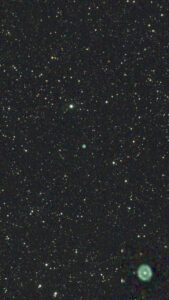
December weather was mixed in Orkney, but I did get one night out with the Seestar S50, and managed to capture the December object of interest target NGC 1501, though it was much lower than I had anticipated.
I also got a few Messiers and the interstellar comet 3i/Atlas as it passed under Leo.
It was one of the better nights here with SQM 21.7.
It was also pleased to see that my picks-from-the-journals in the last update made it into the news, with the BBC running on the type 1a supernovae as standard candles problem
https://www.bbc.co.uk/news/articles/c17xe5kl78vo
And the ‘hiding’ Pleiades was written up by Phil Plait for Scientific American
https://www.scientificamerican.com/article/the-pleiades-star-cluster-has-a-secret-stellar-family/
Paul Leyland has also been investigating the possibility of determining apparent magnitudes for the star in the extended Pleiades from the details in the original paper. Paul has created a spreadsheet of these, and hopes to write up this as a Deep Sky Note.
I also had some time to do some updates to the variable nebulae programme in the section website (apologies to Richard for taking sooo long to do this). Some more recent images added, and more details about the newer VNe (V347 Aur and HBC 340/341)
Meeting Update
Just a reminder that tickets can now be purchased for the Section Meeting on March 28th in Cheltenham. BAA members can use a discount code (see the event page)to get the member price of £15, £20 for non-members. Price includes refreshments and a hot buffet lunch.
Book online here: https://buytickets.at/baa/1898897
More details here: https://britastro.org/event/deep-sky-section-meeting-2026
Double Stars for January – Peter Morris
This month I continue along the horizon (ignoring the delights of Orion) and arrive at Canis Major. I begin with the famously tricky binary Sirius (AGC 1). The discovery of the white dwarf companion by Alvan Graham Clark in January 1862 while testing the 18.5-inch refractor made by his father’s firm (ordered by the Dearborn observatory north of Chicago) is legendary. He suddenly realised he could see the predicted companion of Sirius when the main star was accidentally hidden by a nearby building. Sirius B is notoriously difficult to observe with a telescope, not on account of its closeness to the main star, but because of that star’s brilliance. In the mid-1990s, it was only 2.5 arcseconds from the main star, but reached its maximum separation of 11.3 arcseconds in 2023. However, it is still very difficult to make out. The current separation is 11.1 arcseconds, the magnitude of the main star is -1.5 and the white dwarf is only mag. 8.4; the position angle is about 58°.
I now move south-east below Sirius to the double sometimes known as the “Winter Albireo”, namely 145G Canis Majoris (HJ 3945). It is worth noting in passing that the 145 is not a Flamsteed number, but a Gould number (hence the G) in the Uranometrica Argentina of 1879 compiled by the American-Argentinian astronomer Benjamin Apthorp Gould (the man who killed Argo Navis, but that is another story). The primary is exactly magnitude 5.0 and the secondary is only slightly fainter at mag. 5.8; the position angle is 49.7°. At declination -23° it is very low in the UK and it was first catalogued by John Herschel at the Cape of Good Hope, but I have been able to observe it without too much difficulty. With a separation of 26.5 arcseconds, it is an easy split even in a small telescope. Their spectral types are K and A, and unsurprisingly, they are usually seen as yellow and blue, hence its moniker. The main pair is an optical double. The secondary (B; HIP 35213) is a binary (SHY 508) on the basis of its proper motion, but its companion (C; HIP 35578) is very distant since it is 3.5°[sic] below B and is, in fact, closer to Omega Canis Majoris, which is 75 arcminutes to the west (or preceding). But Gaia has now shown the two stars to be 50 light years apart (as mentioned in the Webb Society Double Star of the Month for January 2025). The magnitude of C is 6.8 and the position angle is 166°. As it is spectral type A, it is presumably seen as white.
Finally, I move west of 145G Canis Majoris pass Omicron2 and Omicron1 Canis Majoris to reach two doubles catalogued by James South in 1825. S 537 is a multiple star, but D is very faint (mag. 13.0). AB is actually BU 324, catalogued by Sherburne Wesley Burnham in 1875. The main star is magnitude 6.6 and B is mag. 7.9 and the separation is a tricky 1.8 arcseconds; the position angle is 209.8°. I was able to split it with a 5-inch mak-cas and saw both stars as white (the main star is spectral type A). S 537 is actually AC and C is magnitude 8.3. The separation is an easy 30.3 arcseconds and the position angle is 282.3°. C is also spectral type A and is seen as white. AC is a binary, but it must be a very large orbit as the separation and position angle are unchanged in the last two hundred years. The nature of AB remains uncertain. Four arcminutes south-south-west (or south preceding if you prefer) of S 537 is S 538. This is a nice easy (if slightly faint) binary. The main star is magnitude 7.2 and the secondary is mag. 8.2 with a separation of 26.9 arcseconds; the position angle is 4.1°. The two stars are spectral type A and they are both seen as white.
Please send any observations of double stars to Peter – doubles@britastro.org
December’s Object of Interest
December’s target was the planetary nebula, the Camel’s Eye, NGC 1501 in Camelopardalus. It has proved quite popular with many observing it (including myself!). Images were received or sent via members albums from Alan Thomas, Brian Scott, Jonathan Elliott, Ivan Walton, and Iain Cartwright.
Lee MacDonald sent a visual report from his observing logbook back in December 1992, 33 years ago.
This is an interesting object to observe visually and is well within range of medium-sized telescopes. Using a 222mm reflector at 19:30UT on 28 December 1992, I instantly saw it at 65x as a faint grey disc. At 232x it appeared as an ellipse with a hole and a hint of mottling.
Here is Iain Cartwright’s image of NGC 1501 which nicely shows the mottling of the PNe disk.
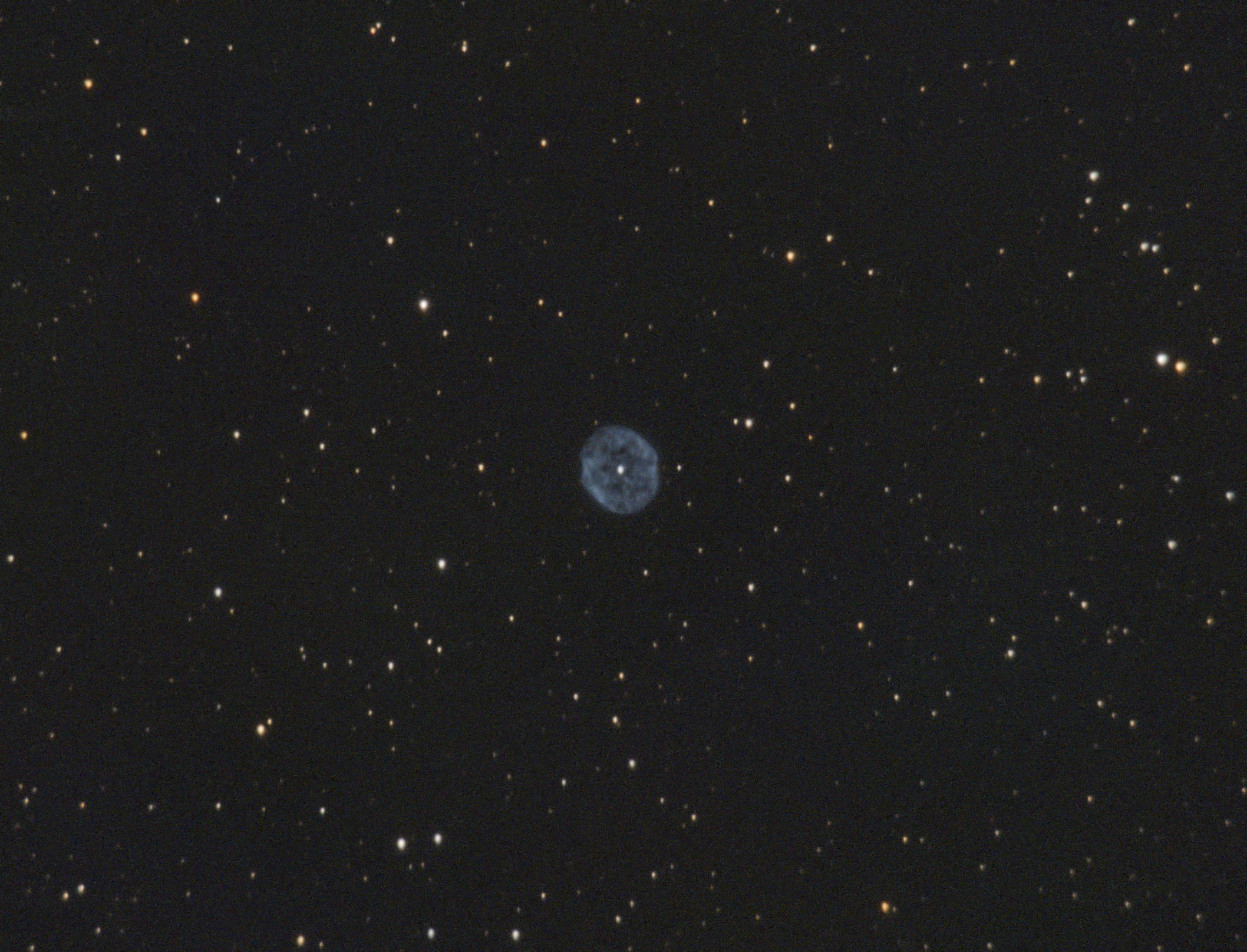
Nikon D810A (DX), SW 2″ ED Barlow Lens, Sky-watcher 200PDS, HEQ5 Pro
Object of Interest for January
For January the target is a rather hard visual observation, but may be easier for imaging. Palomar 2 is a faint globular cluster in Auriga. Jim Latham writes:
I saw it once, on 4 January 2022. My notes read “Location identified with a nice star hop, forms an extended triangle with two stars. Seen with averted vision, visible as an extremely faint nebulous patch, surprisingly extended and broad. Location checked against Stellarium – confirmed”.
Deep Sky Picture of the Month
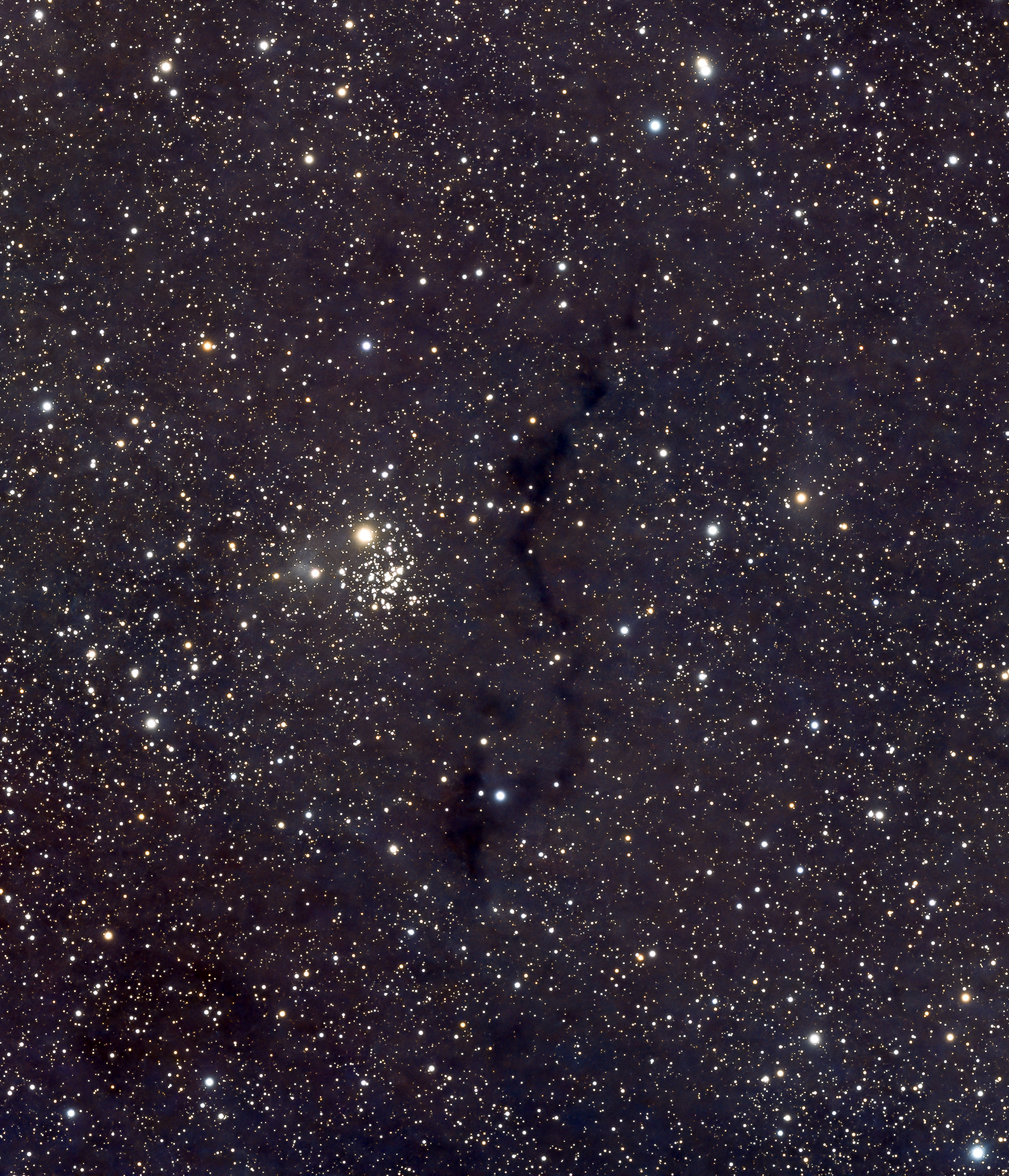
Lots of really nice images posted in December – my pick, because it’s been a while since a dark nebula has featured, is of LDN 1337 by Thomas Wade from South Yorkshire. LDN 1337 is in Cassiopea and Thomas’ kit was a Skywatcher Esprit 100,EQ6RPRo, ASI294MCPro, Optolong UV/IR cut filter. Exposure 134 x 120 sec subs.
And Finally
As always input from members is very much appreciated – so if you have any ideas about what we should be doing in the section, what support you would like, or topics you’d like covered in more detail, please let me know.
Clear, dark skies.
Callum
| The British Astronomical Association supports amateur astronomers around the UK and the rest of the world. Find out more about the BAA or join us. |