
2026 March 4
Deep Sky Update – March 2026
Sorry for a brief update this month. No deep sky observing in Orkney in February – weather has been very poor. Hopefully things will improve in March.
Section Meeting – March 28
Not long now until the section meeting which takes place on March 28th. There are only a few tickets left so if you have not booked yet, please do as soon as you can. Bookings close on March 15th.
Unfortunately Jonathon Elliot is now unable to speak at the meeting, but Mark Radice has kindly agreed to step in, and will give a short talk on “Observing from the Caribbean”.
Full details at: https://britastro.org/event/deep-sky-section-meeting-2026
My planes and trains are booked, so I’m looking forward to seeing you at the meeting.
Double Stars for March – Peter Morris
Continuing along the horizon, I reach the large but faint constellation of Hydra. Tau1 Hydrae (HJ 1167) is a wide double with a separation of 65.7 arcseconds. The two stars are magnitude 4.6 and 7.3 with a position angle of 4.2°. Despite the wide separation, it is a binary star. The stars are spectral type F5 and K0. The main star is usually seen as yellow-white or yellow, but the secondary is variously seen as plum red, blue or purple. To the south-west of Tau1 Hydrae is 17 Hydrae (STF 1295) with two stars of similar magnitude (6.7 and 6.9) and a separation of 4.0 arcseconds; the position angle is 3.9°. They are both A type stars and are usually both seen as white. It is still uncertain if it is a binary star. While they are both more or less the same distance from us (299 and 296 light years), their proper motions are different. Three degrees west (preceding) of 17 Hydrae is F Hydrae (S 579) which also bears the historical designation 31 Monocerotis, although it is 8 degrees from the modern boundary with Monoceros. The two stars are magnitude 4.7 and 8.2 and a separation of 78.8 arcseconds; the position angle is 309.7°. Again, despite this wide separation, it is a binary star. The main star is a yellow supergiant (G1 Ib) and the secondary is B9.5 main sequence star. Unsurprisingly they are seen as yellow and blue.
I now move even closer to the horizon to N Hydrae (H 3 96) which is only 9 degrees above the horizon when it is due south in the southern UK. It is often called 17 Crateris although it is now four degrees below the modern boundary with Crater. The two stars are almost equally bright, being 5.64 and 5.73 and the separation is 9.6 arcseconds; the position angle is 210.1°. It is a binary star and was first observed by William Herschel on 10 January 1783. The stars are both F type main sequence stars and are seen as yellow-white or yellow. To the east (or following) N Hydrae is H N 69, which is slightly higher in the sky with a maximum altitude of nearly 12 degrees in the southern UK. The stars are magnitude 5.7 and 6.6 with a separation of 10.2 arcseconds; the position angle is 190.2°. It is a binary star and was first observed by William Herschel on 10 March 1790. The stars are an evolved A type star and a main sequence F type and are seen as both white or white and bluish-white.
February Object of Interest
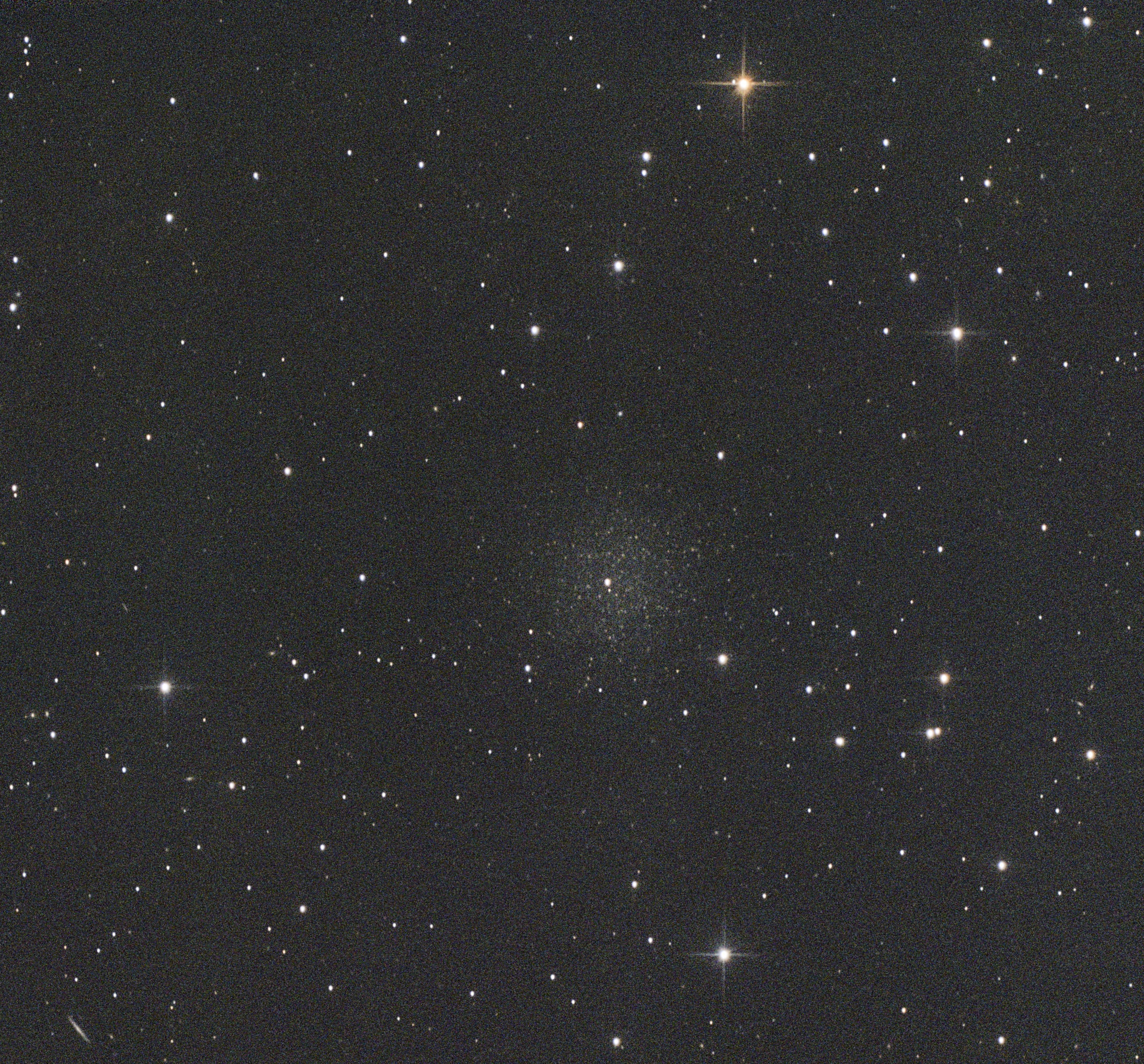
The faint local group galaxy Leo II was the target for February, with Leo A being a secondary target. I was very pleased to see observations from Mark Fairfax, David Strange, Alan Thomas (sorry for the wrong name last month Alan!), Paul Leyland, Duncan Hale-Sutton, and Iain Cartwright. You can view the OOI observations on this page.
And here is Iain’s image:
Target for March
The March Object of Interest is the lenticular galaxy NGC 4460 in Canes Venatici. And as a second target that you might get in the same field of view is the irregular galaxy NGC 4449. NGC 4460 is a bit fainter than NGC 4449, so more of a challenge.
Picture of the Month
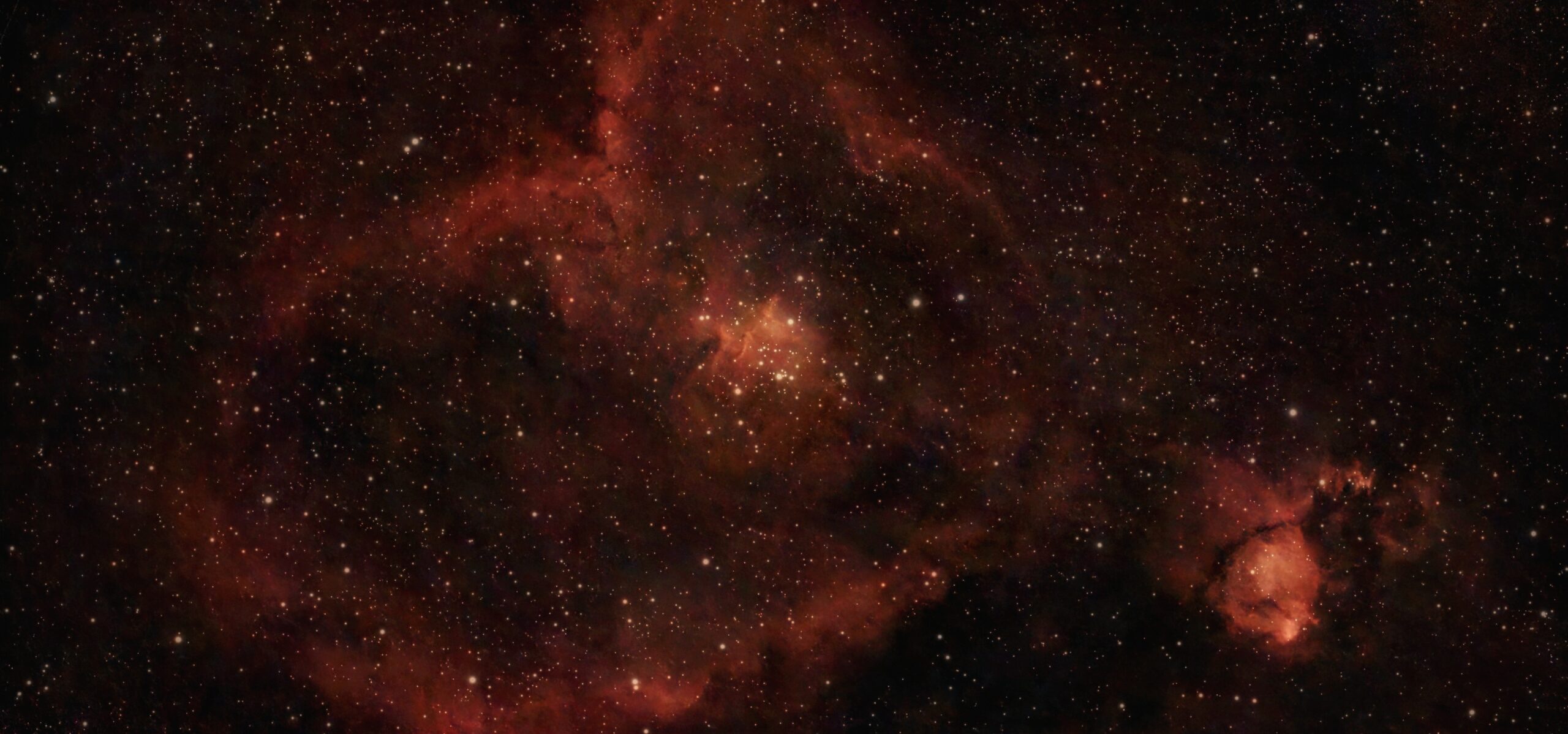
My pick for Deep Sky POTM is this lovely image of the Heart Nebula by Honor Wheeler taken with a Dwarf 3 smartscope – Honor notes “First time attempting a deep sky object with the Dwarf 3 smart telescope, on an unusually clear sky! Capture time 2 hours”
And Finally
The nights are getting noticeably shorter now here in Orkney, and the spring equinox is not very far away. I’m hoping to get some good observing weather in the next couple of months. And I hope you do too – wherever dark skies take you.
Clear, dark skies
Callum
| The British Astronomical Association supports amateur astronomers around the UK and the rest of the world. Find out more about the BAA or join us. |