
2026 October 3
Deep Sky Update – October 2026
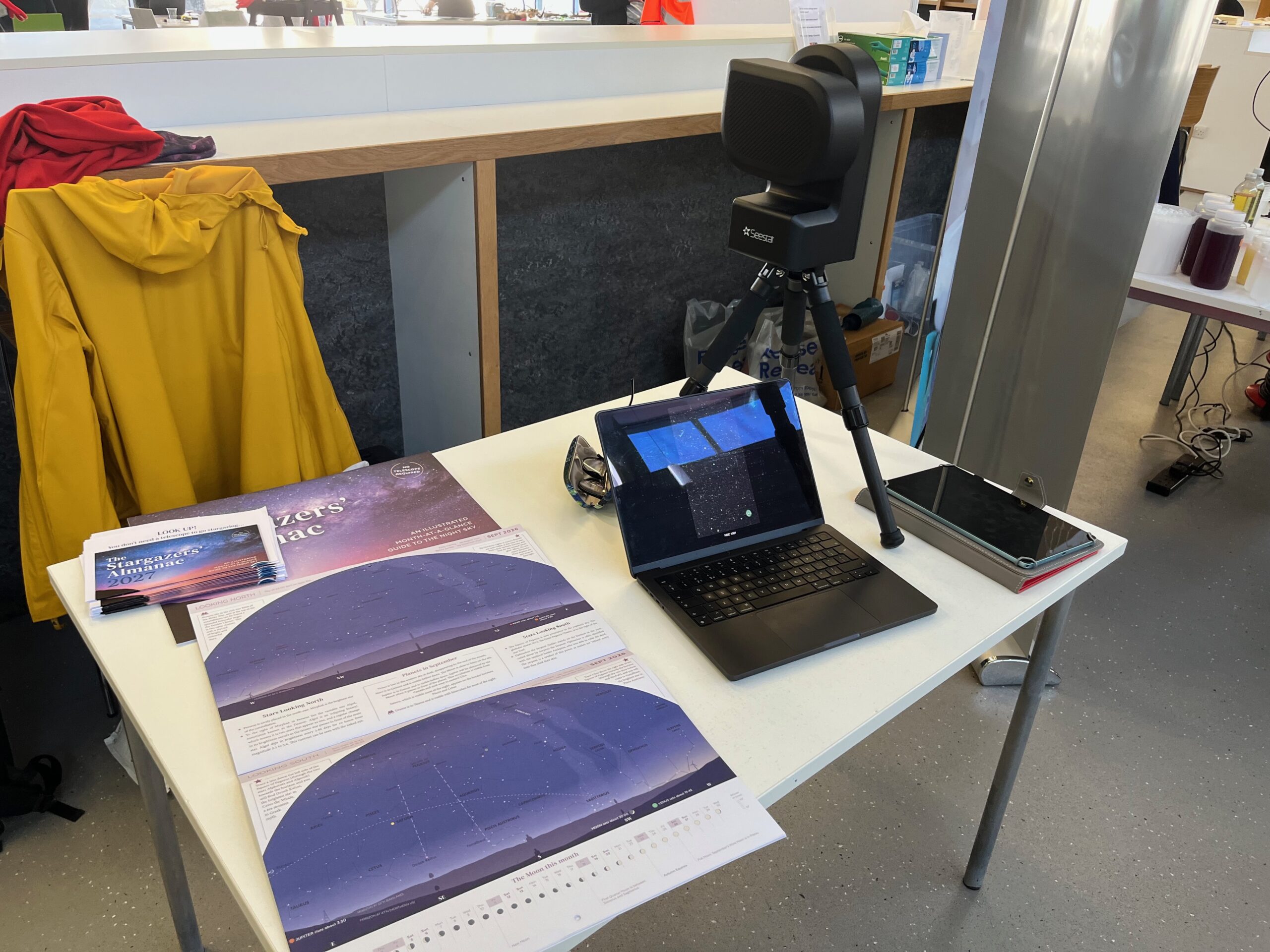 It is nice to be past the equinox and see the nights drawing in. Hopefully with more available hours of darkness there will be more chance of some observing. September was another poor month for observing from Orkney. Though we did have a couple of nights where stars could be seen, and one night where the northern lights were visible through gaps in the cloud. September also saw the Orkney International Science Festival. I volunteered there for the week, and was lucky to attend a few of the astronomically oriented talks. These included talks about the Euclid space telescope, gravity, astronomy and the Odyssey, and the life of Nancy Roman Nasa’s first chief of astronomy. Such is the breadth of the festival that there were a number of other really interesting talks and performances. I also set up my Seestar at the Family Day so kids could play, moving it around via the tablet and peer at the houses in the distance, and I ran a slideshow of images taken with it. It went down well and I met a few other smart-telescope owners and prospective buyers.
And hot on the news about the release of the Seestar S50 Pro, came the news about the new Dwarf Draco – a 90mm aperture smart-telescope with lots of bells and whistles. It will be interesting to hear people’s experiences with it when it arrives for real.
I was browsing Cloudy Nights recently and came upon a posting which related to viewing galaxies through M31. I.e. galaxies that are visible behind. The poster referred to a paper “A HUBBLE SPACE TELESCOPE CATALOG OF 449 GALAXIES SEEN THROUGH THE DISK OF M3” by Hodge and Krienke (https://arxiv.org/pdf/1005.2233)
It would make an interesting challenge for anyone that likes to go deep imaging. The brightest of these background galaxies seems to be around 16th magnitude, with a smattering of 17th and 18th. I’m not suggesting this as a monthly challenge, but if anyone tries to find any of these I would be pleased to hear how you get on.
The New Moon is approaching and so is the Autumn Kelling Heath Star Camp. Rather later in the season than usual, but I expect some of you will be on your way there. Good luck with the weather and do send some reports.
Double Stars for October – Peter Morris
This month I will begin with two famous doubles. Epsilon Pegasi or Enif (S 798). The main star is bright (magnitude 2.5), but the companion star (which is C; B is even fainter at 12.8) is dim (8.7) compared with most of the doubles I have mentioned. The separation is a very wide 144 arcseconds with a position angle of 317.7°. The main star is a red supergiant with the spectral type K21b, which explains its bright yellow colour. The secondary C is spectral type F8 which implies it is yellowish but it appears blue (or violet) by contrast. It is a pretty combination, but it is an optical double. The main interest of this double is the optical trick it produces in a telescope. C is more or less directly below the main star (if the telescope is a reflector – or a refractor without a diagonal – and has north at the bottom) and if you tap the telescope gently the bright primary appears to remain fixed as a result of persistence of vision whereas the dimmer secondary moves with the telescope, hence it appears to swing like a pendulum. This illusion was mentioned by Rev. Thomas Webb in the 1881 edition of his Celestial Objects for Common Telescopes, but was popularised by Robert Burnham in his Celestial Handbook of 1978, and it was given the name of the Pendulum Star around this time.
The other famous double is Gamma Ceti (STF 299) with the tongue-twisting name Kaffaljidhma (meaning in Arabic the cut-short hand which was originally an asterism) in the large but dim constellation of Cetus which is also low in the sky in the UK. The two stars are bright enough (magnitudes 3.5 and 6.2), but the separation is very tight for small telescopes. It is a binary system with an orbital period of 914 years. Unfortunately, the gap is now narrowing and is now only 1.8 arcseconds with a position angle of 300.4°. The colours are the main attraction in this case. The main star is spectral type A, which should be seen as blue (or white) and the secondary is F, which should be white or pale yellow. However, as I have pointed out before, when a double should be blue and yellow, it is in fact often seen as yellow and blue, and this is how Thomas Webb saw it. I see it as yellow-green and dark green. The primary is sometimes called olive-green and the secondary tawny. There is a third member of the system (C) which is faint (mag. 10.2) and has a very wide separation of 843 arcseconds; the position angle is 306° which means it forms more or less a straight line with A and B. Its spectral type is K, so it is probably seen as yellowish-white or white.
We now move up to the much easier target of Gamma Andromedae (STF 205) or Almach (to give the now officially approved spelling of the name) which was one of the first double stars to have its duplicity discovered, by the German physicist Johann Tobias Mayer in 1777. The magnitude of the two stars are 2.3 and 5.0. The separation is a reasonable 9.5 arcseconds and the position angle is 63.3°. The main star is a yellow (K) giant and the secondary is a close binary of a B9 star and a A0 star (so practically the same). Hence, they are nearly always seen as yellow and blue. Almach shares another similarity with Albireo – there is debate about whether AB are a binary system. It is often stated to be a binary with a reputed orbit of 5,000 years. However, recent parallax measurements from two different studies (Hipparcos for the main star and Gaia EDR3 for the secondary) give distances of 393 light years and 270 light years which is incompatible with a binary system. The companion is definitely a binary system with an orbital period of 62.6 years and the gap is rapidly widening again. With a current separation of 0.34 arcseconds it is beyond the reach of most amateur telescopes and it will reach its maximum gap of 0.57 in 2048. The stars are magnitude 5.3 and 6.5.
Just below Almach is our final double star this month, 59 Andromedae (STF 222). The two stars are close in brightness, being magnitude 6.1 and 6.7, with a separation of 16.64 arcseconds; the position angle is 35.7°. It is stated to be a binary system with an orbital period of about 554 years, but the separation has not changed in the current century and it does not appear in the Sixth Catalog of Orbits of Visual Binary Stars. The distances according to Gaia EDR3 are not too far apart but unlikely for a binary (A is 436 light years and B is 440 light years), and according to the Double Star Checker (https://www.stella-vega.de/ds/ds_calc.html), a very useful online program, it appears to be an unlikely binary. The main star is a main sequence B9 spectral type and the companion is an A1 main sequence star, so once again we have a situation where the spectral types are on the B/A boundary. They are usually seen as white with possible tints. I see them as white and bluish-white which is in keeping with the spectral types.
September Object of Interest
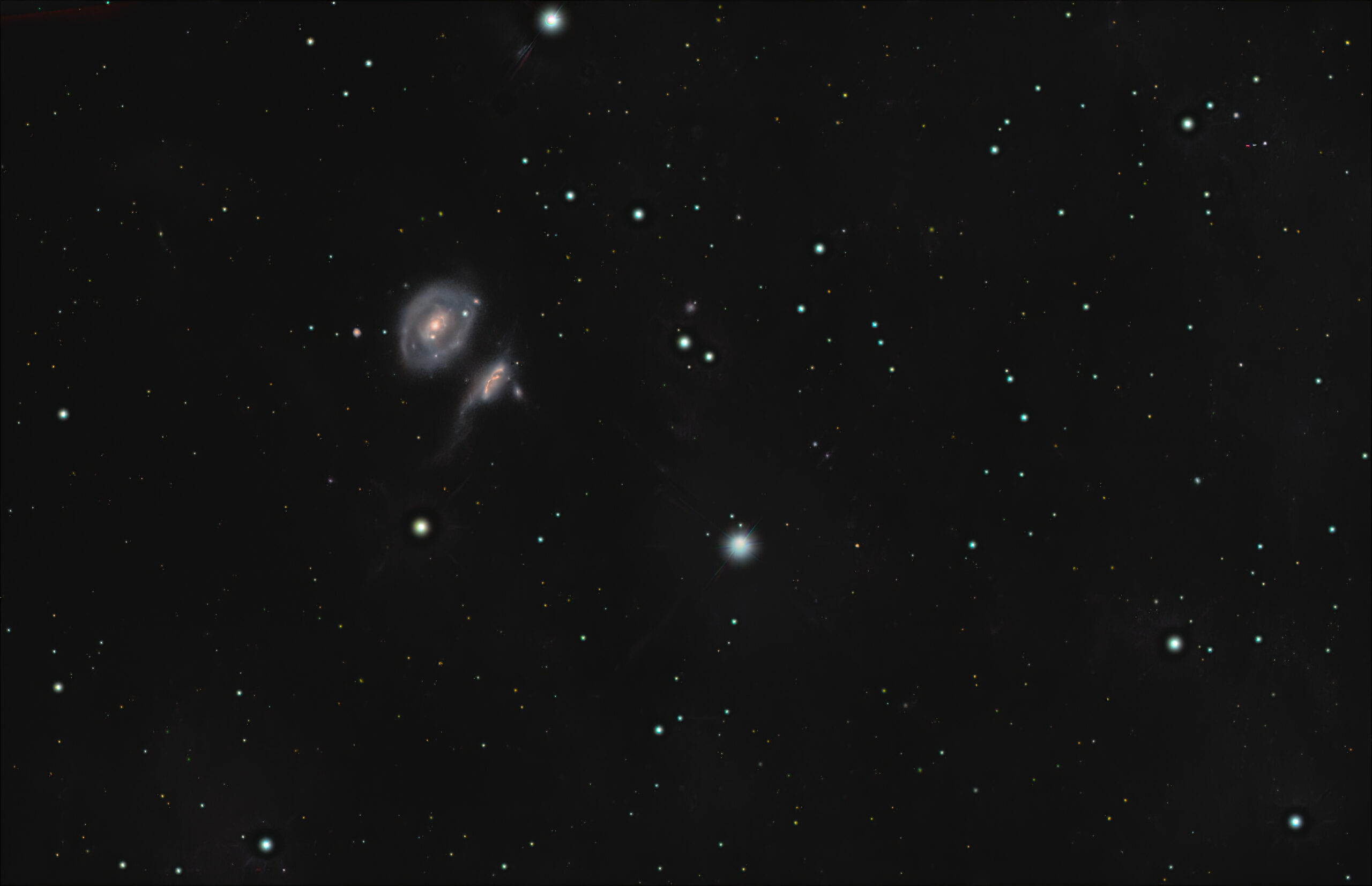
The September target was galaxy NGC 7469 in Pegasus which forms a pair with IC 5283, and together listed as Arp 298. I did not get any visual reports, maybe too hard unless you have a big scope, but it was well imaged by Iain Cartwright, David Davies, Alan Thomas, Fred Stevenson, Des Middlemass, Jonathan Elliott, Brian Scott, David Strange, and Mike Greenhill-Cooper. Here is Mike’s image taken with a 20” Obsession.
Object of Interest for October
Jim has proposed the PN NGC 7354 in Cepheus. It’s reasonably bright at c. mag 12, though quite small at 20-20 arcseconds. HST shows an interesting structure of overlapping shells and jets, apparently a consequence of a binary central star. Jim notes that he saw it visually a couple of years ago (14” Newtonian), noting that it was ‘quite bright and easy to find’, held magnification well (x460), and showed a ‘hazy oval, brighter on the two opposite segments’.
It will be interesting to see how much can be imaged with amateur scopes.
Deep Sky Picture of the Month
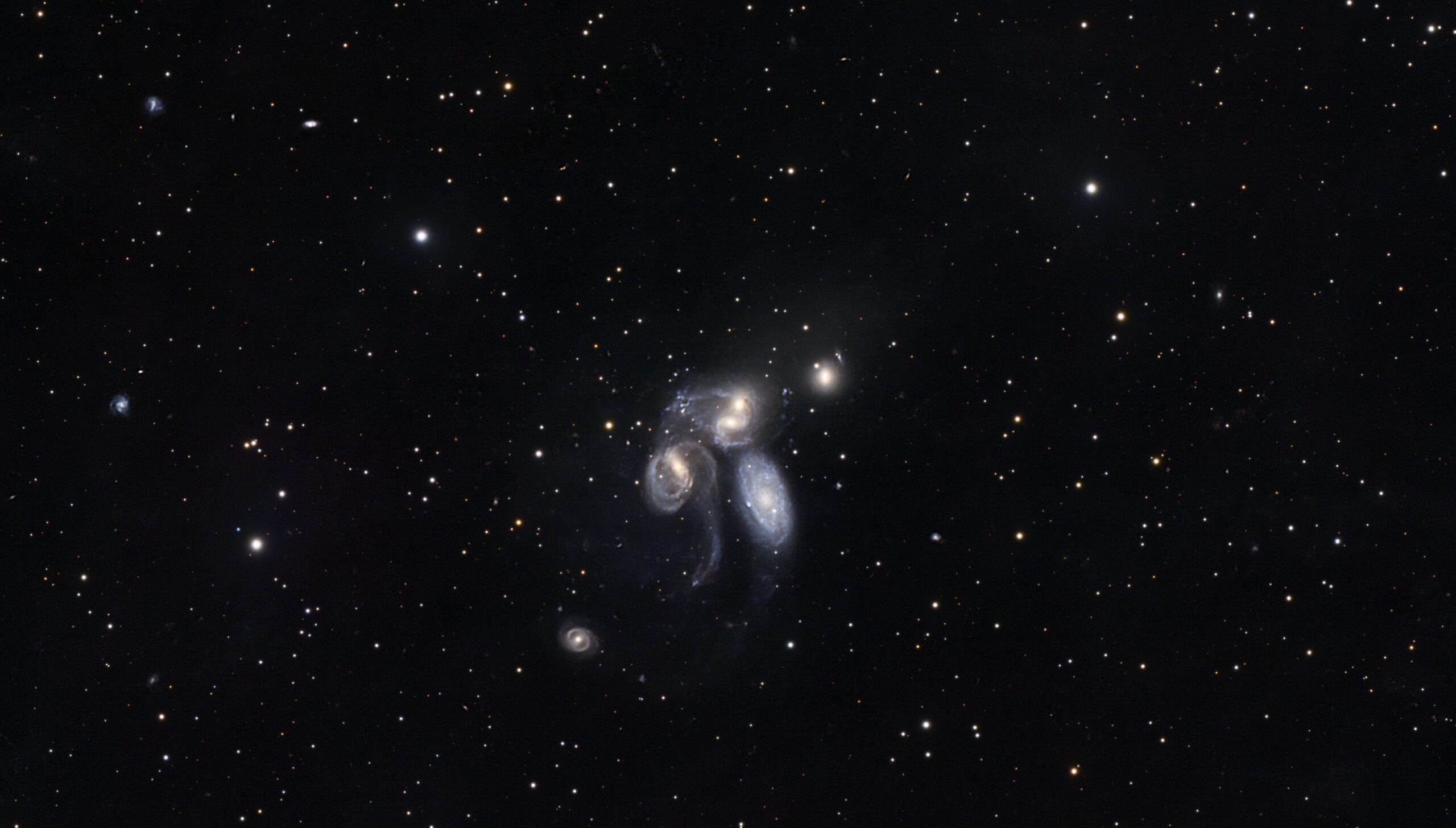
My pick for POTM is by Des Middlemass of Stephan’s Quintet. A delightful group of galaxies in Pegasus, not far from NGC 7331, also known as Arp 319. Des used a Celestron Edge HD 9.25 and a ZWO ASI 294 MC pro camera from Villetoureix in France.
And Finally
With Kelling Heath camp coming up, my mind turned to remembering old friend Owen Brazell, a regular fixture at the spring and autumn camps. No doubt he would have been grumbling about something but it was always one of his highlights of the year. I am working on an obit. for the Journal which I hope will be published in a future issue.
Clear skies,
Callum
https://britastro.org/wp-content/uploads/2026/10/IMG_6310-scaled.jpeg
| The British Astronomical Association supports amateur astronomers around the UK and the rest of the world. Find out more about the BAA or join us. |