
2026 June 30
Mars Opposition Blog 2026 June 30
A number of observers have now joined in, making a total of seven. A list of them will become available on the front page as a Word document. It will be updated from time to time.
Current relevant martian seasonal dates are as follows:
N. Winter Solstice/ 2026 Apr 25 Ls = 270
S. Summer Solstice
N. Spring Equinox/ 2026 Sep 30 Ls = 360
S. Autumn Equinox
The continual shrinkage of the S. polar cap has been followed, and on May 28 the first hints of the presence of the N. polar hood began to be traced in the systematic images of C.Foster.
A few days ago we witnessed the first dust storm of the apparition. On June 20, Foster captured a bright dust cloud along Valles Marineris, which impinged upon the southern parts of Chryse and Xanthe. This image (06:08 UT) is posted here with the dust storm labelled (south up). The closest available prior comparison is another image by Foster taken on June 17. This shows no sign of dust in the area, when it was then close to the evening terminator. On June 21, images by Foster (05:33 UT) and N.J.Haigh (UK; 05:30-06.41 UT) showed the dust to have dispersed, with the proviso that the disk diameter remained tiny, limiting resolution. Foster’s image of Jun 24 confirmed the cessation of activity.
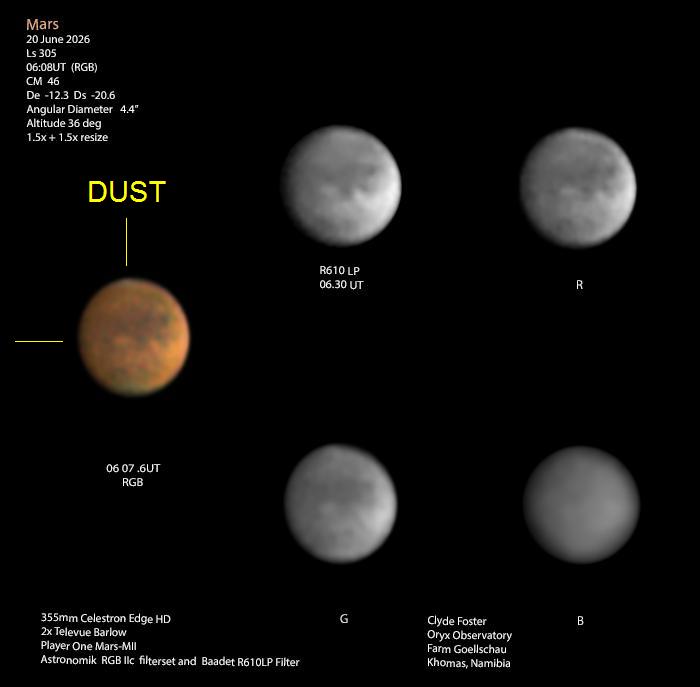
It is some years now since we had an encircling dust storm, the last one being in 2018. What will happen this year? We shall know for sure well by September 30. The seasonally latest date for the start of such an event remains the encircling storm of late 1924, which commenced at Ls = 311. This same seasonal point will be reached in a few days’ time.
It is now very nearly 50 years since the landing of Viking 1 upon Mars. Back then, we had no doubts in our minds that Mars would have been colonized by now, if not long before. But space exploration took a different direction, the Moon being abandoned, followed by a long romance with the space shuttle, space stations, and a proliferation of unmanned spacecraft. Martian orbiters, rovers as well as a martian helicopter have certainly achieved great technological progress, but the human footprint has so far been conspicuous by its absence.
| The British Astronomical Association supports amateur astronomers around the UK and the rest of the world. Find out more about the BAA or join us. |