
2026 June 15
R.I.P. Candice Hansen
We are very sad to report that Dr Candice J. Hansen-Koharchek (Candy Hansen), leader of the JunoCam team in NASA’s Juno project, passed away on 2026 April 11 after a progressive illness. Those of us who met and collaborated with her know her as a firm friend and supporter of many people from all walks of life, who she enabled to become involved in this exciting mission of planetary exploration.
Candy had a long and distinguished career on NASA planetary missions, mainly focussing on the icy moons of the giant planets, and on Mars. She began as an assistant on the Voyager imaging team, before doing her Ph.D. at UCLA while also working on the UV Imaging Spectrograph for Cassini. She had important roles throughout the Cassini mission and on three Mars missions. For most of this time she worked at JPL (Pasadena), then subsequently at the Planetary Science Institute (Tucson). When she became leader of the JunoCam team, she embraced the opportunity for unprecedented public engagement, for which her outgoing character was ideally suited.
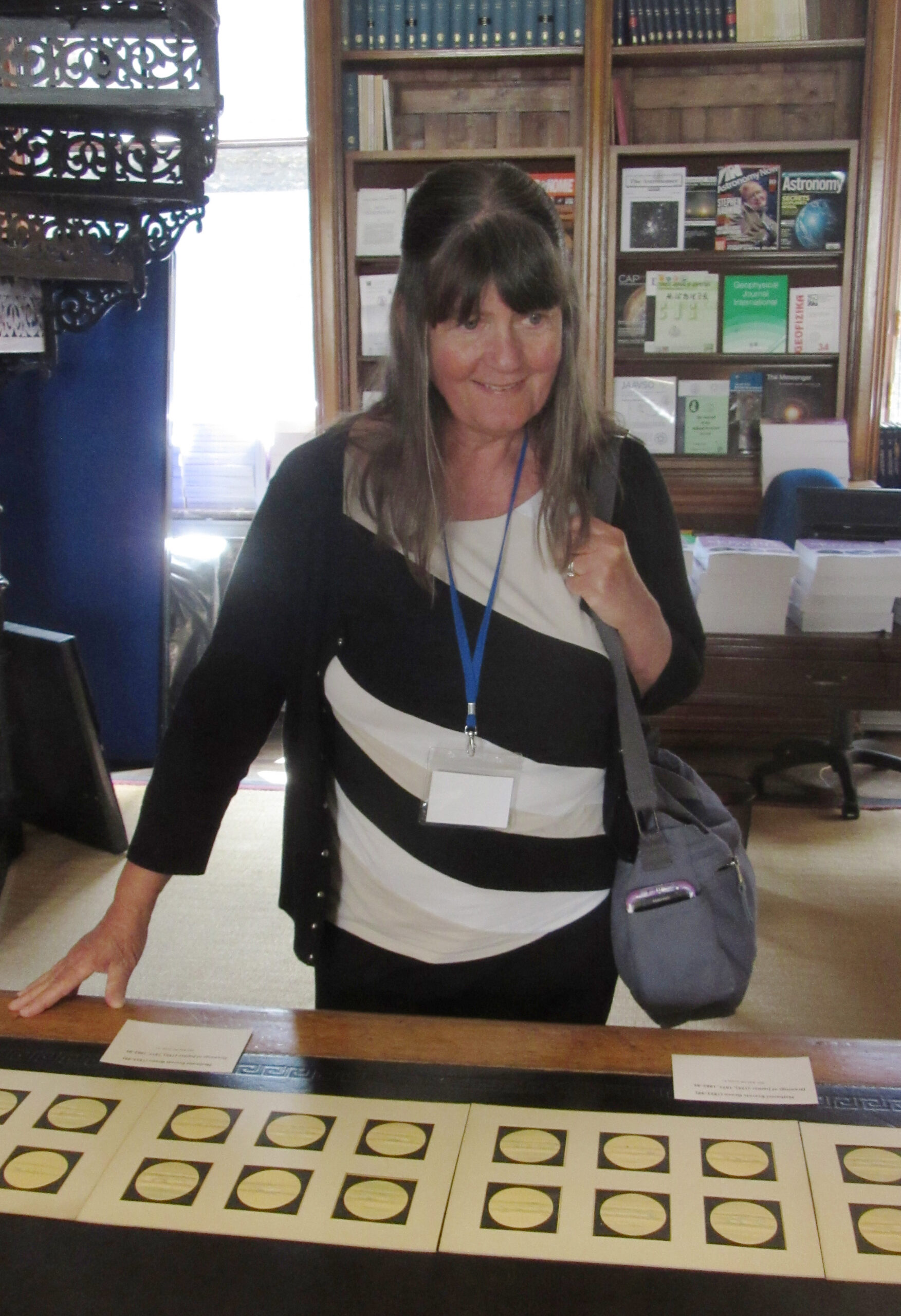
The principal rationale for the camera on Juno was ‘public outreach’, and Candy developed this program enthusiastically and all-inclusively, encouraging amateur astronomers to upload images to show what JunoCam could be viewing, other citizen scientists to process JunoCam’s raw images, and anyone who wished to make creative use of the images for enhancement or artistry. In 2018, when we held an international meeting in London for Jupiter scientists and observers, she volunteered to come and meet the observers, and gave an inspiring talk emphasising that everyone could be a member of Juno’s “virtual imaging team”. (The picture shows her looking at BAA Jupiter archives on that occasion.) She also presented the project in a BBC ‘Sky at Night’ programme. Here is another video about JunoCam from 2019 in which Candy shared her passion for the project: https://www.youtube.com/watch?v=J2uC8ghAluc
In all her public presentations, she made everyone feel valued as she showed and credited their works. Of course, JunoCam’s superb images from 2016 onwards have also produced rich scientific rewards, especially by revealing the detailed structure of the clouds, and viewing Jupiter’s poles for the first time, so through her some of us were able to collaborate with the Juno team on scientific publications.
She was widely admired in the planetary science community, for her expertise as a scientist, her kindness to others, her effectiveness as a planner and collaborator, her value as a mentor, and her enthusiasm and joy in planetary discoveries. Thanks to her, JunoCam’s spectacular images have become the best-known aspect of Juno and indeed of Jupiter, and will always remain as a tribute to her.
–John Rogers
| The British Astronomical Association supports amateur astronomers around the UK and the rest of the world. Find out more about the BAA or join us. |