
Tagged: Sun
- This topic has 22 replies, 9 voices, and was last updated 1 year, 4 months ago by
 Jeremy Shears.
-
AuthorPosts
-
16 October 2022 at 11:19 am #613062
 Nick JamesParticipant
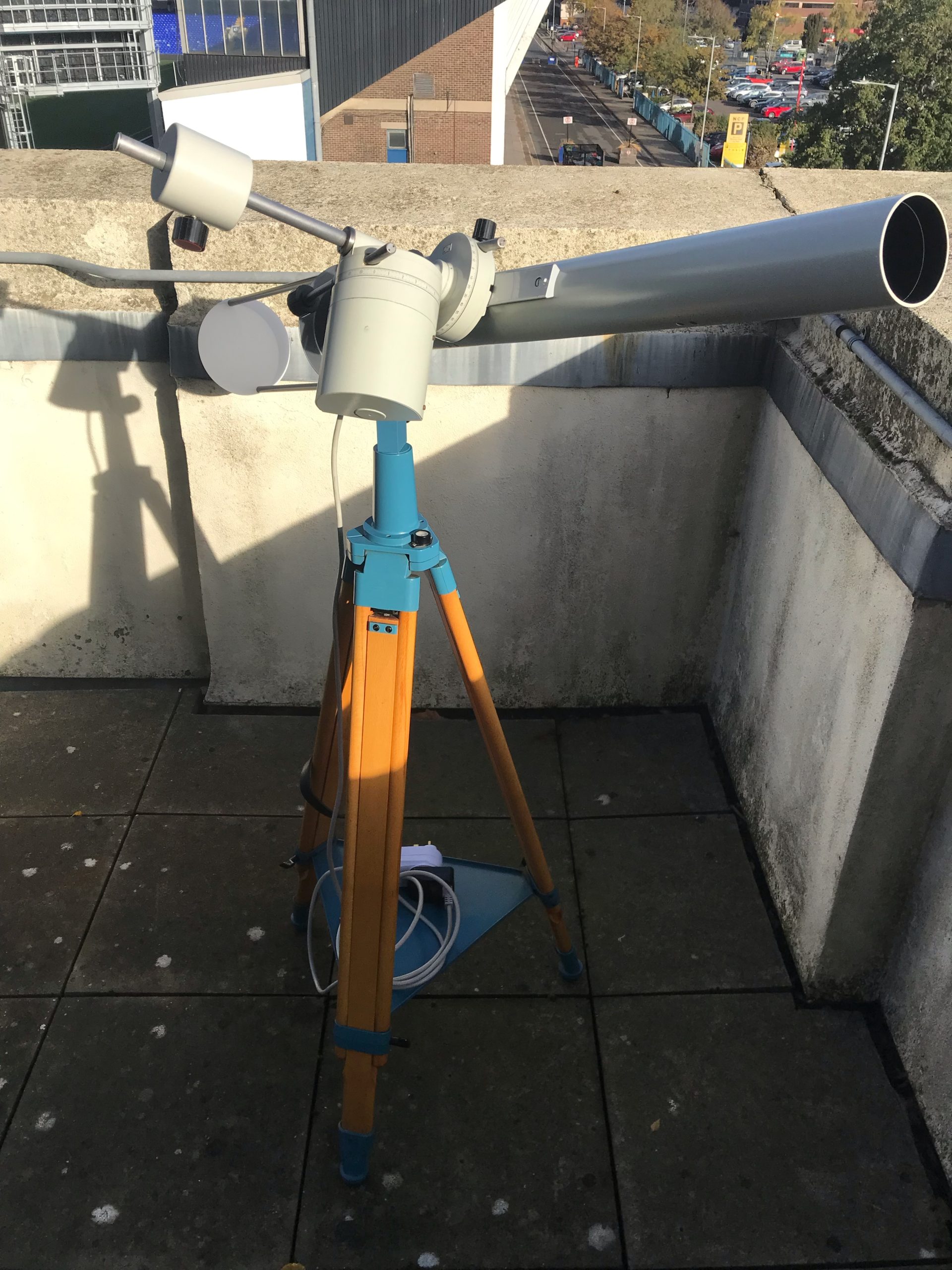
I’m planning to livestream the eclipse from Chelmsford weather permitting using a Megrez 72 refractor and an IP camera. I’ve been checking the system out this morning and have a livestream running here: https://youtu.be/a33mI9szL9k. It should be up for the next few hours. There are a few small spot groups on the Sun at the moment but the big dark blobs are dust spots. I need to clean these off before the big day.
16 October 2022 at 12:22 pm #613063 Grant PrivettParticipant
Seems to be working. Looks like thin cloud presently.
There are a couple of small dust patches – as you said – but nothing thats going to detract from a good chunk of the Sun being obscured…
22 October 2022 at 8:51 am #613216Mr Giovanni Di Giovanni
ParticipantGreetings everyone, I am looking for a few amateur colleagues who can collaborate in observing the phenomenon. More precisely, to establish the timing of the contacts and the maximum phase, together with the contact angle (clockwise from the north). For arrangements cross19@libero.it.
Thank you and greetings to all.
Giovanni (Italy)23 October 2022 at 8:29 am #613221ParticipantDear Nick
I saw the solar disk on the youtu.be page. I download images every 2-4 minutes. I have a few things to ask you:
1) Does the image come in real time? What is the phase shift?
2) The disc image would be fully suitable for my study of the phenomenon. The only small problem is that the disc is too big, it is not entirely included in the picture.
3) If the disc remains stationary within the frame, it is not easy to establish the North-South direction. To do this, it would be necessary to bring (for example every 15-20 minutes) the disc close to the east side of the frame and NOT chase it until it reaches the west side. In this way, the alignment of the various images will make it easy to establish the North-South line on the painting itself. Can you make these breaks?This is the procedure I will follow with the camera (nikon) on my telescope:
– Entire disc in the frame;
– Periodically interrupt the tracking and take 3 or 4 images until the solar disc starts to leave the frame.
Here (L’Aquila near Rome the weather should be permissive)Thank you and good observation
Translated with http://www.DeepL.com/Translator (free version)
23 October 2022 at 11:14 am #613223Nick JamesParticipantMy livestream on Tuesday morning will be here:
The forecast for Tuesday here is light cloud all morning so it may not be a very interesting livestream! At least it is not likely to be raining…
23 October 2022 at 1:57 pm #613224ParticipantSkies with high but thin clouds are also forecast for my locality, I hope well. However, for my study of the phenomenon it is only necessary to have the cusps of the solar sickle visible.
25 October 2022 at 9:43 am #613252Nick JamesParticipantClear here at the moment and the livestream is running. Under 30 mins to go.
https://www.youtube.com/watch?v=1nUMDx8PiF4
Attachments:
25 October 2022 at 11:32 am #613255 Bill BartonParticipant
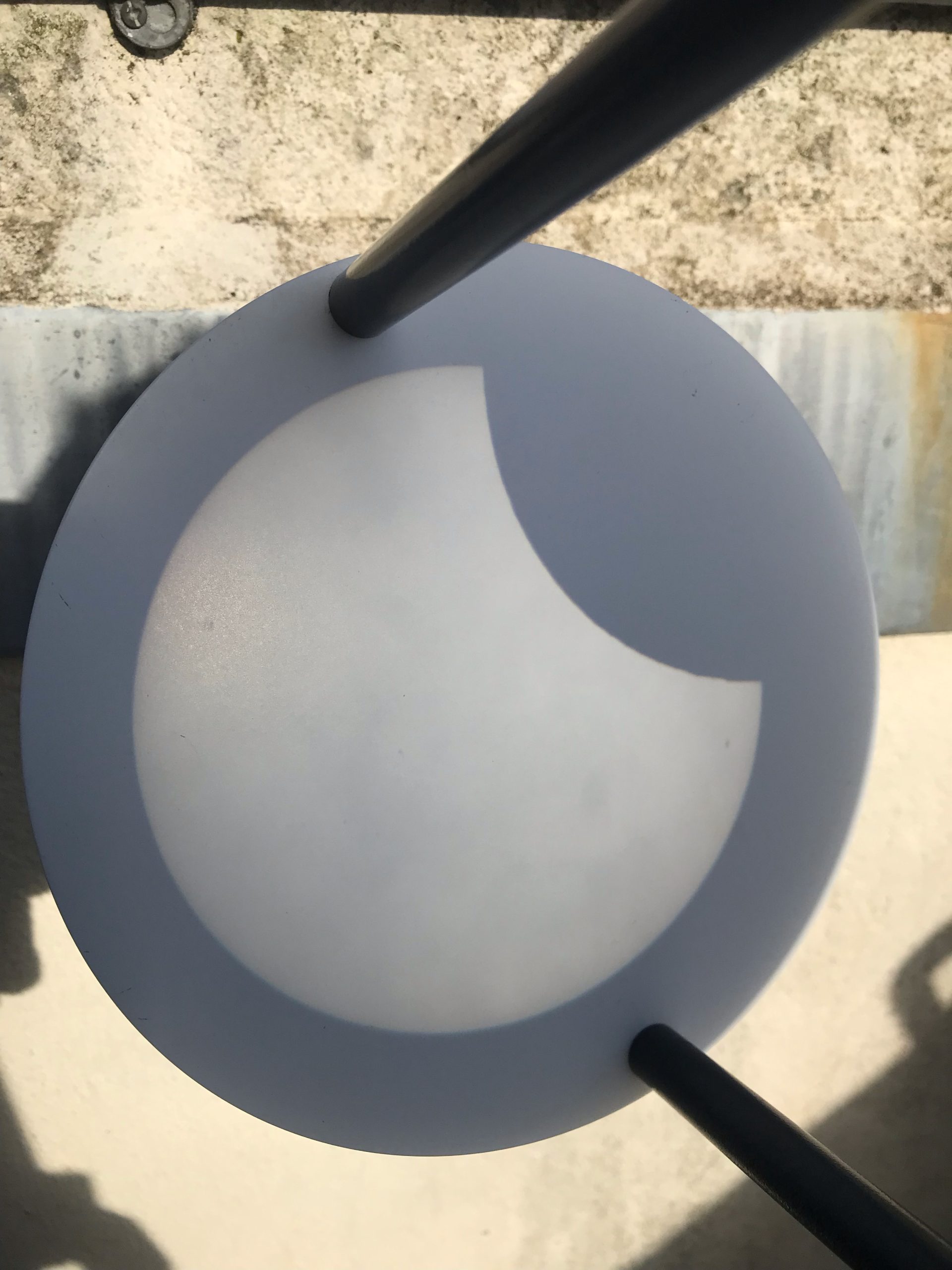
10:00UT, projected image H25 eyepiece, 63mm Aperture OG, 840mm f/l.
25 October 2022 at 11:49 am #613258 Paul G. AbelParticipant
Been a nice sunny morning here in Leicester. Observed the eclipse with the students from Leicester University Astro-soc who had organised the event. Made some drawings with my 40mm PST including one showing the lunar limb close to a sunspot.
25 October 2022 at 12:22 pm #613259 SheridanParticipant25 October 2022 at 1:32 pm #613262Participant
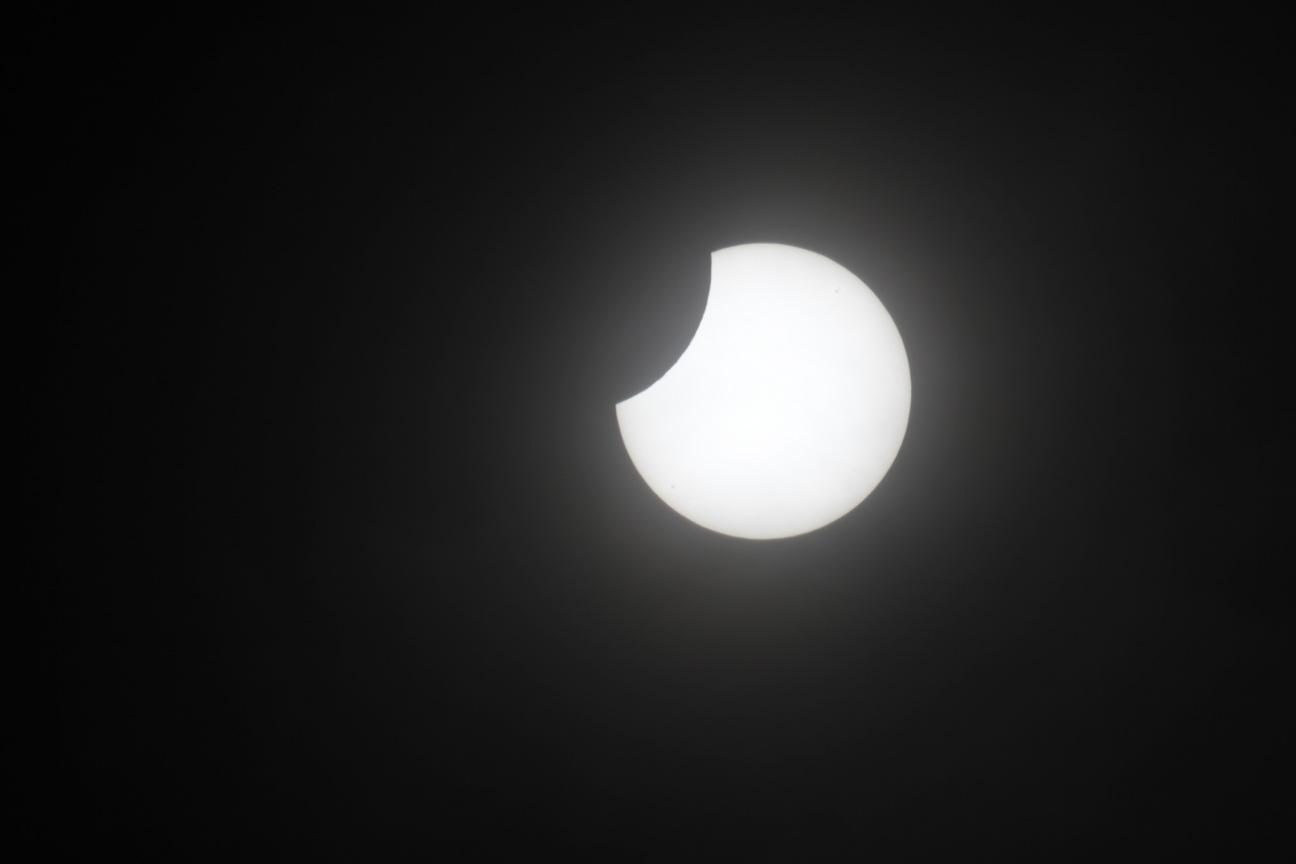
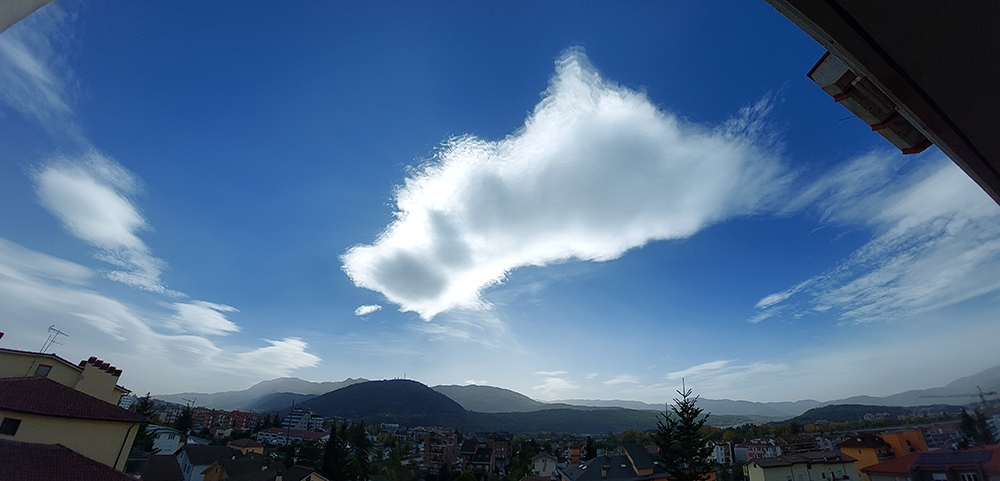
Dear friends, I present to you my photographs of today’s solar eclipse. I have just one question for you: How much would you have bet that the cloud would not move for the duration of the phenomenon? Is this a statistically significant phenomenon? It went wrong for me, very wrong. Best regards to you all.
Attachments:
25 October 2022 at 1:40 pm #613265ParticipantHi Nick, I will do a thorough processing and study of the images I extracted from your You Tube film. Thanks to you I was able to follow the whole phenomenon. You will hear from me soon. Thanks again. Regards.
26 October 2022 at 7:59 am #613278Nick JamesParticipantI’ve put a speeded up version of my eclipse video here:
https://www.nickdjames.com/Eclipses/20221025/eclipse_20221025_ndj.mp4
The entire eclipse in 35 seconds.
Someone on Youtube yesterday said that watching a partial eclipse was like watching paint dry. As a public service this video is short enough that it should not stress the attention span of most social media users.
26 October 2022 at 12:53 pm #613280Grant PrivettParticipantYou probably need to add dancers, a 120bpm backing track, some dry ice, lasers, a conspiracy theory and someone being humiliated to keep social media fans tuned in.
21 November 2022 at 10:02 pm #613808 Alex PrattParticipant
Hi Duncan,
The dynamics of solar eclipses are very well known, although that’s no reason why you shouldn’t measure the obscuration for yourself.
The Observers’ Challenge and the BAA Handbook listed the obscuration percentages for various locations, whereas the article in the October Journal gave the magnitude values (fraction of diameter obscured by the Moon). Some casual observers were put off by the small obscuration percentages, not realising that the magnitude values signified impressive partial phases. I prefer that ‘eclipse magnitudes’ are quoted in eclipse work.
Some teams observe total solar eclipses to measure the Sun’s radius, aiming to determine any evidence of long-term change in its diameter, e.g.
‘Estimating the Eclipse Solar Radius from Flash Spectrum Videos’ in
https://www.iota-es.de/JOA/joa2022_2.pdf
(17 MB download)
Cheers,
Alex.
24 November 2022 at 12:33 am #613910Steve Holmes
ParticipantHi Duncan,
Inspired by your remarks, I derived a series of formulae to calculate the obscuration from the chord length but “did it the hard way” i.e. by using just basic trigonometry, in order to get a completely different method from yours. Comparing my result with yours, for the chord length and sun diameter you quote, I found that the two answers are precisely the same. I think we may therefore conclude that your equation is correct (and very much simpler than my deliberately straightforward but multi-step derivation!).
I then applied the formulae to the observations I had made. I was fortunate to be able to take an image within seconds of maximum eclipse at my location, and as it was captured with a camera using a “hyper-zoom” lens the image was much larger than your projected image, enabling me to get a greater precision in the lengths involved. I found that the chord length was 846px and the Sun’s diameter was 1200px, resulting in an obscuration of 17.98%. I also calculated the magnitude using the same lengths, which was 0.2908. These numbers should be compared to the predicted values of 17.96% and 0.2910 given by the eclipse circumstances predictor written by the well-known “computer” Xavier Jubier. Pretty good result, I thought!
And now addressing myself to Nick James, concerning his message about the eclipse video above:-
Hi Nick!
I was quite lucky here in north Suffolk as although I had patchy cloud cover I was able to capture images between the clouds about every 5 mins, and from them assemble not a video as such but rather a “video animation”. This was after quite a lot of processing to get the images consistent of course! It shows the entire eclipse in just 25secs, as per the attachment.
Attachments:
24 November 2022 at 12:43 am #613912ParticipantHi Nick,
And here’s another animation I constructed showing that, although it appears to “roll” in an arc across the Sun in the previous animation, the Moon’s track across the Sun is indeed a straight line. Made by not removing previous frames when adding a new one until the straight line position is reached, and then successively removing early frames until last contact.
Attachments:
24 November 2022 at 11:23 am #613916ParticipantAnd hello to Duncan again!
I didn’t have my BAA Handbook at hand when typing my previous replies last last night but now I have I can perhaps shed some light on the eclipse diagram to which you refer.
Diagrams such as these are taken from the NASA eclipses website rather than being generated by the BAA, and there is an explanatory page about them at https://eclipse.gsfc.nasa.gov/SEplot/SEplotkey.html which might help you. It is, unfortunately, worded in very technical terms but the last part should help you understand the various numbers and times around the map. But basically the blue lines are lines of equal eclipse magnitude and the green lines join places where maximum eclipse for that place occurs at the same time. A larger and clearer version of the magnitude/time plot for the UK appears on page 273 of the current version of the Journal, where the text clearly says that the numbers are magnitudes rather than obscurations.
Hope that helps!
24 November 2022 at 11:01 pm #613931ParticipantHi Duncan,
Happy to hear you liked my video animations. Given the “rather variable” (!) conditions I experienced during the eclipse; the need to take several shots on different exposures each time to combat the variable cloud cover, as well as experimenting with two different density filters for the same reason, and the problem of taking shots at the required 5 minute interval if clouds decided to intrude meant that the individual frames needed A LOT of processing to get them consistent enough to be assembled into the animations. I’m thus glad to know that my efforts have been appreciated! The second one is particularly intriguing, as you say – I haven’t seen anything similar on the Internet so I was rather pleased it came out so well.
I also found equations of the form you derived on the Internet but wanted to explicitly avoid that approach so I could get my results via an entirely different route and thus be confident in the comparison between the two methods. Doing it “the hard way” also enabled me to sort of work backwards from the answer and derive an again multi-step process for converting from magnitude to obscuration, which I’m sure will prove useful.
In terms of the measurement and calculation errors which might be expected, the fact that I was able to use a much larger image gave me advantages in both precision and accuracy. More precise as I was working at the 1 in 1000 level whereas you were at 1 in 250, and potentially more accurate as, because of the greater precision, I could determine my measurements at a smaller “step length”. That is, in my case a 1 pixel step hardly moved the “marquee” lines I was using to measure distances, and so the lines could be more closely aligned with the Sun, whereas your 1 pixel change will have moved the measurement point by four times as much so you might not have been able to line things up exactly. I still had the problem of estimating the correct points to measure from of course, given that my image was not sharp (because of the limitations of the home-made filters I was using), but even so I believe that my distances were probably correct to +/- 1 pixel. Translated to the difference this would make to the final result, as compared to the nominal 1200 by 846 figures, the maximum difference (in the cases 1201 / 845 and 1199 / 847) was just less than 0.5% which is still pretty acceptable.
The same website I used to determine the theoretical magnitude and obscuration also gave the ratio of the diameters at my maximum eclipse, which was 0.99253. The assumption of equal sizes is thus highly reasonable, involving potential errors of only the same order of magnitude as those involved in taking the measurements and probably less as the radii are used as part of more complex equations rather than as direct parameters. The SD values on the NASA chart are of course those relating to the point of absolute greatest magnitude (over eastern Siberia) so, while indicative of the situation, will not be applicable to the UK as the Moon will have moved along its orbit during the eclipse.
Steve
29 November 2022 at 12:44 am #613981ParticipantOddly, although before I made this reply the front page of the website said the latest reply was from Duncan, and the total number of replies before this one was given as 23 with the last made by Duncan 5 hrs 57 mins ago (at time of typing), the number of actual posts was shown as only 22 with nothing visible from Duncan. An aborted reply, or a glitch somewhere?
-
AuthorPosts

- You must be logged in to reply to this topic.