
Mars Opposition 2026-27
A blog of all posts for the 2026 – 2027 Opposition
Mars Opposition Blog 2026 August 11
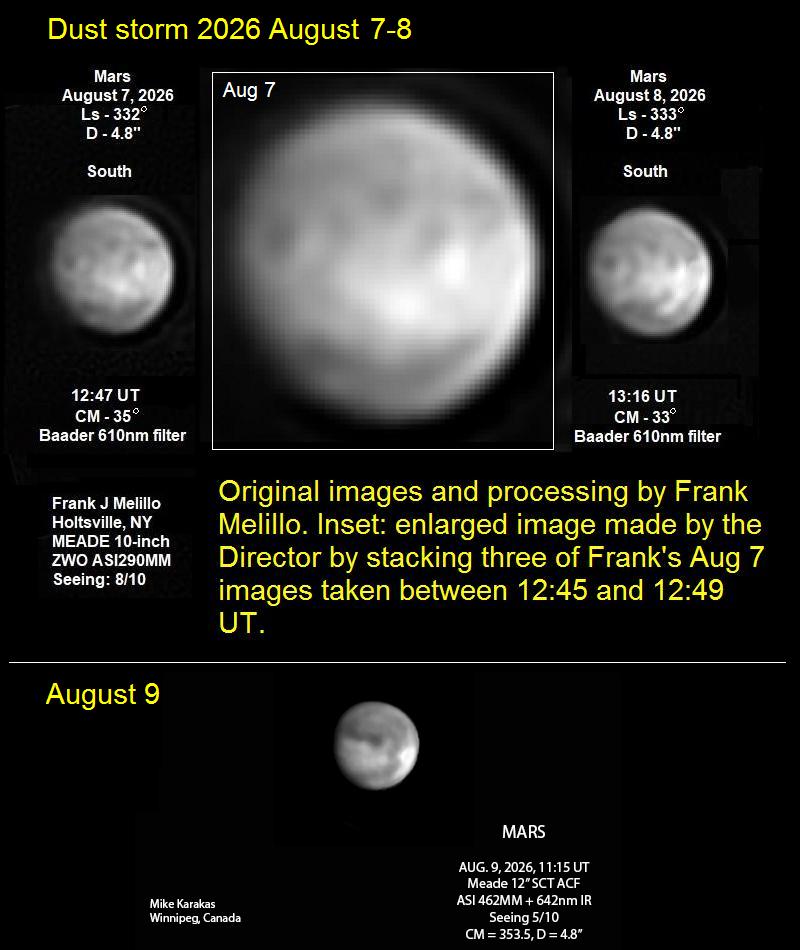
No further information has come to light about the dust storm reported last time, but there has been further dust activity, and more observers have joined in.
Two sets of near-IR images by Frank Melillo (USA) show new and changeable bright dust clouds across central and northern Chryse-Xanthe on Aug 7 and 8. There appears to have been dust at Ophir-Candor too, while on the second date the main cloud extends as far north as Chryse Planitia, the frequently dust-storm active basin bordering Mare Acidalium and Nilokeras. (I have taken the liberty of stacking and enlarging three of Frank’s Aug 7 images together to show the initial clouds more clearly.) Upon receipt of the report, I rapidly contacted all of our contributors in America and Canada (none of whom had yet observed the event) and then posted an alert on the BAA Forum. Mike Karakas (Canada) subsequently obtained a confirmatory lower resolution near-IR image on Aug 9 that clearly shows Chryse filled with bright dust, at the morning limb.
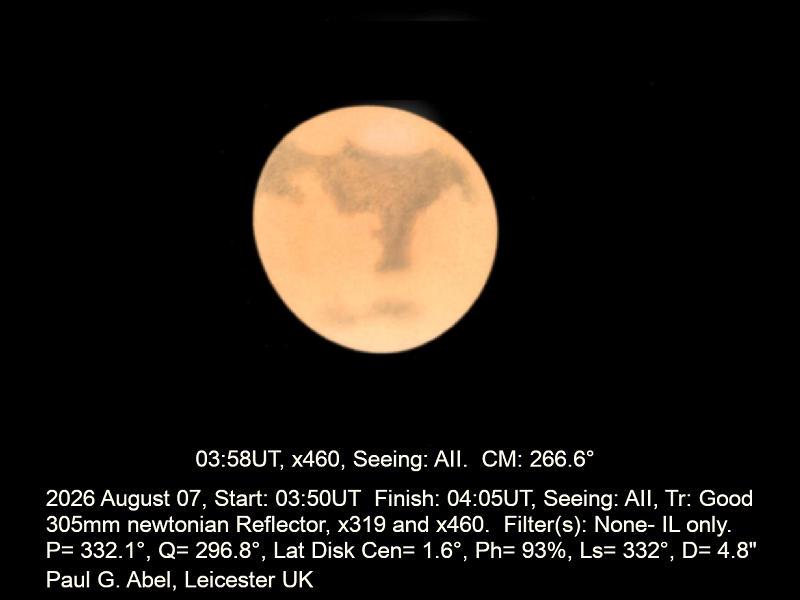
Unfortunately the storm is not observable from the longitude of the UK, and will probably have died out before the region becomes accessible, but sometimes dust activity can occur at the polar hood boundary in the longitude of Utopia, an area which is now visible from the UK, and shown in Paul Abel’s (normal) drawing of Aug 7.
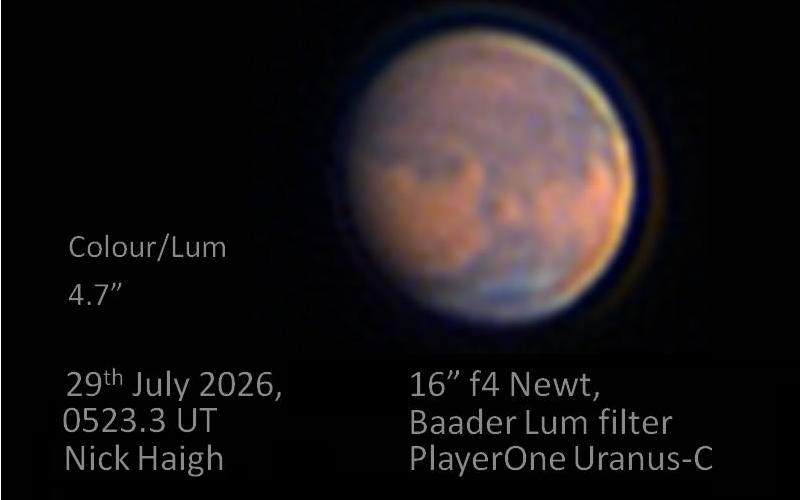
An image by Nick Haigh for Jul 29 shows an E-W elongated belt of white cloud crossing Mare Acidalium, which is a pretty typical appearance for the season.
The western end of this or a similar cloud belt can be seen near the evening terminator in a very high resolution image by Tom Williams taken on Jul 22. On Jul 22 the cloud appears slightly warm-toned, suggesting dust activity could be involved. To be certain of distinguishing white clouds from dust, a set of RGB filter images is desirable.
Furthermore, the polar hood exhibits partial transparency to the north of Mare Acidalium, giving rise to a dark rectangular patch of albedo marking nicknamed “Dawes’ slit” after the 19th century observer who first recorded it clearly. Another extraordinarily detailed image by Tom Williams from Jul 29 shows this effect very clearly despite the disk diameter still remaining below 5 arcseconds.
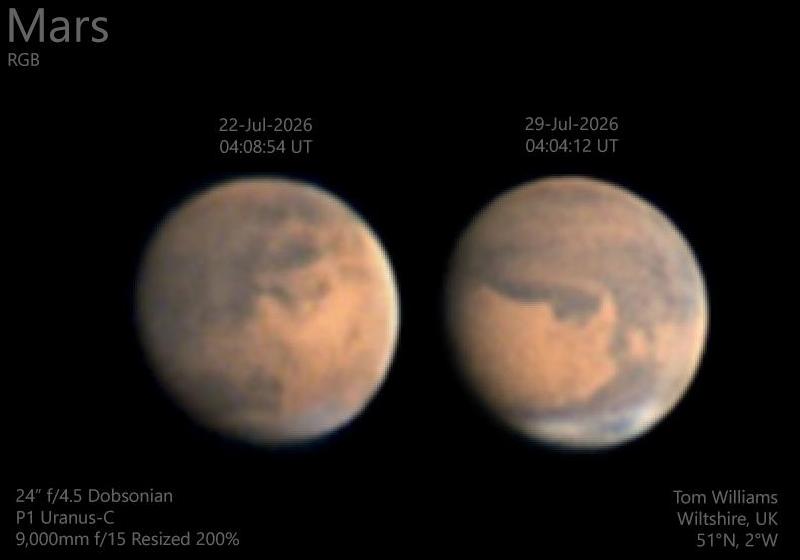
Of the surface features, Nepenthes remains invisible, the Oxia Palus-Indus development (2018-) remains prominent, and Solis Lacus is still large and conspicuous (see the image by Tom Williams on Jul 22). All the observations referred to above have been posted here, orientated with south up.
I have not been able to produce the current full list of observers for the front page yet, but hope to do so soon. Good observing!
Mars Opposition Blog 2026 June 30
A number of observers have now joined in, making a total of seven. A list of them will become available on the front page as a Word document. It will be updated from time to time.
Current relevant martian seasonal dates are as follows:
N. Winter Solstice/ 2026 Apr 25 Ls = 270
S. Summer Solstice
N. Spring Equinox/ 2026 Sep 30 Ls = 360
S. Autumn Equinox
The continual shrinkage of the S. polar cap has been followed, and on May 28 the first hints of the presence of the N. polar hood began to be traced in the systematic images of C.Foster.
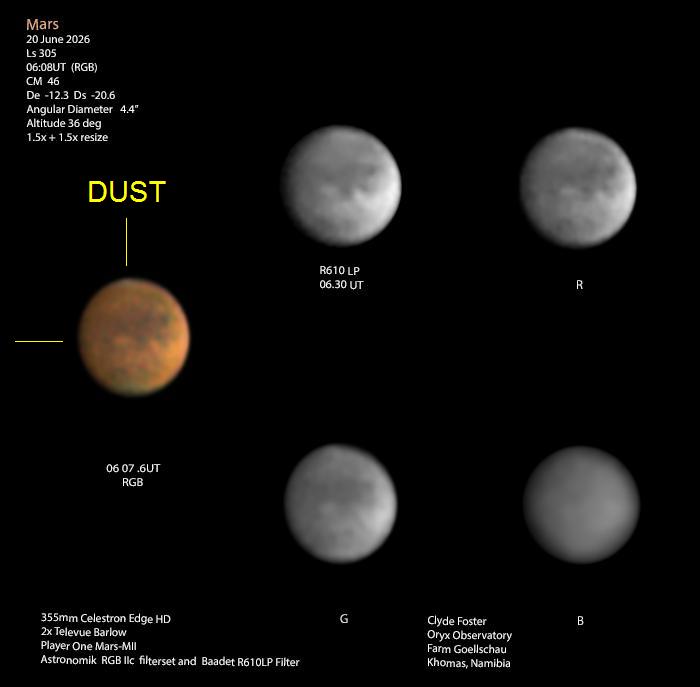
A few days ago we witnessed the first dust storm of the apparition. On June 20, Foster captured a bright dust cloud along Valles Marineris, which impinged upon the southern parts of Chryse and Xanthe. This image (06:08 UT) is posted here with the dust storm labelled (south up). The closest available prior comparison is another image by Foster taken on June 17. This shows no sign of dust in the area, when it was then close to the evening terminator. On June 21, images by Foster (05:33 UT) and N.J.Haigh (UK; 05:30-06.41 UT) showed the dust to have dispersed, with the proviso that the disk diameter remained tiny, limiting resolution. Foster’s image of Jun 24 confirmed the cessation of activity.
It is some years now since we had an encircling dust storm, the last one being in 2018. What will happen this year? We shall know for sure well by September 30. The seasonally latest date for the start of such an event remains the encircling storm of late 1924, which commenced at Ls = 311. This same seasonal point will be reached in a few days’ time.
It is now very nearly 50 years since the landing of Viking 1 upon Mars. Back then, we had no doubts in our minds that Mars would have been colonized by now, if not long before. But space exploration took a different direction, the Moon being abandoned, followed by a long romance with the space shuttle, space stations, and a proliferation of unmanned spacecraft. Martian orbiters, rovers as well as a martian helicopter have certainly achieved great technological progress, but the human footprint has so far been conspicuous by its absence.
Mars Opposition Blog 2026 May 3rd
Welcome to the 2026-27 BAA Mars blog. We shall be covering the observational work of our members right up to and beyond the date of the next opposition, 2027 February 19. I will try to write regular updates, and in later months there will be the usual note appearing in the Journal about martian seasonal dates during 2026-27, and a description of what can be expected to be visible at different parts of the martian year. Meanwhile, the southern hemisphere summer solstice occurred on 2026 April 25, and southern autumnal equinox will follow on September 30.
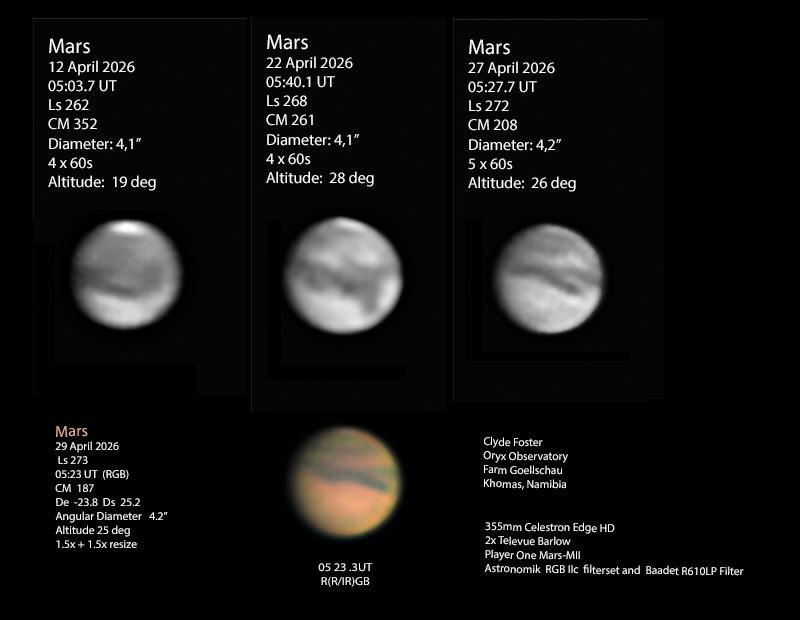
Observations have begun quite early once again, thanks to Clyde Foster of Namibia. His current images are shown here. They show the large and rapidly shrinking S. polar cap in late southern spring and early summer, and normal albedo markings. Note the intense darkness of Syrtis Minor, preceding Syrtis Major, and the absence or faintness of Pandorae Fretum in the first one. There is an absence of obvious dust activity in these early images, but we must emphasise that the apparent diameter of Mars is barely larger than 4” at the present time. Conditions have only recently allowed synthetic colour images, but the better seeing found in the near-infrared had allowed decent imaging in that waveband.
The Director is now busily writing the 2022 final apparition report, in continuation of 2020. All past reports can be accessed from the link on the front page of the Mars Section website. Meanwhile, blogs for 2022 and 2025 are still to be found on the website.
At this early stage, every single observation will count in maintaining our global coverage of the Red Planet. If you can help, please send in your data as soon as possible.
| The British Astronomical Association supports amateur astronomers around the UK and the rest of the world. Find out more about the BAA or join us. |