
2026 June 2
Deep Sky Update – June 2026
We’ve had a few nice days in Orkney in April, but not the heatwave experienced by those down south. A couple of nice sunsets and clear overnight, but no signs of noctilucent clouds from here yet. Proper dark skies won’t return until mid-august, so I should be getting on with the maintenance jobs, but unfortunately the grass keeps on growing….
Webb Deep-Sky Society Annual Meeting
The Webb Deep-Sky Society annual meeting is on Saturday 20th June at the Institute of Astronomy in Cambridge. The programme and ticket prices are now posted on their website at:
https://www.webbdeepsky.com/annual-meeting/year/2026
A great lineup of speakers and an excellent venue. I am all booked up to attend, so hope to catch up with a few of you there. All welcome, you don’t need to be a Webb Soc member.
APOD
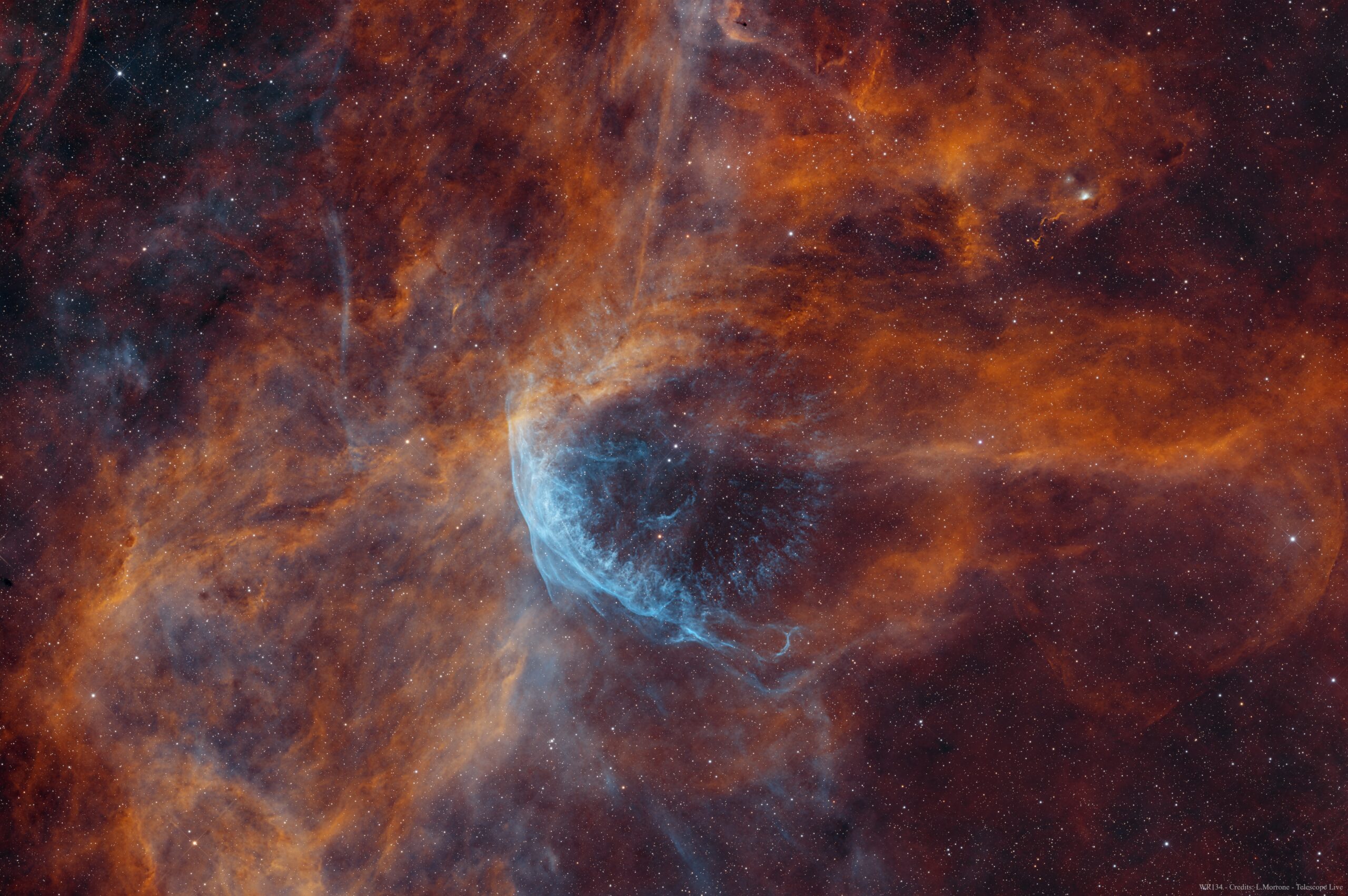
Our member Luigi Morrone had an image featured as NASA APOD on May 22nd. His image of WR134 in Cygnus was taken with a Newton ASA250mm and Player One mono IMX571 camera, from Italy.
Double Stars for June
I head towards the horizon again this month and visit Scorpius. Xi Scorpii lies in a narrow northern extension of Scorpius (probably created in 1928 to capture an existing variable). The main pair (STF 1998 AB) is a very tight binary with a remarkably short orbital period of 45.9 years. It has a current separation of 1.1 arcseconds (which will need a 150mm telescope for a clear separation) and a position angle of 20.5°. Unfortunately, the widest separation (1.13 arcseconds) was in 2022 and the gap is narrowing rapidly. The two stars are almost identical in magnitude (4.84 and 4.86) which will help. They are both F type stars and are seen as amber yellow. For observers with a smaller telescope, there is a third member of the system (C) which is magnitude 7.3 and has a nice separation of 7.5 arcseconds; the position angle is 42°. It is also a binary, but with a much longer orbital period of 1514 years. The stellar type is G, but I see it as blue. However, the real beauty of STF 1998 lies in the presence to the south-east (following) of STF 1999 only 280 arcminutes away. It is a binary (orbital period not stated) and the magnitude of the two stars are 7.4 and 8.0. The separation is 11.9 arcseconds and the position angle is 98.2°. They are both K type stars and are seen as tangerine orange. William Herschel observed them as a “double-double” in Libra on 23 May 1780 and called the dimmer pair as “small and obscure”. He subsequently split the AB pair in Xi Scorpii.
Moving southwards to the mouth of the enfilade, we arrive at Nu Scorpii, also called Jabbah, which is surrounded by nebulosity. The AB pair (BU 120) is another tight pair, with a separation of 1.35 arcseconds which brings it within reach of a 125mm telescope and a position angle of 1.5°. The separation appears to be increasing slowly and it is a binary of unknown period. The magnitudes are 4.4 and 5.3. The stellar type of A is B, but the type is not given in Simbad for B. Judging by its B-V value, it is also B and they are both seen as white. The AC pair is H 5 6 (a Herschel designation for a wide pair) and has a separation of 41.5 arcseconds; the position angle is 336°. It is stellar type B and is seen as white. Herschel observed it on 19 September 1779 and saw them as white. C is itself a binary (MTL 2 CD) with a separation of 2.4 arcseconds and a position angle of 49°. D has a magnitude of 7.2 and is also a B star and is observed as white. MTL refers to Ormsby MacKnight Mitchel (1810–1862) who established Cincinnati Observatory in 1845 and reputedly founded the first astronomy magazine in the United States. He was made a Brigadier General in the Union army in the Civil War, but died of yellow fever.
Moving south-westwards (preceding) by one and a half degrees, we reach Beta Scorpii or Acrab (it has been confusingly been called Graffias in the past, but Acrab is now its official name). The AB binary pair (BU 947) is very tight (0.36 arcseconds), but AC (H 3 7) has a separation of 13.7 arcseconds and a position angle of 19°. The stars are magnitude 2.6 and 4.5 and they are both main sequence B. They should both be seen as white, but they are often observed as white and cobalt blue which is clearly a contrast effect. Herschel observed the pair on 19 September 1779 (as whitish red and red), but noted other astronomers had previously seen it as double. AC is an optical double, but there is another visible binary star in the system, namely PWL 9001 AD. D (HD 144273) has a separation of 519 arcseconds and a magnitude of 7.5; the position angle is 30.4°. The stellar type is B and it is presumably white although I have not yet observed it. PWL is Eyre Burton Powell (1819-1904), a Cambridge graduate who became Principal of Presidency College in Madras – did he really observe over 9,000 doubles? Just below Acrab is the naked-eye (but unofficial) double Omega1 and Omega2Scorpii which are magnitude 3.9 and 4.3 and are separated by 877 arcseconds (or 14.6 arcminutes). They are types B and G, but I see them both as white.
We only see half of Scorpius from the UK (the whole constellation with its stinger, is far more impressive, I have seen it only once) and I end this account with a very low but attractive binary, BSO 12. At declination 31°S, it is only barely visible in southern England and its maximum altitude is 7.5°. The magnitude of the stars are 5.6 and 6.9, but even at their maximum altitude, they are extincted to 6.4 and 7.9. The separation is 23.6 arcseconds and the position angle is 318°. They are both F type stars; I see them as yellow and a darker yellow. The Brisbane Observatory (BSO) stars were catalogued by John Herschel in his Cape Results (1847), but originated from Brisbane Observatory in Parramatta, near Sydney, which produced a catalogue of 7385 stars published in 1835. The observatory was founded by Sir Thomas Makdougall Brisbane, a Scottish military officer and astronomer, who also gave his name to the city in Queensland. BSO 12 was probably observed (but this is not certain) by James Dunlop, also a Scottish astronomer and the assistant to Brisbane, who has his own double star designation, DUN (formerly Δ).
Object of Interest for May
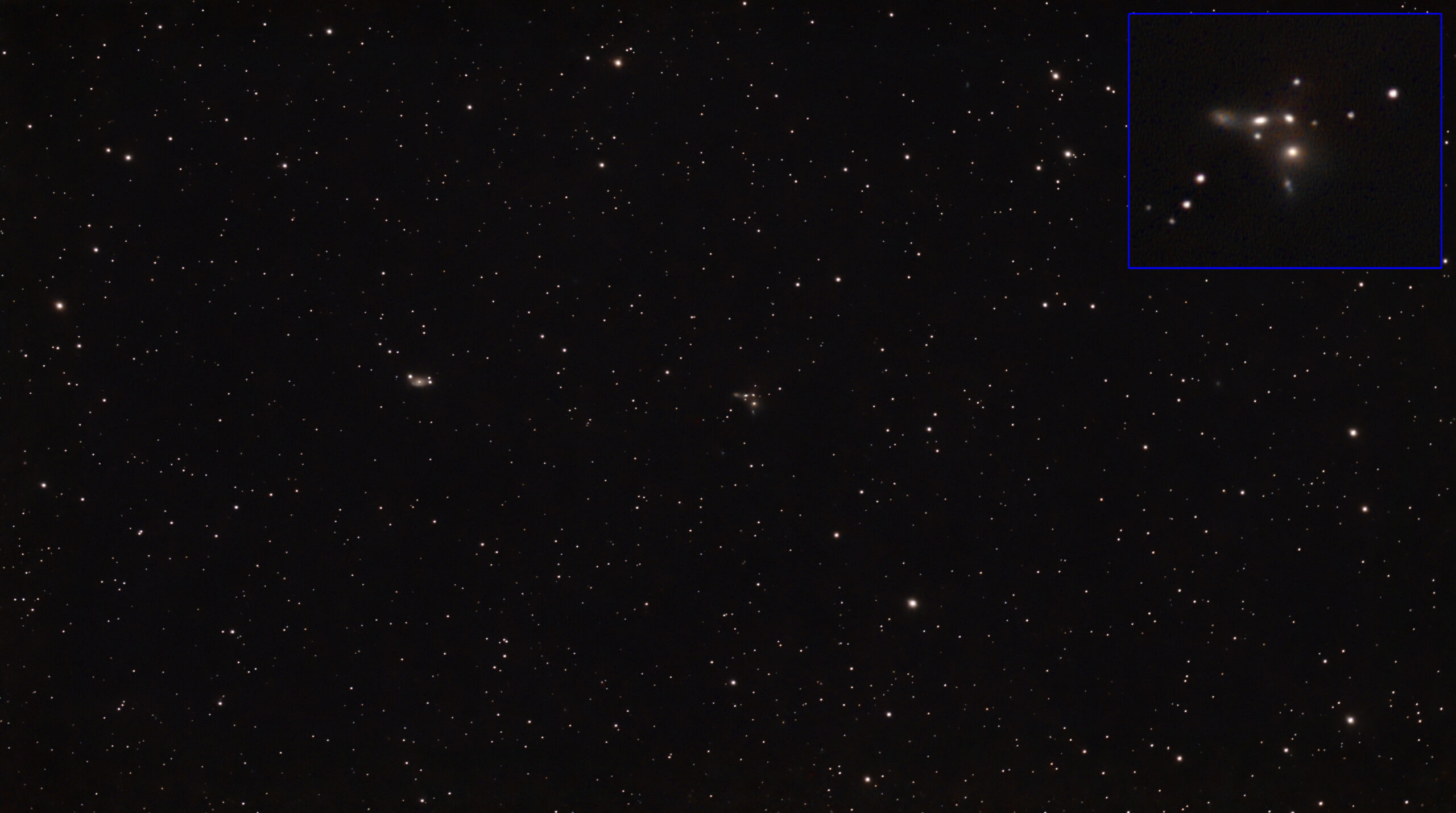
The May target was Seyfert’s Sextet in Serpens, a tight galaxy group around NGC 6027. This was a fair challenge as pretty small to image, so huge thanks to those who had a go at it: Iain Cartwright, Ivan Walton, David Strange, Mark Fairfax, Jonathan Elliott, Brian Scott, Paul Whitmarsh, and Karen Smith. Seems to have been a challenge with some catching it multiple times. Paul Whitmarsh made interesting comparison images taken with a Seestar S50 and a 152mm f7.9 Refractor with Player One Poseidon-M camera.
Here is Mark Fairfax’s image taken with a Celestron Origin V2.
OOI for June
Our target for June is the globular cluster NGC 6366 in Ophiuchu. It’s mag +9.5, very loose (Shapley-Sawyer class XI) and shows reddened to a golden colour in some images and forming a pleasant contrast with a nearby bluish star. Hopefully it won’t be too low!
Deep Sky Picture of the Month
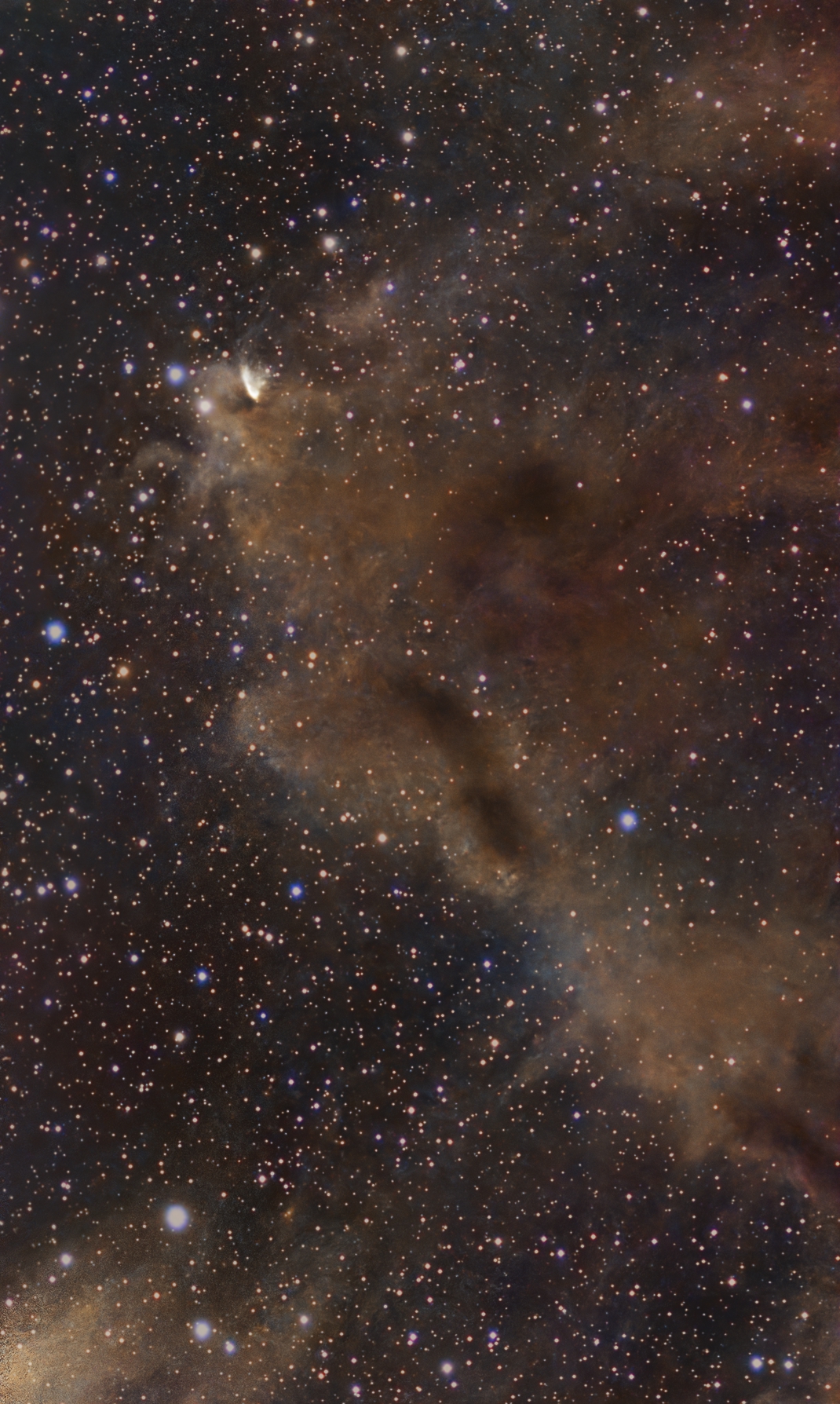
My pick of the May pictures is this one of Gyulbudaghian’s Nebula taken using a Seestar S50 by Simon Davis. It’s really nice to see a wider field and colour view of this target.
Clear, dark skies,
Callum
| The British Astronomical Association supports amateur astronomers around the UK and the rest of the world. Find out more about the BAA or join us. |