
2026 July 3
Deep Sky Update – July 2026
June has seen really bright skies in Orkney when clear, so no deep sky observing for me this month. There was one display of Noctilucent Clouds on June 9-10, but this was fairly diffuse and just caught on my aurora-cam in summer mode. Round mid-summer is not really good for NLC from our high latitudes, so I hope we will see some better displays through July.
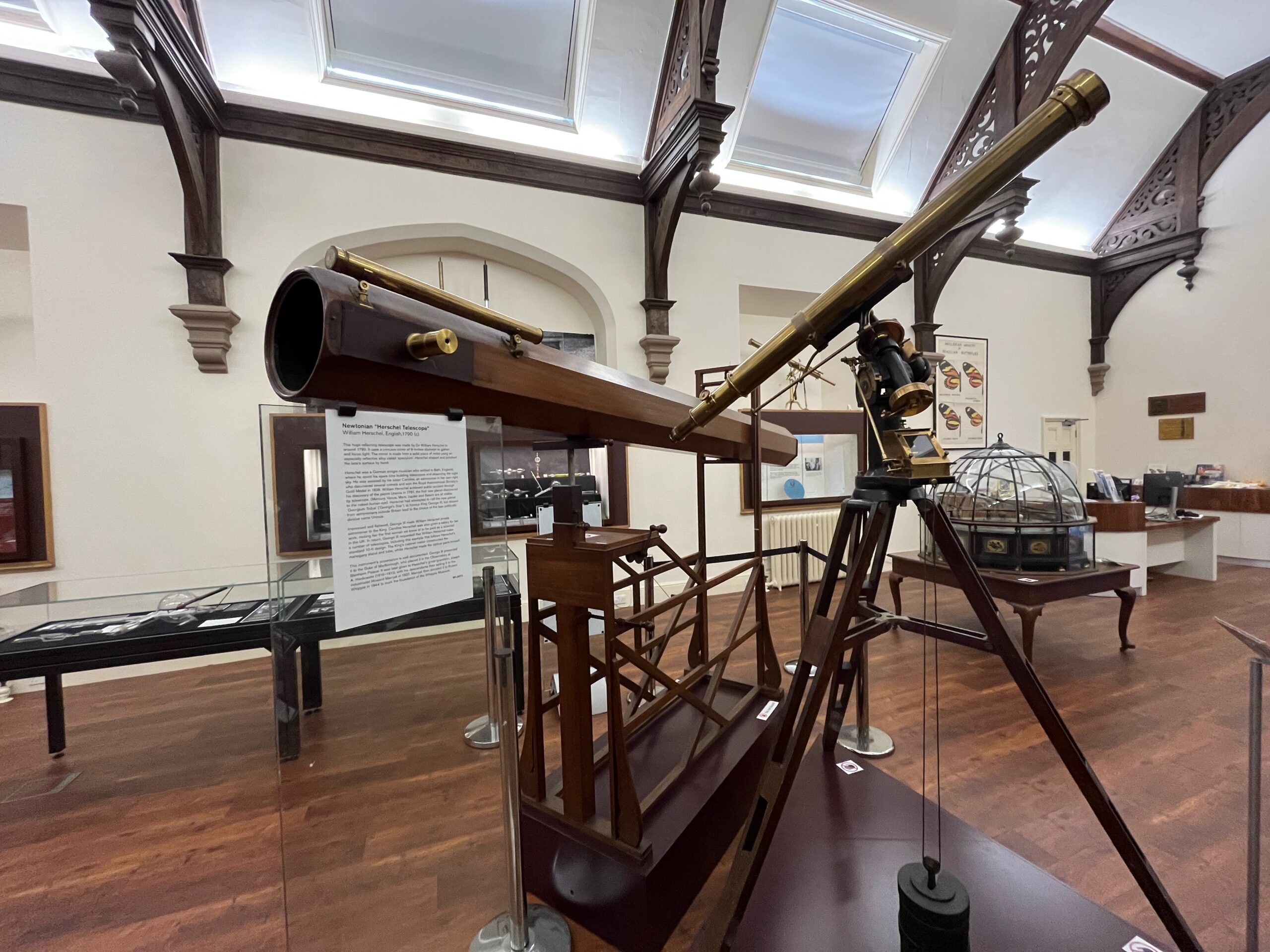
I ventured south to the Webb Deep-Sky Society annual meeting in Cambridge on June 20th. Although the weather was rather hot, it was a good trip. The meeting was excellent with interesting speakers and topics. And it was great to meet up with so many astro-friends. In Cambridge I was able to visit the Whipple History of Science museum, and also the Polar Museum (which is about the exploration of the north and south polar regions); both are recommended.
Section Meeting 2027
I have penciled in March 20 2027 for the next section meeting. Lincoln AS have offered to host the meeting, and we are looking into venues at the moment. If you’d like to give a talk at the meeting, or would like to hear talks on any specific topics, please let me know.
From the Journals
I came across a couple of interesting papers recently.
“Discovery of a nebula associated with a high proper motion sdB star” by Ortiz et al. shows fairly deep imaging of the star TYC 3315-1807-1 (in Perseus), with a large telescope. Imagers with large scopes and lots of observing time might like to have a go!
I was trying to find out a bit more about the type of photographic plates that EE Barnard used for his Photographic Atlas, and came across this paper on “Digitization, Measurement, and Analysis of a 1905 Barnard Atlas Photographic Plate” by Glusman et al. Really interesting to see what modern techniques can be brought to bear on historic data.
Double Stars for July – Peter Morris
This month, I visit Aquila. I begin in the eastern edge of the constellation with a double in an enclave of Aquila encroaching on Serpens Cauda. The binary star 5 Aquilae (STF 2379) has four members, but here I will only deal with the easy AB pair. The magnitude of the two stars are 5.9 and 7.0 and the separation is 12.5 arcseconds; the position angle is 120.9°. They are both main sequence stars, being A and F, and are usually seen as yellow-white and blue. It was observed by William Herschel on 30 July 1781 as white and bluish. Moving east (following) I reach 15 Aquilae (SHJ 286) which is an optical double. The magnitudes are similar to 5 Aquilae (5.6 and 7.0), but it is much wider at 39.6 arcseconds; the position angle is 211.3°. They are both K giants, but they are seen as yellow and blue, despite the fact that B is slightly more yellow (K3) than A (K0/1). They were seen by Herschel on 25 July 1781 as both pale red. The two stars are very far apart – A is 314 light years away, whereas B is more than double the distance at 641 light years. Unsurprisingly the absolute magnitudes are similar (0.58 vs 0.53). 15 Aquilae is also a member of the ‘Swoosh’ asterism which points the way to Messier 11. We now move much further eastwards (following) to 57 Aquilae (STF 2594), another binary star. The magnitudes are 5.7 and 6.4, with a separation of 36.3 arcseconds; the position angle is 171°. The stars are main sequence B stars. They are both observed as white, but with tints – I see them as yellow-white and bluish, whereas Sissy Haas considered them to be white and scarlet-tinged white. This double was observed by Herschel on 2 August 1780 as white and white inclining to red.
My final double in Aquila is the binary star S 749 in the far east of the constellation in a line formed by Delta, Eta and Theta Aquilae. There are six stars listed under S 749, but none of them (except A and B) are part of the binary system and they are faint (the brightest is magnitude 11.0). The magnitudes are 6.8 and 7.5, with a very wide separation of 60.2 arcseconds; the position angle is 189°. They are both main sequence F type stars. This raises a slight conundrum. They are almost identical stellar types (F7V and F6V) so the difference in magnitudes implies that they are not close to each other. Their parallax was measured by Gaia (EDR3) and their relative distances to us are 155 light years and 150 light years – they are considered to be physically connected by Bayesian analysis. The absolute magnitudes are 3.4 and 4.2 which are rather surprising. I saw them both as white, but Sissy Haas observed the pair as lemon-yellow and a subtle tangerine orange. This double was catalogued by Sir James South in 1825. It was possibly observed by Herschel on 25 July 1781, but this is doubtful. I will conclude with one of the few easily observed doubles in Sagittarius which is in the far north of the constellation and almost in Aquila, namely 54 Sagittarii (HJ 599). The AB pair is an optical double and B is magnitude 12.7, so I will concentrate on the AC binary pair. The magnitudes are 5.4 and 7.7 with a separation of 45.5 arcseconds; the position angle is 41.4°. B and C are practically the same distance from A and separated by an angle of 128° if you can observe it. A is a K giant and C is a main sequence F star. They are usually seen as yellow and white.
Object of Interest for June
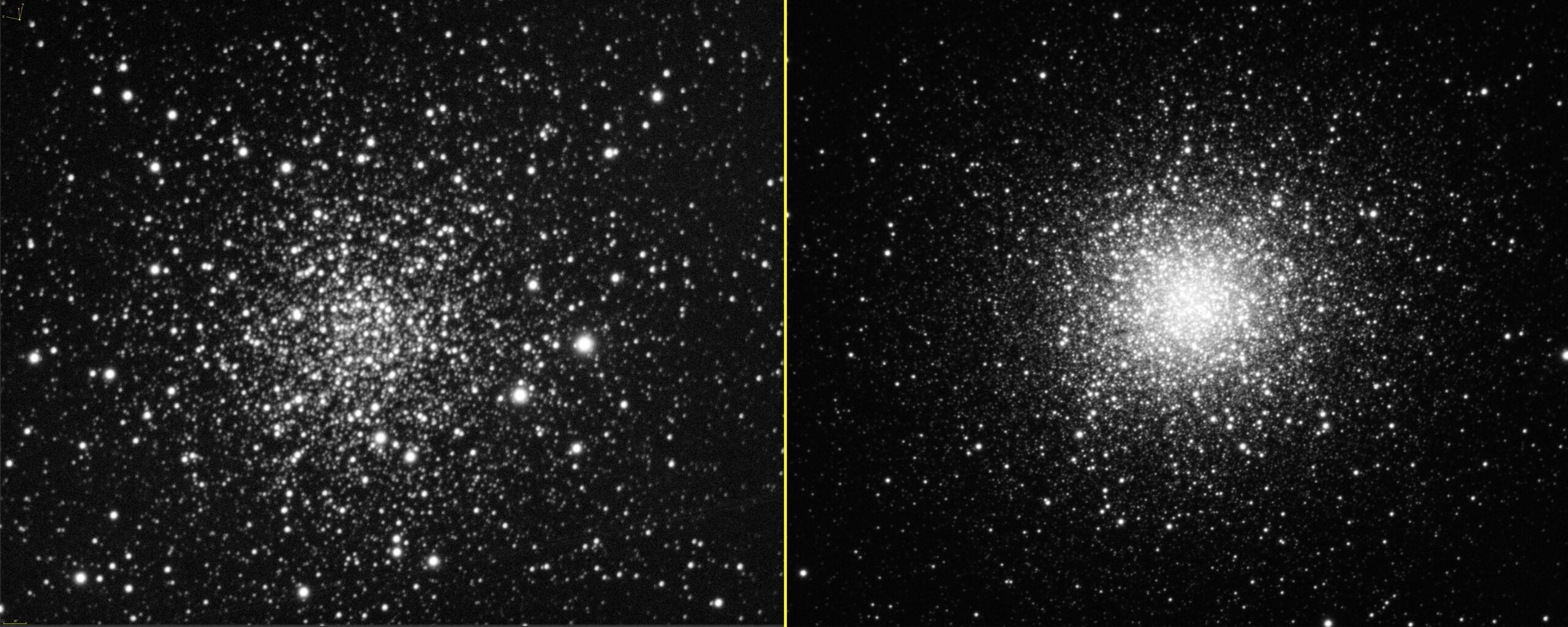
The June target was the globular cluster NGC 6366 in Ophiuchus. Many thanks to Grant Privett, Philip Terry, Jonathan Elliott, Ivan Walton, Iain Cartwright, John Axtell, and Karen Smith for their observations.
Grant posted a nice comparison of NGC 6366 against M13 which nicely shows the difference in their concentration classes. Here is Grant’s image:
July Target Object of Interest
Jim’s pick for July’s target is more challenging than June’s. In Sagitta lies Sh 2-80 also known as “Merrill’s Star Nebula” and also Minkowski 1-67. It is an interesting object – a roughly ring shaped nebula formed around the highly energetic Wolf Rayet star WR 124. Quite small, it will be a challenge for imagers.
Deep Sky Picture of the Month
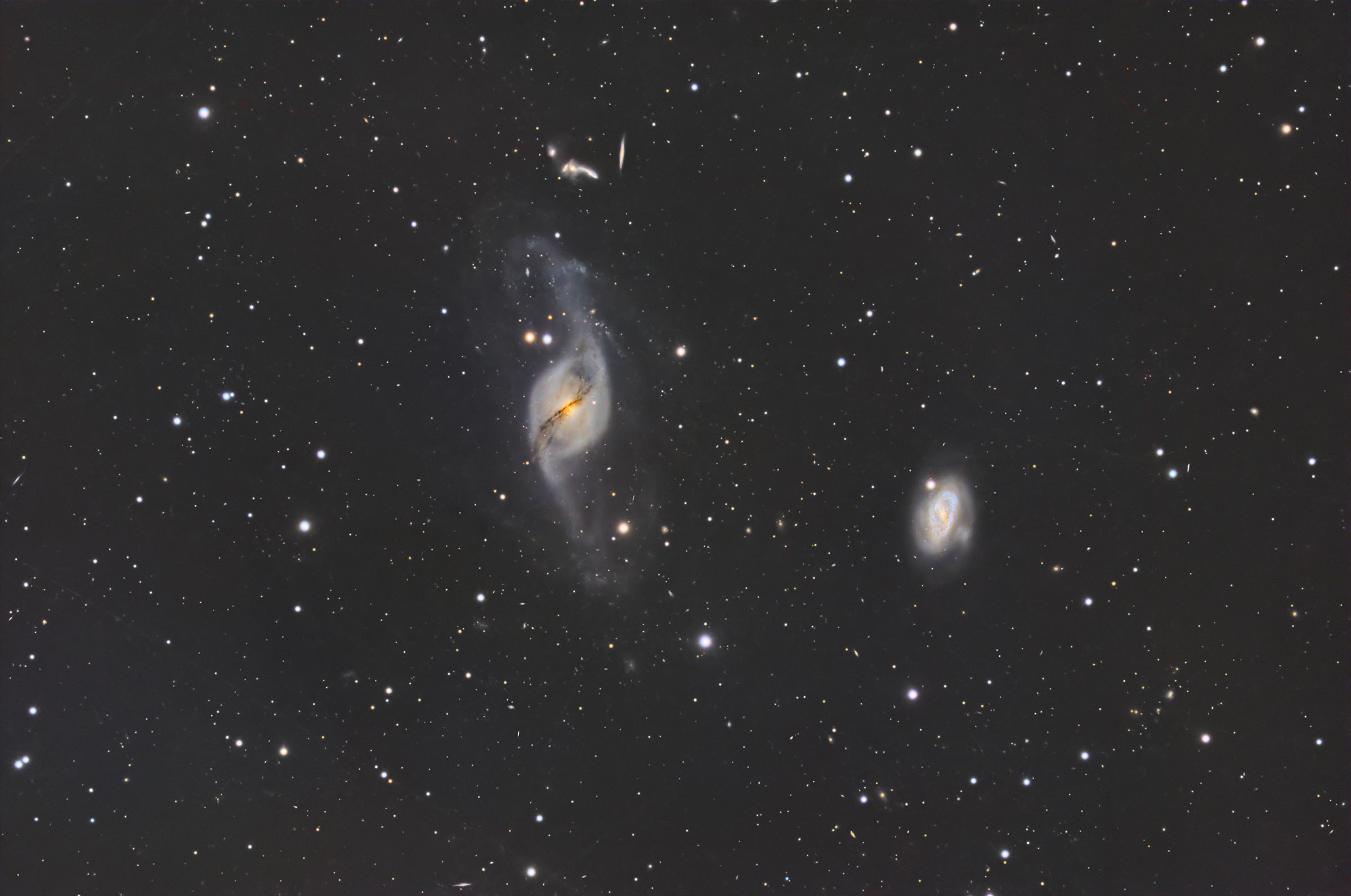
Not so many image submissions in June, I guess reflecting the short nights and poor weather. However, Ian Sharp & Paul Downing were able to image Arp 214 in Ursa Major from Spain.
And Finally
I expect it will still be challenging for observing in July, though for me I have to wait to mid August for astronomical darkness to return. But it is really nice to be able to observe on a ‘warm’ summer night – so if you do get a chance, take advantage of it.
Clear, dark skies,
Callum
| The British Astronomical Association supports amateur astronomers around the UK and the rest of the world. Find out more about the BAA or join us. |