
› Forums › Variable Stars › ER UMa stars: IX Dra update
- This topic has 6 replies, 3 voices, and was last updated 3 months, 1 week ago by
 Stewart John Bean.
-
AuthorPosts
-
3 November 2025 at 8:36 pm #631945
 Stewart John BeanParticipant
Moving on from V1159 Ori ( see earlier topic) I am working on the superoutburst of IX Dra. I am most grateful to R Sargent for observations on 2459906 that fills an observational gap. However, I am stuck with three unobserved super outbursts. TESS, BAA, and AAVSO databases do not cover superoutbursts at the following approximate ( +- 5 days) times:
2460260, 2460630 and 2460750
Does anyone have observations around this time?I have done battle with ASAS-SN and Lasair and lost. I may well be approaching these two systems incorrectly.
Can anyone help?
Stewart
3 November 2025 at 9:15 pm #631947 Jeremy ShearsParticipant
So that’s around 2023 Nov 11, 2024 Nov 15 and 2025 Mar 15. I will check tomorrow.
It was in outburst last night.9 November 2025 at 10:15 am #632029 Mr Ian David SharpParticipant
Hi all,
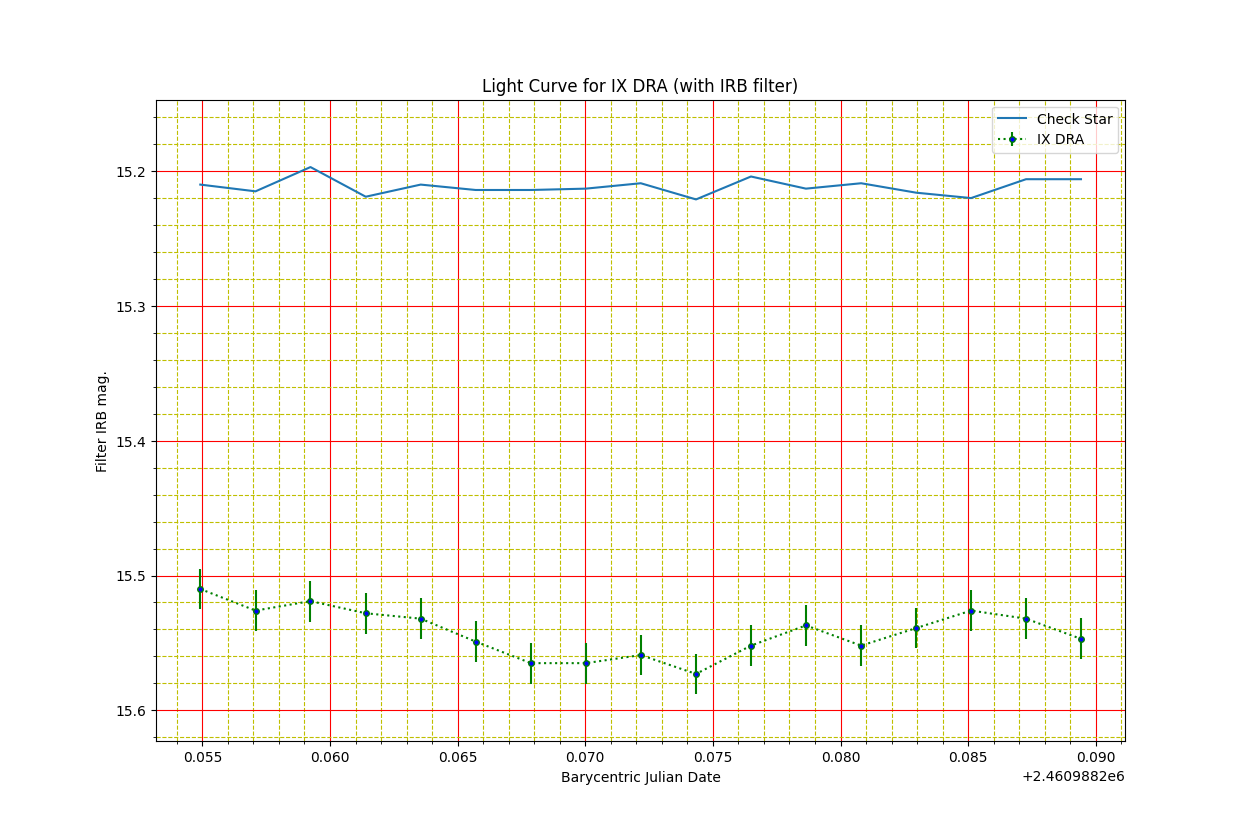
I got an average of 15.54 CV mag last night (17 exposures). See attached.
Cheers
Ian.20 February 2026 at 2:17 pm #634710Stewart John BeanParticipantHi ,
I have been looking into IX Dra and its status as a “period bouncer” reported by Olech, A. et al 2004.
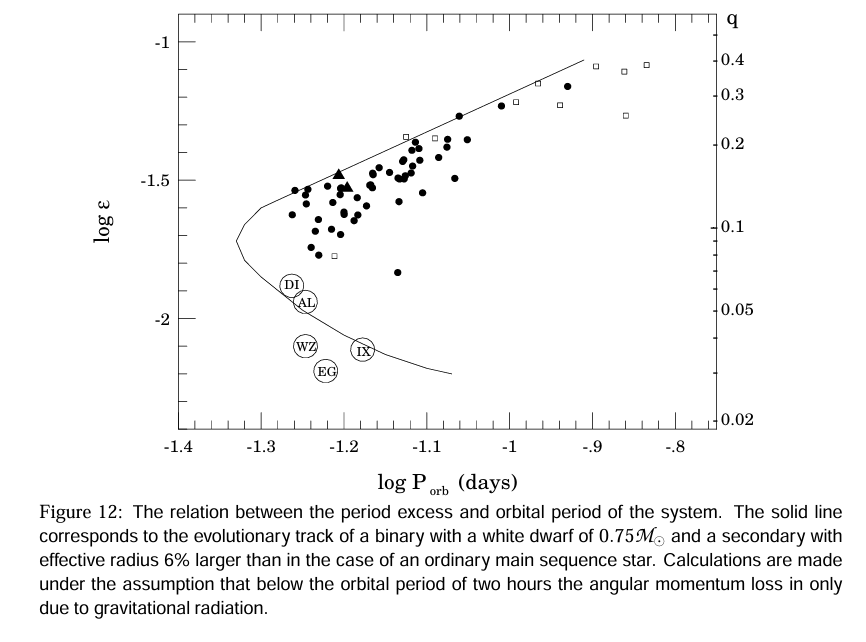
Their Fig 12 places IX Dra as a period bouncer. It turns out that decision is based upon an accurate understanding of the difference between P(sh) and P(orb). Determining P(orb) has not been easy. Thorstensen has recently (2020) determined P(orb) accurately and to check I looked at the TESS results for IX Dra. TESS date from the normal outburst sections of the light curve agrres with Thorstensen. So IX Dra can be moved to the upper branch of the curve in the attached figure and join its ER Uma cousins.Stewart
Attachments:
2 March 2026 at 11:34 am #634835Stewart John BeanParticipantIX Dra is not a period bouncer but sits with ER Uma and V1159 Ori on the upper branch of the evolutionary curve.
I have started a short note for the next VSSC describing the topic.As an aside, the position of DI Uma on the graph is curious as the absence of RZ Lmi (its twin) on the graph. DI Uma seems to have a solid orbital period and yet its “twin” RZ Lmi has not revealed its orbital period “as it is usually in outburst”. I am wondering if the orbital period for DI Uma is wrong. I think only time resolved Doppler spectroscopy has a chance as the TESS coverage is poor and noisy.
DI Uma is not well observed and is also close to a standard star. Because it is very active (half the time in superoutburst) only very regular observations actually show the light curve clearly.
Stewart
13 March 2026 at 7:00 pm #636572Stewart John BeanParticipantAAVSO have agreed to start observing DI Uma.
It is not particularly bright object and there is a bright star close by so need to be careful with the photometry aperture selection.
However, it is an interesting object in that it does appear to be a dwarf novae at the period minimum with a brown dwarf secondary. Today, results from the TESS mission, processed in Lightkurve, seem to confirm its orbital period is only 0.0545 d. Its behaviour is very similar to RZ Lmi in that it spends most time in superoutburst and its super outburst period is small – only 20 -30 days. They might be considered twins.If anyone can join in an observe DI Uma it would help. It is in the evening sky at present and observable for most of the year.
Stewart
11 July 2026 at 4:19 pm #641960Stewart John BeanParticipantI have just sent a contribution, for consideration, for the next VSSC on IX Dra and its supercycle period. The period over the last seven years, from BAA, AAVSO, TESS, and Lasair sources, is 59 days. This value is the largest of the published results but it does rest on the largest data set/time span. I think all previous results are influenced by having a short time span. There is a tiny hint of some periodicity in the period graph that suggests the need for another seven years of observation.
Observations for the next 12 months are particularly valuable as TESS satellite will not be observing IX Dra until autumn of next year. The good news is that TESS is in good condition and may be observing until 2030 – funding permitting.
Anyway thanks for all contributions so far and hope you can continue.
Stewart
-
AuthorPosts
- You must be logged in to reply to this topic.