
› Forums › Variable Stars › ER UMa stars: V1159 Orion update
- This topic has 19 replies, 3 voices, and was last updated 3 months, 3 weeks ago by
 Stewart John Bean.
-
AuthorPosts
-
27 October 2025 at 9:35 am #631788
 Stewart John BeanParticipant
With the clocks changing, its time to review the behaviour of some of the ER Uma stars. First up: V1159 Ori.
VSSC 193 covered V1159 Ori in detail suggesting a irregular trend towards longer superoutburst periods ( 45 days to upto 70 days). The nominal definition of ER Uma is that they have superoutbursts between 20 and 90 days apart. Recent V1159 Ori observations support the trend but also make a definitive statement difficult.
This trend appears to be strengthening with only two superoutbursts ( JD 2460611 and 2460741) in the most recent complete observing season – 130 days apart. Interestingly the frequent normal outbursts continue which are perhaps a better definition for this group of stars.
The difficulty of interpreting the light curve is compounded as two superoutbursts may have occurred either side of the observing season. The good news is that a superoutburst was observed in early 2025 September meaning that we a have a chance to observe the next superoutburst over this winter. After the next superoutburst I will prepare an update for the VSSC.Regards
Stewart Bean
27 October 2025 at 4:09 pm #631831 Jeremy ShearsParticipant
Thanks for the timely update, Stewart.
One to keep an eye on over the next few months.28 October 2025 at 9:21 am #631852Stewart John BeanParticipantHow do I look up the ZTF code for ER Uma? It will be something like ZTF******* Stewart
28 October 2025 at 10:44 am #631854Stewart John BeanParticipantFor V1159 Ori an observer on the equator would be able to fill in, to some extent, the summer gap in observations.
28 October 2025 at 4:33 pm #631857Jeremy ShearsParticipantHow do I look up the ZTF code for ER Uma? It will be something like ZTF******* Stewart
VSX lists synonyms, but not for ER UMa it seems. In the case of V1159 Ori it is ZTF22abhvjny
If you need ZTF photometry on ER UMa, you can access it from the the VSX entry on ER UMa, using the “External Links” drop down and selecting “ZTF”.
-
This reply was modified 11 months, 4 weeks ago by
 Jeremy Shears.
-
This reply was modified 11 months, 4 weeks ago by Jeremy Shears.
29 October 2025 at 10:54 am #631867 Mr Ian David SharpParticipant
Hi all,
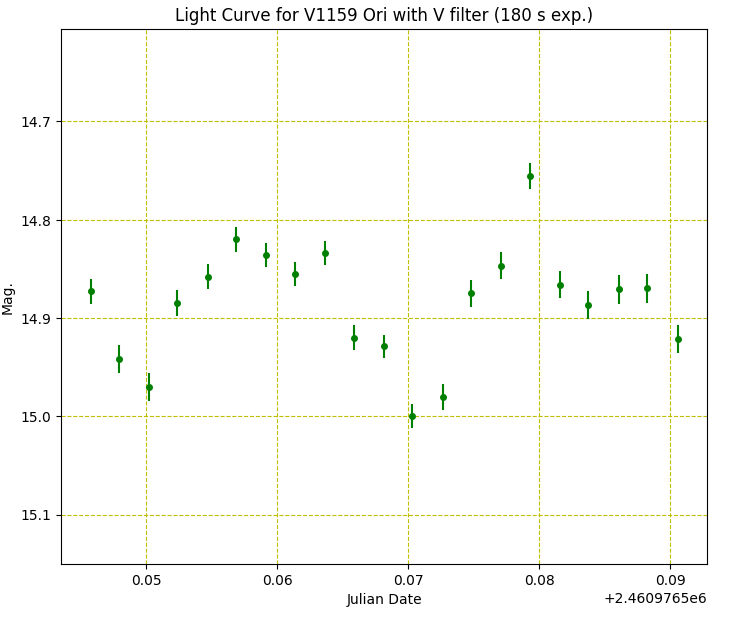
Here’s a run I did on V1159 Ori the night before last from my C11 in Spain (2025-10-27). Interesting short term variability. The SNR of the target star was around 100. The average V mag was 14.89 over the 21 frames.
I will carry on monitoring it…
Cheers
Ian.Attachments:
29 October 2025 at 4:53 pm #631872Stewart John BeanParticipantIan,
Interesting that you are in Spain. One of the challenges is to observe V1159 Ori ( Declination only -3 degrees) around conjunction. The best place would be from the Equator. All my reported observations have been via an AAVSOnet project.
I forgot to use the Slooh Canary 2 (27 deg latitude) instrument this summer for the job – especially as it now has a V filter.VSX gives a period of 90min for V1159 Ori.
Stewart
30 October 2025 at 8:30 am #631886Mr Ian David SharpParticipantVSX gives a period of 90min for V1159 Ori.
Hi Stewart,
Well, I’m not in Spain but my kit is. I’ll try and get a really long run on it to see if I can pick up the period. The weather in Spain is not cooperating!
Cheers
Ian.12 December 2025 at 9:53 am #632704Stewart John BeanParticipantA milestone for V1159 is approaching.
According to the observations in the AVVSO record for V1159 Ori, it is now 98 days since the last superoutburst. This exceeds the previous interval of about 70 days. So either the observations have missed a superoutburst or we continue to see normal outbursts but no superoutburst. I am inclined to think that conditions for triggering a superoutburst are not present. Longer intervals between superoutbursts has been the trend for V1159 Ori. At this rate, if V1159 Ori were discovered today it would not meet the criteria for being classed as a ER Uma type CV. However, normal outbursts do continue and these may be a better guide to classification – which is arbitrary anyway.
Once the next superoutburst occurs and provides another data point on the graph, I will write up for the VSSC.
21 December 2025 at 10:20 am #632789Mr Ian David SharpParticipantHi Stewart,
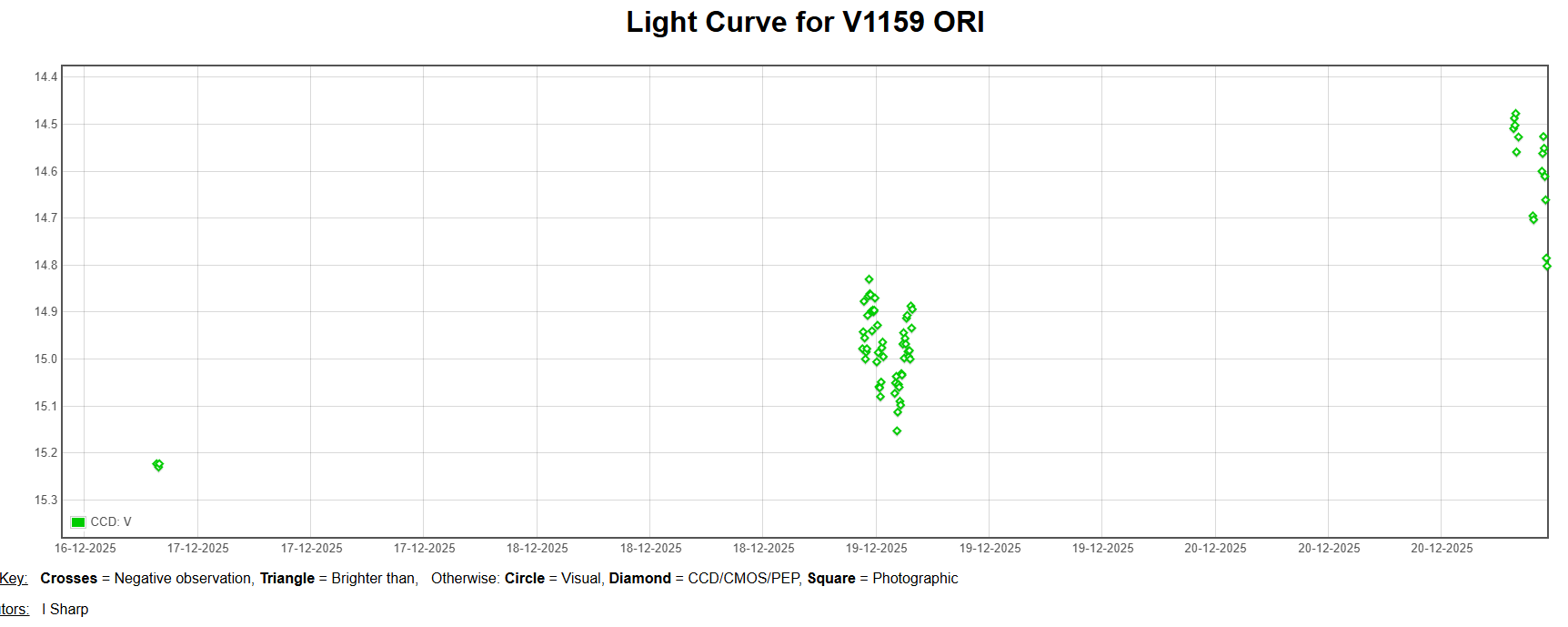
I’ve noticed a brightening from around 15.2V on 16th Dec. to around 14.6V last night (20th Dec). See attached.
Cheers
Ian.Attachments:
24 December 2025 at 10:24 am #632813Stewart John BeanParticipantHi Ian,
Yes there was a normal outburst peaking on the 19th peaking at about 13.5 and returning to 15 on subsequent days. Thanks for the observation.
However, Still no super outburst . So we are at 110 days since the last superoutburst – which is the longest wait yet.
Seems as if the flow of material from the donor star is not stable for V1159 Ori.
Stewart
PS I see you are in the ALTAIR group with one Sebastian Von Harriach. Is this Sebastian a electron microscope professional? I am ex Zeiss31 December 2025 at 11:35 am #632847Jeremy ShearsParticipantInteresting stuff, Stewart. I see Eddy Muyllaert had it at 13.9 vis on Dec 28, but Ian’s latest data on Dec 29-30 showed it has faded. So another normal outburst….
5 January 2026 at 11:44 am #632955Stewart John BeanParticipantGuys, Thank you all who have contributed observations over Xmas.
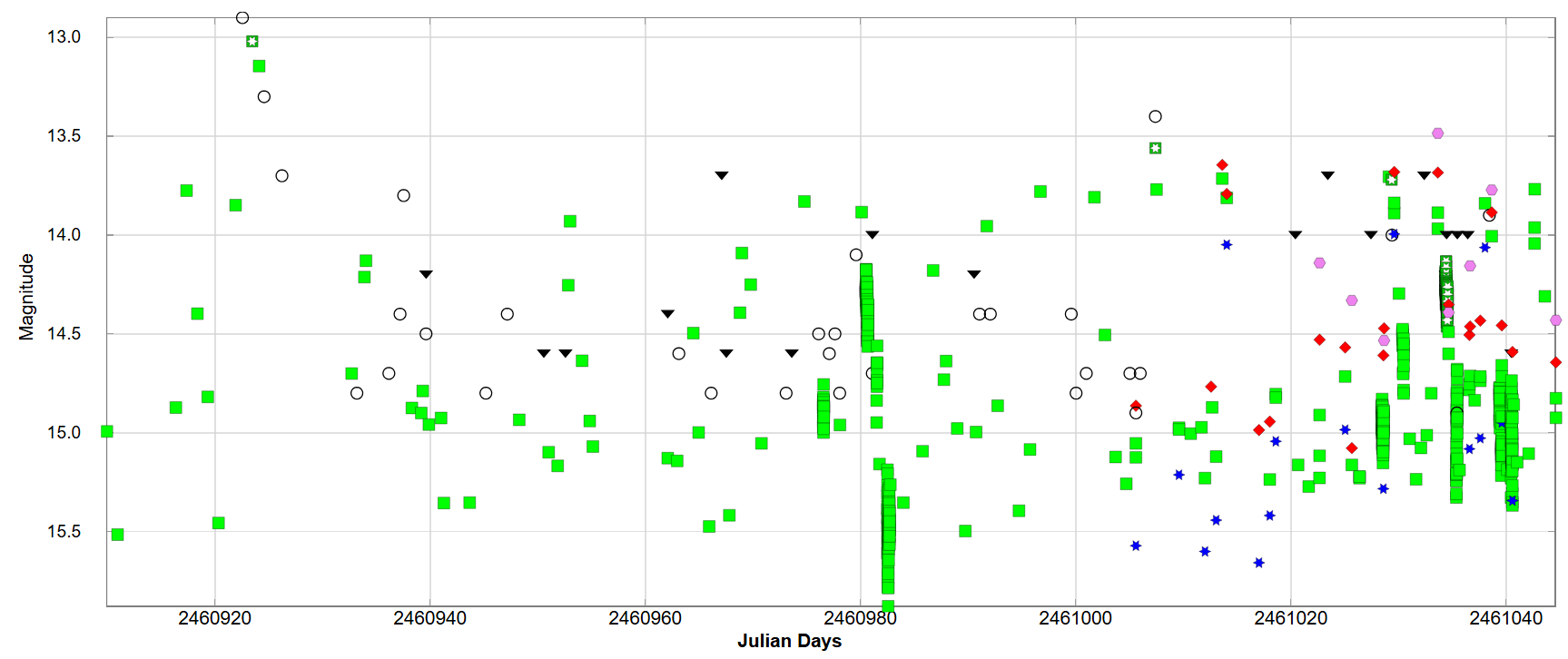
The pattern remains of continuing normal outbursts – see upto date light curve attached. It is now ~120 days since the last superoutburst. I have worried about having missed a superoutburst but cannot see where it may have occurred.
Is there a category for stars only showing normal outbursts?Will check on the deadline for the next VSSC in preparation for a write up.
Stewart
Attachments:
5 January 2026 at 12:53 pm #632971Jeremy ShearsParticipantDeadline for the next VSSC is 2026 February 15, Stewart.
6 January 2026 at 11:34 am #633000Mr Ian David SharpParticipant17 January 2026 at 12:34 pm #633176Stewart John BeanParticipantV1159 Ori has now shown a superoutburst event starting on Jan 7 and running to Jan 15 approximately.
It has been 126 days since the last superoutburst making this interval in the observing record that I am aware of. This continues an irregular trend towards longer intervals between superoutbursts. Normal outbursts have continued as usual. Ian’s observations above are the last before the outburst started.
I interpret this as showing that the flow of material from the donor star has not stopped. Rather the quantity flowing has fallen to a point where conditions needed for a superoutburst have not been present.Time now to write the work up and submit to VSSC.
Thanks to all who have contributed. As usual the interest continues. Has this been an outlier or is the next superoutburst only 40 days away?
STewart
20 February 2026 at 1:56 pm #634709Stewart John BeanParticipantI have summarised this topic and submitted to the VSSC.
Next point of interest is IX Dra.
Stewart
22 February 2026 at 10:58 am #634728Mr Ian David SharpParticipantHi Stuart,
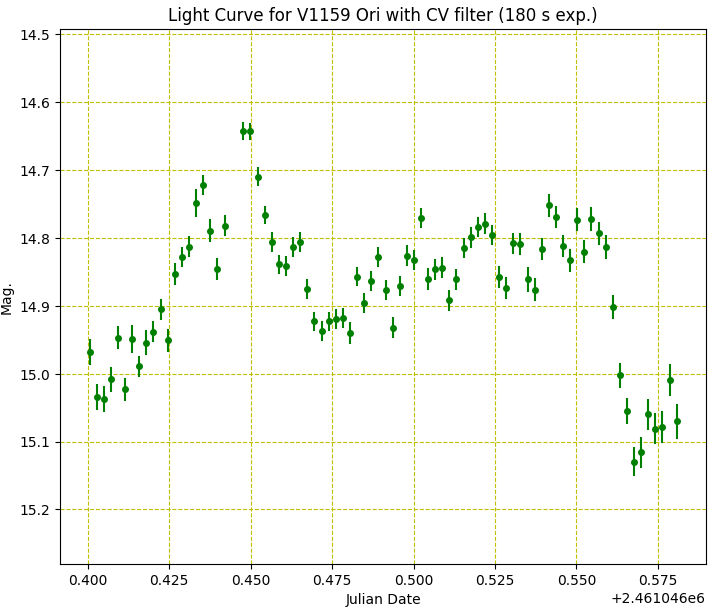
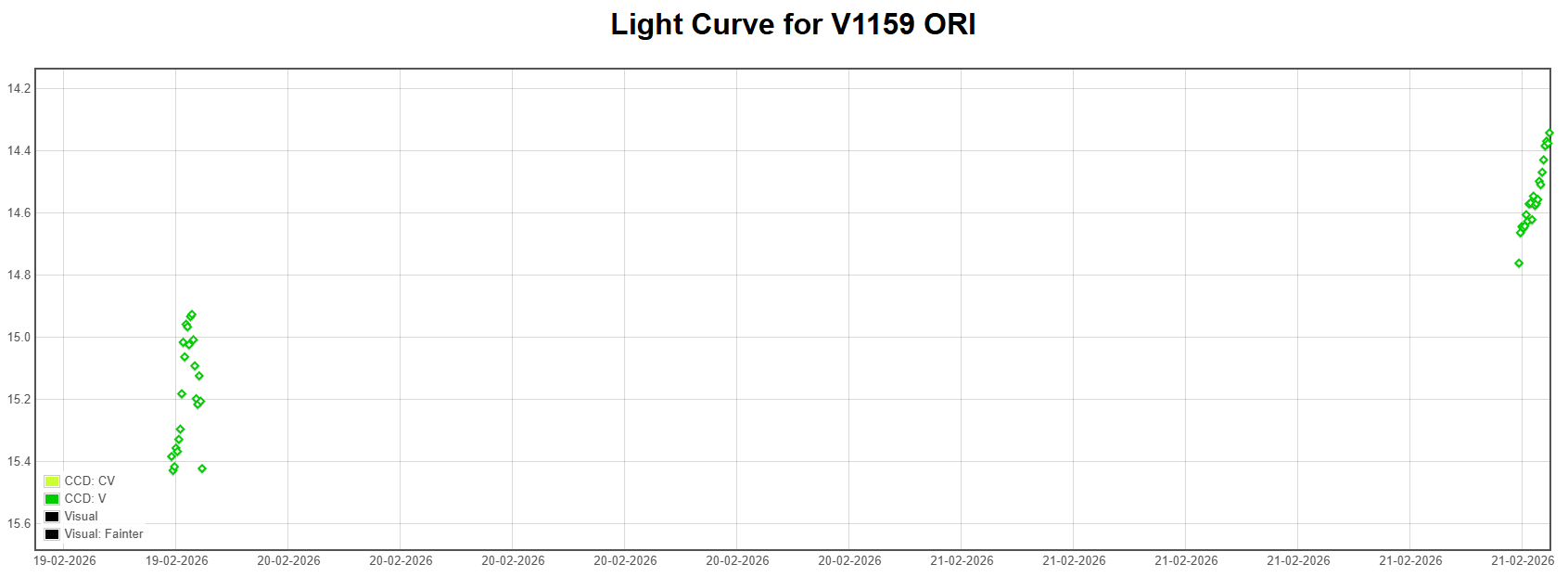
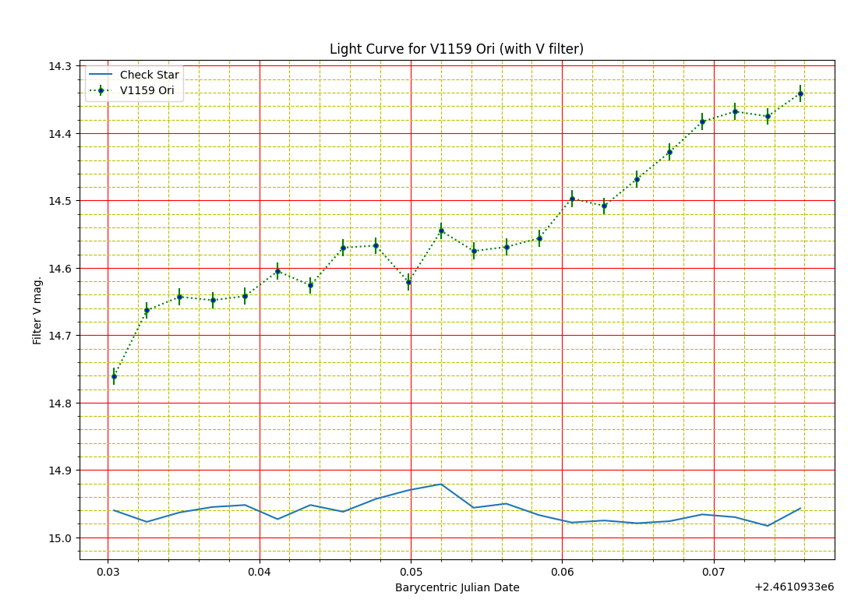
Just to say that V1159 Ori has brightened quite a bit over the past few nights. It’s brightened by nearly a full magnitude in V from 19th Feb to last night (21st Feb). See attached. I’m also attaching just last night’s light curve where it brightened consistently.
Cheers
Ian.Attachments:
11 June 2026 at 11:58 am #640715Stewart John BeanParticipantWith the close of the observing season for V1159, what does this seasons light curve tell us? Well, we have only two superoutbursts, separated by 128 days, indicating a continuation of the longer intervals between superoutbursts. Normal outbursts continue a pace.
With a probable super outburst being missed in mid May, the next likely super outburst is in Sept just after the observing season starts. So making a good start in Aug is important. From Chile it is 20 deg at dawn on July 5 and I note an observation on July 17 in 2024. For Tenerife it is only 20deg at dawn on Aug 1 so v. difficult. but could be worthwhile making the effort.
Thanks for those contributing
Stewart27 June 2026 at 9:02 pm #641751Stewart John BeanParticipantSlooh Chile 2 just provided the first V1159 Ori field image of the new observing season. V1159 Ori was at V mag 15.6 at JD 2461218.94. This mag is typical of the quiescent state. So hopefully we can hope to record a super-outburst in July IF the 100 day interval still holds.
Stewart -
This reply was modified 11 months, 4 weeks ago by
-
AuthorPosts
- You must be logged in to reply to this topic.