
› Forums › Variable Stars › Nova Aql 2026
- This topic has 15 replies, 6 voices, and was last updated 2 months, 3 weeks ago by
 Nick James.
-
AuthorPosts
-
3 July 2026 at 10:00 am #641851
 Gary PoynerParticipant
ATel #17867 reports the discovery of a Nova in Aquila on 2026-07-01.305 UT by M. Ning and H. Lin, on behalf of the DCAP collaboration. The Nova was measured at
g = 14.45 and r = 12.53 (AB mag). Details of the spectrumn have been posted on ATel 17868The Nova is a highly reddened classical nova, close to maximum brightness.
The position is 19:14:31.37 +12:03:53.6 (J2000)
Nick James reports an unfiltered magnitude of 9.79C on July 3.027 UT
A chart is available from the AAVSO under the designation AT 2026rdg or N Aql 2026.
Gary
-
This topic was modified 3 months, 1 week ago by
 Gary Poyner.
-
This topic was modified 3 months, 1 week ago by Gary Poyner.
3 July 2026 at 11:33 am #641854 Robin LeadbeaterParticipant
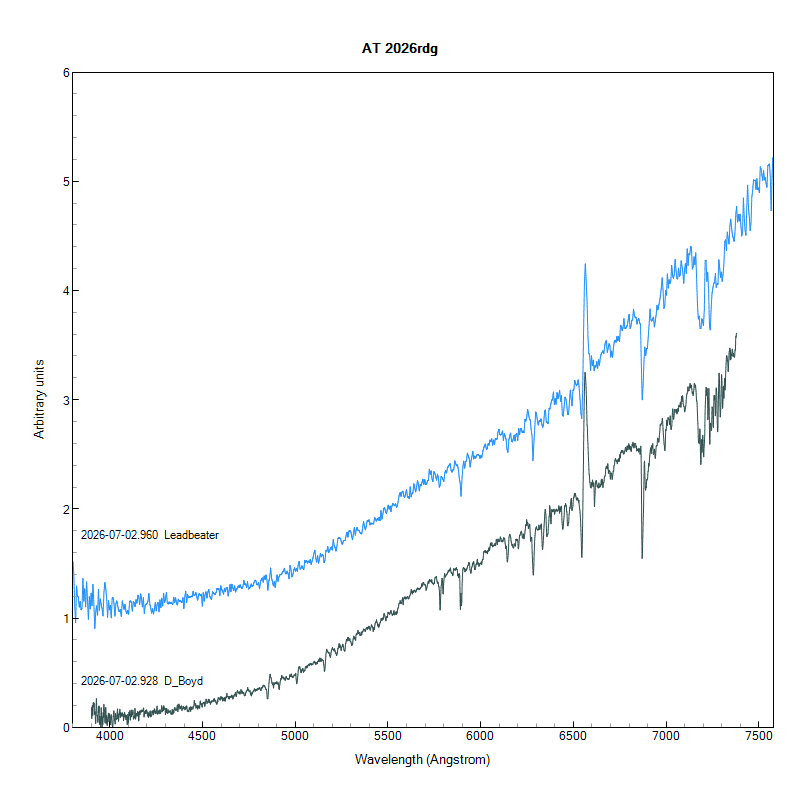
Spectra by me and David Boyd last night (in the BAA database)
Cheers
RobinAttachments:
3 July 2026 at 11:20 pm #641868 Nick JamesParticipant
I get unfiltered 9.69C tonight (July 3.923) using the same system so a little brighter.
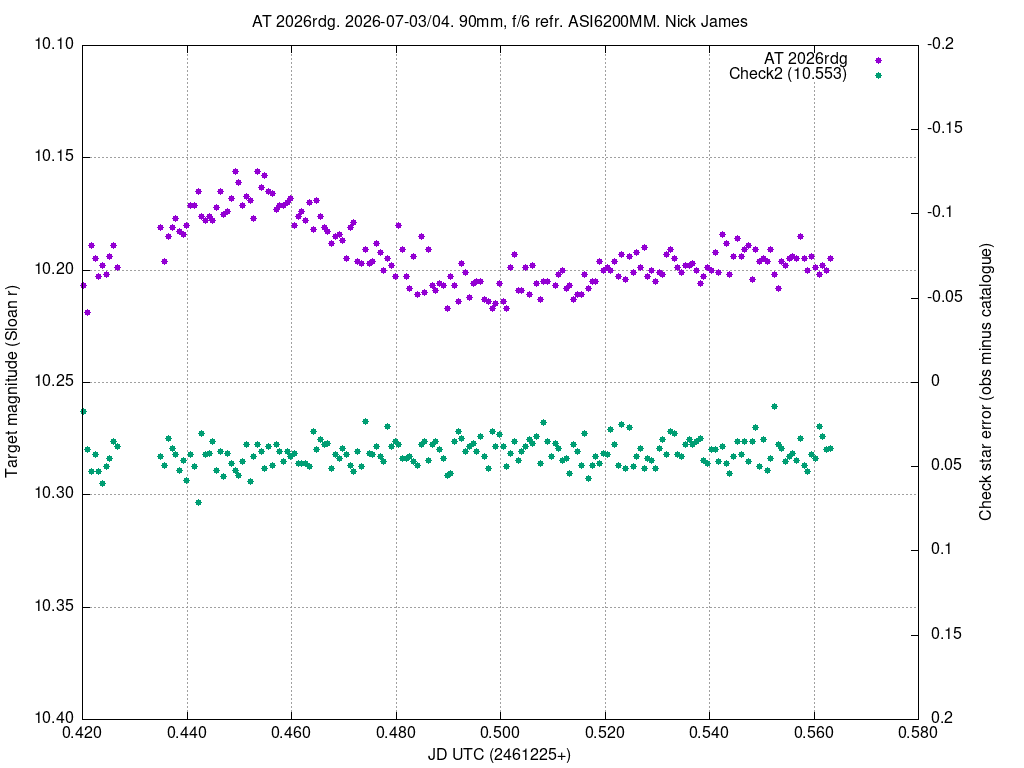
4 July 2026 at 10:18 am #641869Nick JamesParticipantI did around 3 hours of Sloan r’ time series photometry on this nova last night in good conditions. The mean magnitude was 10.20 in r’ and 12.45 in g’ so it is a very red object. The time series showed a small hump of around 0.05 mag at around July 3.95.
Attachments:
4 July 2026 at 3:42 pm #641879Gary PoynerParticipantI have a V measure from Slooh Australia of 11.300V on Jly 3.458 UT, and an unfiltered measure from Slooh Tenerife on Jly 3.913 UT of 10.927CV. Still haven’t measured it visually though, which is frustrating (although I have seen it but without a sequence to measure it by)
Gary
-
This reply was modified 3 months, 1 week ago by Gary Poyner.
-
This reply was modified 3 months, 1 week ago by Gary Poyner.
4 July 2026 at 9:59 pm #641882 Jeremy ShearsParticipant
This has now received the permanent GCVS designation of V2104 Aql: http://www.cbat.eps.harvard.edu/iau/cbet/005700/CBET005711.txt
-
This reply was modified 3 months, 1 week ago by
 Jeremy Shears.
4 July 2026 at 11:54 pm #641884Nick JamesParticipantJust started a time-series run on the nova. It looks a bit brighter tonight. Currently 9.85 r’, it was 10.20 r’ last night.
Comet 169P/NEAT is in the same field so I can get a comet and a nova at the same time. The comet is around mag 15.
5 July 2026 at 1:39 am #641885Gary PoynerParticipantNova Aql 2026 now has an official standard VS designation – V2104 Aql.
Gary
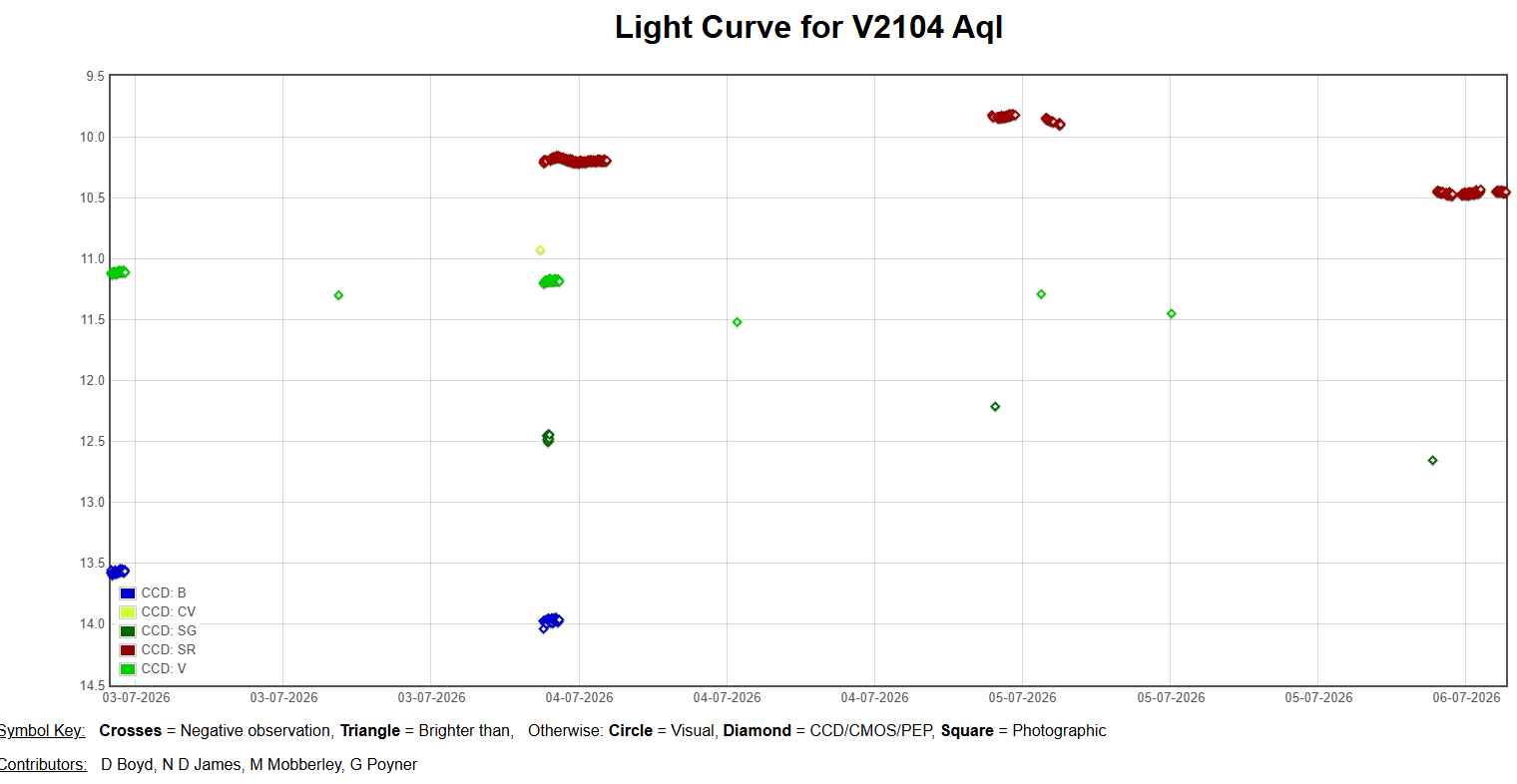
6 July 2026 at 7:27 am #641893Nick JamesParticipantGot another time-series last night although there was cloud around. It looks like it is starting to fade.
Attachments:
7 July 2026 at 9:07 am #641922 Mr Ian David SharpParticipant
Hi all,
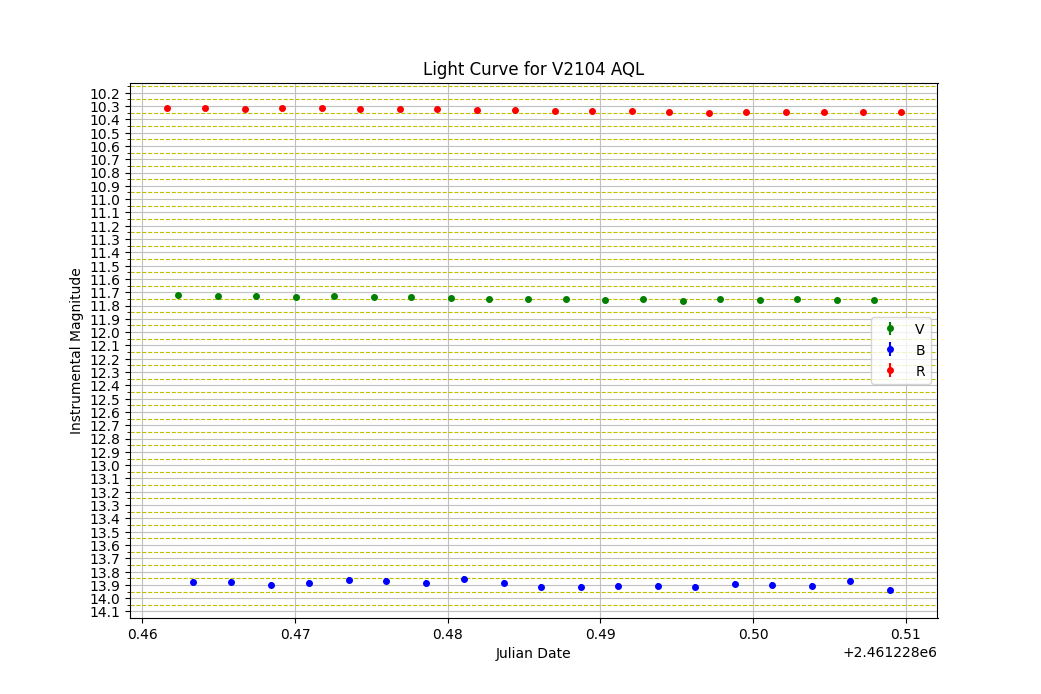
A bit late to the party but here’s a plot of my R, V and B results from Spain last night. Data added to the database.
Cheers
Ian.Attachments:
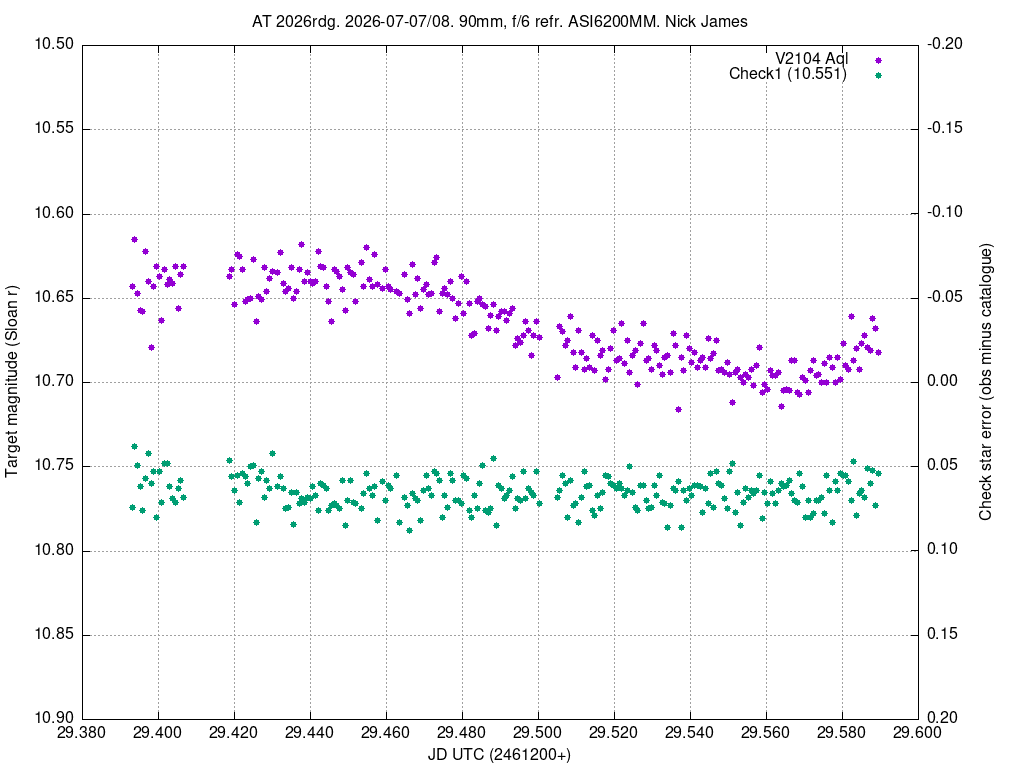
8 July 2026 at 6:59 am #641934Nick JamesParticipantThe nova was still showing 0.05 mag amplitude variations last night (July 7/8). Check star 1-sigma is 0.009 mag. Mean mag is now 10.67 r’, 12.99 g’.
Attachments:
13 July 2026 at 8:42 am #641965 Mike HarlowParticipant
Quick spectrum last night. The ‘first light’ image testing my new CMOS camera. Posted in the gallery: https://britastro.org/observations/observation.php?id=20260713_072824_86481dc86de71492
Mike.17 July 2026 at 3:29 pm #642031Mike HarlowParticipantThere is an interesting summary of the evolution of this nova in a recent Astronomer’s Telegram, ATel#17900. It includes a very nice sequence of spectra showing changes in the IR.
Mike.-
This reply was modified 2 months, 3 weeks ago by
 Mike Harlow.
-
This reply was modified 2 months, 3 weeks ago by Mike Harlow.
-
This reply was modified 2 months, 3 weeks ago by Mike Harlow.
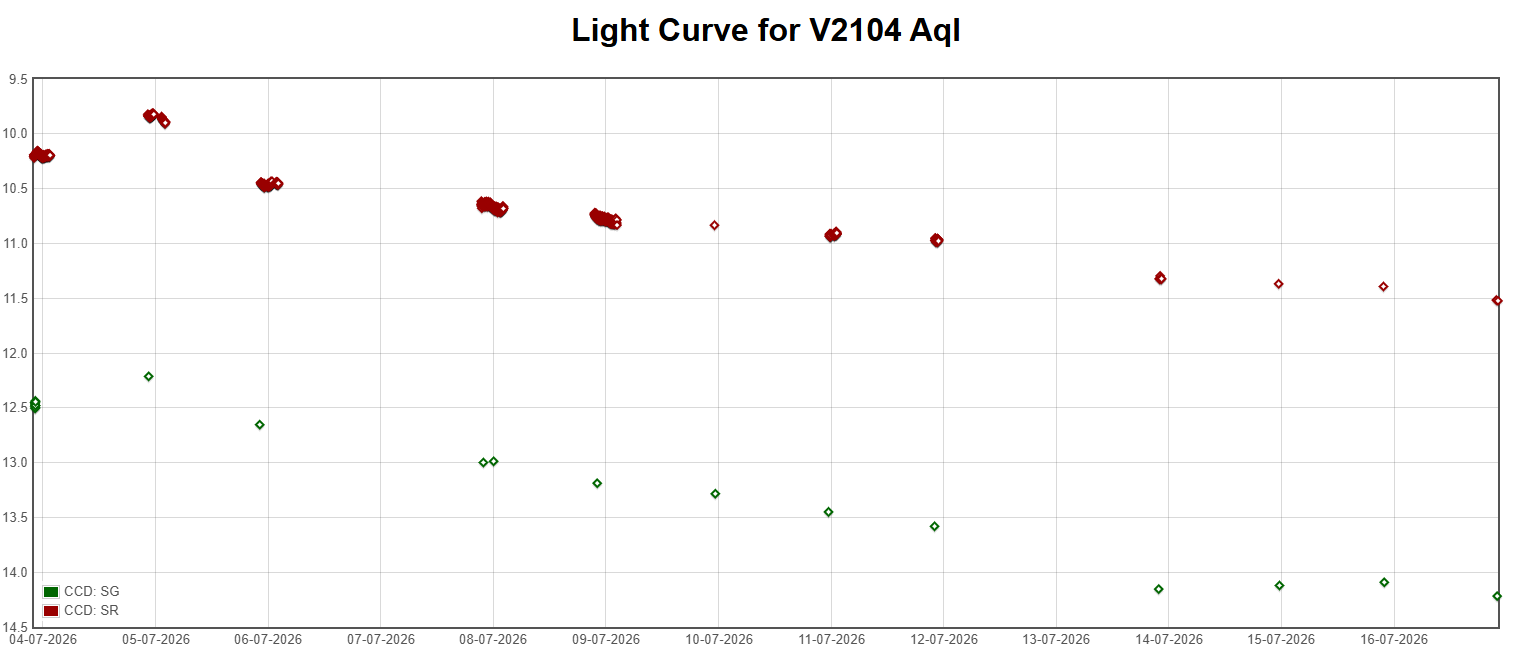
17 July 2026 at 9:08 pm #642035Nick JamesParticipantVery interesting to see how the spectrum evolves. My Sloan photometry shows that it is currently getting redder as it fades. I assume that this is due to the current dominant H-alpha emission. The g’-r’ was around 2.2 at maximum and is around 2.7 now. The great weather we have had in July means that I have been able to observe it practically every night since the outburst.
Attachments:
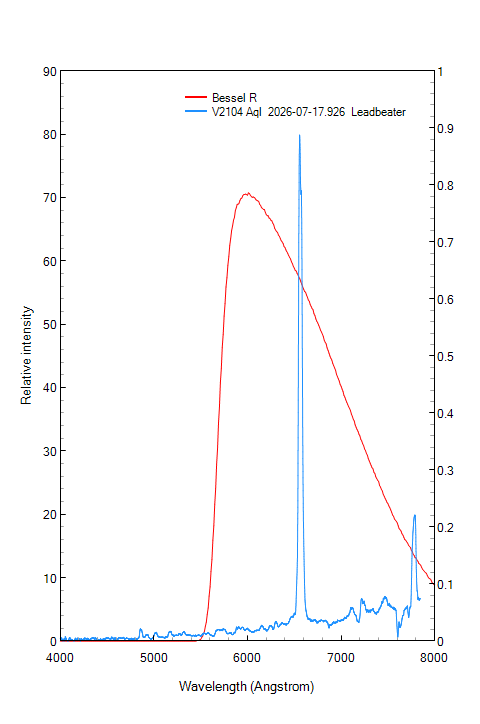
18 July 2026 at 12:13 pm #642046Robin LeadbeaterParticipantMy Sloan photometry shows that it is currently getting redder as it fades. I assume that this is due to the current dominant H-alpha emission.
I don’t have the Sloan passbands in a digitised form to hand but H alpha emission currently accounts for approximately 40% of the flux in the Bessell R passband
EDIT: About 50% in Sloan r’
Cheers
Robin-
This reply was modified 2 months, 3 weeks ago by
 Robin Leadbeater.
Attachments:
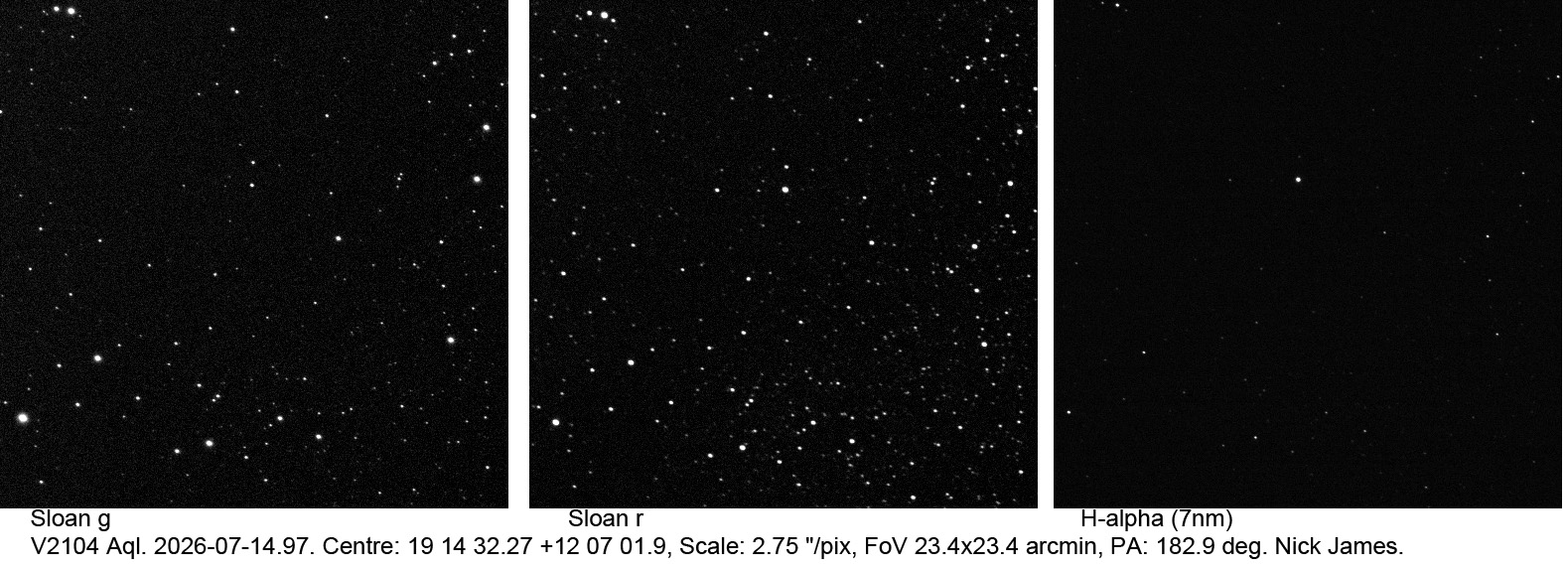
18 July 2026 at 7:59 pm #642053Nick JamesParticipantRobin. Thanks for that. To emphasise how dominant the H-alpha emission is at the moment the attached is a comparison of the field in Sloan g’, Sloan r’ and narrowband H-alpha. Spot the nova!
Attachments:
-
This topic was modified 3 months, 1 week ago by
-
AuthorPosts
- You must be logged in to reply to this topic.