
Observing categories
To return to the Section home page. Select here
Occultation studies
Welcome to the Occultation group of the Asteroids and Remote Planets Section. (ARPS)
From Tim Haymes …

Introduction
The occultation of stars by asteroids and remote planets, are contributing to the determination of their sizes, shapes and positions. In the last few years we have been fortunate to add two binary asteroid discoveries; a relatively new class of object. Despite the “English weather” we are in the top five European regions in terms of the number of observations reported. There is much to discover out there.
Predictions for selected asteroids can found at “What to Observe” …above.
More observers are encouraged to take part. Read an earlier intoduction <here> in this BAA tutorial.
The “minor planets” we in-directly observe via occultations are: Main Belt, NEOs, Trojans, Trans-Neptunian objects (TNOs), Centaurs and planetary satellites; and some comets. Sizes range from 100+ km down to 1 km. The ease of observing these events depends on the magnitude of the star being occulted, but also on the telescope and camera sensitivity. More on the technical aspects can be read <here>
Techniques
We time (UT) the disappearance (D) and reappearance (R) of a star when occulted by these bodies. The star is often brighter than the asteroid, but not always. Sometimes the asteroid and star can be of similar magnitudes. The occultation provides us with important scientific information not easily obtained by other means. IR Photometry (IRAS) has produced most of the size data now being checked by occultations, and Gaia (ESA) has improved the orbits.
Our main technique uses video recordings from USB3 CMOS and analogue cameras. These recordings are time-stamped by the software used (E.g Sharpcap), so that the observer can report the UTC to 0.1 sec accuracy. (Typically). During the video analysis, we produce a light curve (using TANGRA) which may contain hidden information. Section members are guided through the techniques used and how to make a preliminary report.
Hidden Information in a Tangra light curve:
Alex Pratt recorded an apparent graze at (325) Heidelberga on 2023 Jan 19. Two events were timed: 0.9s and 2.6s duration.
Re-investigation of the video suggest the light curve has the characteristics of a double star occultation.
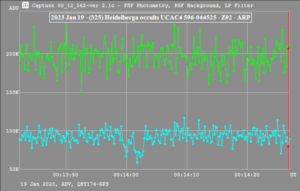
Results from our observations
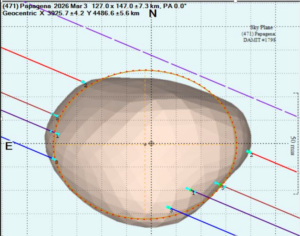
Above: D/R Chords from four observers fitted to an asteroid profile model. The observer (blue dashed line) recorded no occultation. (Produced by D.Herald’s Occult4 software, and results in the IOTA-ES SODIS database.)
Timing data produces an accurate position (ca 10 mas accuracy). Several observers might observe the same occultation from their home based telescope to form a shape-profile. We use OccultWatcher software to plan our observations, and to assist collaboration between observers, often widely separated across countries and sometimes oceans ! (US-EU)
Occasionally, an observer might operate a mobile telescope to get timings from widely separated locations (10-20km apart). This is more valuable than a single observation. Suitably equipped observers are encouraged to do this team work.
We don’t always get an occultation, because of remaining uncertainties such as shape and dimensions but its always worth a try. Negative observations can be used to restrain asteroid profiles.
There are international and Pro/Am projects that ask for observations of particular importance. When successful, amateur data is requested for upload to the Pro/Am results portal where observations are fully acknowledge via astrophysical publications.
Transient events like occultations are challenged by the weather, so positive results are always greeted with glee.
Movie from the Assistant Director’s web page: (External link) (8581) Johnen on 2026 Mar 11.9 (Diameter 6 km)
QHY174m-GPS (2×2 bin) Exp 0.02s, C11 F5.8, Star magnitude 10, asteroid mag 18
The asteroid occultation observer’s information “tool-kit”.
UKoccultations group.io https://ukoccultations.groups.io/g/main
Occultwatcher (OW) software. Predictions, and “who is observing”. https://www.occultwatcher.net/
Occultwatcher Cloud (OWC) https://cloud.occultwatcher.net/
OW and OWC are linked with the same password. An account is need for the full functionality.
IOTA-ES Call-4-Observations https://call4obs.iota-es.de/
TANGRA: Video analysis and reports. (Windows users). http://www.hristopavlov.net/Tangra3/
Recording software (e.g. SharpCap, IOTA Video Capture 2.3, or other possibilities ).
Computer time synchronisation software: NTP/Meinberg (With assistance from the Section).
GOTO the Section web page on techniques <here>
Photometry of asteroids
Text goes here …
| The British Astronomical Association supports amateur astronomers around the UK and the rest of the world. Find out more about the BAA or join us. |